The Future of Bioinformatics: Market Innovations, Growth, and Trends
Bioinformatics stands at the intersection of biological science, computer engineering, and data analytics, serving as a critical pillar for modern life sciences research. By converting complex biological data into actionable insights, computational biology has transformed how researchers analyze genomic sequences, protein structures, and cellular functions. Over recent years, rapid technological breakthroughs have shifted bioinformatics from an academic research tool into an essential commercial driver across pharmaceutical development, personalized medicine, and agricultural biotechnology. As computational infrastructure expands and algorithmic accuracy improves, the field continues to revolutionize global healthcare frameworks, paving the way for data-driven diagnostic methods and accelerated therapeutic breakthroughs.
Current Industry Overview
The global computational biology landscape is experiencing significant financial expansion, reflecting its growing necessity across healthcare and biotechnology ecosystems. In 2025, the worldwide valuation for computational biological solutions reached $16.70 billion. Building on this momentum, the sector expanded to $18.63 billion in 2026 and is projected to escalate to $34.41 billion by 2031. This trajectory represents a compound annual growth rate (CAGR) of 13.1% over the forecast window from 2026 to 2031.
Software solutions maintained the dominant position within the product offerings segment during 2025. This dominance is largely propelled by the extensive adoption of digital analytical platforms, specialized databases, and automated analytical workflows by pharmaceutical corporations, biotechnology startups, academic research facilities, and medical networks. The heightened necessity to store, process, and evaluate massive multi-omics and next-generation sequencing datasets has made robust software ecosystems indispensable.
From a functional perspective, data analysis captured the largest revenue share in 2025. The exponential generation of biological information generated by high-throughput platforms requires sophisticated algorithmic tools to extract therapeutic meaning, identify genetic variations, and accelerate target validation. In terms of end-use sectors, medical biotechnology led the market, fueled by expanding applications in molecular diagnostics, companion diagnostic development, and computational target identification. Consequently, pharmaceutical and biotechnology organizations emerged as the single largest end-user segment, driven by the imperative to streamline research pipelines and lower clinical failure rates through data-led strategies.
Key Market Drivers
Several powerful factors are accelerating the continuous adoption of bioinformatics platforms globally. Primary among these is the escalating deployment of Next-Generation Sequencing (NGS) methodologies. Compared with traditional sequencing practices, NGS offers unprecedented throughput at dramatically reduced operational costs and accelerated turnaround times. As research institutions and clinical facilities produce petabytes of genomic data through NGS, the demand for sophisticated cloud-native computational pipelines capable of handling raw output, performing alignment, and calling variants becomes paramount.
Simultaneously, the global shift toward precision medicine acts as a fundamental growth catalyst. Tailoring medical treatments to inpidual genetic profiles requires extensive molecular profiling and sophisticated genomic interpretation. Computational biological tools enable clinicians and clinical researchers to evaluate complex disease mechanisms, stratify patient cohorts for clinical trials, and identify specific genetic alterations responsible for drug resistance or elevated adverse reactions.
Furthermore, drug discovery and development pipelines represent the largest practical application area for modern bioanalytic solutions, accounting for 34.0% of total market value in 2025. Pharmaceutical developers heavily rely on computational modeling to perform virtual screening of candidate molecules, assess target validity, evaluate pharmacokinetic properties, and predict off-target toxicity before entering expensive clinical phases. Increased research and development funding in oncology, rare genetic disorders, and complex infectious diseases further solidifies the essential role of computational biological applications in modern drug discovery workflows.
Emerging Technologies
Technological disruptions are fundamentally altering how life science researchers process and interpret biological data. Artificial intelligence (AI) and machine learning algorithms are leading this transformation by automating routine sequence alignment, improving structural variant interpretation, and uncovering subtle pattern correlations across disparate omics datasets that traditional statistical tools miss.
Multi-omics integration is emerging as the fastest-growing technological segment within the industry. By unifying data streams across genomics, transcriptomics, proteomics, metabolomics, and epigenomics, researchers gain a holistic view of human biology rather than analyzing isolated molecular events. Multi-omics analytical frameworks allow scientists to trace biological pathways from inherited DNA modifications down to functional protein interactions, providing unparalleled insight into complex systemic diseases.
Cloud-native architecture and federated learning environments represent another pivotal technological leap. Traditional localized computing servers frequently struggle under the storage weight of modern high-throughput sequencing systems. Cloud-hosted bioinformatics platforms provide scalable processing power, centralized data repositories, and secure collaborative environments for global research consortia. Additionally, federated learning approaches allow AI models to train on decentralized medical datasets across different diagnostic labs without transferring sensitive raw genomic data outside local networks, resolving crucial data security and sovereign compliance hurdles.
Future Trends
Looking ahead, the commercial landscape for bioinformatics will witness a rapid shift toward service-based delivery models. Bioinformatics services are projected to register the highest annual growth rate among market offerings, accelerating at a CAGR of 14.8% between 2026 and 2031. Small-to-midsize biotechnology enterprises and academic centers increasingly prefer specialized contract research organizations (CROs) and outsourced bioinformatics service providers to manage high-complexity analysis rather than investing heavily in internal high-performance computing infrastructure and specialized software licensing.
In parallel, point-of-care clinical bioinformatics is set to move from specialized academic medical centers directly into routine diagnostic environments. As regulatory bodies establish clearer validation frameworks for clinical software, genomic sequence platforms will increasingly integrate real-time variant assessment tools. This shift will allow clinicians to receive automated, actionable variant reports during patient consultations, dramatically shortening turnaround times for oncology treatment selection and rare disease diagnosis.
Another major trend involves localized, edge-computing solutions designed to comply with evolving data residency regulations. For instance, in July 2026, Illumina, Inc. introduced a localized, DRAGEN-powered Mobile Workstation in Mainland China. Deployed in Shanghai, this system incorporates ten high-performance servers to conduct on-site secondary genomic analysis while fully satisfying national data compliance and localization mandates. Such deployments highlight a growing industry trend toward high-performance computing packages capable of localized processing without compromising compliance.
Opportunities
The expansion of clinical bioinformatics presents massive commercial opportunities for technological developers and service providers. Beyond traditional research environments, clinical settings require robust, user-friendly computational frameworks capable of linking patient genomic profiles directly to electronic medical records (EMRs) and clinical decision support tools. Developing diagnostic-grade platforms that simplify complex variant interpretation into clear clinical reports offers substantial growth potential.
There is also substantial opportunity in expanding federated bioanalytic networks and cloud collaboration platforms. As multi-center clinical trials become standard in oncology and rare disease research, secure software solutions capable of aggregating anonymized data across perse institutions without compromising patient privacy will see rapid market uptake.
Additionally, non-medical biotechnology domains represent untapped growth avenues. Plant biotechnology, animal genetics, forensic analysis, and environmental metagenomics increasingly leverage high-throughput sequencing to optimize crop yields, improve livestock disease resistance, track environmental microbiomes, and solve criminal cases. Enterprise software providers that adapt medical-grade genomic workflows for agricultural and environmental applications can capture new revenue streams outside traditional life science sectors.
Challenges
Despite positive growth projections, several critical obstacles continue to impede seamless industry expansion. High capital expenditure requirements associated with establishing advanced computational infrastructure, securing high-density storage systems, and acquiring enterprise software licenses pose significant barriers, particularly for smaller research organizations and institutions in developing regions.
Managing massive data volumes presents another persistent technical bottleneck. Next-generation sequencing facilities generate terabytes of uncompressed output daily. Archiving, retrieving, harmonizing, and transferring these massive biological datasets across cloud and on-premise platforms requires significant computational bandwidth and ongoing storage expenditure.
Furthermore, a lack of standardization and cross-platform interoperability creates workflow friction. Biological data originates from perse sequencing platforms, assay formats, and clinical software, making seamless multi-omics integration difficult. Additionally, stricter global regulations regarding patient privacy, genomic data ownership, and cross-border information transfer introduce operational hurdles that software vendors and clinical research organizations must continuously navigate.
| Challenge Area | Key Operational Impact | Strategic Mitigation Path |
| Infrastructure Expenditures | High initial setup and software licensing costs limit smaller labs. | Transition to flexible, cloud-based pay-as-you-go service platforms. |
| Massive Data Volumes | Storage bottlenecks and transfer bandwidth limits from daily sequencing output. | Implementation of advanced compression algorithms and edge-computing servers. |
| Interoperability & Privacy | Data format fragmentation and strict cross-border regulatory compliance rules. | Adoption of unified data formats and secure federated learning architecture. |
Regional Outlook
North America maintained the dominant share of the global bioinformatics market in 2025, accounting for 42.2% of total worldwide revenue. This leading position is supported by substantial regional research funding, an advanced pharmaceutical research ecosystem, early adoption of high-throughput genomic technologies, and strong presence of major market players. The United States continues to lead regional growth due to significant investments in precision oncology, government-backed genomic initiatives, and extensive clinical trial activity.
Conversely, the Asia-Pacific region is poised to record the highest growth rate during the forecast period from 2026 to 2031. Rapid expansion in Asia-Pacific is propelled by escalating government investments in national population genomics projects, expanding biotechnology hubs in China, India, and Japan, and increasing R&D outsourcing by global pharmaceutical leaders. Enhanced healthcare infrastructure, rising prevalence of chronic conditions, and growing venture capital funding across regional life science startups further reinforce Asia-Pacific as a primary growth engine.
Europe continues to represent a significant market segment, characterized by strong collaborative research programs, robust regulatory standards, and extensive integration of genomic research within national public healthcare systems. Meanwhile, Latin America and the Middle East & Africa are demonstrating steady progress, driven by expanding academic research initiatives and gradual modernizations of clinical diagnostic laboratories.
Competitive Landscape
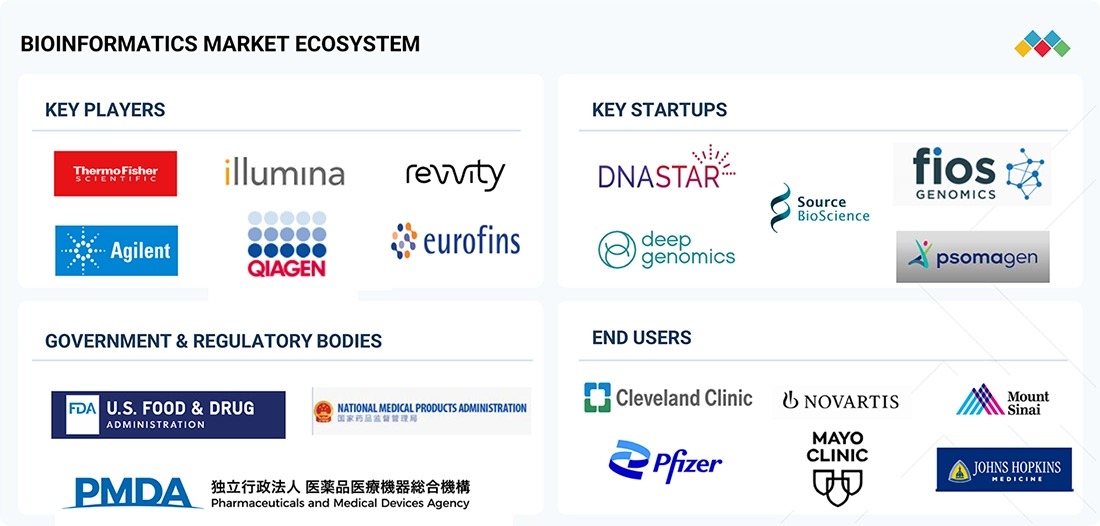
The competitive environment within the global bioinformatics industry is characterized by a strategic mix of established enterprise life science leaders and agile, specialized niche developers. Major industry players including Thermo Fisher Scientific Inc., Illumina, Inc., QIAGEN N.V., and Agilent Technologies, Inc. maintain market dominance through comprehensive sample-to-insight product portfolios, global distribution networks, and continuous technology acquisition strategies.
For example, Thermo Fisher Scientific stands out as a market leader, delivering end-to-end analytical solutions spanning Next-Generation Sequencing platforms, cloud computational environments, and transcriptomic data workflows. Similarly, Illumina continues to strengthen its ecosystem by unifying sequencing hardware with high-performance secondary analysis software like DRAGEN, streamlining sequence interpretation across research and clinical applications.
Simultaneously, specialized players and emerging startups are capturing targeted market segments. Companies such as SOPHiA GENETICS leverage AI-powered cloud platforms like the SOPHiA DDM Platform to optimize variant interpretation and clinical decision support in oncology and rare inherited diseases. Other specialized entities, such as DNASTAR, Fios Genomics, DEEP GENOMICS, Dotmatics, Revvity, and Oxford Nanopore Technologies, focus on dedicated scientific workflows, single-cell analysis, or novel long-read sequencing applications, keeping the competitive landscape dynamic and innovation-focused.
What the Future Looks Like
The future of bioinformatics points toward an automated, highly integrated, and intelligence-driven biological research environment. As artificial intelligence models mature from basic pattern-recognition tools into predictive discovery engines, computational platforms will actively propose novel drug candidates, forecast patient responses, and construct functional biological models directly from multi-omics data inputs.
The boundary between laboratory experimentation and computational analysis will continue to blur. Automated cloud laboratories linked to real-time bioinformatics pipelines will allow scientists to execute hypotheses rapidly, where computational feedback immediately directs physical robotics systems to run follow-up assays.
Ultimately, computational biology will serve as the core engine driving democratized precision healthcare. By converting raw biological data into reliable diagnostic insights, bioinformatics will enable earlier disease detection, highly personalized therapeutic interventions, and more cost-effective clinical trial frameworks worldwide.
80% of the Forbes Global 2000 B2B companies rely on MarketsandMarkets to identify growth opportunities in emerging technologies and use cases that will have a positive revenue impact.
- Food Packaging Market Size Set for Strong Growth Through 2030 Amid Rising Demand for Convenience Foods
- Crop Protection Chemical Market Size, Share & Growth Forecast (2025–2030)
- Mulch Films Market: Driving Sustainable Agriculture Through Innovation
- Agricultural Adjuvants Market Analysis, Trends, and Growth Outlook (2026–2031)
- Japan Enterprise Asset Management Market Growth: AI and Smart Infrastructure Drive Demand

The global bioinformatics market is undergoing a period of sustained expansion, evolving from a scientific support discipline into an essential catalyst for biotechnology and medicine. Driven by the proliferation of Next-Generation Sequencing, rising precision medicine adoption, and multi-omics research integration, the market is set to reach $34.41 billion by 2031. Although challenges around high capital investments, data volume management, and interoperability persist, ongoing innovations in AI-driven analysis, service outsourcing, and cloud-native edge computing offer clear paths forward. Organizations that successfully navigate data security, adopt scalable software solutions, and leverage multi-omics analytical capabilities will lead the next era of scientific and clinical discovery.