The Future of Gene Editing: Market Innovations, Growth, and Trends
Gene editing represents one of the most transformational frontiers in modern biotechnology, enabling scientists to make precise, targeted alterations to the genetic material of living organisms. By directly modifying DNA sequences, researchers can correct faulty genes, switch off disease-causing mutations, or introduce beneficial traits across medical, agricultural, and industrial domains. As molecular biology tools become increasingly sophisticated and accessible, the ability to rewrite genomic code is shifting from experimental laboratory trials into mainstream therapeutic and commercial applications. Today, genetic engineering stands at the forefront of medical research, offering unprecedented possibilities for treating previously incurable hereditary conditions and chronic human diseases.
Current Industry Overview
The commercial sector for genomic modification tools and services has entered a phase of sustained financial expansion. In 2023, the global market valuation reached $4.44 billion, which subsequently grew to $4.66 billion in 2024. Industry projections indicate that this upward trajectory will maintain a compound annual growth rate of 10.2% between 2024 and 2029, ultimately pushing the total market size to $7.59 billion by the end of the forecast timeframe.
This economic progress spans both physical products and specialized support services. Within the product domain, tools powered by Clustered Regularly Interspaced Short Palindromic Repeats, widely recognized as CRISPR technology, generated the largest revenue share in 2023. This market position stems from the widespread availability of Cas9 proteins including enhanced specificity, nickase, wild-type, and green fluorescent protein-fused variants alongside specialized single-guide RNA constructs and donor oligos used for homology-directed repair. Reagent providers such as Merck KGaA, Integrated DNA Technologies, Takara Bio, and Revvity continue to supply the market with comprehensive screening libraries and transcription kits. Transcription Activator-Like Effector Nucleases, or TALENs, maintained the second-largest product segment share, while Zinc Finger Nucleases, base editing, antisense, RNA interference, and piggyBac systems represent additional contributing platforms.
On the commercial services side, pharmaceutical and biotechnology companies accounted for the largest end-user segment in 2023, relying heavily on outsourced cell line development, guide RNA synthesis, vector construction, and library screening. Academic and research institutions constituted the second-largest service end-user group, driving baseline target discovery and functional genomics research.
Key Market Drivers
Multiple intersecting factors are accelerating investment and commercial adoption across the gene editing field. Chief among these is the expanding scope of cellular and molecular therapies designed to tackle severe chronic illnesses, genetic disorders, and complex cancers. Global oncology data highlights this growing imperative; estimates from GLOBOCAN recorded 19.3 million new cancer cases and 10.0 million cancer-related deaths in 2020, with total annual diagnoses projected to reach 28.4 million by 2040 a 47% rise over two decades. As the global incidence of rare congenital conditions and oncology cases climbs, biopharmaceutical firms are turning to genetic modification as a foundational mechanism for curative treatments.
Public sector investment and regulatory backbones are further solidifying this growth. In the United States, the National Institutes of Health allocated $814 million toward genetic editing initiatives as of September 2024. A notable portion of this funding includes over $140 million directed in July 2023 to the Somatic Cell Genome Editing program, which aims to transition laboratory discoveries into human clinical settings. Additionally, the National Institutes of Health granted $22 million in July 2023 to a collaborative research initiative involving the University of California, Berkeley, and Ohio State University to explore CRISPR-driven treatments for neurological conditions.
Simultaneously, the demand for personalized healthcare solutions is forcing healthcare systems to move away from generalized treatments. Patient-specific therapies depend heavily on precise molecular tools that can tailor treatments to an individual’s exact genetic makeup, ensuring long-term demand for specialized reagents and custom viral vectors.
Emerging Technologies
Technical innovation is rapidly moving beyond traditional double-stranded DNA break mechanisms, introducing refined methods that offer greater precision and reduced cellular toxicity. Prime editing has surfaced as a significant advancement, combining a modified Cas9 nuclease with a reverse transcriptase enzyme and a specialized prime editing guide RNA. This configuration allows scientists to execute single-base substitutions and targeted sequence insertions without creating double-stranded breaks, dramatically minimizing off-target disruptions. Clinical progress in this space is already underway; following positive preclinical studies by AstraZeneca in March 2022, Prime Medicine received regulatory approval for Phase I/II clinical trials of its PM3Sg candidate, designed to target chronic granulomatosis disease, a rare immunodeficiency condition.
Another breakthrough approach is bridge RNA technology. Demonstrated by researchers at the Broad Institute in June 2024, bridge RNA mechanisms connect target genomic sequences with desired insertion fragments, enabling the incorporation of large DNA sequences in a single step without collateral genomic damage. This capability addresses a long-standing limitation of earlier gene modification tools, which struggled to incorporate substantial genetic sequences cleanly.
Beyond human somatic cell targets, gene editing is expanding into microbiome modification and antimicrobial development. Startups are developing phage-delivered CRISPR tools to eradicate specific disease-causing gut bacteria without disturbing beneficial microflora, as demonstrated by Eligo's $30 million funding round. Similarly, SNIPR Biome secured $50 million to develop engineered phages designed to destroy drug-resistant bacterial strains. In the neuromuscular arena, companies such as Epic Bio are advancing targeted platforms aimed at addressing complex genetic muscle disorders like facioscapulohumeral muscular dystrophy.
Future Trends
The next phase of growth will be heavily defined by platform diversification and structural shifts in manufacturing and healthcare reimbursement. Biopharmaceutical firms are increasingly combining standard Cas9 knock-out methods with base editing, multi-base editing, and prime editing capabilities to build versatile therapeutic platforms. This diversification allows developers to match specific genetic conditions with the most appropriate editing tool, maximizing therapeutic efficacy.
Manufacturing paradigms are also undergoing a major structural realignment. Because reliance on third-party Contract Development and Manufacturing Organizations often leads to delays of 18 to 24 months due to slot shortages and raw material bottlenecks, larger biopharmaceutical corporations are moving toward vertical integration. Companies are constructing proprietary manufacturing sites to control their viral vector production pipelines. For instance, Thermo Fisher Scientific established a dedicated gene therapy campus, while Green Cross in South Korea built a large-scale viral vector facility to service regional supply chains.
In parallel, healthcare payment frameworks are adapting to accommodate high-cost single-administration genetic therapies. In 2024, Medicare proposed increases to its New Technology Add-on Payment program for cell and gene therapies. This adjustment specifically benefits newly approved therapies, such as Casgevy and Lyfgenia for sickle cell disease, ensuring that treatment centers receive higher upfront reimbursements and easing commercialization pathways.
Opportunities
Untapped opportunities exist in expanding therapeutic applications into previously underserved medical domains and non-traditional geographic regions. While early clinical pipelines concentrated heavily on hematological disorders and rare liver conditions, therapeutic attention is now shifting toward common neurological, muscular, and infectious diseases. Phage-guided CRISPR delivery systems present a lucrative avenue for creating targeted antimicrobials that circumvent conventional antibiotic resistance mechanisms.
Geographically, emerging regions are establishing proactive regulatory environments to attract clinical trials and biotech capital. Middle Eastern jurisdictions are actively building life sciences ecosystems. A prominent example is the health authority in Abu Dhabi, which established a streamlined 30-day trial approval pathway utilizing local Emirati genomic data to accelerate clinical studies for inherited retinal disorders. Similar high-return opportunities are taking shape in Latin America, where expanding clinical research infrastructure offers cost-effective development settings.
Additionally, addressing buyer demand for improved quality control presents a major commercial opening for tool vendors. Life sciences research groups consistently seek standardized enzymes, cleaner guide RNA synthesis, and tighter lot-to-lot consistency to eliminate activity variations during high-throughput screening and clinical vector production.
Challenges
Despite rapid commercial progress, technical and operational hurdles continue to restrict broad therapeutic implementation. Primary among these technical restraints are off-target effects, where single-guide RNAs incorrectly direct Cas9 or related enzymes to cleave unintended DNA sites. These unintended modifications can cause non-specific genomic damage, creating safety risks that complicate human clinical applications. While engineered Cas variants and modified sgRNAs have reduced these occurrences, off-target cleavage remains a central focus for regulatory scrutiny.
Safety concerns also surround delivery mechanisms and long-term biological consequences. The primary in vivo delivery vehicles, adeno-associated virus vectors, carry inherent risks related to immunogenicity, host integration, and manufacturing complexity. Controlling recombinant adeno-associated virus quality at commercial scale represents a technical bottleneck. Furthermore, ethical debates regarding human germline editing continue to prompt cautious oversight from international regulatory bodies, limiting germline modifications to strict exploratory research.
Operational scalability poses an equally formidable obstacle. Ex vivo workflows, which involve harvesting, editing, and reinfusing patient cells, are inherently complex, labor-intensive, and expensive. Small and mid-sized biotechnology start-ups that lack the capital to build proprietary manufacturing infrastructure remain vulnerable to vendor delays, high CDMO contract rates, and supply chain disruptions.
Regional Outlook
North America held the largest share of the global gene editing market in 2023 and is projected to maintain its leading position through 2029. This position is supported by a robust concentration of biopharmaceutical headquarters, an established clinical approval framework, and extensive public funding initiatives. The United States market benefits directly from sustained financial commitments by institutions like the National Institutes of Health, alongside active commercialization of approved cell and gene therapies.
Europe represents the second-largest regional market, driven by strong academic research infrastructure, well-established national healthcare systems, and increasing public-private biopharmaceutical partnerships across major nations including Germany, the United Kingdom, and France.
The Asia Pacific region is expanding at the fastest compound annual growth rate. Growth across Asia Pacific is fueled by expanding government funding for genomics research, rising adoption of molecular diagnostics, and growing clinical development capabilities in countries such as South Korea, Japan, China, and India. Regional expansion is further supported by strategic international collaborations, such as the June 2024 partnership between South Korea's GenKOre and United States-based Revvity to advance in vivo treatments for Leber Congenital Amaurosis 10 and Usher Syndrome Type 2A using TaRGET platform technology and adeno-associated virus delivery systems.
Competitive Landscape
The market features a mix of multinational life sciences providers, specialized biotech corporations, and clinical-stage developers. Industry leaders maintain their market presence through broad reagent portfolios, integrated research platforms, and targeted corporate acquisitions.
Mergers, acquisitions, and joint ventures play a central role in corporate growth strategies. In July 2024, Agilent Technologies acquired Canadian CDMO BIOVECTRA to expand its biomanufacturing and gene editing supply capabilities. In May 2024, Merck KGaA acquired Mirus Bio to combine Mirus’s specialized transfection reagents with Merck’s global bioprocessing and viral vector production network.
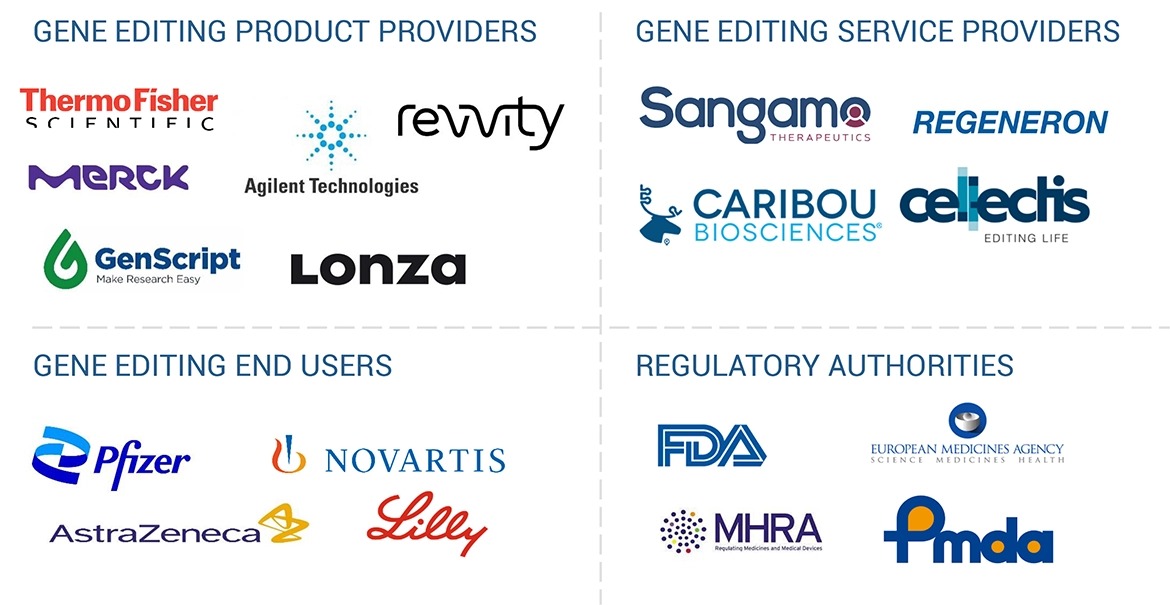
Strategic research alliances are equally vital for platform validation and service expansion. In May 2023, Revvity entered into a collaborative agreement with AstraZeneca to supply gene editing services for pharmaceutical discovery. Earlier, in February 2023, Tecan Life Sciences partnered with Singular Genomics to develop dedicated sequencing libraries for the G4 platform. On the cell therapy front, GenScript partnered with PersonGen-Anke Cellular Therapeutics in March 2023 to integrate the CytoSinct cell isolation platform, aimed at lowering production costs and improving therapy development efficiency. Other prominent market participants driving tool development and therapeutic pipelines include Thermo Fisher Scientific, Lonza, Sangamo Therapeutics, Precision BioSciences, Cellectis, Regeneron Pharmaceuticals, Synthego, Caribou Biosciences, and Bio-Techne.
What the Future Looks Like
The future of gene editing is shifting toward hyper-precise, non-cleaving genomic modifications supported by automated workflows and scalable non-viral delivery platforms. Over the next decade, technologies such as prime editing, multi-base editing, and bridge RNA systems will likely reduce reliance on traditional double-stranded break nucleases, significantly improving patient safety profiles.
As manufacturing technologies mature, non-viral delivery systems including lipid nanoparticles and engineered electroporation systems will complement viral vectors, helping bypass current CDMO production bottlenecks and reducing overall treatment costs. Regulatory frameworks and public reimbursement programs will continue adapting, establishing standardized approval pathways and outcome-based payment structures for curative single-dose therapies.
Ultimately, gene editing is transitioning from an experimental technology used primarily in academic research into a standard component of clinical medicine, therapeutic drug discovery, and precision healthcare globally.
80% of the Forbes Global 2000 B2B companies rely on MarketsandMarkets to identify growth opportunities in emerging technologies and use cases that will have a positive revenue impact.
- Food Packaging Market Size Set for Strong Growth Through 2030 Amid Rising Demand for Convenience Foods
- Crop Protection Chemical Market Size, Share & Growth Forecast (2025–2030)
- Mulch Films Market: Driving Sustainable Agriculture Through Innovation
- Agricultural Adjuvants Market Analysis, Trends, and Growth Outlook (2026–2031)
- Japan Enterprise Asset Management Market Growth: AI and Smart Infrastructure Drive Demand

The gene editing market is poised for robust expansion, driven by continuous technological refinements, rising investment, and an increasing focus on targeted therapies. Although challenges regarding off-target effects, vector delivery, and manufacturing scalability remain, ongoing advances in base editing, prime editing, and bridge RNA are systematically overcoming these limitations. Supported by expanding public funding and favorable reimbursement adjustments, the global ecosystem is moving closer to widespread clinical adoption. As tools become safer, more precise, and commercially scalable, genetic editing will play a fundamental role in shaping the future of biopharmaceuticals and global human health.