The Future of Home Healthcare : Market 2025-2030 Outlook
Modern healthcare is undergoing a structural shift as patient care transitions from traditional hospital settings directly into residential living spaces. Driven by breakthroughs in medical technology, smart sensor connectivity, and a growing preference for personal comfort, home-based clinical management has evolved into a vital pillar of the global medical ecosystem. Individuals dealing with chronic illnesses, post-operative recovery, or age-related mobility issues increasingly seek compassionate, high-quality interventions without the overhead of extended hospital stays. This transformation reshaping modern clinical delivery is broadly captured within the expanding home healthcare market, where technological capability meets patient-centered care.
Current Industry Overview
The home healthcare market is experiencing steady expansion as health systems worldwide seek cost-effective, scalable treatment models. Valuation estimates highlight a strong trajectory: after reaching USD 285.26 billion in 2024, the market advanced to USD 309.94 billion in 2025. Over the forecast period spanning 2025 through 2030, the global sector is projected to expand at a compound annual growth rate (CAGR) of 8.9%, ultimately reaching an estimated total valuation of USD 473.76 billion by 2030.
Within product classifications, therapeutic equipment commands the primary share of revenue. This leadership stems from widespread adoption of home dialysis units, insulin delivery networks, respiratory therapy tools, and continuous positive airway pressure systems. On the service front, skilled nursing accounts for the largest operational segment, driven by the requirement for qualified medical practitioners to administer complex medication regimes, wound management, and continuous health assessments. From an indication perspective, cancer management represents the largest revenue share, as palliative treatments, post-chemotherapy care, and ongoing symptom tracking are increasingly conducted within residential settings.
Key Market Drivers
Multiple demographic and structural factors are fueling sustained momentum across the home healthcare market. Chief among these is an aging global population, particularly the accelerating growth of individuals aged 85 and older. Advanced age correlates directly with an increased vulnerability to multi-morbidity conditions, necessitating long-term clinical supervision that traditional hospital facilities cannot sustainably accommodate.
Additionally, the surging incidence of chronic illnesses such as cardiovascular diseases, type 2 diabetes, chronic kidney disease, and severe respiratory disorders demands ongoing monitoring rather than episodic care. Lifestyle changes, shifting dietary habits, and sedentary routines further exacerbate these conditions across diverse age demographics.
Economic considerations also play a decisive role. Extended hospital stays impose substantial financial burdens on both insurance providers and private individuals. Shifting treatment regimes into the home dramatically lowers facility overhead, curtails emergency readmissions, and reduces the risk of hospital-acquired infections. Furthermore, growing patient insistence on autonomy, dignified care, and familiar surroundings reinforces preference for home-based solutions.
Emerging Technologies
Technological refinement is continuously widening the clinical capabilities of the home healthcare market. Remote patient monitoring (RPM) platforms, coupled with miniaturized biosensors and wearable devices, allow medical personnel to track blood pressure, cardiac rhythm, oxygen saturation, and body temperature in real time.
Continuous glucose monitoring (CGM) systems have revolutionized diabetes management by offering non-invasive, continuous tracking that integrates directly with mobile applications. Key industry collaborations, such as the strategic initiative between Abbott and Medtronic to integrate CGM technology with automated delivery devices, showcase the shift toward interconnected chronic care tools.
Innovations in home hemodialysis and peritoneal dialysis equipment are similarly transforming kidney care. Devices such as the NxStage Versi HD equipped with GuideMe software enable patients to conduct complex dialysis routines at home with step-by-step digital guidance, reducing clinical visits while improving treatment adherence.
Furthermore, advanced respiratory solutions including smart inhalers, portable oxygen concentrators, and compact CPAP or BiPAP systems provide automated data transmission to clinicians. Artificial intelligence and digital health software are also entering the domain, analyzing streaming patient data to flag early indicators of clinical decline before severe complications materialize.
Future Trends
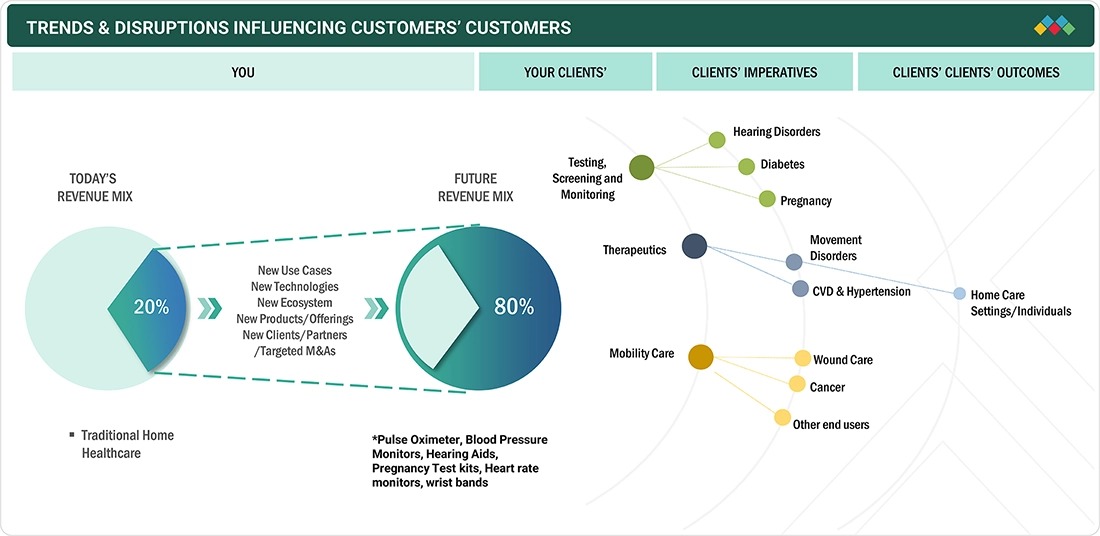
Several overarching operational and clinical trends are shaping the future trajectory of the home healthcare market. Primary among these is the convergence of home diagnostics and virtual consultation platforms. Self-testing kits covering diabetes, coagulation parameters, infectious diseases, and hormone tracking are giving patients direct access to immediate diagnostic data.
Value-based healthcare frameworks are also prompting care organizations to prioritize long-term clinical outcomes over transaction volume. Home-based care delivery fits seamlessly into this philosophy by lowering overall readmission rates and facilitating continuous, preventative monitoring.
Specialized medical programs delivered in residential settings are expanding rapidly. Home oncology care, comprehensive palliative routines, and specialized pediatric home nursing are evolving from niche offerings into mainstream healthcare segments. As specialized treatments become safer and more user-friendly, therapies that once required dedicated hospital beds such as complex IV infusions and long-term wound care are increasingly administered at home.
Opportunities
The home healthcare market offers broad opportunities for device manufacturers, software developers, and service providers. The expansion of high-speed digital infrastructure, such as 5G networks, opens possibilities for real-time telehealth consultations, remote diagnostics, and immersive caregiving tools.
Developing economies represent a major area of untapped growth. As disposable income rises and awareness around preventative health improves across emerging regions, home care solutions offer a viable pathway to bridge gaps in traditional hospital infrastructure.
Strategic partnerships between hardware producers and digital health platforms present another compelling growth avenue. Combining physical devices like pulse oximeters, ECG monitors, or insulin pumps with unified cloud platforms allows companies to offer comprehensive subscriptions that encompass both hardware and monitoring services.
Challenges
Despite strong expansion, the home healthcare market faces significant structural barriers. A primary operational challenge is the persistent shortage of qualified personal care aides and skilled home health nurses. Low compensation structures, demanding working conditions, and high burnout rates hinder recruitment and retention, creating staffing shortages that limit service capacity.
Regulatory and reimbursement policies present another headwind. Modifications to payment frameworks, such as the Patient-Driven Groupings Model (PDGM) instituted by Medicare, have reduced baseline reimbursement rates while tying compensation strictly to patient acuity and clinical metrics. These financial shifts disproportionately burden smaller, rural home health operators.
Additionally, coverage gaps in private insurance plans leave patients with considerable out-of-pocket expenses for durable medical equipment and diagnostic monitoring systems. Technical infrastructure challenges such as inconsistent broadband access in rural regions and ongoing patient safety concerns regarding self-administered medical care also require diligent management.
Regional Outlook
Asia Pacific
The Asia Pacific region is projected to register the fastest growth rate throughout the forecast period. Rapidly aging demographics in countries like Japan and China, coupled with a sharp rise in chronic disease prevalence, make home care an economic necessity. Governments across the region are actively investing in digital healthcare infrastructure and rural health accessibility to alleviate pressure on overburdened hospital networks.
North America and Europe
North America currently holds a dominant position in market revenue, supported by high healthcare expenditure, advanced technological adoption, and well-established reimbursement systems. Europe follows closely, driven by public health initiatives encouraging home care for aging populations and favorable regulatory frameworks supporting telehealth integration.
Emerging Markets
Regions such as Latin America, the Middle East, and Africa display steady momentum. Expanding urban centers, growing private health investments, and rising consumer awareness regarding home diagnostic convenience are fueling gradual device and service uptake.
Competitive Landscape
The global home healthcare market features a dynamic competitive structure characterized by leading medical technology giants, specialized home care providers, and agile digital health innovators. Key industry players include Fresenius Medical Care AG, Abbott, Linde plc, F. Hoffmann-La Roche Ltd., ResMed Inc., Koninklijke Philips N.V., GE Healthcare, OMRON Healthcare Co., Ltd., Invacare Corporation, Amedisys Inc., Convatec Group PLC, Sunrise Medical, Drive DeVilbiss Healthcare, A&D HOLON Holdings Company, and BAYADA Home Health Care.
To consolidate market standing, industry leaders frequently employ targeted mergers, acquisitions, and strategic cross-sector alliances. For instance, ResMed strengthened its diagnostics capabilities by acquiring sleep software developer Somnoware. Similarly, organizations like Fresenius Medical Care are expanding dedicated training facilities, such as opening home hemodialysis education hubs to assist patients in adopting home care protocols. Product innovation, user interface optimization, and software integration remain central strategies for market participants.
What the Future Looks Like
The future of the home healthcare market points toward a fully connected, patient-focused ecosystem where the home becomes the primary site for routine care and chronic condition management. Advanced sensors, predictive analytics, and automated delivery systems will continuously communicate with clinical care teams, catching health deviations before emergency intervention is required. Hospitals will increasingly function as specialized centers reserved for acute, surgical, and emergency procedures, while long-term care, rehabilitation, and preventive monitoring shift smoothly into living rooms. This paradigm shift promises higher patient satisfaction, reduced health system expenditure, and improved clinical outcomes globally.
80% of the Forbes Global 2000 B2B companies rely on MarketsandMarkets to identify growth opportunities in emerging technologies and use cases that will have a positive revenue impact.
- Food Packaging Market Size Set for Strong Growth Through 2030 Amid Rising Demand for Convenience Foods
- Mulch Films Market: Driving Sustainable Agriculture Through Innovation
- Agricultural Adjuvants Market Analysis, Trends, and Growth Outlook (2026–2031)
- Crop Protection Chemical Market Size, Share & Growth Forecast (2025–2030)
- Japan Enterprise Asset Management Market Growth: AI and Smart Infrastructure Drive Demand

Conclusion
The home healthcare market is poised for transformative expansion over the coming decade. Driven by an expanding elderly population, rising chronic disease rates, and rapid technological innovations, the market's trajectory from USD 309.94 billion in 2025 to USD 473.76 billion by 2030 underscores its critical role in modern medicine. While headwinds like labor shortages and reimbursement constraints remain, ongoing investments in remote patient monitoring, digital diagnostics, and skilled care services will sustain long-term growth. Ultimately, home-based health care represents a sustainable, compassionate, and efficient future for global clinical delivery.