The Future of Surgical Robots: Market Innovations, Growth, and Trends
The integration of robotics into operating rooms represents one of the most profound medical advancements of the 21st century. By combining human expertise with machine precision, these sophisticated platforms have transformed complex operations into minimally invasive procedures. Surgeons now routinely operate with enhanced vision, unmatched dexterity, and absolute control, leading to dramatically improved patient outcomes. From delicate cardiovascular interventions to routine joint replacements, automated assistance is rapidly becoming the gold standard in modern healthcare. As technology continues to evolve, the surgical robots market is poised for explosive expansion, promising to reshape how hospitals and clinics approach patient care worldwide over the coming decade.
Current Industry Overview
The surgical robots market is currently experiencing a highly robust expansion phase. In 2024, the industry achieved a remarkable global valuation of $11.98 billion, which further accelerated to $13.69 billion by the start of 2025. This rapid financial trajectory underscores a fundamental shift in how medical facilities prioritize their capital investments and surgical capabilities.
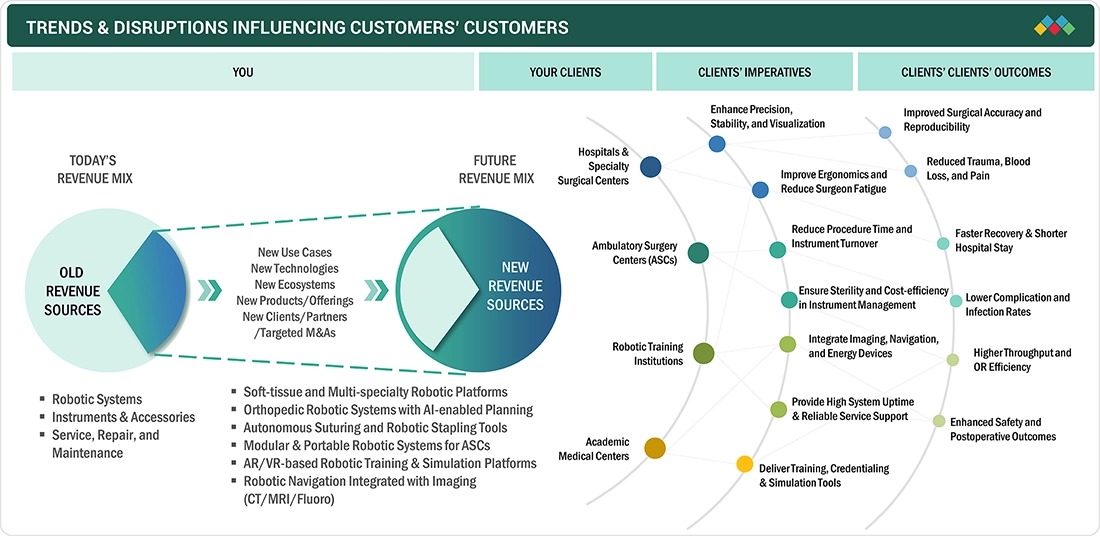
Interestingly, a significant portion of this revenue stems not just from the initial purchase of the heavy robotic platforms, but from the continuous need for specialized instruments and accessories. Consumable components reliably capture between 55% and 60% of the total industry revenue. Because items like multi-jointed end-effectors, staplers, trocars, and energy devices require regular replacement after a fixed number of uses, they generate a highly predictable and recurring revenue stream for manufacturers.
When looking at medical applications, general surgery currently leads the landscape, capturing roughly 28% to 32% of the sector. This dominance is primarily due to the high volume of routine procedures such as hernia repairs, colorectal surgeries, and bariatric operations that are perfectly suited for automated assistance. Meanwhile, major hospitals and established specialty clinics remain the primary end-users. These large-scale facilities possess the necessary capital, advanced infrastructure, and high clinical caseloads required to support and justify these advanced systems.
Key Market Drivers
Several compelling clinical and operational benefits are propelling the surgical robots market forward at an accelerated pace. At the forefront is the global medical community's strong preference for minimally invasive techniques. Automated assistance provides surgeons with advanced tremor filtration and high-definition, three-dimensional visualization. This allows medical professionals to execute incredibly precise movements in tight anatomical spaces with minimal tissue disruption.
Consequently, patients experience significantly less postoperative pain, reduced blood loss, and much shorter hospital stays compared to traditional open surgeries. Beyond individual patient benefits, macroeconomic factors play a crucial role. The worldwide increase in chronic ailments, such as cardiovascular diseases and various forms of cancer, necessitates a higher volume of highly complex interventions.
Simultaneously, an aging global population is driving up the demand for joint replacements and other age-related orthopedic operations. For healthcare providers, the ability to offer faster recovery times and lower complication rates directly translates to improved patient satisfaction, better clinical reputations, and highly efficient hospital resource management.
Emerging Technologies
The rapid evolution of the surgical robots market is heavily intertwined with broader technological breakthroughs. Artificial intelligence and machine learning are increasingly being integrated directly into operative workflows. These digital tools analyze vast amounts of intraoperative data to provide real-time decision support, helping surgeons anticipate potential complications before they occur and standardize procedural outcomes.
Advanced imaging capabilities have also leaped forward, offering augmented reality overlays that map a patient's unique anatomy instantly during a procedure. Furthermore, developers are making significant strides in tactile feedback often referred to as haptic technology. This innovation allows operators sitting at a remote console to physically feel the tissue resistance as if they were holding the instruments directly in their own hands, greatly reducing the risk of accidental tissue damage.
Combined with improved ergonomic console designs and highly articulated instrument tips, these emerging technologies are steadily eliminating the historical variability in surgical performance, paving the way for safer interventions.
Future Trends
Looking ahead, the surgical robots market is shifting away from rigid, space-consuming hardware toward much more versatile solutions. Manufacturers are increasingly prioritizing modular and highly portable systems that can be easily moved between different operating rooms, maximizing their daily utilization and return on investment for the hospital.
There is also a distinct trend toward expanding the scope of automated applications. While general and urological operations have traditionally dominated the space, fields like orthopedics, neurosurgery, and specialized microsurgery are seeing rapid technological adaptation.
Perhaps the most disruptive trend is the transformation of commercial purchasing models. To overcome high initial financial barriers to entry, leading companies are introducing flexible subscription-based pricing and pay-per-use agreements. This democratization of technology ensures that mid-sized facilities can afford cutting-edge equipment without committing to massive, upfront capital expenditures.
Opportunities
One of the most lucrative opportunities within the surgical robots market lies in the growing penetration of ambulatory surgery centers (ASCs). As surgical platforms become more compact and easier to integrate into smaller clinical footprints, ASCs are rapidly adopting them to perform outpatient procedures.
These specialized facilities focus heavily on efficiency, fast patient turnover, and highly cost-effective care models. Because modern automated platforms facilitate quicker recovery times and require less invasive anesthesia protocols, many operations that previously demanded a multi-day hospital stay can now be safely executed in an outpatient setting.
This shift not only creates an entirely new, untapped revenue channel for equipment manufacturers but also aligns perfectly with modern value-based healthcare models that prioritize patient convenience and lower overall treatment costs.
Challenges
Despite its massive potential, the surgical robots market faces several formidable hurdles that must be navigated carefully. The most prominent restraint is the exceptionally high cost associated with these advanced platforms. Beyond the initial multimillion-dollar purchase price, hospitals must commit to ongoing maintenance contracts, expensive disposable accessories, and mandatory software upgrades. Additionally, integrating these systems often requires extensive operating room redesigns and costly facility downtime.
Another critical challenge revolves around the steep learning curve and the risk of surgical errors. Surgeons and support staff must undergo rigorous, time-consuming training to operate the complex consoles safely. During this initial adaptation phase, the risk of intraoperative complications can temporarily increase, particularly in facilities with lower procedural volumes. System malfunctions, software glitches, or improper handling of delicate instruments in high-stakes environments can lead to severe consequences. Managing these risks through stricter certification programs, continuous performance monitoring, and better mechanical fail-safes remains a top priority for the industry to maintain public and regulatory trust.
Regional Outlook
Geographically, North America currently dominates the surgical robots market, commanding an impressive 60% to 65% share of global revenue. This leadership position is fueled by a highly modernized healthcare infrastructure, widespread clinical acceptance of cutting-edge medical technologies, and the concentrated presence of industry-leading manufacturers within the United States.
However, the Asia Pacific region is rapidly emerging as the fastest-growing territory for automated medical systems. Rapid healthcare modernization, surging investments in clinical infrastructure, and robust government funding in countries like China, Japan, South Korea, and India are supercharging regional demand.
Additionally, a booming medical tourism sector in Southeast Asia is prompting local hospitals to invest heavily in robotic platforms to attract international patients seeking high-quality, affordable care. As regional manufacturers begin introducing more cost-effective automated solutions, overall accessibility in the Asia Pacific sector will expand exponentially in the coming years.
Competitive Landscape
The competitive dynamics of the surgical robots market are characterized by a mix of established titans and highly innovative challengers. Industry pioneers with massive global installed bases and comprehensive digital ecosystems continue to hold the largest market shares, benefiting heavily from strong brand recognition, extensive clinical validation, and comprehensive surgeon training programs.
Meanwhile, emerging leaders are fiercely disrupting the status quo by introducing versatile, cost-effective, and modular systems that appeal to a broader range of healthcare facilities. Smaller startups and specialized engineering firms are successfully carving out lucrative niches by focusing on highly specific applications, such as handheld orthopedic devices or AI-driven navigational tools for complex spine surgeries.
As the industry matures, strategic partnerships, intellectual property acquisitions, and collaborative training initiatives will remain vital for companies looking to expand their technological portfolios and geographic footprints.
What the Future Looks Like
The long-term forecast for the surgical robots market is overwhelmingly positive and highly dynamic. From a baseline valuation of $13.69 billion in 2025, the sector is projected to surge to an astonishing $27.14 billion by the year 2030. This represents a remarkably strong compound annual growth rate (CAGR) of 14.7% over the forecast period.
This aggressive expansion will be characterized by the widespread democratization of automated surgical care. As subscription models lower financial barriers and equipment becomes increasingly portable, robotic assistance will transition from a luxury available only at elite metropolitan hospitals to a standard tool found in regional clinics and ambulatory centers worldwide. Ultimately, the seamless fusion of artificial intelligence, real-time data analytics, and ultra-precise mechanics will usher in an era of hyper-personalized, flawlessly executed surgical interventions.
80% of the Forbes Global 2000 B2B companies rely on MarketsandMarkets to identify growth opportunities in emerging technologies and use cases that will have a positive revenue impact.
- Food Packaging Market Size Set for Strong Growth Through 2030 Amid Rising Demand for Convenience Foods
- Mulch Films Market: Driving Sustainable Agriculture Through Innovation
- Agricultural Adjuvants Market Analysis, Trends, and Growth Outlook (2026–2031)
- Crop Protection Chemical Market Size, Share & Growth Forecast (2025–2030)
- Japan Enterprise Asset Management Market Growth: AI and Smart Infrastructure Drive Demand

The surgical robots market stands at the precipice of a golden era in medical technology and patient care. Driven by an aging population, the rising prevalence of chronic conditions, and a universal clinical demand for minimally invasive care, this sector is set to double in financial value by the end of the decade. While challenges such as high implementation costs and steep learning curves remain valid concerns, flexible commercial models and rapid technological advancements are quickly mitigating these barriers. As continuous innovation blurs the lines between digital intelligence and physical surgical execution, healthcare providers worldwide will be empowered to deliver safer, more efficient, and highly effective patient outcomes.