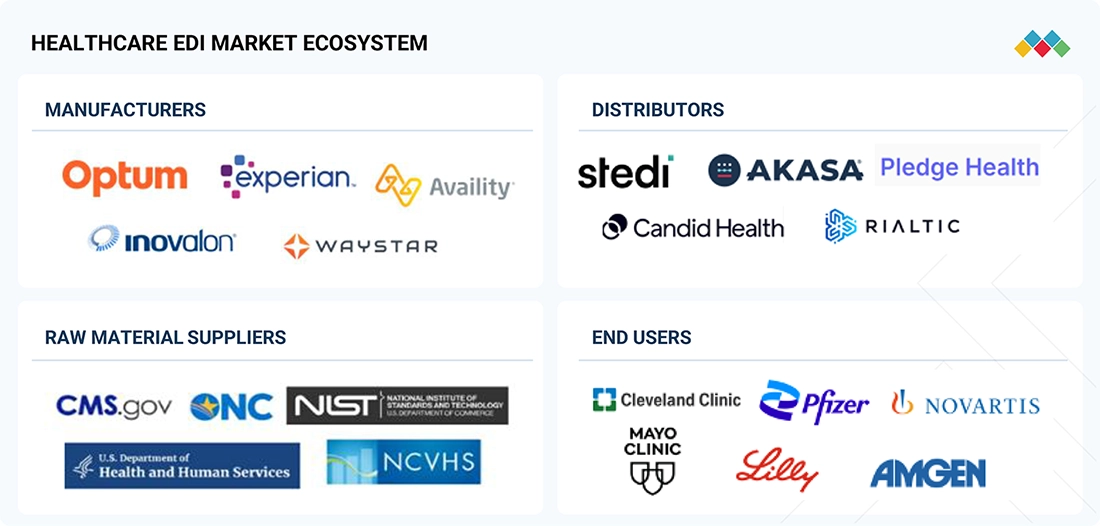
20 Leading Healthcare EDI Companies Shaping Innovation and Market Growth to 2031
Discover the top 20 companies driving innovation in the healthcare electronic data interchange (EDI) market. This in-depth analysis explores competitive advantages, transformative trends, and key players poised to influence healthcare claims processing, eligibility verification, revenue cycle management, referral management, and interoperability through 2031. Access the comprehensive Healthcare EDI Market by Offering (Clearinghouse, Claims, Eligibility & Verification, Referral Management), Connectivity (VAN, Point-to-point, Web Portal, API-enabled), Deployment, End user (Hospitals, ASC, Payers, Pharmacies) - Global Forecast to 2031 report for further insights.
Spotlights on the Industry's Top Healthcare EDI Companies
The healthcare EDI market is evolving as healthcare providers, insurance payers, pharmacies, and other stakeholders increasingly adopt digital solutions to exchange administrative and financial information. Electronic transactions such as insurance claims, eligibility inquiries, remittance advice, prior authorization requests, and referral information are essential for streamlining healthcare operations. Growing emphasis on interoperability, administrative cost reduction, and regulatory compliance is accelerating the adoption of clearinghouse platforms, API-enabled connectivity, and cloud-based EDI solutions. Artificial intelligence, automation, advanced analytics, and secure data exchange technologies are further transforming transaction management. Competition is increasingly driven by transaction processing capabilities, integration with electronic health records and practice management systems, data accuracy, scalability, and compliance with healthcare transaction standards such as HIPAA and X12.
1. Optum Inc.
Optum Inc., part of UnitedHealth Group, is a major healthcare services and technology provider with capabilities spanning payer and provider administration. Its healthcare EDI-related services support claims processing, payment integrity, eligibility verification, revenue cycle management, and administrative transactions. Through its Optum Insight business, the company provides technology platforms and services that help healthcare organizations manage financial and operational workflows. Its extensive healthcare ecosystem, data capabilities, and experience across payer and provider environments position Optum as an important participant in healthcare transaction management and electronic information exchange.
2. Availity, LLC
Availity, LLC is a healthcare technology company specializing in connectivity between health plans and healthcare providers. Its Availity Essentials platform supports electronic eligibility and benefits verification, claims submission, claim status inquiries, remittance information, and other administrative transactions. The company also provides solutions for prior authorization and revenue cycle workflows. By connecting providers and payers through a centralized network, Availity helps reduce administrative complexity and improve information exchange. Its specialized healthcare transaction network and payer connectivity make it a significant participant in clearinghouse services and healthcare EDI solutions.
3. Waystar Holding Corp.
Waystar Holding Corp. provides healthcare payment technology and revenue cycle management solutions that support electronic transactions between providers and payers. Its platform facilitates claims management, eligibility verification, patient financial engagement, payment processing, and denial management. Waystar combines transaction connectivity with analytics and automation to help healthcare organizations improve reimbursement processes and administrative efficiency. Its cloud-based technology and integration capabilities support hospitals, health systems, physician practices, and other providers. The company's focus on simplifying complex financial interactions across the healthcare ecosystem strengthens its position in the healthcare EDI market.
4. Cognizant
Cognizant provides healthcare technology, consulting, and business process services to healthcare payers, providers, and life sciences organizations. Its healthcare capabilities include claims administration, payer operations, enrollment management, provider data management, and revenue cycle transformation. The company supports electronic transaction workflows through technology integration, application modernization, and process automation. Its experience with healthcare information systems and enterprise-scale digital transformation enables organizations to improve administrative connectivity and streamline data exchange. Cognizant's combination of healthcare domain knowledge and technology services makes it relevant to the broader healthcare EDI ecosystem.
5. McKesson Corporation
McKesson Corporation is a healthcare distribution and technology company with extensive involvement in pharmaceutical distribution, healthcare services, and provider solutions. Its technology capabilities support electronic ordering, billing, inventory management, reimbursement-related workflows, and information exchange across healthcare supply chains. Through its healthcare technology and distribution operations, McKesson helps connect pharmacies, manufacturers, providers, and other stakeholders. Its role in electronic healthcare transactions is particularly relevant to pharmacy operations and administrative connectivity. The company's established healthcare network and technology infrastructure support the exchange of information required for efficient healthcare and pharmaceutical operations.
6. Experian Information Solutions, Inc.
Experian Information Solutions, Inc. provides data analytics, identity management, and information services, including specialized solutions for healthcare organizations. Its healthcare portfolio supports patient identity verification, insurance discovery, eligibility checks, patient access, and revenue cycle management. These capabilities help providers obtain accurate coverage information and reduce administrative errors associated with patient registration and claims processing. Experian Health connects healthcare organizations with payer and data sources to support more efficient financial workflows. Its expertise in data verification, analytics, and healthcare connectivity makes it relevant to eligibility and verification services within the healthcare EDI market.
7. Inovalon Holdings, Inc.
Inovalon Holdings, Inc. provides cloud-based healthcare data analytics and technology solutions serving health plans, providers, and pharmaceutical organizations. Its capabilities include data integration, quality measurement, risk adjustment, clinical data management, and healthcare workflow support. Through its technology platform, Inovalon helps organizations connect and analyze information from multiple healthcare sources. These capabilities support administrative processes that depend on accurate and timely data exchange, including payer-provider coordination and healthcare reporting. Its relevance to healthcare EDI is primarily through data connectivity, interoperability, and technology-enabled administrative workflows.
8. athenahealth Group, Inc.
athenahealth Group, Inc. provides cloud-based healthcare technology solutions for medical practices and health systems. Its athenaOne platform integrates electronic health records, practice management, and revenue cycle management capabilities, supporting electronic claims submission, eligibility verification, payment posting, and payer connectivity. The company's network-based model facilitates administrative information exchange between healthcare providers and insurance organizations. By combining clinical and financial workflows, athenahealth helps providers manage billing operations and reduce administrative burdens. Its integrated technology platform and connectivity with payer systems establish its relevance in healthcare EDI and electronic transaction management.
9. Veradigm Inc.
Veradigm Inc. develops healthcare technology and data solutions supporting providers, payers, pharmaceutical companies, and other healthcare stakeholders. Its portfolio includes electronic health records, practice management, revenue cycle management, and data analytics solutions. These systems support administrative workflows such as electronic claims processing, eligibility verification, billing, and payer connectivity. Through its healthcare technology infrastructure, Veradigm helps facilitate information exchange between provider organizations and other healthcare entities. Its integration of clinical and financial data supports interoperability and more coordinated administrative processes, making the company relevant to healthcare EDI applications.
10. The SSI Group, LLC
The SSI Group, LLC specializes in healthcare revenue cycle management and electronic transaction processing solutions. Its services include electronic claims management, claims status inquiries, eligibility verification, remittance processing, payment management, and clearinghouse connectivity. The company supports hospitals, health systems, and physician organizations in managing administrative interactions with insurance payers. Its EDI capabilities help automate high-volume healthcare transactions and improve the accuracy of billing and reimbursement workflows. SSI's specialized focus on healthcare transaction management and revenue cycle operations makes it a direct participant in the healthcare EDI market.
11. IBM
IBM provides enterprise integration, cloud computing, data management, and automation technologies that support secure information exchange across industries, including healthcare. Its integration solutions enable organizations to connect applications, manage data flows, and exchange business transactions between internal systems and external partners. IBM Sterling technologies support B2B integration and electronic document exchange, while its broader enterprise platforms support healthcare data integration and interoperability initiatives. These capabilities are relevant to healthcare organizations seeking scalable EDI infrastructure, system connectivity, and automated administrative workflows. IBM's role is primarily technology- and integration-focused rather than limited to healthcare-specific clearinghouse services.
12. Oracle
Oracle provides healthcare information technology, cloud infrastructure, database management, and enterprise integration solutions. Through Oracle Health, formerly Cerner, the company supports healthcare providers with electronic health records and connected clinical and administrative systems. Its broader enterprise technologies facilitate data integration, application connectivity, and secure information exchange across complex organizations. These capabilities can support healthcare EDI workflows involving patient administration, billing, claims-related information, and interoperability. Oracle's enterprise software expertise and healthcare technology presence make it relevant to the infrastructure and integration requirements of healthcare transaction management.
13. NTT DATA Group Corporation
NTT DATA Group Corporation provides IT consulting, systems integration, cloud services, and digital transformation solutions for healthcare organizations. Its capabilities include healthcare application modernization, data integration, interoperability, and managed services. These services help providers and payers connect disparate systems and streamline the exchange of administrative and clinical information. The company's expertise in enterprise integration and global technology delivery is relevant to organizations implementing electronic transaction platforms and modernizing legacy EDI infrastructure. NTT DATA supports the broader healthcare EDI ecosystem through technology integration, secure connectivity, and digital workflow transformation.
14. Comarch S.A.
Comarch S.A. develops enterprise software and IT solutions, including electronic data interchange, B2B integration, electronic invoicing, and supply chain management platforms. Its EDI technologies enable organizations to exchange structured business documents and automate transactions with trading partners. Although its capabilities extend across several industries, the company's integration expertise can support healthcare-related supply chain and administrative connectivity requirements. Comarch's cloud-based EDI services, document processing, and partner integration capabilities make it relevant to the broader healthcare data exchange ecosystem. Its direct healthcare EDI participation should be evaluated according to specific healthcare implementations and customer applications.
15. Axway
Axway provides enterprise integration, API management, managed file transfer, and B2B integration technologies. Its solutions help organizations securely exchange business documents and connect applications, partners, and enterprise systems. The company's B2B integration capabilities support structured electronic transactions, while its API management technologies facilitate modern application connectivity. These capabilities are relevant to healthcare organizations seeking to modernize EDI infrastructure, integrate legacy systems, and establish secure data exchange with providers, payers, and other stakeholders. Axway's expertise in enterprise connectivity and digital integration positions it as a technology provider within the healthcare EDI ecosystem.
16. Boomi, LP
Boomi, LP develops cloud-based integration platform as a service (iPaaS) solutions that connect applications, data, APIs, and business processes. Its platform supports application integration, B2B/EDI connectivity, workflow automation, and data management. These capabilities can help healthcare organizations exchange structured transactions and connect electronic health records, billing systems, payer platforms, and other enterprise applications. Boomi's low-code integration environment and cloud-based architecture are relevant to healthcare providers and technology partners seeking to modernize legacy connectivity and automate administrative data flows. Its contribution to healthcare EDI is primarily through integration infrastructure and connectivity solutions.
17. TrueCommerce, Inc.
TrueCommerce, Inc. provides supply chain connectivity and B2B integration solutions, including electronic data interchange, managed services, and trading partner connectivity. Its platform enables businesses to exchange structured documents and automate transactions across partner networks. The company's EDI capabilities are applicable to healthcare-related supply chain processes, including electronic purchasing, invoicing, and transactions involving manufacturers, distributors, and other trading partners. TrueCommerce's network-based integration model and managed EDI services support organizations seeking to simplify partner connectivity. Its direct involvement in payer-provider healthcare claims clearinghouse services is more limited than its broader B2B EDI specialization.
18. Plexis Healthcare Systems, Inc.
Plexis Healthcare Systems, Inc. develops healthcare administration software, particularly for health plans and third-party administrators. Its QNXT platform supports core payer operations, including claims processing, benefits administration, provider management, and member services. These functions rely on electronic data exchange and standardized transactions between payers, providers, and other healthcare entities. Plexis helps organizations manage complex health plan workflows through integrated administrative technology. Its specialization in payer systems and claims administration makes it relevant to healthcare EDI, particularly where electronic transactions are embedded within broader health plan processing operations.
19. Epicor Software Corporation
Epicor Software Corporation develops enterprise resource planning and business management software for manufacturing, distribution, retail, and other industries. Its EDI-related capabilities support electronic document exchange and integration between trading partners, including transactions such as purchase orders, invoices, and shipping information. These technologies can be relevant to healthcare supply chains, particularly for distributors and organizations managing pharmaceutical, medical device, and healthcare product transactions. Epicor's contribution to the healthcare EDI ecosystem is primarily through enterprise and supply chain connectivity rather than specialized clinical claims clearinghouse services or payer-provider eligibility networks.
20. Cleo Communications LLC
Cleo Communications LLC provides B2B integration, electronic data interchange, API integration, and managed connectivity solutions. Its integration platform helps organizations exchange structured business documents, connect applications, and automate transactions across trading partner networks. Cleo's EDI and API capabilities can support healthcare-related administrative and supply chain data exchange, particularly where providers, distributors, and business partners require reliable system-to-system communication. Its managed services and integration technologies help organizations address complex connectivity requirements. The company's healthcare EDI relevance is primarily based on its enterprise B2B integration capabilities and their application to healthcare transaction environments.
80% of the Forbes Global 2000 B2B companies rely on MarketsandMarkets to identify growth opportunities in emerging technologies and use cases that will have a positive revenue impact.
- Food Packaging Market Size Set for Strong Growth Through 2030 Amid Rising Demand for Convenience Foods
- Crop Protection Chemical Market Size, Share & Growth Forecast (2025–2030)
- Mulch Films Market: Driving Sustainable Agriculture Through Innovation
- Agricultural Adjuvants Market Analysis, Trends, and Growth Outlook (2026–2031)
- Japan Enterprise Asset Management Market Growth: AI and Smart Infrastructure Drive Demand

Conclusion: Unlock the Full Healthcare EDI Market Intelligence
The healthcare EDI market is expected to remain strategically important as providers, payers, pharmacies, and other stakeholders prioritize administrative automation, interoperability, and efficient transaction processing. The adoption of API-enabled connectivity, cloud-based clearinghouses, intelligent automation, and advanced data integration is transforming traditional EDI infrastructure. At the same time, regulatory compliance, data security, transaction accuracy, and interoperability standards remain critical considerations for market participants. Companies offering integrated claims management, eligibility verification, referral management, and secure connectivity solutions are positioned to address the evolving needs of the healthcare ecosystem. To gain deeper insights into market opportunities, competitive dynamics, emerging technologies, and strategic developments through 2031, explore the full report: Healthcare EDI Market by Offering (Clearinghouse, Claims, Eligibility & Verification, Referral Management), Connectivity (VAN, Point-to-point, Web Portal, API-enabled), Deployment, End user (Hospitals, ASC, Payers, Pharmacies) - Global Forecast to 2031.