24 Leading AI in Life Science Companies Shaping Innovation and Market Growth to 2031
Discover the top 24 companies driving innovation in the AI in life science market. This in-depth analysis explores competitive advantages, transformative trends, and key players poised to influence drug discovery, clinical trials, precision medicine, and pharmaceutical research through 2031. Access the comprehensive AI in Life Science Market report for further insights.
Spotlights on the Industry's Top AI in Life Science Market Companies
The AI in life science market is evolving rapidly as pharmaceutical companies, biotechnology firms, healthcare providers, and research institutions integrate artificial intelligence into research and development. Machine learning, generative AI, natural language processing, computer vision, and multimodal foundation models are transforming drug discovery, molecular design, clinical trial planning, genomics, and disease diagnosis. The market is projected to grow from USD 21.58 billion in 2026 to USD 69.34 billion by 2031, at a CAGR of 26.3%. Growing investment in AI-driven research, increasing availability of biological and clinical data, and advances in computational infrastructure are supporting adoption. Meanwhile, data privacy, model validation, regulatory compliance, and the reproducibility of AI-generated findings remain important considerations.
1. NVIDIA CORPORATION
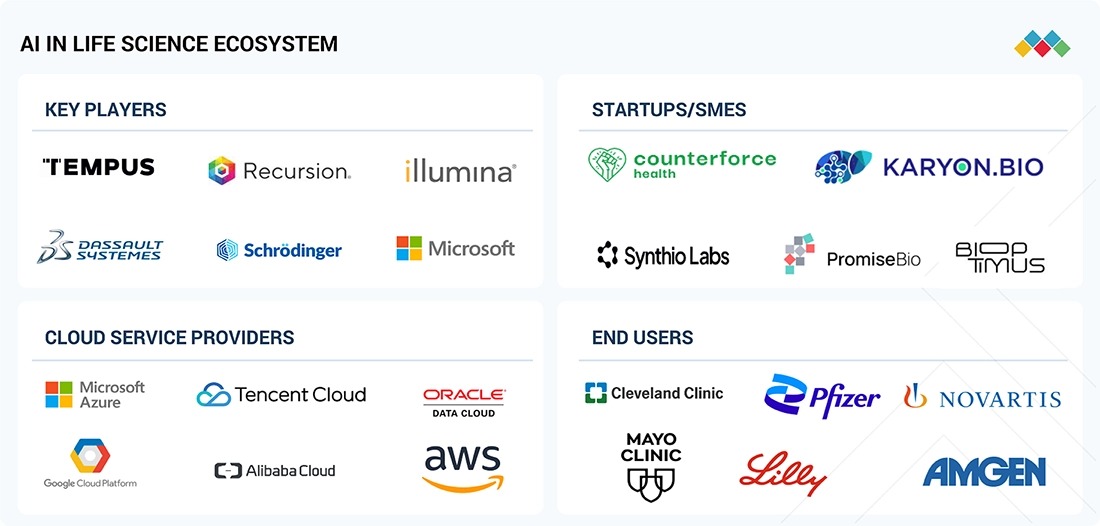
NVIDIA Corporation supports AI adoption across the life sciences industry through accelerated computing, GPUs, AI software, and high-performance computing infrastructure. Its technologies enable researchers to process large biological datasets, train machine learning models, simulate molecular interactions, and accelerate computational drug discovery. NVIDIA's BioNeMo platform provides tools and workflows for developing and deploying AI models for biological and chemical research. By supporting generative AI, protein modeling, and scientific computing, the company serves as an important technology provider for pharmaceutical companies, biotechnology businesses, and research institutions developing AI-enabled life science applications.
2. ILLUMINA, INC.
Illumina, Inc. is a genomics technology company whose sequencing platforms and genomic analysis solutions generate data used in precision medicine, biological research, and drug development. AI and machine learning can help researchers interpret complex genomic datasets, identify disease-associated variants, and investigate molecular mechanisms underlying health conditions. Illumina's sequencing technologies support applications in oncology, genetic disease research, and population genomics. As life science organizations increasingly combine genomic information with clinical and molecular datasets, the company remains relevant to AI-enabled research requiring high-quality sequencing data and advanced analytical workflows.
3. TEMPUS AI, INC.
Tempus AI, Inc. applies artificial intelligence to clinical and molecular data to support precision medicine, diagnostics, and therapeutic development. Its platform combines real-world clinical information, genomic data, and AI-driven analytical capabilities to help healthcare professionals and pharmaceutical researchers generate actionable insights. Tempus supports applications including oncology research, biomarker identification, patient stratification, and clinical trial planning. By connecting clinical evidence with molecular information, the company helps drug developers investigate patient populations and treatment responses, positioning its data and AI capabilities within the expanding market for technology-enabled life science research.
4. RECURSION
Recursion is a biotechnology company using AI, automation, and large-scale biological datasets to accelerate drug discovery and development. Its Recursion Operating System integrates computational models, cellular imaging, experimental biology, and chemistry to investigate disease mechanisms and identify potential therapeutic candidates. The platform connects laboratory experimentation with machine learning to generate insights across discovery and development workflows. Recursion focuses on areas including oncology and rare diseases, applying computational approaches to prioritize promising drug candidates and improve research efficiency. Its integrated TechBio model illustrates the growing convergence of biotechnology, advanced computing, and AI-driven pharmaceutical innovation.
5. DASSAULT SYSTÈMES SE
Dassault Systèmes SE provides scientific modeling, simulation, and data management technologies used across pharmaceutical research, biotechnology, and healthcare. Its BIOVIA portfolio supports molecular modeling, computational chemistry, laboratory informatics, and scientific collaboration, while its broader virtual-twin capabilities enable complex systems to be modeled and analyzed. These technologies can complement AI applications in drug discovery, formulation development, and life science research by connecting experimental data with computational workflows. The company's relevance lies in its scientific software ecosystem, which helps organizations integrate simulation, data analysis, and collaborative research into increasingly digital drug development processes.
6. SCHRÖDINGER, INC.
Schrödinger, Inc. develops computational chemistry software and applies physics-based modeling and computational methods to drug discovery. Its platform helps researchers evaluate molecular properties, investigate protein-ligand interactions, and prioritize potential drug candidates before experimental testing. The company's technology combines molecular simulation with data-driven approaches to support medicinal chemistry and pharmaceutical research. Schrödinger also applies its computational capabilities to internal drug discovery programs and collaborative research. By integrating predictive modeling with established scientific methods, the company contributes to AI-enabled discovery workflows designed to improve molecular design, reduce unnecessary experiments, and accelerate early-stage therapeutic development.
7. DATA4CURE, INC.
Data4Cure, Inc. develops computational biology and data integration technologies designed to help researchers interpret complex biological information. Its solutions support the integration of molecular, clinical, and biomedical datasets to investigate disease mechanisms, identify biomarkers, and generate hypotheses for therapeutic research. These capabilities are relevant to AI-driven life science applications because effective model development depends on connecting diverse datasets with meaningful biological context. By helping research organizations organize and analyze complex biomedical information, Data4Cure addresses an important challenge in precision medicine and data-intensive drug discovery, where fragmented information can limit the usefulness of advanced analytical models.
8. MICROSOFT CORPORATION
Microsoft Corporation supports AI adoption in life sciences through cloud computing, data analytics, machine learning, and generative AI technologies. Microsoft Azure provides infrastructure for processing large biomedical datasets, developing AI models, and supporting research workloads, while its AI development tools enable organizations to build and deploy specialized applications. These capabilities can support drug discovery, clinical research, scientific collaboration, and biomedical data management. Microsoft's broader technology ecosystem allows life science organizations to connect computational resources with research workflows while addressing requirements such as security, scalability, and governance. Its role is primarily that of a technology and infrastructure provider rather than a dedicated drug developer.
9. INSILICO MEDICINE
Insilico Medicine develops AI-powered technologies for drug discovery and therapeutic development. Its platform combines generative AI, machine learning, and computational biology to identify potential drug targets, design molecules, and support candidate prioritization. The company's approach connects target discovery with molecular generation and preclinical research, helping researchers explore therapeutic possibilities more efficiently. Insilico Medicine has also advanced its own drug development pipeline, demonstrating an application of AI beyond software licensing alone. Its integrated computational approach positions the company within the emerging field of AI-native biotechnology, where predictive models are used throughout multiple stages of pharmaceutical research.
10. EUROFINS DISCOVERY
Eurofins Discovery, part of the Eurofins scientific services group, provides drug discovery research services, biological assays, screening technologies, and related laboratory capabilities. These services help pharmaceutical and biotechnology organizations evaluate compounds, investigate biological targets, and generate experimental evidence during early drug development. Although its core offering is not exclusively an AI platform, its experimental services can complement computational discovery by providing data for model development, validation, and follow-up testing. The combination of laboratory evidence and AI-based predictions is increasingly important for translating computational findings into experimentally supported research decisions.
11. BENEVOLENTAI LIMITED
BenevolentAI Limited has developed AI-enabled drug discovery capabilities focused on integrating biomedical knowledge, scientific literature, and biological datasets to identify therapeutic opportunities. Its computational approach has been used to investigate disease biology, generate drug hypotheses, and support target identification and prioritization. Knowledge graphs and machine learning can help researchers uncover relationships that may be difficult to identify through conventional literature review alone. BenevolentAI's relevance to the market stems from its emphasis on applying AI to scientific reasoning and drug discovery. Its current corporate and commercial status should be verified before publication when describing present-day products, operations, or partnerships.
12. OWKIN
Owkin develops AI technologies for biomedical research, precision medicine, and pharmaceutical development. The company applies machine learning to multimodal biomedical data, including pathology images and clinical information, to investigate disease biology and identify potential biomarkers. Its federated learning approach has been designed to enable collaborative model development across institutions without requiring the centralization of all underlying patient data. Owkin's technologies support research in areas such as oncology, patient stratification, and therapeutic development. By connecting AI methods with biomedical expertise and privacy-conscious data collaboration, the company addresses important challenges in translating complex healthcare data into useful scientific insights.
13. PATHAI
PathAI develops AI-powered pathology technologies to improve the analysis of tissue samples and support pharmaceutical research. Its digital pathology solutions apply machine learning and image analysis to identify patterns in tissue images, assist biomarker research, and generate quantitative insights for drug development. These capabilities can support clinical trials, translational research, and the evaluation of treatment responses. PathAI also works with biopharmaceutical organizations on AI-enabled research applications. By converting complex pathology images into structured analytical information, the company contributes to more reproducible tissue assessment and supports the growing use of computational pathology in precision medicine and therapeutic development.
14. AIDOC MEDICAL LTD.
AiDoc Medical Ltd., commonly known as Aidoc, develops AI-powered medical imaging solutions that help healthcare professionals identify and prioritize potentially urgent findings. Its platform analyzes medical images and supports clinical workflows across multiple imaging specialties. The company's primary focus is clinical imaging rather than pharmaceutical drug discovery, but its technologies are relevant to the broader life sciences ecosystem through AI-enabled diagnosis, clinical data generation, and healthcare research. Aidoc illustrates how computer vision and clinical AI can support medical decision-making and operational efficiency, while its inclusion in a life science market analysis should distinguish medical imaging applications from drug development software.
15. QURE.AI
Qure.ai develops AI-powered medical imaging solutions designed to support the interpretation of radiology images and improve the identification of selected clinical findings. Its technologies include AI applications for analyzing chest X-rays and head CT scans, supporting workflows in areas such as lung disease and stroke assessment. The company's solutions can help clinicians prioritize cases and standardize aspects of image interpretation. Within the wider AI in life science landscape, Qure.ai represents the clinical imaging and diagnostic application segment rather than a dedicated drug discovery provider. Its contribution highlights the potential of machine learning and computer vision to support evidence-based healthcare decisions.
16. DEEP GENOMICS
Deep Genomics applies artificial intelligence to RNA biology and genetic disease research to identify potential therapeutic opportunities. Its computational platform is designed to predict how genetic variations influence RNA processing and biological function, helping researchers investigate disease mechanisms and prioritize therapeutic targets. The company has focused on developing RNA-based medicines for genetically driven diseases. By combining genomic data with machine learning, Deep Genomics aims to address challenges in identifying disease-causing variants and designing targeted interventions. Its approach demonstrates how AI can extend beyond conventional small-molecule discovery to support precision therapeutics and research into the molecular basis of genetic disorders.
17. SOPHIA GENETICS SA
SOFIA GENETICS SA, commonly styled SOPHiA GENETICS, develops data-driven technologies that support genomic analysis and precision medicine. Its SOPHiA DDM platform uses advanced analytics and AI-enabled methods to help healthcare institutions interpret complex genomic data across clinical applications. The platform supports the identification of clinically relevant molecular alterations and facilitates data-driven collaboration between healthcare organizations. These capabilities are relevant to life science research because genomic insights can inform biomarker discovery, patient stratification, and the development of targeted therapies. SOPHiA GENETICS operates at the intersection of healthcare data analytics, molecular diagnostics, and AI-enabled precision medicine.
18. UNLEARN.AI
Unlearn.AI develops AI technologies intended to improve clinical trial design and analysis through digital twins of patients. Its approach uses clinical data and machine learning to create individualized computational representations that can support research into disease progression and treatment outcomes. These methods are designed to help clinical researchers improve trial efficiency and explore alternatives to conventional trial designs, including the potential use of digital-twin information in control-group analyses. Their application depends on appropriate validation, study design, and regulatory acceptance. Unlearn.AI represents the clinical development segment of the AI in life science market, where predictive modeling is being explored to address the cost and complexity of clinical research.
19. VERGE GENOMICS
Verge Genomics is a biotechnology company applying machine learning and human biological data to discover and develop therapeutics. Its approach uses computational analysis of large-scale human genomic and molecular datasets to identify disease targets and prioritize drug development opportunities. The company has focused on neurological diseases and other conditions where complex biological interactions can make target identification challenging. By emphasizing human-derived data and computational target discovery, Verge Genomics seeks to improve the biological relevance of early-stage research. Its model reflects a broader industry shift toward combining AI, human genetics, and experimental validation to advance potential treatments.
20. SYNTHIO LABS LTD
Synthio Labs Ltd. is included among the companies identified for this market analysis; however, its specific products, operating activities, and verified role in AI-enabled life science applications require further confirmation from authoritative company sources. In this market, relevant capabilities would need to be established through documented evidence of AI-based drug discovery, molecular design, biomedical data analysis, laboratory automation, or related research services. Its inclusion should therefore be treated as provisional until its corporate identity and direct participation in the AI in life science ecosystem are verified. No unconfirmed product claims or competitive advantages should be attributed to the company.
21. BIOPTIMUS
Bioptimus is a biotechnology AI company developing foundation models for biology. Its research focuses on building models that learn from biological data at multiple scales, with the goal of capturing relationships between molecular processes, cells, tissues, and broader biological systems. Such models can potentially support biomedical research, disease understanding, and therapeutic discovery by helping scientists analyze complex biological information. The company's foundation-model approach is relevant to the growing use of generative and multimodal AI in life sciences. Its long-term significance will depend on model performance, scientific validation, practical integration into research workflows, and demonstrated value for drug developers and research institutions.
22. KARYON BIO
Karyon Bio is listed among the companies supplied for this AI in life science market analysis, but its specific market participation and technical capabilities could not be established confidently from the available verified information. Before publication, its legal identity, official website, product portfolio, and relationship to AI-enabled biological or pharmaceutical research should be confirmed. If evidence establishes that it develops relevant computational biology, drug discovery, or life science data technologies, its profile can be expanded to describe those capabilities accurately. Until then, attributing specific AI products, partnerships, or therapeutic programs to Karyon Bio would risk introducing unsupported claims into the article.
23. COUNTERFORCE HEALTH
Counterforce Health is included in the supplied company list; however, its precise role in the AI in life science market requires additional verification. A reliable profile should establish whether the company develops healthcare AI software, clinical decision-support systems, biomedical research tools, or technologies directly relevant to pharmaceutical and biotechnology workflows. These categories have different applications and should not be treated as interchangeable. Before assigning specific capabilities or competitive strengths, publishers should review official corporate information and supporting product documentation. Until its market relevance is confirmed, its inclusion should be regarded as provisional rather than evidence of a direct role in AI-driven drug discovery.
24. PROMISE BIO
Promise Bio is included in the supplied list of AI in life science companies, but its exact corporate identity and specific product portfolio require confirmation before detailed market claims can be made. Verification should establish whether its activities involve computational biology, therapeutic discovery, biomedical data analytics, or another life science application, and whether AI is a core component of its offering. This distinction is important for accurately assessing its competitive position in a market spanning drug discovery, clinical trials, and precision medicine. Official company documentation should be consulted before attributing particular technologies, partnerships, or research programs to the organization.
80% of the Forbes Global 2000 B2B companies rely on MarketsandMarkets to identify growth opportunities in emerging technologies and use cases that will have a positive revenue impact.
- Food Packaging Market Size Set for Strong Growth Through 2030 Amid Rising Demand for Convenience Foods
- Crop Protection Chemical Market Size, Share & Growth Forecast (2025–2030)
- Mulch Films Market: Driving Sustainable Agriculture Through Innovation
- Agricultural Adjuvants Market Analysis, Trends, and Growth Outlook (2026–2031)
- Japan Enterprise Asset Management Market Growth: AI and Smart Infrastructure Drive Demand

The AI in life science market is positioned for substantial expansion as pharmaceutical companies, biotechnology innovators, healthcare organizations, and research institutions adopt advanced computational technologies. AI-driven drug discovery, generative molecular design, genomics, digital pathology, and predictive clinical trial tools are creating opportunities to improve research productivity and support more personalized approaches to medicine. However, commercial success will depend on scientific validation, reliable data, regulatory compliance, privacy protection, and the integration of AI-generated insights into established research and clinical workflows. Companies that combine strong technical capabilities with credible scientific evidence and scalable applications are well positioned to participate in this evolving landscape. For a deeper understanding of market opportunities, competitive developments, and industry trends, access the full AI in Life Science Market by Offering (End-to-End, Niche/Point, AI Tech), Application (Drug Discovery, Clinical Trials, Quality Assurance, Regulatory), Tool (Machine Learning, NLP, Computer Vision), End User (Pharma, Biotech) - Global Forecast to 2031 report from MarketsandMarkets.