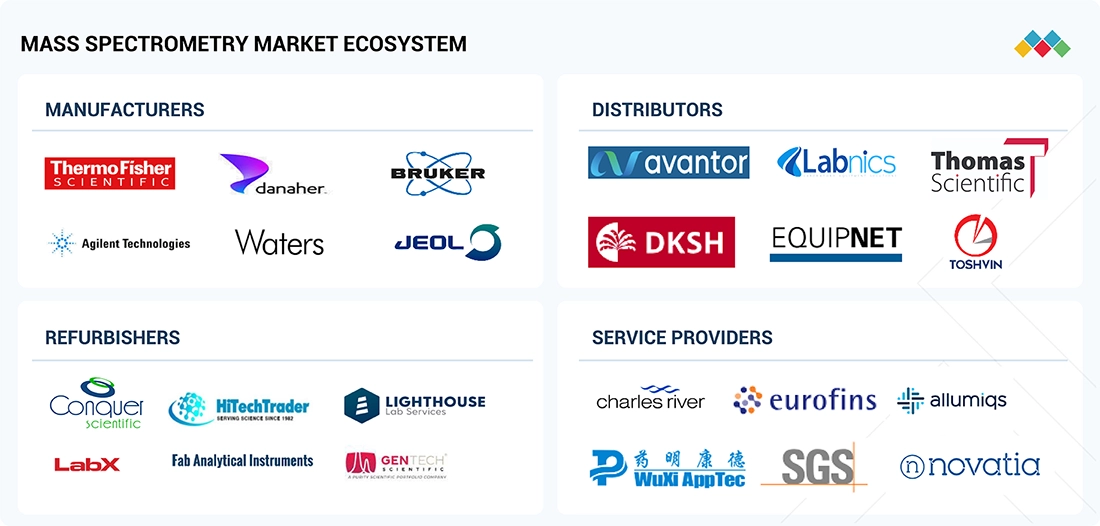
29 Leading Mass Spectrometry Companies Shaping Innovation and Market Growth to 2031
Discover the top 29 companies driving innovation in the mass spectrometry market. This in-depth analysis explores competitive advantages, transformative technologies, and key players poised to influence pharmaceutical research, biotechnology, clinical diagnostics, food safety, environmental monitoring, and proteomics through 2031. Access the comprehensive mass spectrometry market research report for further insights.
Spotlights on the Industry's Top Mass Spectrometry Companies
The mass spectrometry market is evolving through advances in high-resolution instrumentation, tandem mass spectrometry, chromatography coupling, automated sample preparation, and data-processing software. Growing demand for precise molecular identification and quantification is expanding applications across pharmaceutical development, biotechnology, metabolomics, proteomics, food testing, and environmental analysis. Liquid chromatography-mass spectrometry (LC-MS), gas chromatography-mass spectrometry (GC-MS), and inductively coupled plasma-mass spectrometry (ICP-MS) are essential technologies for analyzing complex samples. Manufacturers are increasingly focusing on sensitivity, analytical throughput, reproducibility, workflow automation, and integration with laboratory information systems. According to MarketsandMarkets, the global mass spectrometry market is projected to grow from USD 7.07 billion in 2026 to USD 10.78 billion by 2031, at a CAGR of 8.8%. Competition spans established analytical instrument manufacturers and specialized suppliers serving research laboratories, industrial process monitoring, and targeted analytical applications.
1. Agilent Technologies, Inc.
Agilent Technologies, Inc. is a major analytical instrumentation provider with an extensive mass spectrometry portfolio supporting pharmaceutical research, clinical research, food safety, environmental testing, and chemical analysis. Its offerings include single-quadrupole, triple-quadrupole, quadrupole time-of-flight (Q-TOF), and inductively coupled plasma mass spectrometry systems, alongside chromatography platforms and analytical software. Integration with LC and GC workflows enables laboratories to identify and quantify compounds in complex samples. Agilent's global service network, application expertise, and established laboratory customer base strengthen its competitive position across regulated and research-driven markets.
2. Thermo Fisher Scientific Inc.
Thermo Fisher Scientific Inc. is a leading supplier of analytical instruments and laboratory technologies, offering mass spectrometry solutions for pharmaceutical development, proteomics, metabolomics, clinical research, and environmental analysis. Its portfolio includes Orbitrap-based high-resolution systems, triple-quadrupole instruments, and LC-MS and GC-MS platforms. These technologies support applications ranging from small-molecule quantification to biomolecular characterization and contaminant identification. The company's broad chromatography, sample preparation, software, and laboratory services portfolio enables integrated analytical workflows. Its global distribution and application-support capabilities reinforce its relevance to pharmaceutical, biotechnology, academic, and industrial laboratories.
3. Waters Corporation
Waters Corporation specializes in analytical instruments and software, with mass spectrometry technologies closely integrated with its liquid chromatography portfolio. Its offerings include tandem quadrupole and high-resolution mass spectrometry systems used in pharmaceutical analysis, bioanalysis, metabolomics, food testing, and chemical characterization. The company supports laboratories requiring sensitive quantitative measurements, compound identification, and reproducible analytical methods. Its expertise in chromatography, instrument control, and data interpretation helps customers develop integrated workflows for complex samples. Waters' established presence in pharmaceutical quality control and analytical research contributes to its competitive relevance in the mass spectrometry market.
4. Danaher Corporation
Danaher Corporation is a diversified science and technology group with businesses spanning life sciences, diagnostics, biotechnology, and laboratory equipment. Its relevance to mass spectrometry should be assessed at the operating-company and product-portfolio level rather than assumed from its broader analytical sciences presence. Danaher's laboratory technologies, bioprocessing capabilities, and diagnostic platforms support workflows that can complement mass spectrometry-based research and testing. However, its current direct participation in mass spectrometry instrument manufacturing requires further verification against its operating-company portfolio. Buyers and researchers should distinguish these adjacent capabilities from dedicated mass spectrometry systems when evaluating its competitive position.
5. Bruker Corporation
Bruker Corporation develops advanced scientific instruments, with mass spectrometry technologies supporting life sciences, pharmaceutical research, clinical research, microbiology, and materials analysis. Its portfolio includes MALDI-TOF systems, high-resolution Q-TOF instruments, timsTOF platforms, and other specialized mass spectrometry solutions. These technologies enable applications such as proteomics, molecular identification, spatial biology, and microbial characterization. Bruker's expertise in high-resolution analysis, ion mobility, and specialized research workflows distinguishes its offerings in demanding analytical environments. Its global customer base and continuing development of integrated analytical platforms support its role in research-intensive segments of the market.
6. Shimadzu Corporation
Shimadzu Corporation is a Japanese analytical instrument manufacturer with a broad mass spectrometry portfolio covering pharmaceutical analysis, environmental monitoring, food safety, forensic testing, and chemical research. Its systems include triple-quadrupole LC-MS/MS instruments, quadrupole time-of-flight platforms, GC-MS systems, and gas chromatography tandem mass spectrometry solutions. These instruments support quantitative analysis, compound identification, and trace-level contaminant detection. Shimadzu also integrates chromatography, automation, and analytical software to streamline laboratory workflows. Its international sales and service infrastructure, combined with its experience in precision instrumentation, reinforces its competitiveness across industrial, academic, and regulated testing applications.
7. MKS Instruments, Inc.
MKS Instruments, Inc. develops technologies for advanced manufacturing, semiconductor processing, vacuum systems, and analytical instrumentation. Its relevance to mass spectrometry is associated particularly with analytical and process-monitoring technologies used to characterize gases and support demanding industrial environments. Such capabilities can be important in vacuum process diagnostics, contamination monitoring, and applications requiring precise gas analysis. MKS's broader engineering expertise in pressure measurement, gas delivery, and process control complements these applications. Its direct product-level participation in the wider pharmaceutical and research mass spectrometry market should be distinguished from its specialized industrial analytical technologies.
8. PerkinElmer
PerkinElmer has an established history in analytical instrumentation, including mass spectrometry technologies used in pharmaceutical research, environmental testing, food analysis, and chemical laboratories. Its historical portfolio includes GC-MS and ICP-MS solutions for compound identification, elemental analysis, and contaminant measurement. The PerkinElmer name has undergone corporate and portfolio changes, so current ownership and product availability should be verified when assessing its present market position. Its legacy analytical instrument expertise remains relevant to understanding installed systems and established laboratory workflows, while buyers should confirm current commercial support and product sourcing through the appropriate operating company.
9. JEOL Ltd.
JEOL Ltd. develops scientific instruments for analytical chemistry, materials science, biotechnology, and advanced research. Its mass spectrometry portfolio includes high-resolution time-of-flight and other specialized systems designed for applications such as organic compound characterization, polymer analysis, and biomolecular research. JEOL's instrument engineering capabilities support demanding analytical tasks where accurate mass measurement and detailed structural information are important. The company also has expertise in electron microscopy and nuclear magnetic resonance systems, providing complementary technologies for scientific characterization. Its specialized product range and research-oriented customer base support its position in advanced analytical instrumentation.
10. Hitachi High-Tech Corporation
Hitachi High-Tech Corporation supplies analytical and scientific instruments for materials research, industrial analysis, healthcare, and advanced manufacturing. Its expertise in mass spectrometry is particularly associated with specialized analytical applications, including surface analysis and secondary ion mass spectrometry through relevant instrument technologies. These techniques help characterize elemental composition, chemical species, and material surfaces in semiconductor, electronics, and materials research environments. The company's broader portfolio also includes electron microscopes and elemental analyzers. Its relevance to the mass spectrometry market is strongest in specialized materials and industrial applications, rather than across every mainstream LC-MS and GC-MS segment.
11. Teledyne Technologies Incorporated
Teledyne Technologies Incorporated operates across instrumentation, digital imaging, aerospace, and industrial technologies, with analytical instrument businesses serving environmental, scientific, and industrial applications. Its mass spectrometry-related capabilities are associated with specialized analytical systems and technologies used in selected process and measurement environments. Such solutions can support gas analysis, monitoring, and scientific investigation where reliable detection and characterization are required. Teledyne's wider instrumentation expertise and industrial customer relationships provide relevant adjacent capabilities. Its specific competitive role should be evaluated against the current product portfolios of its operating businesses and their direct involvement in mass spectrometry instrumentation.
12. AMETEK, Inc.
AMETEK, Inc. is a global manufacturer of electronic instruments and electromechanical products, with analytical instrumentation serving industrial, laboratory, and process applications. Through its specialized instrumentation businesses, the company participates in analytical measurement technologies that can complement mass spectrometry-based testing and monitoring. Its broader capabilities include precision measurement, process analysis, and equipment designed for demanding operating environments. These strengths are relevant where analytical performance, reliability, and integration into industrial workflows are important. However, specific mass spectrometry products and their market positioning should be verified at the relevant business-unit level to distinguish direct instrument offerings from adjacent analytical technologies.
13. JASCO Corporation
JASCO Corporation develops analytical instruments for spectroscopy, chromatography, and scientific research. Its portfolio is particularly recognized for optical spectroscopy and chromatographic systems, which can complement mass spectrometry in compound identification and characterization workflows. These technologies support pharmaceutical research, chemical analysis, biotechnology, and materials science. JASCO's established expertise in analytical measurement and laboratory instrumentation makes it relevant to the broader analytical sciences ecosystem. However, its direct participation in mass spectrometry instrument manufacturing should be verified against current product documentation. Its role should not be conflated with that of dedicated manufacturers of tandem mass spectrometers or high-resolution MS platforms.
14. F. Hoffmann-La Roche Ltd.
F. Hoffmann-La Roche Ltd. is a global pharmaceutical and diagnostics company with substantial activities in drug development, clinical testing, and personalized healthcare. Mass spectrometry is relevant to these areas through its use in biomarker research, therapeutic drug monitoring, molecular characterization, and specialized clinical laboratory workflows. Roche's broader diagnostic and pharmaceutical capabilities provide an important application-side connection to the technology. However, the company should not automatically be classified as a direct mass spectrometry instrument manufacturer. Its competitive relevance is better assessed through documented mass spectrometry-based assays, research applications, and diagnostic workflows within its current business portfolio.
15. Analytik Jena GmbH+Co. KG
Analytik Jena GmbH+Co. KG develops analytical measurement technologies and laboratory solutions for chemical analysis, life sciences, environmental testing, and quality control. Its established instrument portfolio includes elemental analysis and sample preparation technologies that can support workflows associated with mass spectrometry. These capabilities are relevant to laboratories preparing samples for trace-element measurement, contamination analysis, and other demanding analytical procedures. The company's role should be distinguished from that of manufacturers offering extensive standalone mass spectrometry platforms. Its market relevance depends on the specific instruments and complementary technologies included in the applicable market definition, as well as current product availability and ownership.
16. Hiden Analytical
Hiden Analytical specializes in mass spectrometry systems for gas analysis, residual gas analysis, surface science, plasma diagnostics, catalysis, and process monitoring. Its portfolio includes quadrupole mass spectrometers and application-specific analytical systems designed to characterize gases, vapors, ions, and surface species. These technologies support research in vacuum environments, semiconductor processing, electrochemistry, materials science, and industrial process development. Hiden's specialization in demanding measurement conditions differentiates it from suppliers focused primarily on routine pharmaceutical LC-MS/MS. Its application-oriented engineering, configurable systems, and technical expertise support its role in specialized mass spectrometry segments.
17. LECO Corporation
LECO Corporation develops analytical instruments for elemental analysis, materials characterization, and advanced chemical testing. Its mass spectrometry-related capabilities include time-of-flight mass spectrometry used in applications such as comprehensive two-dimensional gas chromatography coupled with time-of-flight mass spectrometry (GC×GC-TOFMS). These systems support the separation and identification of complex mixtures in food, environmental, petrochemical, fragrance, and other analytical applications. LECO's combination of separation science, detection technology, and specialized data-processing capabilities helps laboratories investigate samples containing numerous compounds. Its established presence in industrial and research laboratories supports its relevance to specialized mass spectrometry workflows.
18. Rigaku Holdings Corporation
Rigaku Holdings Corporation develops analytical and scientific instruments used in materials research, pharmaceutical development, semiconductor manufacturing, and industrial quality control. Its principal expertise includes X-ray analytical technologies, crystallography, and elemental analysis, which can complement mass spectrometry in broader chemical and materials characterization workflows. These capabilities help laboratories investigate composition, structure, and material properties using different analytical techniques. However, Rigaku's direct role in mass spectrometry instrument manufacturing should be verified against current product documentation before assigning it a position among dedicated mass spectrometry suppliers. Its relevance is strongest where complementary analytical methods support integrated laboratory research and testing.
19. Youngin Chromass
Youngin Chromass is associated with analytical instrumentation and chromatography-mass spectrometry solutions serving laboratory analysis and research applications. Its relevance includes systems and related technologies intended to support compound separation, identification, and quantification. Depending on the product configuration and regional portfolio, such solutions can address pharmaceutical analysis, chemical testing, and other applications requiring reliable analytical measurements. The company's position should be assessed using current manufacturer documentation, instrument specifications, and distribution information. Verification of its available LC-MS and GC-MS systems, technical support capabilities, and geographic presence is important when comparing it with larger multinational analytical instrument suppliers.
20. SCION Instruments
SCION Instruments supplies chromatography systems and mass spectrometry solutions for analytical laboratories. Its portfolio includes single-quadrupole and triple-quadrupole GC-MS instruments designed for applications requiring compound identification and quantitative analysis. These systems can support environmental testing, petrochemical analysis, food safety, and routine chemical laboratories. Integration with gas chromatography enables users to separate complex mixtures before mass-based detection, improving analytical specificity. SCION's focus on practical laboratory performance and established GC workflows makes it relevant to laboratories seeking targeted analytical solutions. Its competitive position is shaped by instrument capabilities, application support, and compatibility with existing laboratory methods.
21. Kore Technology
Kore Technology specializes in mass spectrometry and related analytical systems for research, industrial analysis, and specialized measurement applications. Its technologies include time-of-flight mass spectrometry and systems designed for applications involving molecular analysis, surface characterization, and advanced analytical research. Such capabilities can be useful when conventional chromatography-based methods do not fully address sample complexity or measurement requirements. Kore Technology's emphasis on specialized instrumentation differentiates it from suppliers whose portfolios concentrate on routine pharmaceutical testing. Its market relevance depends on the requirements of individual applications, including sensitivity, mass range, sample introduction, and integration with complementary analytical techniques.
22. Process Insights, Inc.
Process Insights, Inc. provides analytical measurement technologies for industrial process monitoring, environmental applications, and quality assurance. Its portfolio spans specialized analyzers and measurement systems designed to help users monitor gases, liquids, and industrial processes. Mass spectrometry-related relevance should be established through the specific product lines and operating businesses included in its current portfolio, particularly where gas analysis or process monitoring is involved. These applications differ from high-throughput LC-MS/MS used in pharmaceutical bioanalysis. Evaluating Process Insights requires attention to product-level capabilities, detection methods, and target industries rather than assuming that all its analytical instruments are mass spectrometers.
23. MassTech
MassTech develops mass spectrometry instrumentation and specialized analytical solutions for scientific research. Its technologies are associated with ionization methods, mass spectrometry interfaces, and systems used to investigate complex chemical and biological samples. These capabilities can support research in proteomics, biomolecular analysis, and analytical chemistry, depending on the instrument configuration. MassTech's specialized focus provides an alternative to the broad instrument portfolios of larger suppliers, particularly for laboratories pursuing specific analytical approaches. Its competitive relevance depends on demonstrated instrument performance, application compatibility, technical support, and the availability of validated methods for the intended research or testing environment.
24. Advion, Inc.
Advion, Inc., associated with Advion Interchim Scientific, supplies analytical instrumentation and laboratory technologies, including compact mass spectrometry systems and chromatography-related solutions. Its expression CMS product family supports rapid mass-based analysis in chemical synthesis, pharmaceutical research, and laboratory workflows where timely compound identification is important. The company's approach emphasizes accessibility, practical operation, and integration with complementary analytical techniques. These characteristics make its systems relevant to medicinal chemistry, academic research, and smaller laboratories seeking mass spectrometry capabilities for routine investigations. Its specialized product offerings complement the broader portfolios of manufacturers focused on high-resolution and high-throughput analytical platforms.
25. Spetec Technology AG
Spetec Technology AG provides laboratory equipment and technologies associated with analytical environments, including solutions for sample handling and contamination control. Such capabilities can support the reliability of laboratory workflows that incorporate mass spectrometry, particularly where sample integrity and controlled operating conditions are important. However, its direct involvement in manufacturing mass spectrometry instruments should be confirmed through current product documentation before it is positioned as a core instrument supplier. Evaluating its role requires distinguishing complementary laboratory technologies from systems that perform mass-to-charge analysis. This distinction helps buyers and researchers assess its relevance accurately within the market's competitive landscape.
26. Elementar Analysensysteme GmbH
Elementar Analysensysteme GmbH specializes in analytical instrumentation for elemental analysis, isotope ratio analysis, and stable isotope research. Its portfolio includes isotope ratio mass spectrometry (IRMS) systems used in environmental studies, food authenticity testing, agricultural research, forensics, and geochemical investigations. These instruments help laboratories measure isotope ratios to investigate sample origin, authenticity, and environmental processes. Elementar's expertise in elemental analysis and isotope measurement distinguishes it from suppliers focused primarily on LC-MS/MS for drug development. Its application-specific systems and technical knowledge support its position in specialized analytical segments where isotope information provides additional scientific or commercial value.
27. Skyray Instruments USA, Inc.
Skyray Instruments USA, Inc. is associated with analytical instruments for elemental composition, environmental monitoring, industrial quality control, and laboratory testing. Its broader instrument portfolio includes technologies such as X-ray fluorescence and other elemental analysis solutions, which serve applications that may overlap with mass spectrometry in analytical testing but rely on different measurement principles. Its direct participation in mass spectrometry should be verified through current product specifications and official company materials. Where applicable, its relevance depends on the availability of dedicated mass spectrometry systems rather than its broader presence in analytical instrumentation and elemental measurement.
28. Microsaic
Microsaic is known for developing compact mass spectrometry technologies designed to support analytical workflows in pharmaceutical research, chemical synthesis, and process development. Its microengineered systems aim to make mass spectrometry more accessible for applications where rapid analysis and reduced instrument footprint are valuable. Compact analytical platforms can help researchers monitor reactions, identify compounds, and investigate samples closer to the point of production or use. The company's market position is linked to miniaturized instrumentation and application-specific integration. Its current commercial status, product availability, and ownership should be verified before making claims about its active market presence or competitive scale.
29. Pfeiffer Vacuum+Fab Solutions
Pfeiffer Vacuum+Fab Solutions provides vacuum technology, leak detection, gas analysis, and related equipment for semiconductor manufacturing, research, and industrial applications. Its residual gas analysis and quadrupole mass spectrometry-related technologies support the identification of gases in vacuum systems, contamination monitoring, and process diagnostics. These capabilities are particularly relevant to semiconductor fabrication, coating processes, and scientific equipment operating under controlled vacuum conditions. The company's expertise in vacuum engineering and gas measurement differentiates its offering from mass spectrometry platforms primarily designed for pharmaceutical bioanalysis. Its specialized instrumentation contributes to industrial and process-oriented segments of the broader market.
80% of the Forbes Global 2000 B2B companies rely on MarketsandMarkets to identify growth opportunities in emerging technologies and use cases that will have a positive revenue impact.
- Food Packaging Market Size Set for Strong Growth Through 2030 Amid Rising Demand for Convenience Foods
- Crop Protection Chemical Market Size, Share & Growth Forecast (2025–2030)
- Mulch Films Market: Driving Sustainable Agriculture Through Innovation
- Agricultural Adjuvants Market Analysis, Trends, and Growth Outlook (2026–2031)
- Japan Enterprise Asset Management Market Growth: AI and Smart Infrastructure Drive Demand

The mass spectrometry market is positioned for continued expansion as pharmaceutical and biotechnology research, precision analytical testing, food safety requirements, environmental monitoring, and multi-omics research increase demand for advanced measurement technologies. High-resolution mass spectrometry, tandem MS, improved chromatography integration, automated sample preparation, and sophisticated data analysis are shaping product development and competition. Manufacturers must also address analytical reproducibility, laboratory data integrity, validation requirements, instrument lifecycle costs, and evolving regulatory expectations in pharmaceutical and clinical applications. Opportunities span established instrument platforms, specialized analytical systems, software, services, and integrated laboratory workflows. Understanding the differences between direct instrument manufacturers, specialized technology providers, and companies with complementary analytical capabilities is essential for evaluating the competitive landscape. For detailed market sizing, segment analysis, competitive assessments, and strategic opportunities, explore the full report, Mass Spectrometry Market by Product [Instrument (Triple Quadrupole, Q-TOF, FTMS, Quadrupole, TOF), Software, Services], Inlet Type (LC-MS, GC-MS, ICP-MS, Other Inlet Types), Application (Omics, Drug Discovery, Food, Environmental), End User (Pharma, Biotech) - Global Forecast to 2031.