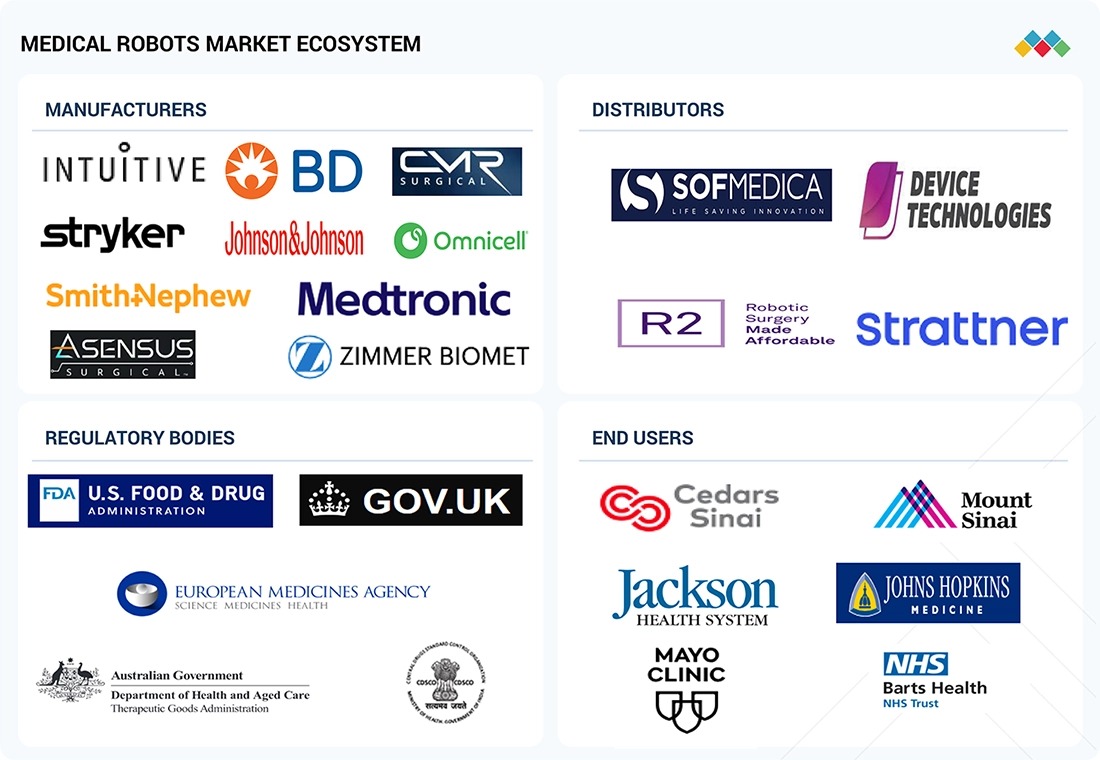
25 Leading Medical Robots Companies Shaping Innovation and Market Growth to 2031
Discover the top 25 companies driving innovation in the medical robots market. This in-depth analysis explores competitive advantages, transformative trends, and key players poised to influence surgical procedures, rehabilitation, hospital automation, and patient care through 2031. Access the comprehensive market research report here for further insights.
Spotlights on the Industry's Top Medical Robots Market Companies
The medical robots market is evolving rapidly as healthcare providers increasingly adopt robotic-assisted surgery, rehabilitation exoskeletons, automated pharmacy systems, autonomous mobile robots, and image-guided treatment technologies. Advances in artificial intelligence, computer-assisted navigation, machine vision, and precision instrumentation are expanding the potential applications of medical robotics. Competition is shaped by clinical performance, workflow integration, regulatory clearances, system reliability, and the cost of implementation. Companies across surgical robotics, rehabilitation, radiation therapy, and hospital logistics are contributing to the industry's development.
1. INTUITIVE SURGICAL, INC.
Intuitive Surgical is a prominent developer of robotic-assisted minimally invasive surgery technologies. Its da Vinci surgical systems integrate robotic instruments, high-definition three-dimensional visualization, and surgeon-controlled movements to support complex procedures across multiple specialties. The company also offers instruments, accessories, and services that support its installed systems. Its established clinical ecosystem, training programs, and continued development of surgical platforms position it as an influential participant in the medical robots market.
2. STRYKER
Stryker participates in medical robotics through its Mako SmartRobotics platform, which supports robotic-assisted orthopedic procedures, including hip and knee replacement. The technology combines preoperative planning, imaging-based guidance, and robotic-arm assistance to help surgeons execute planned bone preparation. Stryker's orthopedic implants, surgical instruments, and hospital technology portfolio complement its robotics business. Its established healthcare relationships and integrated approach to surgical planning and execution strengthen its position in the orthopedic robotics segment.
3. BD
BD (Becton, Dickinson and Company) contributes to healthcare automation through technologies used in medication management, dispensing, and pharmacy workflows. Its automated medication dispensing and related systems support hospitals in managing medication distribution and improving operational consistency. Although BD's portfolio spans a much broader range of medical devices and diagnostic products, its automation capabilities are relevant to the hospital and pharmacy robotics ecosystem. Its installed healthcare technology base provides opportunities to integrate automation into clinical and medication-management processes.
4. MEDTRONIC
Medtronic develops robotic-assisted surgical technologies, including the Hugo robotic-assisted surgery system for soft-tissue procedures and robotic guidance technologies for spine surgery. Its portfolio combines surgical instrumentation, navigation, planning software, and digital technologies designed to support minimally invasive interventions. The company serves healthcare providers across multiple specialties and geographies. Its experience in surgical devices and clinical workflow integration supports its role in advancing robotic-assisted procedures and precision-driven surgical care.
5. OMNICELL, INC.
Omnicell specializes in medication management and pharmacy automation solutions for healthcare organizations. Its technologies include automated dispensing cabinets, medication packaging systems, and pharmacy automation platforms designed to streamline medication handling and distribution. These solutions support hospital and health-system workflows, helping staff manage inventory and medication access. While its portfolio is primarily focused on automation rather than surgical robotics, Omnicell is relevant to the medical robots market through the growing adoption of automated pharmacy operations and technology-enabled medication management.
6. ZIMMER BIOMET
Zimmer Biomet is a medical technology company with a significant presence in robotic-assisted orthopedic surgery through its ROSA robotics portfolio. ROSA systems support procedures involving the knee, hip, and other orthopedic applications, depending on the platform and indication. By combining surgical planning, anatomical information, and robotic assistance, the technology helps surgeons execute procedure-specific plans. Zimmer Biomet's orthopedic implants, digital planning capabilities, and relationships with orthopedic specialists reinforce its role in the development of technology-enabled joint replacement and surgical care.
7. SMITH+NEPHEW
Smith+Nephew participates in surgical robotics through its CORI Surgical System, designed to support robotic-assisted knee procedures. The platform uses handheld robotic technology and intraoperative planning to assist surgeons with bone preparation and implant positioning. Its approach is intended to provide flexibility within the operating room while supporting personalized surgical execution. The company's broader orthopedic reconstruction and sports medicine portfolio complements its robotics offering, making it relevant to the development of precision-focused orthopedic procedures and technology-assisted joint replacement.
8. EKSO BIONICS
Ekso Bionics develops wearable robotic exoskeletons for rehabilitation and mobility assistance. Its EksoNR system is designed for clinical rehabilitation, supporting gait training for people recovering from neurological injuries and conditions, while its Ekso Indego products address additional mobility applications. These technologies enable therapists to deliver repetitive, task-oriented movement training and assist users with standing and walking. The company's specialization in powered exoskeletons places it within the rehabilitation robotics segment. Ekso Bionics has joined forces with Wandercraft, making current corporate ownership and portfolio developments relevant when evaluating its market position.
9. ARXIUM
ARxIUM develops automated pharmacy systems that help healthcare organizations improve medication preparation, dispensing, packaging, and distribution workflows. Its portfolio includes technologies for central pharmacy operations and medication management, supporting hospitals and other healthcare facilities seeking greater operational efficiency. Although its focus is pharmacy automation rather than robotic surgery, its solutions align with the medical robots market's hospital and pharmacy automation segment. Its relevance stems from the increasing role of automated equipment in medication handling, inventory management, and pharmacy workflow standardization.
10. ASENSUS SURGICAL US, INC. (SUBSIDIARY OF KARL STORZ)
Asensus Surgical developed the Senhance Surgical System, a robotic-assisted platform for minimally invasive surgery that incorporated reusable instruments, eye-tracking control, and digital surgical capabilities. The company also developed its Intelligent Surgical Unit to provide real-time intraoperative insights. Asensus has been integrated into KARL STORZ, and the Senhance system is being discontinued, with customer support and transition activities communicated through the company. Its technologies remain relevant to the history of digital surgery, but current product availability and corporate integration should be considered when assessing its competitive position.
11. RENISHAW PLC
Renishaw is an engineering and precision technology company with capabilities relevant to medical robotics, particularly in neurosurgical planning and stereotactic procedures. Its neurosurgical technologies have included systems for image-guided planning and precise positioning during interventions. The company's expertise in metrology, motion control, and precision engineering supports applications where accurate localization and repeatable mechanical performance are essential. Renishaw's medical technology activities extend beyond conventional robotic surgery, making it relevant to specialized image-guided and precision-treatment applications within the broader medical robotics landscape.
12. SIEMENS HEALTHINEERS AG
Siemens Healthineers contributes to image-guided interventions through medical imaging, angiography, and technologies associated with robotic-assisted endovascular procedures. Its acquisition of Corindus expanded its capabilities in robotic-assisted vascular interventions, including remote-controlled systems designed to support catheter-based procedures. The integration of imaging and intervention technologies is important for precision-driven treatment in cardiovascular care. Siemens Healthineers' global imaging and healthcare technology presence provides a strong platform for developing connected clinical environments in which robotics, visualization, and procedural guidance work together.
13. KUKA AG
KUKA is an industrial automation and robotics company whose robotic arms and control technologies can support specialized medical and healthcare applications. Its expertise in motion control, automation engineering, and robotic system integration is relevant to research, laboratory automation, medical manufacturing, and selected image-guided or treatment-related applications. KUKA is not exclusively a medical robotics company, and its involvement varies by application and system integration. Its contribution to the broader market comes from providing robotics technologies that can be adapted to precision-oriented healthcare environments.
14. CMR SURGICAL
CMR Surgical develops the Versius robotic surgical system for minimally invasive procedures. The platform uses modular robotic arms and a surgeon console, with an emphasis on flexibility in operating-room configuration and integration into surgical workflows. Its technology is designed to support procedures across multiple specialties, subject to local regulatory approvals and indications. CMR Surgical's focus on accessible, adaptable robotic-assisted surgery makes it a notable participant in the soft-tissue surgical robotics segment. Its strategic alliance with Stryker is also relevant to its commercial reach and market development.
15. ACCURAY INCORPORATED
Accuray develops robotic and image-guided radiation therapy systems used in cancer treatment. Its CyberKnife platform combines robotic positioning with image guidance to deliver highly targeted radiation, while the Radixact system supports advanced radiation therapy delivery. These technologies allow treatment teams to manage complex targeting requirements and adapt treatment delivery to clinical needs. Although radiation therapy robotics differs from surgical robotics, it is an important medical robotics application because it combines precision motion, imaging, and computerized treatment planning for oncology care.
16. DIH MEDICAL
DIH Medical focuses on rehabilitation and human performance technologies, including robotic-assisted gait and movement training systems. Its portfolio has included solutions associated with Hocoma and other rehabilitation technology brands, serving hospitals, clinics, and specialized rehabilitation centers. These systems support structured therapy for patients recovering from neurological injuries, mobility impairments, and other conditions affecting movement. By combining robotic assistance, movement analysis, and rehabilitation workflows, DIH Medical contributes to the development of technology-enabled therapy and functional recovery across the rehabilitation robotics market.
17. JOHNSON & JOHNSON
Johnson & Johnson has pursued surgical robotics through its MedTech business, including the development of the OTTAVA surgical robotic system. Its broader surgical portfolio includes devices, instruments, and technologies used across multiple procedural specialties. The company's established clinical relationships and experience in surgical innovation provide a foundation for developing robotic-assisted approaches. As surgical robotics programs evolve through development, testing, and regulatory processes, product availability and approved indications should be verified before drawing conclusions about their commercial contribution to the medical robots market.
18. CYBERDYNE INC.
CYBERDYNE develops robotic and cybernics technologies for rehabilitation and mobility support. Its Hybrid Assistive Limb (HAL) systems use bioelectrical signals and other sensor information to assist voluntary movement during rehabilitation and related applications. The company's medical technologies are designed to support gait training and movement recovery for selected patient populations, while other products address caregiver support and mobility assistance. CYBERDYNE's integration of wearable robotics, human-machine interaction, and rehabilitation-focused engineering makes it a distinctive participant in the medical exoskeleton and assistive robotics segments.
19. LIFEWARD, INC.
Lifeward develops rehabilitation and mobility technologies, including wearable robotic exoskeletons designed to support walking and movement for people with mobility impairments. Its portfolio includes the ReWalk systems, which are intended to assist eligible users with standing and walking, as well as other rehabilitation and physical medicine technologies. The company's focus on restoring mobility and supporting functional independence connects it to the rehabilitation robotics market. Clinical suitability, regulatory authorization, reimbursement, and access to specialized training remain important considerations for the adoption of these technologies.
20. GLOBUS MEDICAL
Globus Medical develops surgical technologies for musculoskeletal care, including its Excelsius robotic navigation and guidance platforms for spine surgery. These systems combine planning, navigation, and robotic assistance to support accurate placement of surgical instruments and implants during spinal procedures. The company also supplies implants, instruments, and related technologies used in spine and orthopedic care. Its integrated portfolio connects robotic guidance with established surgical workflows, positioning Globus Medical as an important participant in the development of precision-oriented spine surgery and technology-assisted procedures.
21. RELAY ROBOTICS, INC.
Relay Robotics develops autonomous mobile robots designed for service and delivery tasks in healthcare and other environments. In hospitals, delivery robots can help transport supplies, medications, meals, and other items between departments, subject to facility workflows and deployment configurations. These systems are intended to reduce routine transport demands on staff and support more efficient operations. Relay Robotics is relevant to the medical robots market through hospital service automation rather than direct patient treatment, reflecting the growing use of autonomous robots in healthcare logistics.
22. PROCEPT BIOROBOTICS CORPORATION
PROCEPT BioRobotics develops robotic-assisted technologies for urological surgery, with its AQUABEAM system using image guidance and high-velocity waterjet technology for Aquablation therapy in men with benign prostatic hyperplasia. The system combines treatment planning and robotic execution to support a procedure designed to remove prostate tissue while limiting reliance on thermal energy. Its specialized focus on urology differentiates it from general-purpose surgical robotics developers. Clinical evidence, regulatory approvals, and adoption among urologists are important factors shaping the company's role in this market segment.
23. AETHON, INC. (SUBSIDIARY OF ST ENGINEERING)
Aethon develops autonomous mobile robots for healthcare logistics, including its TUG robot platform. These robots are designed to transport medications, laboratory specimens, meals, linens, waste, and other materials within hospitals and healthcare facilities. By automating repetitive internal deliveries, Aethon solutions can help healthcare teams reduce manual transport tasks and improve workflow consistency. Aethon's hospital-focused applications illustrate the operational side of medical robotics, where autonomous navigation and fleet coordination support staff productivity rather than direct surgical or therapeutic intervention.
24. XENEX DISINFECTION SERVICES INC.
Xenex Disinfection Services develops pulsed-xenon ultraviolet disinfection robots for healthcare environments. Its LightStrike systems are designed to supplement routine cleaning protocols by applying ultraviolet light to help reduce microbial contamination on exposed surfaces in patient rooms and other spaces. The robots support infection prevention and room-turnover workflows when used according to validated procedures. Xenex occupies a specialized position within the medical robotics market because its technology focuses on environmental hygiene and hospital safety rather than surgery, rehabilitation, or medication management.
25. ZAP SURGICAL SYSTEMS, INC.
ZAP Surgical Systems develops image-guided radiosurgery technology, including the ZAP-X platform for non-invasive stereotactic radiosurgery, particularly for certain brain and head conditions. The system incorporates a gyroscopic radiation delivery design intended to direct high-dose radiation to targeted tissue while limiting exposure to surrounding structures. Its role in the medical robotics ecosystem lies in precision radiation delivery rather than conventional instrument-based surgery. Clinical indications, regulatory authorizations, treatment planning, and access to specialized facilities influence the adoption of this technology in radiosurgery.
80% of the Forbes Global 2000 B2B companies rely on MarketsandMarkets to identify growth opportunities in emerging technologies and use cases that will have a positive revenue impact.
- Food Packaging Market Size Set for Strong Growth Through 2030 Amid Rising Demand for Convenience Foods
- Crop Protection Chemical Market Size, Share & Growth Forecast (2025–2030)
- Mulch Films Market: Driving Sustainable Agriculture Through Innovation
- Agricultural Adjuvants Market Analysis, Trends, and Growth Outlook (2026–2031)
- Japan Enterprise Asset Management Market Growth: AI and Smart Infrastructure Drive Demand

The medical robots market is expected to continue evolving as healthcare providers seek greater procedural precision, improved operational efficiency, and technology-enabled treatment options. Surgical robotics, orthopedic navigation, rehabilitation exoskeletons, automated pharmacy systems, autonomous hospital logistics, and robotic radiation therapy represent distinct opportunities within this diverse industry. Future adoption will depend on clinical outcomes, regulatory approvals, integration with existing healthcare infrastructure, training requirements, reimbursement, and the total cost of ownership. To understand the market's competitive landscape, product segments, end-user opportunities, and regional developments, explore the full report: Medical Robots Market by Product & Services (Instruments & Accessories, Robotic Systems, Services), Type (Surgical (General, Gynecological, Urological, Knee & Hip, Spine), Rehabilitation, Hospital, Pharmacy), End User, and Region - Global Forecasts to 2031.