26 Leading Microscopy Software Companies Shaping Innovation and Market Growth to 2031
Discover the top 26 companies driving innovation in the microscopy software market. This in-depth analysis explores competitive advantages, transformative trends, and key players poised to influence life sciences research, clinical diagnostics, pharmaceutical development, materials science, and digital microscopy through 2031. Access the comprehensive market research report for further insights.
Spotlights on the Industry's Top Microscopy Software Companies
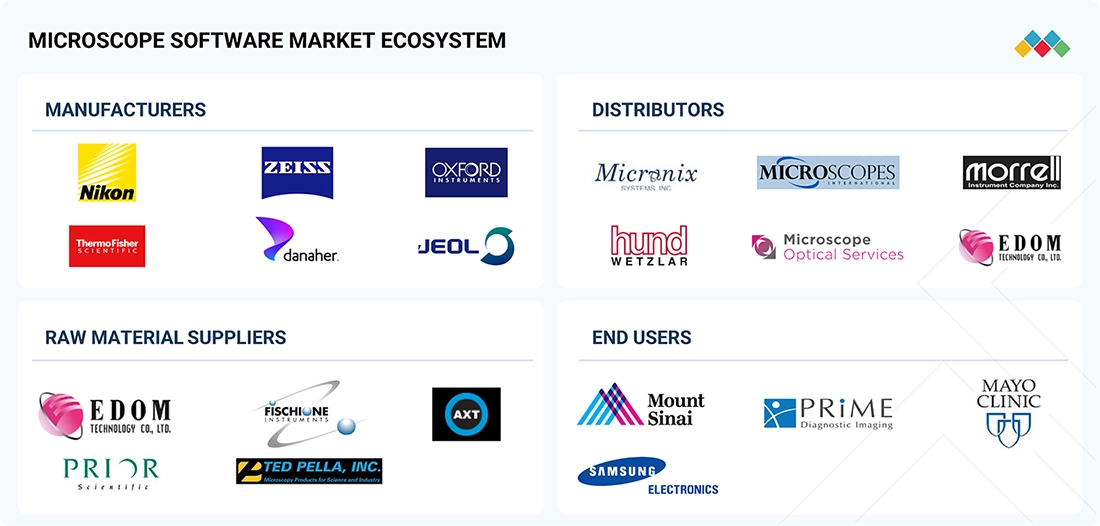
The microscopy software market is evolving as laboratories increasingly adopt digital imaging, automated image acquisition, advanced visualization, and computational image analysis. Software platforms now support workflows spanning optical microscopy, electron microscopy, Raman microscopy, and atomic force microscopy, helping researchers extract quantitative insights from increasingly complex datasets.
Growing demand for digital pathology, high-content imaging, three-dimensional reconstruction, and AI-assisted image analysis is encouraging vendors to develop integrated software environments. Cloud-enabled data management, instrument automation, image segmentation, and reproducible analysis are also becoming important capabilities. Competition includes microscopy manufacturers offering proprietary software, specialist image-analysis developers, and companies providing applications for cell biology, diagnostics, neuroscience, materials research, and pharmaceutical discovery. Interoperability, data security, analytical accuracy, and compatibility with existing laboratory infrastructure remain important purchasing considerations.
1. Carl Zeiss AG
Carl Zeiss AG develops microscopy systems and software for life sciences, clinical research, and materials analysis. Its microscopy software ecosystem includes ZEN, which supports image acquisition, microscope control, visualization, and image analysis across compatible ZEISS instruments. These capabilities help researchers manage complex imaging workflows, quantify biological structures, and examine material properties. The company's integration of optics, imaging hardware, and software supports coordinated laboratory workflows. Its software is particularly relevant to facilities seeking instrument-specific acquisition tools alongside advanced microscopy image processing and analysis.
2. Thermo Fisher Scientific Inc.
Thermo Fisher Scientific Inc. supplies microscopy instruments and related software for biological research, pharmaceutical development, and materials science. Through its electron microscopy portfolio, including products associated with the Thermo Scientific brand, the company offers software for instrument operation, image acquisition, visualization, and analytical workflows. Its broader scientific equipment ecosystem supports research laboratories that require coordinated imaging and data analysis. Software capabilities vary by instrument family and application, with particular relevance to electron microscopy, structural characterization, and workflows involving detailed examination of biological specimens and advanced materials.
3. Danaher Corporation
Danaher Corporation participates in the microscopy software landscape through its life sciences and diagnostics businesses, including Leica Microsystems and Molecular Devices. Leica Microsystems provides software for microscopy acquisition, instrument control, visualization, and image analysis, while Molecular Devices offers imaging and analysis solutions for cellular research. These capabilities serve applications in cell biology, drug discovery, and advanced imaging. Danaher's relevance stems from its portfolio of specialized businesses rather than a single unified microscopy software platform. Individual product capabilities and compatibility depend on the operating company and instrument configuration.
4. Evident
Evident develops microscopy systems and software for life sciences, clinical applications, and industrial inspection. Its imaging software supports microscope operation, image acquisition, processing, measurement, and documentation across compatible systems. These tools help laboratories examine cellular structures, quantify specimens, and analyze materials with consistent imaging workflows. Evident's combination of optical microscopy expertise and application-oriented software makes it relevant to laboratories seeking integrated imaging solutions. Its software capabilities vary across product families, so users should assess instrument compatibility, analysis functions, data export options, and automation requirements before implementation.
5. Nikon Corporation
Nikon Corporation develops optical microscopes and software for scientific imaging, industrial applications, and life sciences research. Its NIS-Elements software supports microscope control, image acquisition, processing, measurement, and analysis, with capabilities varying by configuration. The platform can facilitate multidimensional imaging, automated acquisition, and quantitative analysis in compatible microscopy workflows. Nikon's combination of optical engineering and software integration is relevant to researchers working in cell biology, neuroscience, and advanced imaging. Laboratories can evaluate its software based on automation needs, image-analysis functions, instrument compatibility, and workflow reproducibility.
6. JEOL Ltd.
JEOL Ltd. manufactures electron microscopes and scientific instruments used in materials science, semiconductor analysis, and biological research. Its microscopy systems use dedicated software for instrument control, image acquisition, visualization, and analytical functions associated with electron microscopy. These tools help users inspect fine structures and analyze specimens at high resolution. JEOL's software is closely linked to its instrument ecosystem, supporting workflows involving scanning and transmission electron microscopy. Its relevance to the microscopy software market is strongest in specialized electron imaging and analysis, where instrument compatibility and application-specific capabilities are essential.
7. Hitachi High-Tech Corporation
Hitachi High-Tech Corporation supplies electron microscopes, analytical instruments, and related software for scientific research and industrial applications. Its microscopy software supports instrument operation, image capture, observation, and analytical workflows across compatible scanning and transmission electron microscopy systems. These tools are used to investigate materials, semiconductor structures, biological specimens, and other microscopic features. The company's instrumentation expertise and application-focused solutions support its position in electron microscopy software. Buyers should compare software functions by instrument model, including image processing, measurement capabilities, data management, and integration with analytical detectors.
8. Oxford Instruments
Oxford Instruments develops scientific instrumentation and software for microscopy, materials characterization, and nanotechnology research. Its microscopy-related portfolio includes solutions for electron microscopy and analytical techniques such as energy-dispersive X-ray spectroscopy and electron backscatter diffraction. Associated software supports acquisition, processing, visualization, and interpretation of analytical imaging data. These capabilities help researchers characterize material composition, crystal structure, and microstructural properties. Oxford Instruments is relevant to specialist microscopy workflows in academic, industrial, and semiconductor laboratories, particularly where imaging software must coordinate with analytical detectors and materials-analysis systems.
9. Shimadzu Corporation
Shimadzu Corporation supplies analytical instruments and measurement technologies used in pharmaceutical research, life sciences, and materials analysis. Its broader portfolio includes microscopy-related analytical systems and software for data acquisition, visualization, and interpretation. However, its direct participation in dedicated microscopy software depends on the specific instrument and application being considered. The company is best assessed through its verified microscopy and imaging-related offerings rather than its entire analytical instrument portfolio. Laboratories evaluating Shimadzu should confirm whether particular software supports microscope control, image analysis, or an adjacent analytical workflow relevant to their needs.
10. Bruker
Bruker develops scientific instruments and software for advanced microscopy, molecular analysis, and materials characterization. Its portfolio includes atomic force microscopy and other specialized imaging technologies supported by software for instrument control, image visualization, measurement, and quantitative analysis. These capabilities help researchers examine surface topography, nanoscale properties, and material behavior. Bruker's expertise in high-resolution measurement makes it relevant to microscopy software used in nanotechnology, materials science, and selected life sciences applications. Software functionality and data-analysis options depend on the specific microscopy platform and the measurements being performed.
11. HORIBA Ltd.
HORIBA Ltd. develops analytical instruments and spectroscopy technologies used in scientific research, industrial analysis, and life sciences. Its Raman spectroscopy systems and associated software support spectral acquisition, processing, visualization, and interpretation, including applications involving microscopic samples. These capabilities are relevant to Raman microscopy workflows that combine spatial imaging with molecular information. HORIBA's strength in spectroscopy and analytical measurement supports research in materials science, pharmaceuticals, and biological characterization. Its role in microscopy software is particularly relevant where spectral imaging, chemical identification, and analysis of microscopic regions are central to the application.
12. Euromex Microscopen BV
Euromex Microscopen BV supplies optical microscopes, digital imaging equipment, and accessories for educational, laboratory, industrial, and life sciences applications. Its digital microscopy solutions include software for image capture, measurement, annotation, and documentation, depending on the system configuration. These tools support routine observation and image sharing in laboratories, educational institutions, and inspection environments. Euromex's relevance to microscopy software centers on accessible digital imaging workflows that complement optical instruments. Buyers should evaluate supported cameras, operating-system compatibility, measurement functions, and available image-processing tools when selecting a solution.
13. MBF Bioscience
MBF Bioscience specializes in software and tools for neuroscience, microscopy, and quantitative biological research. Its products include Neurolucida for neuron tracing and anatomical reconstruction, Stereo Investigator for unbiased stereology, and related solutions for analyzing complex biological structures. These tools help researchers quantify tissue features, reconstruct neural pathways, and generate reproducible measurements from microscopy images. MBF Bioscience's application-specific software is particularly relevant to neuroscience, histology, and quantitative morphology. Its specialization in scientific image analysis distinguishes it from vendors primarily focused on microscope hardware or general-purpose image acquisition software.
14. 3DHISTECH Ltd.
3DHISTECH Ltd. develops digital pathology systems and software for whole-slide imaging, visualization, and tissue analysis. Its software ecosystem supports the viewing and management of digitized histology slides, enabling pathologists and researchers to examine tissue structures at multiple magnifications. These tools can facilitate image navigation, annotation, and digital pathology workflows, depending on the product. The company's integration of slide-scanning hardware and image-management software makes it relevant to pathology laboratories, clinical research, and pharmaceutical studies. Interoperability, image quality, storage requirements, and workflow integration are important considerations for users.
15. Etaluma, Inc.
Etaluma, Inc. develops compact fluorescence microscopy systems designed for biological research and live-cell imaging. Its microscopy solutions support observation of cells and biological processes, with associated imaging software enabling instrument operation, image capture, and data review. These systems are relevant to laboratories conducting cell-based experiments, including workflows that require imaging within incubators or other controlled environments, depending on the configuration. Etaluma's focus on compact imaging hardware and practical research applications gives it a specialized position in the microscopy software landscape. Software capabilities should be evaluated alongside imaging performance and experimental requirements.
16. Scientific Volume Imaging B.V.
Scientific Volume Imaging B.V. develops Huygens software for advanced microscopy image restoration and analysis. Its capabilities include deconvolution, image enhancement, three-dimensional visualization, and processing of multidimensional microscopy datasets. These functions help researchers improve image quality and extract meaningful information from fluorescence and other microscopy techniques. The software is relevant to laboratories working with complex biological structures, high-resolution imaging, and large image datasets. Its focus on computational image restoration complements microscope acquisition software and supports research environments that require more detailed processing than basic viewing and measurement tools provide.
17. CellaVision
CellaVision develops digital imaging and automated cell morphology analysis systems primarily for hematology laboratories. Its solutions combine microscopy-based imaging with software that assists in identifying, classifying, and reviewing blood cells in peripheral blood and body fluid samples. These technologies support laboratory workflows by digitizing cell images and helping qualified personnel review morphological findings. CellaVision's specialized image-analysis software is relevant to clinical microscopy and diagnostic laboratories, although its focus is narrower than general-purpose microscopy platforms. Its systems are designed for defined diagnostic applications rather than unrestricted analysis across all microscopy modalities.
18. PicoQuant
PicoQuant develops instrumentation and software for time-resolved fluorescence spectroscopy, fluorescence lifetime imaging, and single-photon-sensitive measurements. Its solutions support advanced optical microscopy applications requiring precise timing and analysis of photon signals. Associated software helps researchers acquire, visualize, and analyze fluorescence data for studies in cell biology, molecular interactions, and photophysics. PicoQuant's specialized capabilities make it relevant to microscopy workflows involving fluorescence lifetime imaging and related techniques. Researchers should assess compatibility with their optical setup, detector configuration, acquisition requirements, and data-analysis methods when considering its software.
19. MetaSystems
MetaSystems develops imaging systems and software for cytogenetics, fluorescence in situ hybridization, and related diagnostic applications. Its platforms support automated image acquisition and analysis of chromosomes, fluorescent signals, and cellular structures in clinical and research laboratories. These tools help users review complex microscopy images and perform specialized evaluations in genetic testing and cytogenetic analysis. MetaSystems' application-specific software is particularly relevant to diagnostic laboratories and research facilities working with chromosome analysis and fluorescence microscopy. Its competitive relevance lies in integrating imaging and analysis workflows tailored to defined cytogenetic applications.
20. Visiopharm
Visiopharm develops image analysis software for digital pathology and tissue-based research. Its platform supports quantitative analysis of whole-slide images, image segmentation, biomarker evaluation, and AI-assisted workflows, depending on the application and validated configuration. These capabilities help pharmaceutical researchers, pathology laboratories, and translational research teams extract structured information from complex tissue images. Visiopharm's emphasis on computational pathology makes it relevant to microscopy software used for tissue analysis and biomarker research. Users should consider algorithm validation, data interoperability, regulatory requirements, and compatibility with their slide-imaging systems.
21. BioDock Inc.
BioDock Inc. is included in the supplied competitive landscape, but its exact corporate identity and current microscopy software portfolio require verification before publication. Research should establish whether the company develops image-analysis tools, digital microscopy platforms, laboratory software, or services supporting microscopy workflows. Its products should be assessed against the market's defined modalities and applications rather than assumed to include microscope-control or image-analysis capabilities. Until reliable company documentation confirms its role, detailed claims about its technology, customer base, and competitive strengths should remain flagged for editorial review.
22. Clemex
Clemex develops image analysis software and automated microscopy solutions, particularly for materials science, metallography, and industrial quality control. Its software supports image acquisition, measurement, segmentation, and quantitative analysis of microstructures, particles, and material features. These tools help laboratories standardize inspection and characterize materials using repeatable analytical methods. Clemex's specialization in quantitative microscopy makes it relevant to industrial and research applications where measurement accuracy and reproducibility are important. Its software is particularly suited to materials characterization workflows, distinguishing it from platforms focused primarily on biological imaging or clinical pathology.
23. Biodata Analysis GmbH
Biodata Analysis GmbH is included in the supplied list of microscopy software companies, but its current corporate identity and specific product portfolio should be confirmed through reliable sources. Research should determine whether its software supports microscopy image processing, quantitative biological analysis, visualization, or another related scientific workflow. Any profile should distinguish dedicated microscopy applications from broader bioinformatics or data-analysis products. Until its direct relevance to the defined microscopy software market is verified, specific claims about its capabilities, products, and market position should be reviewed before publication.
24. Phase Holographic Imaging
Phase Holographic Imaging develops quantitative phase imaging technologies for label-free analysis of living cells. Its HoloMonitor platform combines imaging hardware with software for monitoring cell morphology, growth, movement, and other cellular characteristics over time. These capabilities support research in cell biology, cancer studies, drug development, and other applications where repeated observation without fluorescent labeling can be beneficial. The company's focus on quantitative phase imaging gives it a specialized role in microscopy software and live-cell analysis. Researchers should assess imaging performance, analysis functions, and compatibility with their experimental workflows.
25. Inscoper
Inscoper specializes in microscopy automation and software designed to coordinate imaging systems and experimental workflows. Its technologies can help integrate microscope hardware, imaging devices, and laboratory components to simplify acquisition and improve workflow consistency. Such capabilities are relevant to research laboratories that require automated microscopy, repeatable imaging protocols, and coordination across compatible instruments. Inscoper's role differs from that of companies focused mainly on image restoration or diagnostic interpretation, as automation and system integration are central to its offering. The supported hardware, software interfaces, and available functions should be confirmed for each implementation.
26. MicroDimensions GmbH
MicroDimensions GmbH develops software for digital pathology and advanced biomedical image analysis. Its technologies have supported the visualization, processing, and analysis of microscopy and medical imaging data, including workflows involving histology and three-dimensional image reconstruction. These capabilities are relevant to researchers and pathology teams seeking to extract quantitative information from complex image datasets. Before publication, the company's current operating status, product ownership, and availability of specific software should be verified against official sources. This confirmation is important when describing its present competitive position and distinguishing legacy products from actively marketed solutions.
80% of the Forbes Global 2000 B2B companies rely on MarketsandMarkets to identify growth opportunities in emerging technologies and use cases that will have a positive revenue impact.
- Food Packaging Market Size Set for Strong Growth Through 2030 Amid Rising Demand for Convenience Foods
- Crop Protection Chemical Market Size, Share & Growth Forecast (2025–2030)
- Mulch Films Market: Driving Sustainable Agriculture Through Innovation
- Agricultural Adjuvants Market Analysis, Trends, and Growth Outlook (2026–2031)
- Japan Enterprise Asset Management Market Growth: AI and Smart Infrastructure Drive Demand

Conclusion: Unlock the Full Microscopy Software Market Intelligence
The microscopy software market is positioned to benefit from growing adoption of digital imaging, AI-assisted analysis, automated microscopy, and advanced visualization across research, diagnostics, and industrial applications. As image datasets become more complex, software interoperability, reproducible analysis, cybersecurity, data management, and compatibility with microscopy hardware will remain important competitive factors. Companies offering specialized analytical capabilities and integrated imaging workflows are well positioned to address diverse user requirements. Explore the full report to understand the competitive landscape, emerging technologies, and strategic opportunities shaping the microscopy software market through 2031.
Access the Microscopy Software Market by Product Configuration (On-premise: Standalone, integrated; Cloud-native, Hybrid), Modality (Optical, electron, Raman, Atomic Force Microscopy), End User (Academia, Diagnostic Labs, Pharma-Biotech Co) - Global forecast to 2031 report from MarketsandMarkets for detailed market insights, competitive analysis, and growth opportunities.