
The Growth and Future of the Data Center and AI Infrastructure Ecosystem in India
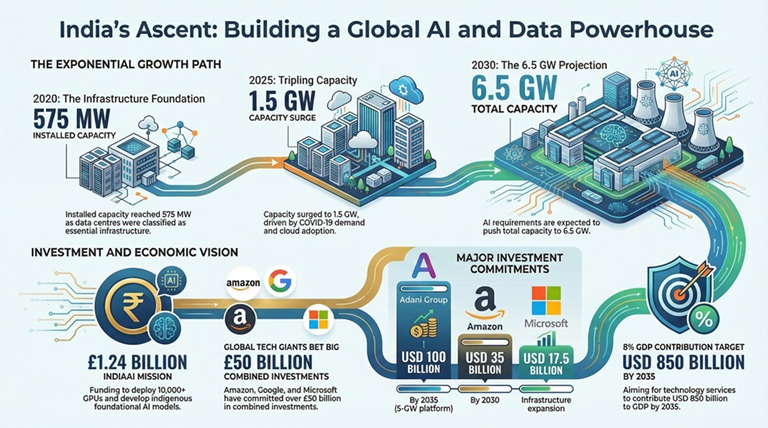
The Indian data center market has undergone a paradigm shift over the past decade, evolving from a small-scale, enterprise-owned server room into a multi-billion-dollar sector on the cusp of becoming a global giant. This transformation has been driven by the widespread adoption of digital technologies, the imposition of strict data localization regulations, and the growing demand for artificial intelligence. This article outlines the sector's history to date and delves into the future of data centers and AI infrastructure.
Historical Background: From Niche to a National Imperative
The Indian data center market dates back to the early 2000s, when it was a small-scale sector that primarily supported IT outsourcing and the enterprise sector. However, after 2010, with the advent of cloud computing and e-commerce, the sector began growing rapidly. By 2020, the total installed capacity reached approximately 520-575 MW, dominated by metro cities like Mumbai and Chennai. The COVID-19 pandemic further accelerated growth, leading to a dramatic increase in demand. As a result, capacity tripled to around 1.5 GW in late 2025.
Major milestones include the government's 2020 classification of data centers as ‘essential infrastructure,’ which facilitated access to incentives such as reduced electricity rates and favorable financing terms. The Digital Personal Data Protection (DPDP) Act of 2023 empowers the government to restrict data transfers to certain countries, compelling multinational companies to establish local infrastructure and increasing demand by an estimated 1,800 MW by 2027. Consequently, investments surged, totaling USD 95 billion between 2019 and 2025. Local players like AdaniConneX, Yotta, and CtrlS grew rapidly, while global giants such as Equinix and NTT entered the market through joint ventures. In February 2026, Larsen & Toubro will partner with NVIDIA to establish a sovereign AI factory in India as part of the IndiaAI Mission. This initiative includes expanding a 30 MW GPU compute cluster on a 300-acre campus in Chennai and launching a new 40 MW AI-ready data center in Mumbai.
Get More Info, Download Pdf Brochure: https://www.marketsandmarkets.com/pdfdownloadNew.asp?id=173006400
Current Scenario: Investments, Government Initiatives, and AI Integration
As of February 2025, India's data center solutions market was estimated to be approximately USD 13.39 billion, with installed power capacity expected to reach 1.5 GW by the end of the year. The data center landscape comprises more than 150 facilities, with Mumbai, Chennai, Delhi-NCR, and Bengaluru serving as hubs, accounting for almost 90% of total capacity. Tier-II cities such as Pune, Bangalore, and Raipur are also emerging as prominent locations, driven by lower costs and government incentives.
Government initiatives remain supportive of infrastructure development. Data centers, especially AI-integrated data centers, are at the forefront of India’s digital vision. Almost USD 70 billion in investments are already underway in the data center industry, with an additional USD 90 billion planned, indicating the massive development of AI and cloud infrastructure in the country.
Significant investments indicate a focus on AI. Adani Group's commitment of USD 100 billion by 2035 includes a 5-GW renewable-powered hyperscale data center platform, in collaboration with Google, Flipkart, and Microsoft, for campuses in Visakhapatnam, Noida, and Hyderabad.
Tech giants are also betting big on India—Google is investing USD 15 billion for its first AI hub, Microsoft is investing USD 17.5 billion, and Amazon is aiming to invest up to USD 35 billion in India by 2030. Meanwhile, domestically, NTT DATA is developing a USD ~1.2 billion AI cluster in Hyderabad, and Digital Connexion is establishing a USD 11 billion campus in Andhra Pradesh.
The AI Impact Summit 2026 showcased the country's homegrown developments, including the launch of Param2 (a 17B-parameter model supporting 22 Indian languages) from BharatGen and vernacular-centric solutions from Sarvam AI. Yotta Data Services partnered with NVIDIA to catalyze India’s AI evolution with the launch of large-scale, sovereign GPU infrastructure.
Future Projections and Emerging Trends
India’s data center capacity is projected to reach 6.5 GW by 2030, driven by AI requirements, while the sector is expected to reach USD 57.67 billion by 2030. In 2025, data centers consumed 0.5% of India’s electricity and approximately 150 billion liters of water, which is projected to increase by over 100% by 2030, making infrastructure and sustainability choices imperative. Key trends include:
-
AI-Ready Design & Distributed Growth - India is poised to become a multi-hub data center ecosystem with government support and infrastructure development beyond Mumbai. Expect the rise of high-density, GPU-optimized data centers with sophisticated cooling systems.
-
IndiaAI Mission- As part of the IndiaAI Mission, funded at approximately USD 1.24 billion (?10,371.92 crore), India will deploy 10,000+ GPUs through PPP models, develop indigenous foundational models, establish AI marketplaces, and support startups in moving from hosting workloads to developing Indian AI capabilities
- Global Integration - With 100% FDI allowed, India plans to capture more than 25% of the global market share in digital services by 2035.
Challenges: Power, Water, and Disruptions
Although the future looks bright, challenges lie ahead. Energy consumption driven by AI may pose a challenge, as data centers are expected to account for 3-5% of India’s total grid load by 2030. Water scarcity affects 60-80% of data centers, and cooling systems exacerbate the problem. Infrastructure bottlenecks, such as land and regulatory issues, are causing delays in expansion.
India’s USD 250 billion IT sector is poised to be disrupted by AI, impacting traditional outsourcing and low-end services. To survive, the sector must transform through reskilling, AI adoption, innovation-driven services, productivity enhancement, and a transition from labor arbitrage to high-value AI-driven transformation services.
Opportunities: Economic Catalyst and Global Leadership
According to NITI Aayog, India has set a target for the technology services sector to contribute 7-8% of GDP (USD 750-850 billion) by 2035 as part of its Viksit Bharat vision. However, current growth projections indicate a potential shortfall of USD 250-300 billion, which can be addressed through AI-driven transformation and the development of higher-value services. Opportunities exist in areas such as Data Center as a Service (DCaaS), data monetization, and AI for public good initiatives, such as healthcare and agriculture. Additionally, India's large population of 1.4 billion provides a significant data advantage for model training.
With strategic priorities such as reskilling, public-private collaboration, and innovation hubs, and the right policies, such as the National Tech-Services Single Window, India can become one of the first three AI superpowers by 2047.
Conclusion: A Digital Powerhouse in the Making
The story of India's data center and AI infrastructure development exemplifies its ambition to lead the intelligence revolution. Starting from nothing and evolving into a potential USD 200 billion investment hub, the nation stands at a pivotal moment. The future will reveal whether India can achieve its goal of becoming a net exporter of AI technologies and fostering sustainable, inclusive economic growth. As Prime Minister Modi emphasizes, prioritizing vernacular and population-scale AI remains crucial to realizing this vision.
80% of the Forbes Global 2000 B2B companies rely on MarketsandMarkets to identify growth opportunities in emerging technologies and use cases that will have a positive revenue impact.
- Food Packaging Market Size Set for Strong Growth Through 2030 Amid Rising Demand for Convenience Foods
- Crop Protection Chemical Market Size, Share & Growth Forecast (2025–2030)
- Mulch Films Market: Driving Sustainable Agriculture Through Innovation
- Agricultural Adjuvants Market Analysis, Trends, and Growth Outlook (2026–2031)
- Japan Enterprise Asset Management Market Growth: AI and Smart Infrastructure Drive Demand