

AI Sensor Technology Innovation: Key Trends, Growth Drivers and Opportunities
Introduction to AI Sensor Technology
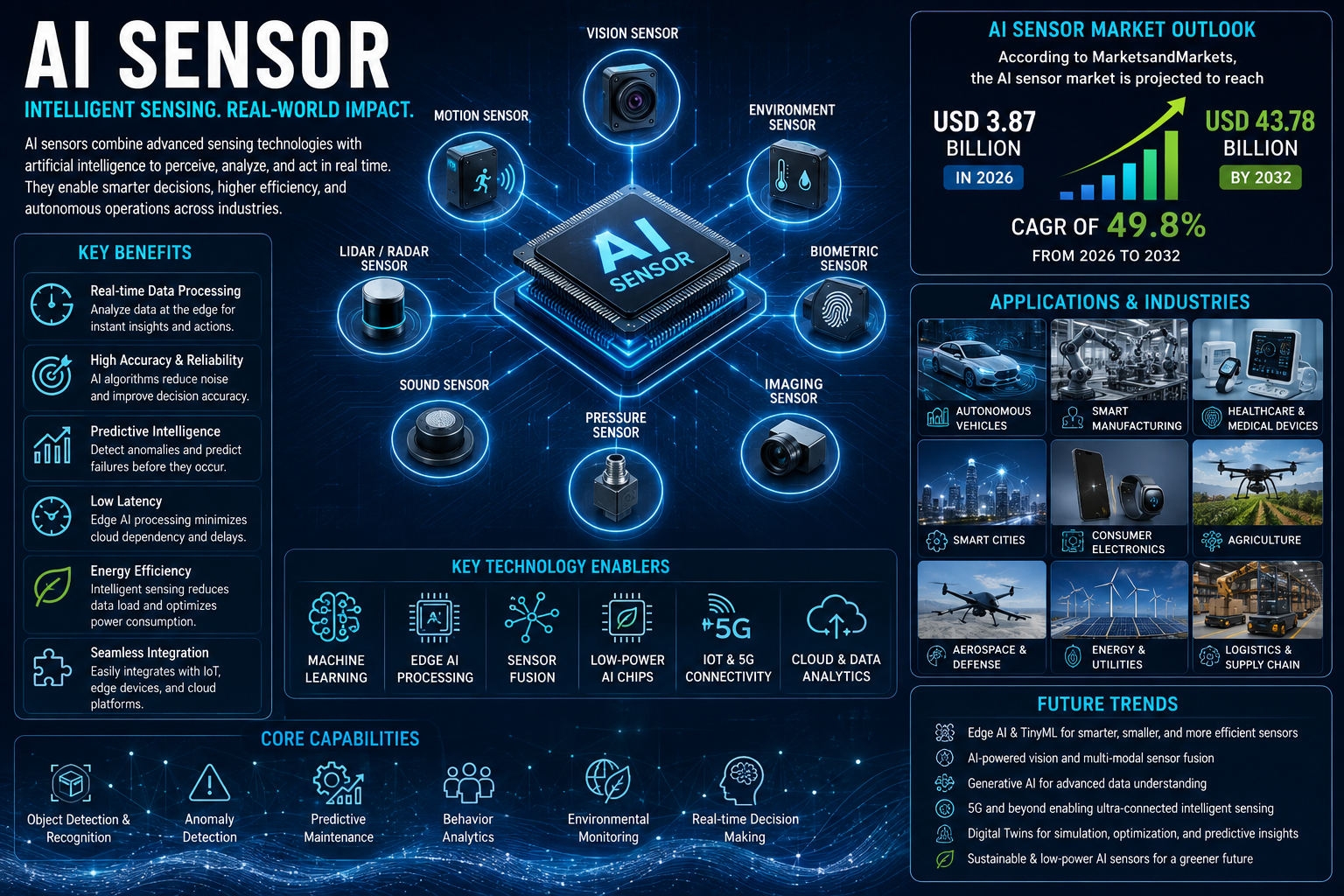
AI Sensor technology is transforming the way machines, devices, and intelligent systems perceive and interact with their surroundings by combining advanced sensing capabilities with Artificial Intelligence (AI) algorithms. Unlike conventional sensors that simply collect raw data, AI sensors can process, analyze, and interpret information locally, enabling real-time decision-making with minimal latency. By integrating machine learning, computer vision, edge AI, and intelligent analytics, these sensors improve automation, predictive maintenance, safety, and operational efficiency across multiple industries. As demand for autonomous systems, smart manufacturing, connected healthcare, intelligent transportation, and IoT ecosystems continues to grow, AI sensors are becoming a foundational technology for next-generation digital transformation.
History of AI Sensor Technology
The evolution of AI Sensor technology began with traditional sensing devices designed to detect environmental parameters such as temperature, pressure, motion, and light. As embedded computing and semiconductor technologies advanced, sensors became more intelligent, enabling basic data processing and communication. The emergence of Artificial Intelligence, machine learning, computer vision, and edge computing marked a significant milestone, allowing sensors to analyze data, recognize patterns, and make autonomous decisions without relying entirely on cloud infrastructure. Today, AI sensors are widely deployed across autonomous vehicles, industrial automation, healthcare devices, consumer electronics, robotics, and smart cities, enabling faster, smarter, and more efficient operations.
Benefits of AI Sensor Technology
AI sensors significantly enhance the capabilities of traditional sensing systems by enabling intelligent data analysis, autonomous decision-making, and real-time responsiveness. These advanced sensors reduce processing delays, improve operational efficiency, and support predictive analytics by analyzing data directly at the edge. Their ability to combine sensing with artificial intelligence helps organizations improve productivity, optimize resource utilization, strengthen safety, and accelerate digital transformation initiatives across various industries.
Key Benefits Include:
- Enables real-time data processing and intelligent decision-making at the edge.
- Improves accuracy through AI-powered object detection, pattern recognition, and predictive analytics.
- Reduces latency by minimizing dependence on centralized cloud processing.
- Supports predictive maintenance by identifying equipment anomalies before failures occur.
- Enhances automation across manufacturing, robotics, healthcare, and smart infrastructure.
- Optimizes energy efficiency by processing only relevant sensor data.
- Strengthens safety and security through intelligent environmental monitoring and threat detection.
- Seamlessly integrates with IoT platforms, edge computing systems, and cloud-based analytics.
Current Market Size and Growth Trends of the AI Sensor Market
The AI Sensor market is experiencing remarkable growth as industries increasingly deploy intelligent sensing technologies to enable automation, predictive analytics, and autonomous decision-making. The rapid adoption of artificial intelligence, Internet of Things (IoT), edge computing, robotics, autonomous vehicles, and smart consumer devices is driving strong demand for AI-enabled sensors capable of processing complex data in real time. At the same time, growing investments in Industry 4.0, digital healthcare, smart cities, and intelligent transportation systems are accelerating innovation and expanding the use of AI sensors across global markets.
According to MarketsandMarkets, the global AI Sensor market is projected to grow from USD 3.87 billion in 2026 to USD 43.78 billion by 2032, registering a remarkable CAGR of 49.8% during the forecast period.
Key Market Growth Drivers
- Rapid adoption of Artificial Intelligence (AI) and Machine Learning (ML) across industrial and commercial applications.
- Increasing deployment of edge AI for real-time sensor data processing and autonomous decision-making.
- Growing demand for autonomous vehicles, robotics, and intelligent transportation systems.
- Rising investments in Industry 4.0, smart manufacturing, and predictive maintenance solutions.
- Expansion of IoT-enabled smart devices, wearable technologies, and connected infrastructure.
- Increasing adoption of AI-powered sensors in healthcare, consumer electronics, aerospace, defense, and smart cities.
- Continuous advancements in semiconductor technologies, low-power AI chips, and intelligent sensor fusion.
Key Drivers and Factors Influencing the Future of AI Sensor Technology
The future of AI Sensor technology is being driven by rapid advancements in artificial intelligence, machine learning, edge computing, semiconductor innovation, and the Internet of Things (IoT). As industries increasingly require intelligent systems capable of sensing, processing, and responding to environmental changes in real time, AI sensors are becoming essential for autonomous decision-making and predictive analytics. The growing adoption of smart factories, autonomous vehicles, connected healthcare, robotics, and smart cities is accelerating demand for sensors that combine high accuracy with low-latency AI processing. Additionally, investments in energy-efficient AI chips and edge intelligence are enabling AI sensors to deliver faster performance while reducing power consumption and cloud dependency.
Key Growth Drivers
- Increasing adoption of Artificial Intelligence (AI) and Machine Learning (ML) across industrial and commercial applications.
- Growing deployment of edge AI processors for real-time sensor intelligence and low-latency decision-making.
- Rising demand for autonomous vehicles, advanced driver assistance systems (ADAS), and intelligent transportation.
- Expansion of Industry 4.0, smart manufacturing, and predictive maintenance initiatives.
- Growing implementation of IoT-enabled smart devices, wearables, and connected consumer electronics.
- Rising investments in healthcare monitoring, medical diagnostics, and intelligent patient care systems.
- Continuous innovation in semiconductor technologies, sensor fusion, and low-power AI hardware.
Emerging Trends in AI Sensor Technology
AI Sensor technology is rapidly evolving as organizations seek intelligent sensing solutions capable of delivering accurate, real-time insights across increasingly complex environments. Modern AI sensors combine computer vision, neural processing, edge AI, and advanced analytics to enable autonomous systems that continuously learn and adapt. Emerging technologies such as sensor fusion, Digital Twins, generative AI, and ultra-low-power AI processors are expanding the capabilities of intelligent sensing while improving scalability, efficiency, and reliability across multiple industries.
Key Emerging Trends
- Increasing adoption of edge AI sensors for local data processing without continuous cloud connectivity.
- Growing use of sensor fusion that combines vision, radar, LiDAR, ultrasonic, temperature, motion, and environmental sensors for improved accuracy.
- Integration of Digital Twin technology for real-time monitoring, predictive maintenance, and asset optimization.
- Rising deployment of AI-powered vision sensors supporting object recognition, quality inspection, and autonomous navigation.
- Expansion of ultra-low-power AI chips enabling intelligent sensing in battery-operated IoT devices.
- Growing implementation of Generative AI for contextual data interpretation and enhanced decision support.
- Increasing adoption of wireless AI sensors utilizing 5G, Wi-Fi 6, Bluetooth Low Energy (BLE), and LPWAN connectivity.
Opportunities and Challenges in the AI Sensor Market
The AI Sensor market offers significant opportunities as intelligent sensing becomes fundamental to digital transformation initiatives worldwide. AI-powered sensors are expanding beyond traditional industrial applications into healthcare, automotive, consumer electronics, agriculture, logistics, and smart infrastructure. Their ability to deliver actionable insights from real-time data creates substantial value for organizations seeking automation, operational efficiency, and predictive intelligence. However, challenges related to cybersecurity, interoperability, implementation costs, and data privacy continue to influence large-scale adoption.
Key Opportunities
- Increasing adoption across smart manufacturing for automated quality inspection and predictive maintenance.
- Growing deployment in autonomous vehicles, drones, and intelligent transportation systems.
- Expansion of AI-powered sensing in healthcare, wearable medical devices, and remote patient monitoring.
- Rising demand within smart cities for environmental monitoring, traffic management, and public safety.
- Increasing implementation across agriculture for precision farming, crop monitoring, and resource optimization.
- Growing use in consumer electronics, robotics, logistics, aerospace, and defense applications.
Key Challenges
- High development and implementation costs for advanced AI-enabled sensing solutions.
- Cybersecurity risks associated with connected AI sensor networks and IoT ecosystems.
- Data privacy concerns related to intelligent monitoring and real-time analytics.
- Integration complexity across legacy industrial infrastructure and heterogeneous platforms.
- Requirement for high-quality training datasets to improve AI model accuracy.
- Managing increasing volumes of sensor-generated data while maintaining processing efficiency.
Innovations and Advancements in AI Sensor Technology
Continuous innovation is transforming AI sensors into intelligent devices capable of processing vast amounts of data with exceptional speed and precision. Advances in AI algorithms, edge computing, semiconductor design, and neural processing units are enabling sensors to perform complex analytics directly at the source. These developments improve responsiveness, reduce bandwidth requirements, and enable autonomous systems to operate efficiently across industrial, commercial, and consumer environments.
Recent Innovations
- Development of AI-enabled vision sensors capable of real-time object detection, facial recognition, and defect inspection.
- Integration of Neural Processing Units (NPUs) within sensors for accelerated AI inference at the edge.
- Advanced sensor fusion technologies combining multiple sensing modalities for enhanced situational awareness.
- AI-powered predictive maintenance sensors that identify equipment failures before operational disruptions occur.
- Cloud-connected intelligent sensing platforms supporting remote monitoring, centralized analytics, and predictive reporting.
- Miniaturized low-power AI sensors designed for wearable devices, medical equipment, and IoT applications.
- Integration of AI sensors with robotics, autonomous systems, Digital Twins, and smart infrastructure to enable fully connected, intelligent environments.
Future Applications and Industries That Will Benefit from AI Sensor Technology
AI Sensor technology is expected to become one of the foundational technologies powering the next generation of intelligent automation, connected devices, and autonomous systems. As artificial intelligence, edge computing, 5G connectivity, robotics, and the Internet of Things (IoT) continue to converge, AI sensors will evolve beyond simple data collection into intelligent systems capable of learning, adapting, and making real-time decisions. Future AI sensors will integrate advanced computer vision, multimodal sensor fusion, predictive analytics, and ultra-low-power AI processors to deliver faster, more accurate insights across diverse operating environments. These capabilities will enable organizations to improve operational efficiency, safety, sustainability, and digital transformation across numerous industries.
Key Future Applications
- Autonomous Vehicles & Smart Mobility: AI sensors will power autonomous driving, Advanced Driver Assistance Systems (ADAS), intelligent traffic management, vehicle-to-everything (V2X) communication, and predictive road safety through real-time environmental sensing and decision-making.
- Industrial Automation & Smart Manufacturing: Intelligent sensors will support predictive maintenance, automated quality inspection, collaborative robotics, process optimization, machine vision, and real-time production monitoring within Industry 4.0 environments.
- Healthcare & Medical Devices: AI-enabled sensors will enhance wearable health devices, patient monitoring systems, robotic surgery, medical imaging, remote diagnostics, and personalized healthcare through continuous real-time monitoring and intelligent analytics.
- Smart Cities & Intelligent Infrastructure: AI sensors will improve public safety, traffic control, environmental monitoring, smart lighting, intelligent buildings, waste management, and emergency response systems by delivering actionable insights from connected urban infrastructure.
- Consumer Electronics: Smartphones, smart home devices, AR/VR headsets, wearable electronics, and personal assistants will leverage AI sensors for gesture recognition, facial authentication, environmental awareness, and context-aware user experiences.
- Agriculture & Precision Farming: AI-powered sensors will optimize crop health monitoring, soil analysis, irrigation management, livestock tracking, and precision agriculture, improving productivity while reducing resource consumption.
- Retail & Commercial Facilities: Intelligent sensors will support customer behavior analysis, inventory management, cashier-less shopping, occupancy monitoring, and store security through computer vision and AI-powered analytics.
- Aerospace & Defense: AI sensors will strengthen surveillance, navigation, autonomous drones, battlefield awareness, aircraft monitoring, and mission-critical defense systems requiring intelligent environmental sensing.
- Energy & Utilities: Smart grids, renewable energy plants, oil & gas facilities, and utility infrastructure will use AI sensors for predictive maintenance, equipment monitoring, fault detection, and operational optimization.
- Logistics & Supply Chain: AI sensors will enable real-time asset tracking, warehouse automation, autonomous mobile robots (AMRs), cold chain monitoring, and intelligent fleet management to improve supply chain visibility and efficiency.
Conclusion: The Promising Future of AI Sensor Technology
AI Sensor technology is fundamentally transforming the way machines, devices, and digital systems perceive and interact with the physical world. By combining advanced sensing technologies with artificial intelligence, machine learning, and edge computing, AI sensors enable real-time decision-making, predictive analytics, and intelligent automation that significantly improve operational efficiency, safety, and reliability. Their ability to process data at the source reduces latency, minimizes bandwidth requirements, and supports faster responses across mission-critical applications.
Find More Information on AI Sensor Technology Innovation @ https://www.marketsandmarkets.com/Market-Reports/artificial-intelligence-ai-sensor-market-122565258.html
80% of the Forbes Global 2000 B2B companies rely on MarketsandMarkets to identify growth opportunities in emerging technologies and use cases that will have a positive revenue impact.
- Food Packaging Market Size Set for Strong Growth Through 2030 Amid Rising Demand for Convenience Foods
- Crop Protection Chemical Market Size, Share & Growth Forecast (2025–2030)
- Mulch Films Market: Driving Sustainable Agriculture Through Innovation
- Agricultural Adjuvants Market Analysis, Trends, and Growth Outlook (2026–2031)
- Japan Enterprise Asset Management Market Growth: AI and Smart Infrastructure Drive Demand

