3D Sensor Market Size, Share & Industry Trends

3D Sensor Market by Sensor Type (Image, Position, Acoustic, Magnetometer, Gyroscope, Accelerometer), Technology (Stereo Vision, Structured Light, Time of Flight, Lidar, Radar), Application (Object Detection, Inspection, Mapping) - Global Forecast to 2032




3D SENSOR MARKET OVERVIEW
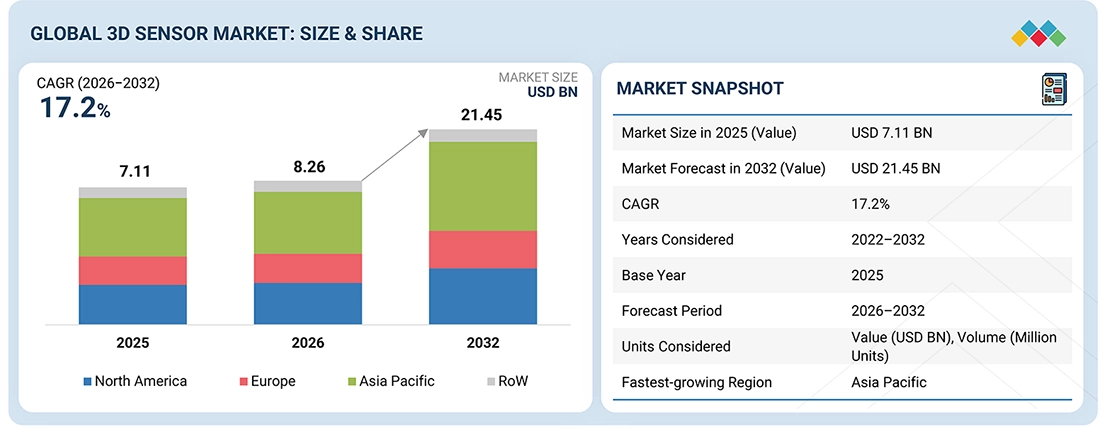
The global 3D sensor market is projected to grow from USD 8.26 billion in 2026 to USD 21.45 billion by 2032, registering a CAGR of 17.2%. The demand for 3D sensors is primarily driven by the deployment of security and surveillance infrastructure. These systems require continuous spatial data capture for accurate monitoring and threat detection. The integration of advanced medical diagnostic equipment is further driving component demand. Medical applications, such as surgical robotics and volumetric tissue scanners, require high-resolution depth processing for accurate patient diagnostics. Additionally, the development of automotive automation creates a requirement for accurate environmental perception.
REPORT SCOPE
| REPORT METRIC | DETAILS |
|---|---|
| Market Size in 2025 (Value) | USD 7.11 Billion |
| Market Size in 2026 (Value) | USD 8.26 Billion |
| Market Forecast in 2032 (Value) | USD 21.45 Billion |
| Growth Rate | CAGR of 17.2% from 2026–2032 |
| Years Considered | 2022–2032 |
| Base Year | 2025 |
| Forecast Period | 2026–2032 |
| Units Considered | Value (USD Million/Billion), Volume (Thousand Units) |
| Report Coverage | Revenue forecast, company ranking, competitive landscape, growth factors, and trends |
|
Top Companies
|
|
|
Growth Drivers
|
|
| Segments Covered |
|
| Regional Scope | North America, Europe, Asia Pacific, Rest of the World (RoW) |
KEY TAKEAWAYS
-
RegionBy region, North America is set to dominate the market, growing at a CAGR of 17.3% during the forecast period.
-
TYPEBy type, the image sensor segment is estimated to lead the market during the forecast period.
-
TechnologyBy technology, the time of flight segment is projected to grow at the fastest CAGR of 18.6% during the forecast period.
-
ApplicationBy application, the object detection & tracking segment is set to lead the market.
-
IndustryThe automotive industry is projected to register the highest CAGR during the forecast period.
-
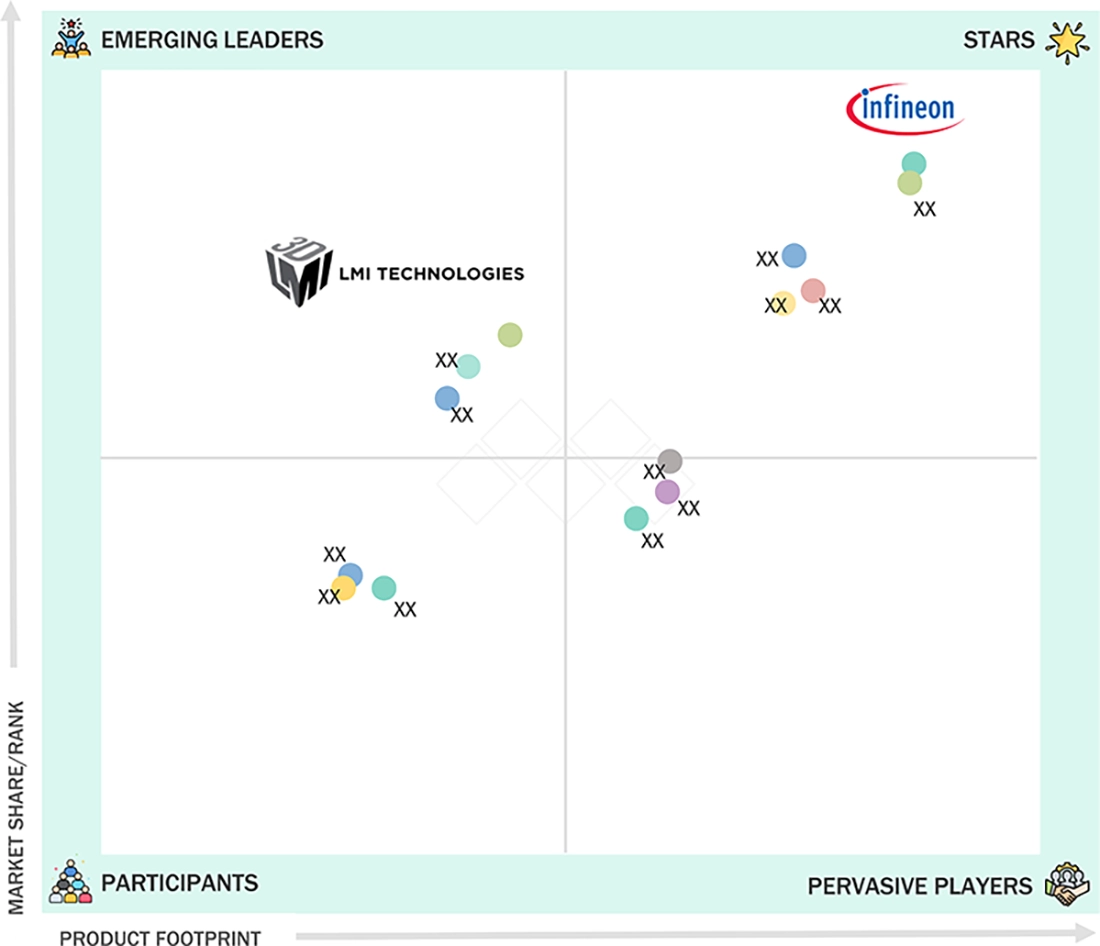
COMPETITIVE LANDSCAPE - KEY PLAYERSInfineon Technologies AG (Germany), Microchip Technology Inc. (US), Sony Group Corporation (Japan), STMicroelectronics (Switzerland), and KEYENCE CORPORATION (Japan) were identified as some of the star players in the global image sensor market, given their strong market share and product footprint.
-
COMPETITIVE LANDSCAPE - STARTUPS/SMESQuanergy Solutions Inc. (US), AIRY3D(Canada), VoxelSensors SRL/BV (Belgium), Phlux Technologies (US), TriEye LTD. (Israel), Newsight Imaging (Israel), Nodar (US), and Terabee (France), among others, have established themselves as specialized players in the 3D sensor market by focusing on high-performance materials and application-specific solutions.
The growth of the 3D sensor industry is being accelerated by the expansion of automated technologies and spatial data processing across industries. This leads to an increase in depth-sensing modules per individual device. As resolution requirements increase and device architectures become compact, traditional stereoscopic vision approaches are being replaced. Manufacturers are adopting advanced technologies such as vertical cavity surface emitting laser (VCSEL) arrays, time of flight (ToF) modules, and backside illuminated (BSI) architectures. This technological transition expands the overall market value. Emerging applications include autonomous vehicles, artificial intelligence integration, medical diagnostics, and smart manufacturing.
Source: Secondary Research, Interviews with Experts, MarketsandMarkets Analysis
TRENDS & DISRUPTIONS IMPACTING CUSTOMERS' CUSTOMERS
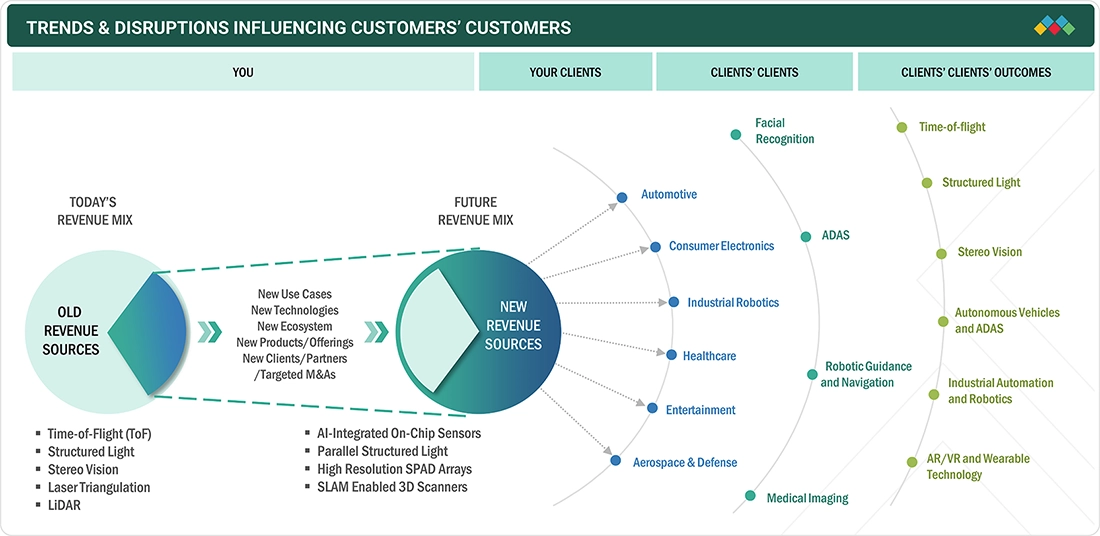
3D sensor is being shaped because companies are replacing conventional stereoscopic vision, ultrasound, and basic structured light systems. Manufacturers are adopting advanced architectures. These include Time of Flight (ToF) modules, back-illuminated stacked CMOS 3D sensors, solid-state LiDAR, and gesture recognition arrays. This shift requires customized component integration for specific client operations. These clients operate across the automotive, consumer electronics, industrial robotics, and healthcare sectors. The new sensor architectures address specific functional requirements. These requirements include safety compliance, real-time spatial mapping, automated inventory management, and touchless user interfaces. The adoption of these components leads to direct operational outcomes. These outcomes include the deployment of advanced driver assistance systems (ADAS), robotic obstacle avoidance, smartphone biometric authentication, and precise surgical tracking devices.
Source: Secondary Research, Interviews with Experts, MarketsandMarkets Analysis
3D SENSOR MARKET DYNAMICS

Level
-
Increasing need for advanced security and surveillance systems

-
Growing adoption of 3D sensors in industrial automation and robotics


Level
-
High cost of advanced 3D sensors

-
Data privacy and security concerns


Level
-
Rising inclination toward immersive experiences in entertainment industry

-
Growing adoption of wearables


Level
-
Rapid change in technological landscape

-
Regulatory compliance regarding regional data privacy rules

Source: Secondary Research, Interviews with Experts, MarketsandMarkets Analysis
DRIVER: Increasing need for advanced security and surveillance systems
The demand for high-security tracking infrastructure drives the market. Government facilities, financial hubs, and commercial centers deploy advanced security cameras requiring precise threat identification. These components provide accurate shape and depth classification to prevent data tracking errors.
RESTRAINT: High cost of advanced 3D sensors
Advanced 3D sensing setups incorporate complex optical chips, micro lens arrays, and high-performance processing hardware. These premium component bills restrict adoption to large-scale manufacturers. Budget-constrained small enterprises avoid these integrated technologies due to prolonged return on investment timelines.
OPPORTUNITY: Rising inclination toward immersive experiences in the entertainment industry
The expansion of augmented, virtual, and mixed reality headsets requires specialized depth mapping modules. Developers create spatial environments requiring real-time motion translation and active gesture capturing. Sensor manufacturers can secure higher volume orders by supplying power-efficient components to gaming device brands.
CHALLENGE: Rapid change in the technological landscape
The continuous evolution of component architectures shortens the standard commercial lifecycle of sensing equipment. Engineering teams must invest heavily in ongoing research to avoid market obsolescence. This fast development cycle creates financial stress for firms managing long-term inventory.
3D SENSOR MARKET SIZE, SHARE & INDUSTRY TRENDS: COMMERCIAL USE CASES ACROSS INDUSTRIES
| COMPANY | USE CASE DESCRIPTION | BENEFITS |
|---|---|---|
 |
Infineon provides REAL3 and XENSIV Time of Flight (ToF) 3D image sensors. These sensors function within automotive in-cabin monitoring systems, industrial automation, and consumer electronics to capture accurate spatial depth data. | Enables continuous 3D environmental mapping | Operates reliably across variable lighting conditions | Supports automated vehicle safety systems | Integrates into compact electronic hardware |
 |
Microchip develops GestIC technology. This hardware utilizes electrical near field (E-field) 3D tracking to enable touchless gesture recognition in automotive interfaces, smart home appliances, and consumer electronics. | Provides touchless device control | Operates with low electrical power consumption | Integrates behind non conductive device housings | Functions continuously in space-constrained environments |
 |
Sony manufactures DepthSense ToF sensors. These components utilize Current Assisted Photonic Demodulator (CAPD) and back-illuminated complementary metal oxide semiconductor (CMOS) architectures for machine vision, robotics, and mobile augmented reality. | Delivers precise spatial depth measurements | Supports high speed object detection | Captures high resolution 3D data in low light environments | Maintains stable operational performance |
 |
STMicroelectronics supplies FlightSense Time of Flight (ToF) sensors. These integrated depth-sensing components process visual data for smartphone facial authentication, consumer robotics navigation, and computer presence detection. | Calculates exact physical distance metrics | Supports secure biometric hardware architectures | Enables rapid optical autofocus functions | Integrates into low-power electronic assemblies |
 |
Keyence develops industrial 3D measurement systems. These products include 3D optical profilometers and high speed laser snapshot sensors for inline production inspection, surface roughness analysis, and automated quality control. | Captures sub-micron surface topography data | Inspects fast-moving production lines continuously | Identifies physical manufacturing defects | Integrates directly into automated manufacturing equipment |
Logos and trademarks shown above are the property of their respective owners. Their use here is for informational and illustrative purposes only.
3D SENSOR MARKET ECOSYSTEM
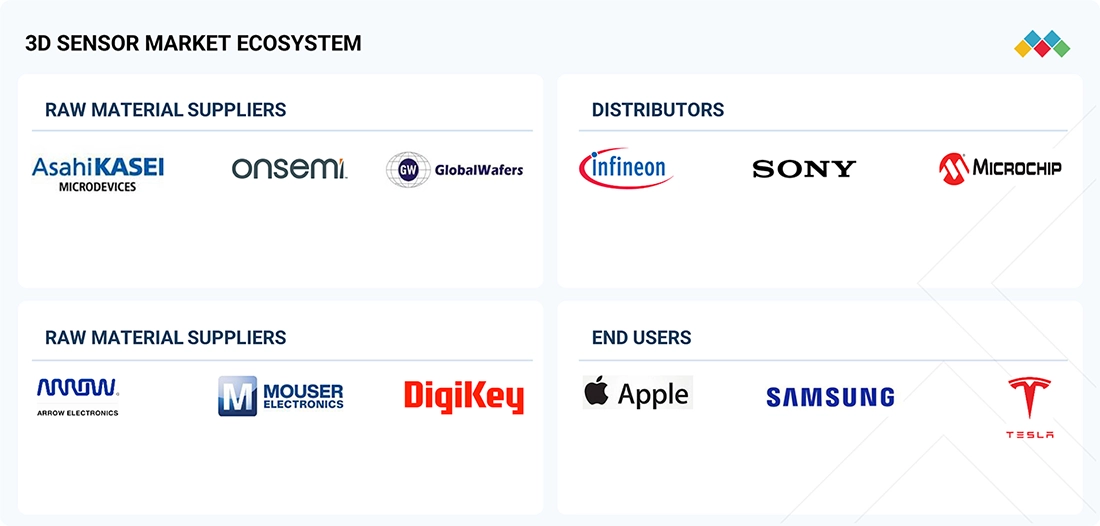
The 3D sensor ecosystem consists of raw material suppliers, manufacturers, distributors, and end users. This structure forms a value chain supporting product manufacturing and deployment. Raw material suppliers provide essential inputs such as silicon wafers, optical components, and specialized semiconductor substrates. Manufacturers fabricate these basic materials into active 3D sensing architectures, including Time of Flight (ToF) and integrated micro sensor components. Distributors manage logistics to ensure global component availability across different regions. End users then integrate these finished sensors into final products across sectors such as consumer electronics, automotive manufacturing, and industrial automated systems.
Logos and trademarks shown above are the property of their respective owners. Their use here is for informational and illustrative purposes only.
3D SENSOR MARKET SEGMENTS
Source: Secondary Research, Interviews with Experts, MarketsandMarkets Analysis
3D Sensor Market, By Type
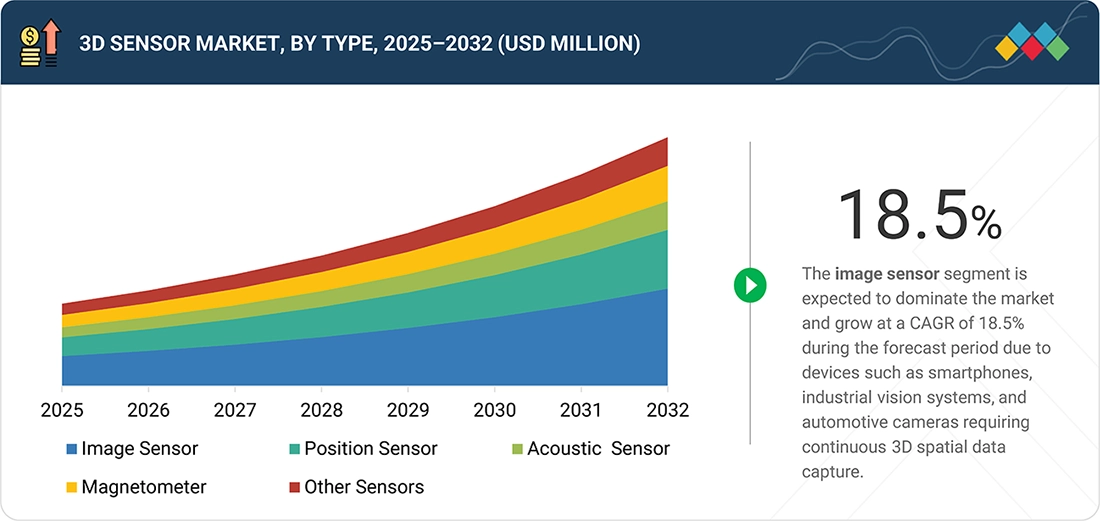
Image sensors dominate the market. This dominance results from their widespread adoption across smartphones, industrial vision systems, and automotive safety equipment to generate high-resolution depth maps. Modern electronic architectures require integrated pixel arrays directly alongside electronic processing circuitry. This hardware configuration enables device miniaturization and supports volume-oriented mass production workflows.
3D Sensor Market, By Technology
The Time of Flight (ToF) segment holds the largest market share. This technique captures complete 3D spatial data in a single exposure window. It is the operational standard for rapid biometric authentication, robotic obstacle avoidance, and vehicle environmental mapping systems. The capacity to provide real-time volumetric tracking under variable ambient lighting conditions sustains this segment's dominance.
3D Sensor Market, By Application
The object detection & tracking segment dominates the market. This segment processes real-time spatial depth coordinates to identify, classify, and track moving targets across diverse environments. High volume integration within industrial automation systems, warehouse robotics, and advanced driver assistance systems (ADAS) creates a continuous demand for precise 3D tracking sensors.
3D Sensor Market, By Industry
The consumer electronics segment dominates the 3D sensor market. This sector manufactures high volumes of premium smartphones, tablets, and virtual or mixed reality headsets. Modern personal electronics frequently incorporate specific hardware emitters and specialized depth receptors per individual unit. This product design convention creates continuous mass volume demand for 3D sensing components.
REGION
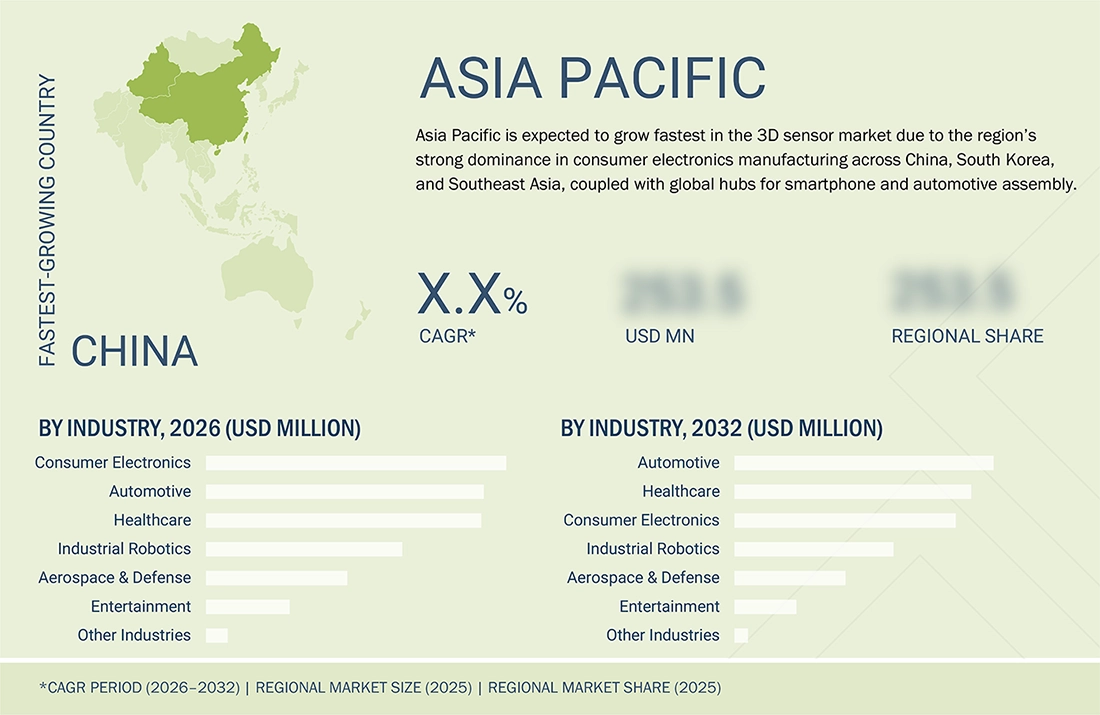
Asia Pacific is expected to be the fastest-growing region across the global 3D sensor market during the forecast period
Asia Pacific is projected to register the fastest compound annual growth rate (CAGR) in the 3D sensor market. This growth is due to the region’s strong dominance in consumer electronics manufacturing and high-volume electronic hardware production. Countries such as China, South Korea, and nations across Southeast Asia operate as major global hubs for smartphone and automotive assembly. The region contains an established semiconductor fabrication and micro lens component ecosystem. Increasing investments in autonomous vehicles, industrial robotics, and advanced healthcare diagnostics drive the demand for specific 3D sensing components. Additionally, the presence of major original equipment manufacturers (OEMs) and scalable manufacturing capabilities accelerates overall regional market growth.
3D SENSOR MARKET SIZE, SHARE & INDUSTRY TRENDS: COMPANY EVALUATION MATRIX
In the global 3D sensor market matrix, Infineon Technologies AG (Star) maintains a high market share and product footprint. The company manufactures a comprehensive portfolio of 3D sensing solutions, including advanced Time of Flight (ToF) sensors. These components process continuous spatial and depth data across the consumer electronics, smartphone, and automotive industries. LMI Technologies Inc. (Emerging Player) is expanding its market position through specific sensor technologies. It develops high-resolution and specialized 3D smart sensors, including laser line profilers and snapshot scanners. These sensors function within industrial machine vision, factory automation, inline inspection, and automated quality testing equipment. This specific operational focus contributes to its position within the global 3D sensor market.
Source: Secondary Research, Interviews with Experts, MarketsandMarkets Analysis
KEY MARKET PLAYERS
- Infineon Technologies AG (Germany)
- Microchip Technology Inc. (US)
- Sony Group Corporation (Japan)
- STMicroelectronics (Switzerland)
- KEYENCE CORPORATION (Japan)
- OMNIVISION (US)
- Qualcomm (US)
- ifm electronic gmbh (Germany)
- LMI TECHNOLOGIES INC. (Canada)
- ams-OSRAM AG (Austria)
WHAT IS IN IT FOR YOU: 3D SENSOR MARKET SIZE, SHARE & INDUSTRY TRENDS REPORT CONTENT GUIDE
DELIVERED CUSTOMIZATIONS
We have successfully delivered the following deep-dive customizations:
| CLIENT REQUEST | CUSTOMIZATION DELIVERED | VALUE ADDS |
|---|---|---|
| 3D sensor Materials Manufacturer |
|
|
| 3D Sensor Component Manufacturer (ToF, Structured Light, LiDAR) |
|
|
| 3D Sensor End User (OEM – Consumer Electronics / Automotive / Industrial) |
|
|
RECENT DEVELOPMENTS
- June 2026: STMicroelectronics launched the VL53L9, a compact direct Time-of-Flight 3D LiDAR module offering 2.3K sensing zones, up to 100 frames per second, on-chip processing and a 5 cm–9 m sensing range. The all-in-one module is designed for robotics, industrial automation, smart buildings, AR/VR and healthcare applications, providing AI-ready depth data with reduced processing and integration requirements. The launch is a direct advancement of compact, high-resolution 3D sensor technology.
- April 2026: Sony Group Corporation obtained IEC 61508 SIL 2 Ready certification for its IMX560 SPAD ToF depth sensor, strengthening its suitability for safety-related industrial LiDAR applications. The sensor integrates SPAD pixels and depth-processing circuitry to provide compact, high-resolution distance sensing, with applications including industrial machine navigation and robotic obstacle detection. The certification directly enhances the deployment potential of Sony’s 3D depth-sensing technology in safety-conscious industrial environments.
- April 2026: Infineon Technologies AG published new design guidance for joysticks using its XENSIV magnetic 3D sensors, providing magnetic and mechanical design parameters for implementing Hall-based three-dimensional sensing in joystick applications. The application note supports faster development of position and movement interfaces using Infineon’s 3D sensor technology. The development directly expands the practical application and design ecosystem surrounding Infineon’s magnetic 3D sensors.
- March 2026: Microchip Technology Inc. updated its technical documentation for the MGC3130 GestIC platform, a 3D sensor technology that uses electric-field sensing to detect, track and classify hand and finger movements in free space. The platform provides real-time three-dimensional position and gesture information for embedded human-machine interfaces, supporting applications such as gesture control and touchless interaction. The update represents continued development of Microchip’s 3D sensing technology for embedded interfaces.
- March 2026: Qualcomm published a patent application describing a perception system that generates 3D sensor features and height maps from sensor data before fusing them with height-gradient information for perception tasks. The approach is designed to improve computer-vision perception by incorporating spatial and height information into feature processing. The development directly involves 3D sensor data and demonstrates Qualcomm’s ongoing work on three-dimensional sensing and perception technologies.
Table of Contents
 Exclusive indicates content/data unique to MarketsandMarkets and not available with any competitors.
Methodology
The research process for this study involved the systematic gathering, recording, and analysis of data on customers and companies operating in the 3D sensor market. This process involved the extensive use of secondary sources, directories, and databases (Factiva and OANDA) to identify and collect valuable information for the comprehensive, technical, market-oriented, and commercial study of the 3D sensor market. In-depth interviews were conducted with primary respondents, including experts from core and related industries, as well as preferred manufacturers, to obtain and verify critical qualitative and quantitative information and assess growth prospects. Key players in the 3D sensor market were identified through secondary research, and their market rankings were determined through a combination of primary and secondary research. This research involved studying the annual reports of top players and conducting interviews with key industry experts, including CEOs, directors, and marketing executives.
Secondary Research
Various sources were utilized in the secondary research process to identify and collect information relevant to this study. These include company annual reports, press releases, investor presentations, white papers, technology journals, certified publications, articles by recognized authors, directories, and databases.
Secondary research was primarily used to gather key information on the industry’s value chain, the total pool of market players, market classification by industry trends at the most detailed level, regional markets, and key developments from both market and technology-oriented perspectives.
Primary Research
Primary research was also conducted to identify the segmentation types, key players, competitive landscape, and key market dynamics, including drivers, restraints, opportunities, challenges, and industry trends, as well as the key strategies adopted by players operating in the 3D sensor market. Extensive qualitative and quantitative analyses were conducted across the complete market engineering process to present key information and insights throughout the report.
Extensive primary research has been conducted following the acquisition of knowledge about the 3D sensor market scenarios through secondary research. Several primary interviews were conducted with experts from the demand side (application, and region) and the supply side (type, technology, application) across four major geographic regions: North America, Europe, Asia Pacific, and RoW. Approximately 60% and 40% of the primary interviews were conducted from the supply and demand sides, respectively. These primary data have been collected through questionnaires, emails, and telephonic interviews.
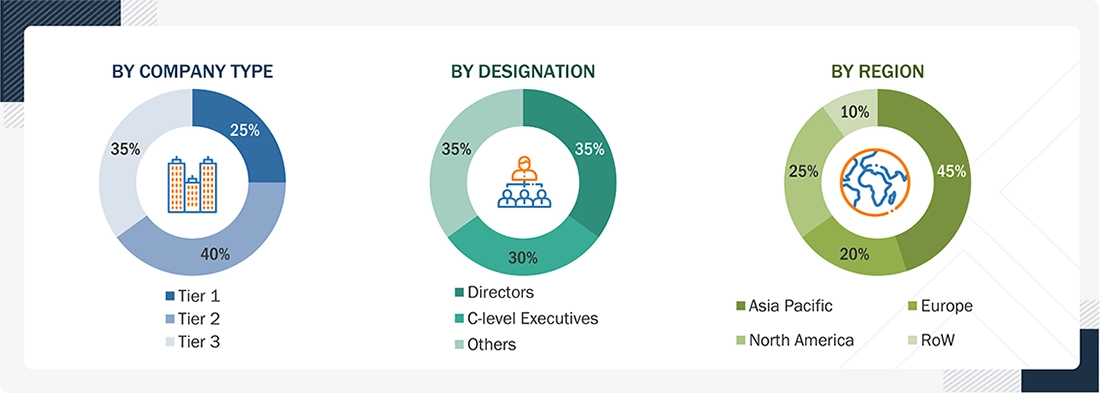
Notes: The three tiers of companies have been defined based on their total/segmental revenue as of 2025: Tier 1 = > USD 1 billion, Tier 2 = USD 1 billion–USD 500 million, and Tier 3 = < USD 500 million.
To know about the assumptions considered for the study, download the pdf brochure
Market Size Estimation
In the complete market engineering process, top-down and bottom-up approaches, along with several data triangulation methods, were used to estimate and validate the size of the 3D sensor market and various other dependent submarkets. Key players in the market were identified through secondary research, and their market share in each region was determined through a combination of primary and secondary research. This research methodology involved analyzing the annual and financial reports of the top players and conducting interviews with experts (including CEOs, VPs, directors, and marketing executives) to gather key insights (both quantitative and qualitative).
All percentage shares, splits, and breakdowns were determined using secondary sources and verified through primary sources. All possible parameters affecting the markets covered in this study were accounted for, examined in detail, verified through primary research, and analyzed to obtain final quantitative and qualitative data. This data was consolidated and supplemented with detailed inputs and analysis from MarketsandMarkets and presented in this report.
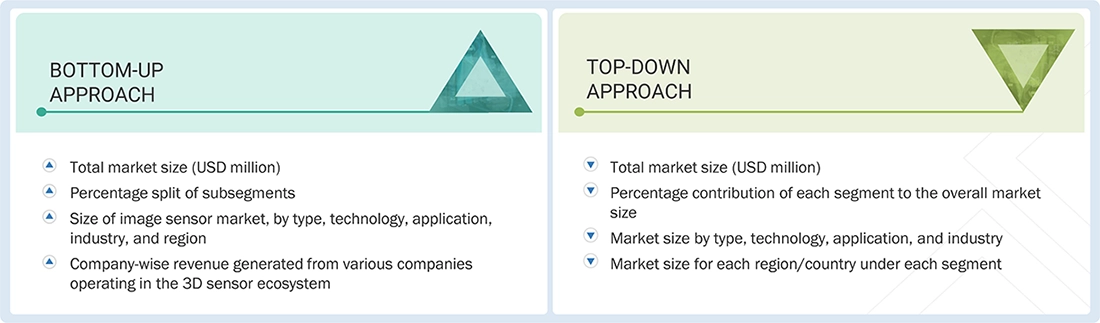
Data Triangulation
After determining the overall market size through the estimation process, as explained above, the total market was divided into several segments and subsegments. To complete the overall market engineering process and obtain precise statistics for all segments and subsegments, the data triangulation procedure was employed, as applicable. The data was triangulated by studying various factors and trends from the demand and supply sides. Additionally, the market has been validated using both top-down and bottom-up approaches.
Market Definition
A 3D sensor is a device that measures distance to objects by emitting some form of energy (such as light or sound) and detecting the reflected signal. Unlike traditional 2D cameras, which capture flat images, 3D sensors provide in-depth information, enabling them to perceive the three-dimensional structure of the scene. This technology is widely used in various applications, including augmented reality, virtual reality, gesture recognition, robotics, automotive safety systems, and more, where accurate spatial understanding is crucial for interaction and decision-making processes.
Key Stakeholders
- 3D Sensor Manufacturers
- Component Suppliers
- Original Equipment Manufacturers (OEMs)
- End Users
- System Integrators
- Resellers and Distributors
- Regulatory Bodies and Compliance Agencies
- Research Institutions
- Industry Associations and Organizations
- Investors and Financial Institutions
Report Objectives
- To describe and forecast the 3D sensor market, in terms of value, based on type, technology application, and industry
- To define and forecast the market size, in terms of value, with regard to four main regions: North America, Europe, Asia Pacific, and RoW (Rest of the World)
- To describe and forecast the market size for 3D sensors, by type and region, in terms of volume
- To provide detailed information regarding drivers, restraints, opportunities, and challenges influencing the growth of the market
- To understand the impact of artificial intelligence (AI) on the market
- To strategically analyze micromarkets with respect to individual growth trends, prospects, and contributions to the total market
- To provide a qualitative overview of the digital and analog outputs of 3D sensors
- To provide a qualitative overview of different technologies of 3D sensors
- To analyze opportunities for various stakeholders by identifying high-growth segments of the market
- To strategically profile key players and comprehensively analyze their market position in terms of ranking and core competencies, along with detailing the competitive landscape of the market
- To analyze competitive developments, such as acquisitions, product launches, developments, and partnerships in the market
- To provide a detailed overview of the ecosystem analysis, case study analysis, patent analysis, trade analysis, technology analysis, average selling price (ASP) analysis, AI/Gen AI impact analysis, Porter’s five forces analysis, macroeconomic outlook, and regulatory landscape pertaining to the 3D sensor market
Available customizations:
With the given market data, MarketsandMarkets offers customizations according to the company’s specific needs. The following customization options are available for the report:
Key Questions Addressed by the Report
What is the 3D Sensors Market?
The 3D sensors market covers sensing technologies that capture depth, distance, shape, and spatial information about objects or environments. These sensors are used across consumer electronics, automotive, industrial automation, healthcare, aerospace, and security applications.
What is the size of the 3D Sensors Market?
According to MarketsandMarkets, the global 3D sensors market is projected to grow from USD 8.26 billion in 2026 to USD 21.45 billion by 2032, registering a CAGR of 17.2% during the forecast period.
What are the major growth drivers of the 3D Sensors Market?
Key growth drivers include increasing adoption of 3D sensors in automotive safety systems, industrial automation, robotics, consumer electronics, security and surveillance, and healthcare applications.
What are the major types of 3D sensors?
Major 3D sensing technologies include time-of-flight (ToF), structured light, stereo vision, and LiDAR-based sensing. Each technology offers different capabilities in terms of range, accuracy, speed, and application suitability.
Which technology is widely used in the 3D Sensors Market?
Time-of-flight (ToF), structured light, stereo vision, and LiDAR are important technologies in the market. Their adoption varies by application, with factors such as sensing range, accuracy, cost, and environmental conditions influencing technology selection.
What are the major applications of 3D sensors?
Major applications include machine vision, robotics, autonomous vehicles, ADAS, facial recognition, gesture recognition, AR/VR, object detection, industrial inspection, security and surveillance, and medical imaging.
Why are 3D sensors important for automotive applications?
3D sensors provide depth and spatial information that can support advanced driver assistance systems, autonomous driving, obstacle detection, parking assistance, driver monitoring, and other vehicle perception functions.
How are 3D sensors used in industrial automation?
In industrial environments, 3D sensors are used for robot navigation, object detection, dimensional inspection, bin picking, quality control, assembly automation, and warehouse automation, helping machines understand the position and shape of objects.
Which industries are adopting 3D sensors?
Key industries include consumer electronics, automotive, industrial manufacturing, healthcare, aerospace and defense, logistics, security and surveillance, and robotics.
What is the future outlook for the 3D Sensors Market?
The market is expected to expand as manufacturers increasingly integrate 3D sensing into AI-powered devices, autonomous systems, robotics, smart factories, connected vehicles, AR/VR platforms, and advanced security solutions. The combination of AI and depth sensing is expected to create further application opportunities.


Personalize This Research
- Triangulate with your Own Data
- Get Data as per your Format and Definition
- Gain a Deeper Dive on a Specific Application, Geography, Customer or Competitor
- Any level of Personalization
Let Us Help You
- What are the Known and Unknown Adjacencies Impacting the 3D Sensor Market
- What will your New Revenue Sources be?
- Who will be your Top Customer; what will make them switch?
- Defend your Market Share or Win Competitors
- Get a Scorecard for Target Partners

Custom Market Research Services
We Will Customise The Research For You, In Case The Report Listed Above Does Not Meet With Your Requirements
Get 10% Free CustomisationTESTIMONIALS

Tetsuya Ohhira
Business Development Manager-Technology Business
Nikon Corporation,
Leading Japanese MNC specializing in optics and imaging productswww.nikon.com
MarketsandMarkets™ response
is quick. Their attitude is flexible and positive. Analyst Insights are globally considered and
significant. Client Services quickly respond to our inquiry and demand. Their wide range of global
surveys help us make our strategic plan.
We hope Knowledge Store will be easier to search
for a report.
VP - Marketing & Business Development
Leading Provider of Process Control Solutions
We engaged with MarketsandMarkets on a study to perform an analysis and recommend a Go-To-Market strategy for metrology and process control in the semiconductor market. The study was tailored to our targets and needs with well-defined milestones. Our overall experience with the MarketsandMarkets team was very good throughout the project in all aspects including the analysis methodologies used, the quality and depth of primary and secondary data sets, the professionalism and flexibility of the team and the ability to meet the target schedule and milestones. We want to thank MarketsandMarkets team for a job well done.
- Rest Of Middle East 3D Sensor Market
- Saudi Arabia 3D Sensor Market
- UAE 3D Sensor Market
- Argentina 3D Sensor Market
- Brazil 3D Sensor Market
- Rest Of South America 3D Sensor Market
- US 3D Sensor Market
- Canada 3D Sensor Market
- Mexico 3D Sensor Market
- UK 3D Sensor Market
- Germany 3D Sensor Market
- France 3D Sensor Market
- China 3D Sensor Market
- Japan 3D Sensor Market
- South Korea 3D Sensor Market
- India 3D Sensor Market
- Rest Of Europe 3D Sensor Market
- Rest Of Asia Pacific 3D Sensor Market
Growth opportunities and latent adjacency in 3D Sensor Market






rudolf
Aug, 2014
we are intrested in 3D metrology for industrial, medical, and professional applications. To what extend does this report adress the area of our interest?.
Emily
Feb, 2015
We are working on depth sensors market and would like to know scope difference between 3D sensor and depth sensor. .
Tadamasa
Nov, 2017
Have you increased pricing analysis? We want to understand Unit price in each technology(ToF, Structured light, etc.). Also we would like to know sources used in analysis of this market study..
Axel
Aug, 2014
In particular we are interested in stereo cameras and future perspectives. Our main focus is on stereo-based solutions for video surveillance and airport security. We would like to know market perspectives and challenges for the same..