

Augmented and Virtual Reality Technology Innovation: Key Trends, Growth Drivers and Opportunities
Introduction to Augmented and Virtual Reality Technology
Augmented Reality (AR) and Virtual Reality (VR) technologies are transforming how people interact with digital content by creating immersive, interactive, and intelligent experiences across industries. AR enhances the real-world environment by overlaying digital information, while VR creates fully immersive virtual environments for users. As organizations accelerate digital transformation, AR and VR are becoming essential technologies for gaming, healthcare, manufacturing, education, retail, defense, and enterprise collaboration. Continuous advancements in artificial intelligence (AI), spatial computing, cloud computing, 5G connectivity, and wearable devices are further expanding the capabilities and commercial adoption of AR and VR solutions worldwide.
History of Augmented and Virtual Reality Technology
The concept of virtual reality dates back to the 1960s with the development of early simulation systems, while augmented reality gained momentum in the 1990s through advancements in computer vision and graphics. Initially adopted for military training, aviation, and research applications, AR and VR technologies have evolved significantly due to improvements in processing power, display technologies, sensors, and connectivity. Today, the emergence of lightweight headsets, AI-powered applications, mixed reality platforms, and enterprise solutions has accelerated the adoption of immersive technologies across both consumer and industrial sectors.
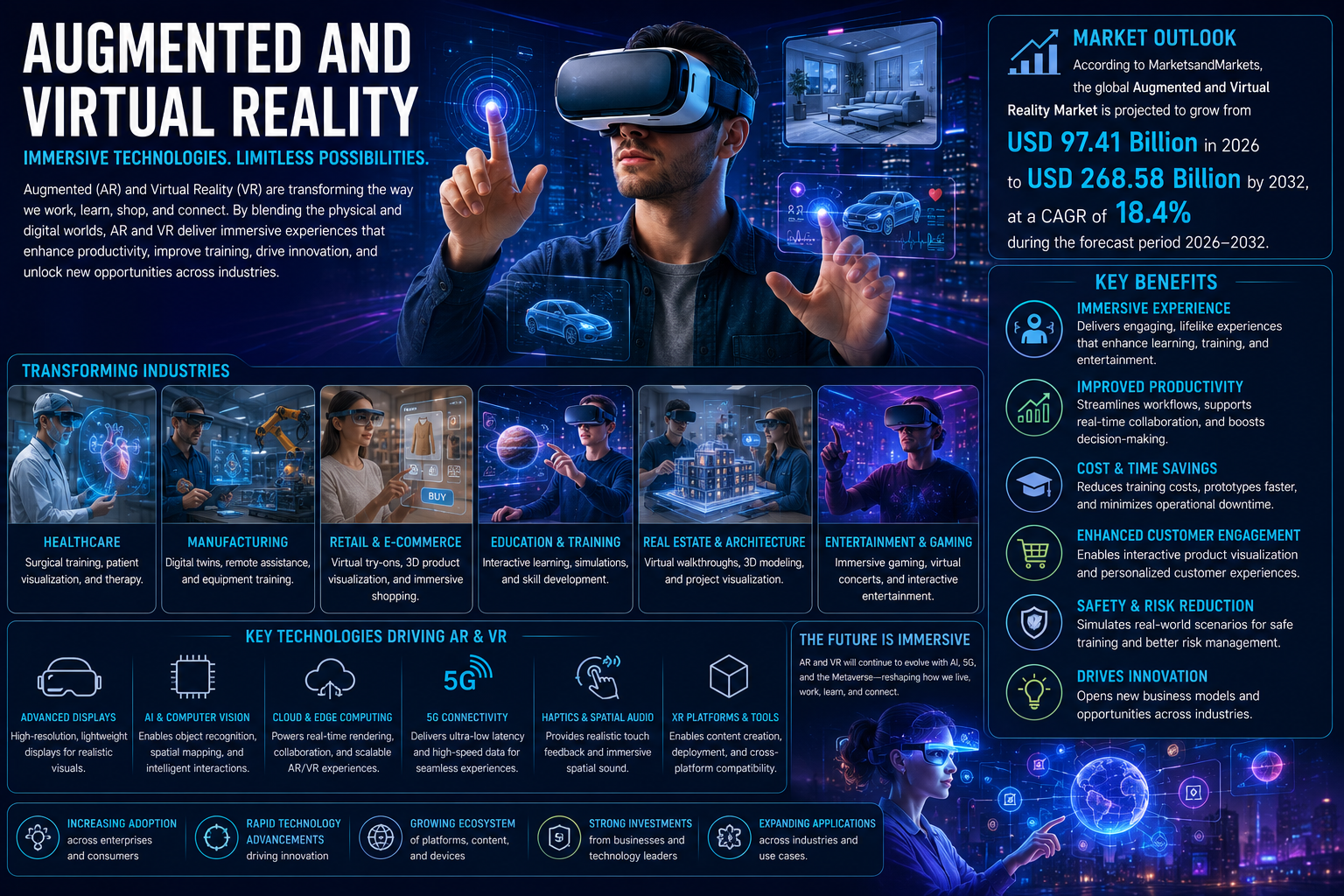
Benefits of Augmented and Virtual Reality Technology
Augmented and Virtual Reality technologies enable organizations to improve productivity, enhance user engagement, and deliver immersive digital experiences across various applications. By combining real and virtual environments, these technologies support better visualization, real-time collaboration, and interactive learning while improving operational efficiency and customer experiences.
Key Benefits Include:
- Enhances immersive learning, training, and simulation experiences.
- Improves product visualization and customer engagement.
- Supports remote collaboration and virtual workplace environments.
- Enables faster product design, prototyping, and engineering visualization.
- Increases operational efficiency through real-time guidance and digital workflows.
- Improves healthcare diagnostics, surgical planning, and medical training.
- Enhances gaming, entertainment, and interactive media experiences.
- Supports smart manufacturing, maintenance, and field service operations.
Current Market Size and Growth Trends of the Augmented and Virtual Reality Market
The Augmented and Virtual Reality market is experiencing rapid growth as organizations increasingly adopt immersive technologies to improve business operations, customer engagement, workforce training, and digital collaboration. Growing investments in AI, spatial computing, extended reality (XR), cloud platforms, and 5G networks are accelerating the commercialization of AR and VR solutions across enterprise and consumer markets. The expanding adoption of wearable devices, smart glasses, VR headsets, and industrial visualization tools continues to create new opportunities across multiple industries.
According to MarketsandMarkets, the global Augmented and Virtual Reality market was valued at USD 97.41 billion in 2026 and is projected to reach USD 268.58 billion by 2032, growing at a CAGR of 18.4% during the forecast period (2026–2032).
Key Market Growth Drivers
- Growing adoption of AI-powered AR and VR applications.
- Expansion of 5G networks enabling low-latency immersive experiences.
- Increasing investments in enterprise digital transformation initiatives.
- Rising demand for virtual training, remote collaboration, and digital learning.
- Growing adoption of smart glasses, VR headsets, and wearable devices.
- Increasing use of immersive technologies across healthcare, manufacturing, retail, and education.
- Continuous advancements in spatial computing, cloud computing, and mixed reality platforms.
Key Drivers and Factors Influencing the Future of Augmented and Virtual Reality Technology
The future of Augmented Reality (AR) and Virtual Reality (VR) technology is being driven by rapid digital transformation, increasing enterprise adoption, and continuous advancements in artificial intelligence (AI), spatial computing, cloud computing, and 5G connectivity. Organizations across industries are investing in immersive technologies to improve employee training, customer engagement, remote collaboration, and operational efficiency. As AR and VR devices become more affordable, lightweight, and powerful, their adoption is expected to accelerate across both consumer and enterprise applications.
Key Growth Drivers
- Growing adoption of AI-powered immersive applications across industries.
- Expansion of 5G networks enabling seamless, low-latency AR/VR experiences.
- Increasing investments in enterprise digital transformation and Industry 4.0 initiatives.
- Rising demand for remote collaboration, virtual meetings, and hybrid work solutions.
- Growing use of AR/VR-based training and simulation in healthcare, defense, manufacturing, and education.
- Increasing adoption of smart glasses, VR headsets, and wearable devices.
- Strong investments by leading technology companies in metaverse and spatial computing platforms.
Emerging Trends in Augmented and Virtual Reality Technology
Augmented and Virtual Reality technologies are rapidly evolving with innovations that improve user experience, realism, and enterprise scalability. Advances in AI, extended reality (XR), cloud rendering, and edge computing are enabling more immersive and intelligent digital experiences. At the same time, next-generation wearable devices and software platforms are making AR and VR solutions more accessible for both businesses and consumers.
Key Emerging Trends
- Growing adoption of Extended Reality (XR) combining AR, VR, and Mixed Reality (MR).
- Integration of AI and Generative AI for intelligent and personalized immersive experiences.
- Expansion of spatial computing for real-world digital interaction.
- Increasing deployment of cloud-based AR/VR platforms for enterprise collaboration.
- Rising adoption of digital twins powered by immersive visualization technologies.
- Development of lightweight AR smart glasses and next-generation VR headsets.
- Increasing use of haptic feedback and eye-tracking technologies for enhanced realism.
Opportunities and Challenges in the Augmented and Virtual Reality Market
The Augmented and Virtual Reality market presents significant opportunities as businesses increasingly adopt immersive technologies to improve productivity, customer engagement, and digital collaboration. The growing use of AR and VR across manufacturing, healthcare, retail, education, and entertainment is creating new revenue opportunities for technology providers. However, challenges related to hardware costs, content development, user adoption, and data privacy continue to influence market growth.
Key Opportunities
- Growing adoption in healthcare for medical training, diagnostics, and surgical planning.
- Expansion of industrial manufacturing through virtual design, maintenance, and workforce training.
- Rising demand in retail and eCommerce for virtual shopping and product visualization.
- Increasing implementation in education for immersive learning experiences.
- Growth of gaming, entertainment, tourism, and live virtual events.
- Expanding use of Digital Twin technology for industrial operations and smart cities.
Key Challenges
- High cost of advanced AR/VR hardware and enterprise deployment.
- Limited availability of high-quality immersive content.
- Data privacy and cybersecurity concerns for connected AR/VR devices.
- Motion sickness and user comfort issues in prolonged VR usage.
- Integration challenges with existing enterprise IT infrastructure.
- Need for standardized development platforms and interoperability.
Innovations and Advancements in Augmented and Virtual Reality Technology
Continuous innovation is expanding the capabilities of AR and VR technologies, making them more intelligent, immersive, and commercially scalable. Advances in AI, graphics processing, cloud computing, wearable devices, and spatial mapping are enabling highly realistic digital experiences for enterprise and consumer applications. These innovations are accelerating the adoption of immersive technologies across digital transformation initiatives worldwide.
Recent Innovations
- AI-powered object recognition and real-time scene understanding.
- High-resolution micro-OLED and microLED displays for improved visual quality.
- Cloud rendering and edge computing for low-latency immersive experiences.
- Advanced hand tracking, eye tracking, and gesture recognition technologies.
- Lightweight wireless AR smart glasses and standalone VR headsets.
- Integration of AR/VR with Digital Twin, IoT, and industrial automation platforms.
- Enhanced haptic feedback and spatial audio for highly immersive user experiences.
Future Applications and Industries That Will Benefit from Augmented and Virtual Reality Technology
Augmented Reality (AR) and Virtual Reality (VR) technology is expected to become a core pillar of digital transformation as organizations increasingly adopt immersive technologies to improve productivity, customer engagement, training, and operational efficiency. The convergence of artificial intelligence (AI), spatial computing, Digital Twins, cloud computing, IoT, and 5G connectivity is enabling highly interactive virtual experiences that extend beyond entertainment into mission-critical enterprise applications. As hardware becomes more affordable and software platforms mature, AR and VR will continue to reshape industries by enabling smarter decision-making, enhanced collaboration, and immersive digital experiences.
Key Future Applications
- Healthcare: Improve surgical planning, medical education, patient rehabilitation, mental health therapy, and remote healthcare through immersive simulations and real-time visualization.
- Manufacturing & Industry 4.0: Enable virtual factory design, Digital Twin visualization, equipment maintenance, workforce training, and remote technical assistance.
- Retail & eCommerce: Deliver immersive shopping experiences through virtual stores, interactive product visualization, virtual fitting rooms, and personalized customer engagement.
- Education & Training: Enhance classroom learning, corporate training, technical skill development, and virtual laboratories with interactive simulations and experiential learning.
- Architecture, Engineering & Construction (AEC): Support 3D building visualization, virtual walkthroughs, collaborative design reviews, and construction planning.
- Gaming & Entertainment: Create next-generation immersive gaming, virtual concerts, sports broadcasting, theme park experiences, and interactive storytelling.
- Automotive & Aerospace: Improve product design, virtual prototyping, employee training, maintenance support, and driving or flight simulation.
- Defense & Public Safety: Enable realistic military simulations, mission planning, emergency response training, and situational awareness using immersive environments.
- Tourism & Real Estate: Offer virtual property tours, destination previews, museum experiences, and interactive travel planning.
- Enterprise Collaboration: Support hybrid work environments with immersive virtual meetings, digital workspaces, and collaborative product development.
As immersive technologies continue to evolve, AR and VR will become fundamental tools for creating intelligent digital experiences across enterprise operations, consumer applications, and next-generation smart ecosystems.
Conclusion: The Promising Future of Augmented and Virtual Reality Technology
Augmented and Virtual Reality technology is transforming the way businesses and consumers interact with digital information by bridging the gap between physical and virtual environments. From enterprise collaboration and industrial automation to healthcare, education, retail, and entertainment, immersive technologies are becoming essential tools for improving productivity, accelerating innovation, and enhancing user experiences.
Looking ahead, the convergence of AR, VR, AI, Digital Twins, IoT, cloud computing, and advanced wearable technologies will unlock new opportunities across virtually every industry. Organizations investing in immersive technologies today will be well positioned to drive innovation, improve operational efficiency, strengthen customer engagement, and gain a competitive advantage in the rapidly evolving digital economy.
Find More Information on Augmented and Virtual Reality Technology Innovation @ https://www.marketsandmarkets.com/Market-Reports/augmented-reality-virtual-reality-market-1185.html
80% of the Forbes Global 2000 B2B companies rely on MarketsandMarkets to identify growth opportunities in emerging technologies and use cases that will have a positive revenue impact.
- Food Packaging Market Size Set for Strong Growth Through 2030 Amid Rising Demand for Convenience Foods
- Crop Protection Chemical Market Size, Share & Growth Forecast (2025–2030)
- Mulch Films Market: Driving Sustainable Agriculture Through Innovation
- Agricultural Adjuvants Market Analysis, Trends, and Growth Outlook (2026–2031)
- Japan Enterprise Asset Management Market Growth: AI and Smart Infrastructure Drive Demand

