

Automated Storage and Retrieval System (ASRS) Technology Innovation: Key Trends, Growth Drivers and Opportunities
Introduction to ASRS Technology
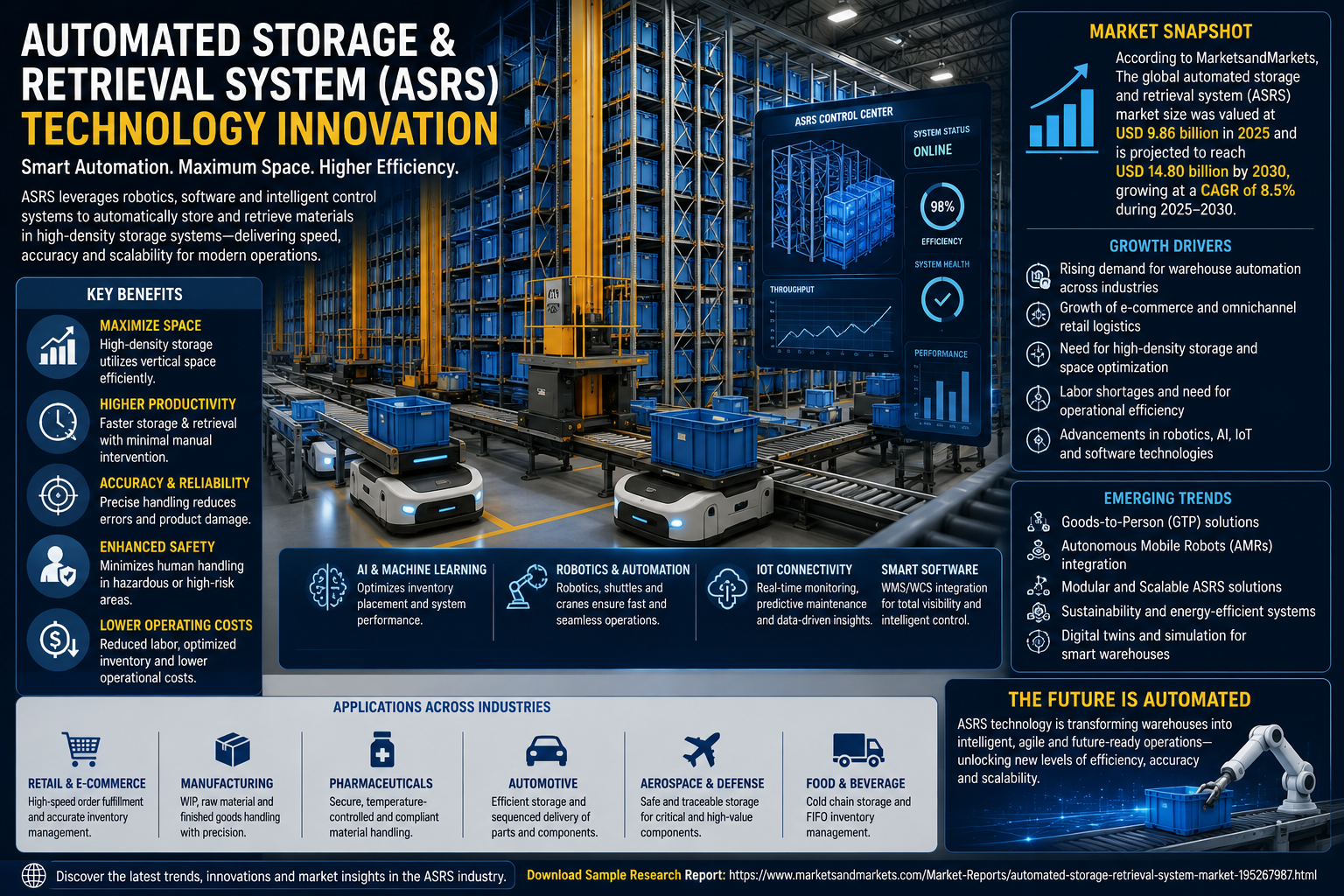
Automated Storage and Retrieval Systems (ASRS) are computer-controlled material handling solutions that automatically place and retrieve loads from defined storage locations. They improve warehouse efficiency, accuracy, space utilization, and productivity across manufacturing, retail, e-commerce, healthcare, and logistics.
History of ASRS
ASRS technology evolved from early automated warehouses in the 1950s and has advanced through robotics, barcode scanning, warehouse management systems, AI, IoT, and autonomous mobile robots, making modern warehouses faster and more intelligent.
Benefits of ASRS
ASRS delivers improved inventory accuracy, reduced labor costs, higher storage density, enhanced worker safety, faster order fulfillment, and 24/7 warehouse operations.
Current market size and growth trends of the ASRS industry
According to MarketsandMarkets, the global automated storage and retrieval system (ASRS) market size was valued at USD 9.86 billion in 2025 and is projected to reach USD 14.80 billion by 2030, growing at a CAGR of 8.5% during 2025–2030. Growth is driven by expanding e-commerce, increasing warehouse automation, labor shortages, and the adoption of Industry 4.0 technologies.
This rapid growth can be attributed to several factors:
- Growing adoption of warehouse automation across e-commerce and retail.
- Increasing demand for high-density storage solutions.
- Integration of AI, robotics, IoT and warehouse management software.
- Expansion of cold chain, food & beverage, and pharmaceutical logistics.
- Rising investments in smart factories and distribution centers.
Key drivers and factors influencing the future of ASRS
Key drivers include labor shortages, demand for same-day delivery, digital transformation, sustainability initiatives, and increasing warehouse throughput requirements.
Emerging trends in ASRS technology
AI-powered inventory optimization, autonomous mobile robots, predictive maintenance, digital twins, vision-guided robotics, and cloud-connected warehouse platforms are reshaping ASRS.
Opportunities and challenges in the ASRS market
Opportunities exist in e-commerce, manufacturing, healthcare, and cold storage. Challenges include high capital investment, system integration complexity, and workforce upskilling.
Innovations and advancements in ASRS technology
Innovations include shuttle-based ASRS, cube storage, robotic picking, AI-enabled analytics, machine vision, and real-time inventory visibility.
Future applications and industries that will benefit from ASRS
Retail, automotive, food & beverage, pharmaceuticals, airports, third-party logistics, and semiconductor manufacturing are expected to benefit significantly.
Conclusion
ASRS technology is becoming a strategic investment for organizations seeking efficient, scalable, and intelligent warehouse operations. According to MarketsandMarkets, continued market growth reflects increasing adoption of automation and smart logistics.
Download Sample Research Report:
80% of the Forbes Global 2000 B2B companies rely on MarketsandMarkets to identify growth opportunities in emerging technologies and use cases that will have a positive revenue impact.
- Food Packaging Market Size Set for Strong Growth Through 2030 Amid Rising Demand for Convenience Foods
- Crop Protection Chemical Market Size, Share & Growth Forecast (2025–2030)
- Mulch Films Market: Driving Sustainable Agriculture Through Innovation
- Agricultural Adjuvants Market Analysis, Trends, and Growth Outlook (2026–2031)
- Japan Enterprise Asset Management Market Growth: AI and Smart Infrastructure Drive Demand

