
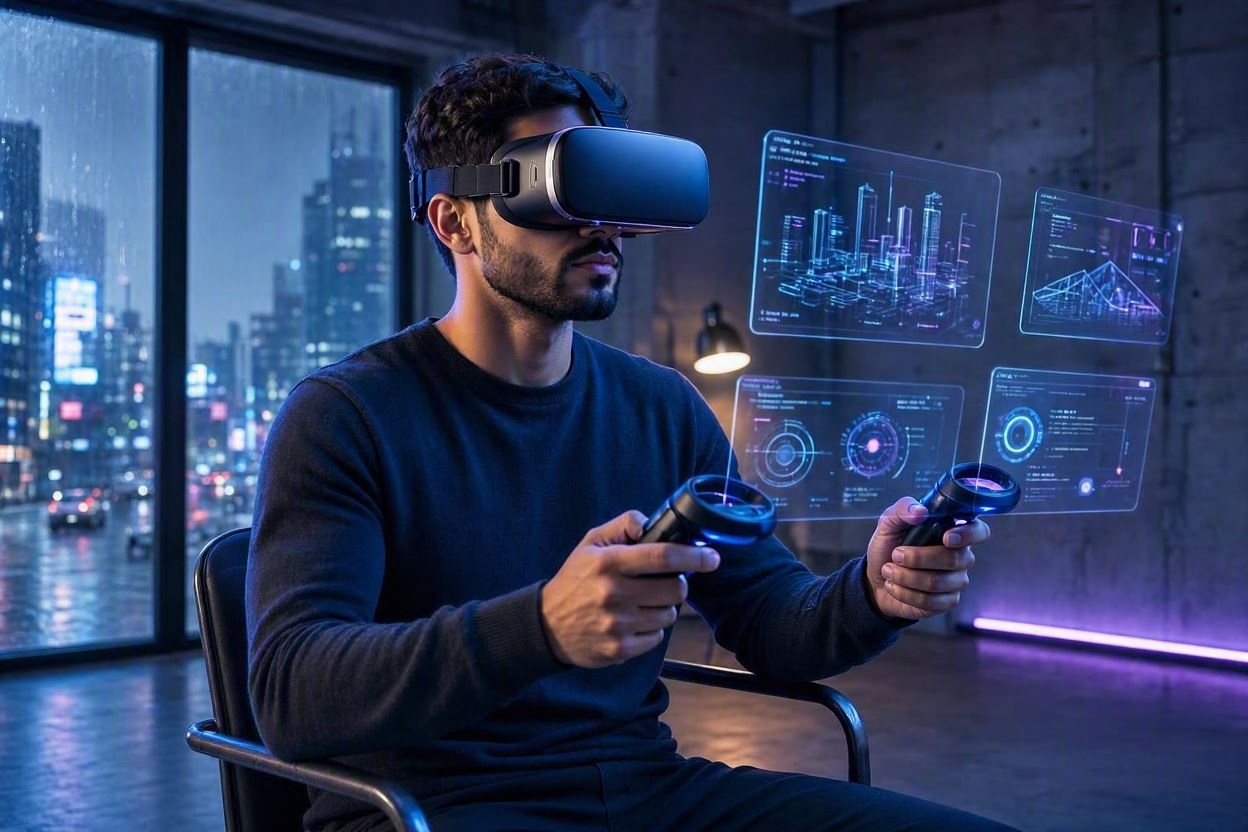
How AutoVRse $2.4 Million Funding Signals a New Growth Phase for the Virtual Reality (VR) Market
The industrial metaverse is steadily moving from concept to commercial reality. Bengaluru-based startup AutoVRse recently raised $2.4 million in a funding round co-led by Singularity AMC and Lumikai, underscoring growing investor confidence in immersive technologies designed for enterprise applications. Unlike consumer-focused virtual reality experiences centered on gaming and entertainment, AutoVRse has built its business around industrial training, AI-powered field guidance, and digital twin-based operational support for sectors such as manufacturing, pharmaceuticals, healthcare, and energy.
The company claims annual recurring revenue exceeding $8 million, with nearly half of its revenue generated outside India. Its customer roster includes multinational organizations such as Amazon, Shell, Exxon Mobil, Bosch, and HDFC Bank. The newly secured capital is expected to support product development and accelerate expansion across North America and Europe.
At first glance, the announcement appears to be another startup funding story. However, the implications run much deeper. It reflects a broader transformation in how enterprises are approaching workforce development, operational safety, and knowledge transfer. Companies are increasingly replacing conventional classroom-based training with immersive, data-driven learning environments capable of reducing risks and improving efficiency.
For business leaders, investors, and technology providers, AutoVRse's latest funding round offers an important signal: enterprise virtual reality is evolving into a strategic infrastructure layer for industrial operations. As AI, digital twins, and spatial computing converge, immersive technologies are emerging as a critical enabler of next-generation workforce productivity.
Breaking Down the News
AutoVRse has secured fresh funding worth $2.4 million from Singularity AMC and gaming-focused venture capital firm Lumikai. The Bengaluru-based company specializes in virtual reality platforms designed to train employees and provide real-time guidance for complex physical tasks.
Unlike many VR startups focused on entertainment, AutoVRse operates in highly specialized sectors where safety, precision, and workforce readiness are critical. Its solutions are used across:
- Manufacturing
- Pharmaceuticals
- Healthcare
- Energy and utilities
- Industrial operations
The company leverages artificial intelligence and immersive digital environments to simulate real-world scenarios. These virtual environments help employees acquire skills, practice procedures, and receive contextual guidance before entering hazardous or high-value operational settings.
A Strong Enterprise Foundation
One of the most notable aspects of AutoVRse's growth story is its business model. The company reports annual recurring revenue (ARR) exceeding $8 million, highlighting the shift from project-based deployments toward long-term enterprise software relationships.
Several global organizations have adopted the platform, including:
|
Enterprise Customer |
Industry |
|---|---|
|
Amazon |
Logistics and E-commerce |
|
Shell |
Energy |
|
Exxon Mobil |
Oil and Gas |
|
Bosch |
Manufacturing |
|
HDFC Bank |
Financial Services |
This customer mix demonstrates that immersive technologies are no longer confined to gaming or consumer entertainment. Instead, they are becoming productivity tools for diverse industries.
Why North America and Europe Matter
The newly raised capital will support expansion into North America and Europe—two regions characterized by:
- Advanced manufacturing ecosystems.
- Increasing labor shortages.
- Growing demand for workforce reskilling.
- Stricter workplace safety regulations.
- Higher adoption of Industry 4.0 technologies.
These markets represent significant opportunities but also introduce challenges related to regulatory compliance, competition, and localization.
The Bigger Picture: AI Meets the Industrial Metaverse
AutoVRse sits at the intersection of several transformative technologies:
- Artificial intelligence
- Spatial computing
- Digital twins
- Extended reality (XR)
- Industrial automation
The company reportedly possesses a decade-long repository of physical workflow data. Such datasets are increasingly valuable because they can train AI models capable of understanding and assisting complex industrial tasks.
This convergence of AI and immersive technologies is giving rise to what many analysts describe as the industrial metaverse—a digital environment where workers, machines, and intelligent systems interact in real time.
Why This News Matters Beyond the Headlines
Funding announcements often attract attention because of the numbers involved. Yet the significance of AutoVRse's latest investment extends beyond venture capital activity. It highlights fundamental shifts occurring across industrial operations, workforce management, and enterprise technology spending.
Enterprises Are Rethinking Workforce Training
Traditional training methods frequently rely on manuals, videos, and classroom sessions. While effective for theoretical knowledge, they often fail to replicate real-world complexity.
Virtual reality introduces experiential learning, allowing workers to:
- Practice high-risk procedures safely.
- Develop muscle memory through repetition.
- Reduce human error.
- Accelerate onboarding timelines.
- Improve retention and skill transfer.
As labor shortages and demographic shifts intensify, organizations are prioritizing technologies that preserve institutional knowledge while improving productivity.
Safety Is Becoming a Strategic Priority
Industries such as manufacturing, pharmaceuticals, and energy operate under strict safety requirements. Mistakes can result in:
- Equipment damage.
- Regulatory penalties.
- Production losses.
- Environmental incidents.
- Human injuries.
Immersive simulations offer a safer environment for employees to practice critical procedures before operating expensive or hazardous equipment. Consequently, safety technology is evolving from a compliance function into a competitive advantage.
AI Is Expanding the Value Proposition
Artificial intelligence is transforming VR from a static visualization tool into an intelligent operational platform.
AI-driven systems can:
- Provide real-time guidance.
- Analyze worker behavior.
- Personalize training experiences.
- Predict skill gaps.
- Improve decision-making.
This combination significantly enhances the return on investment for enterprise VR deployments.
The Industrial Metaverse Is Becoming Practical
For several years, discussions surrounding the metaverse were dominated by consumer applications and speculative visions. However, industrial use cases are proving more tangible and economically viable.
Manufacturers increasingly use immersive technologies for:
- Workforce training.
- Digital twins.
- Remote assistance.
- Maintenance operations.
- Process optimization.
AutoVRse's success suggests that the industrial metaverse may deliver measurable business value long before consumer metaverse applications reach mass adoption.
Investors Are Looking for Enterprise Software Models
One of the strongest signals emerging from this funding round is the preference investors have for recurring revenue models.
Enterprise-focused VR companies offer:
- Long-term contracts.
- Higher customer retention.
- Predictable cash flows.
- Stronger margins.
- Scalable software ecosystems.
This model differs significantly from hardware-centric businesses, which often face intense competition and margin pressures.
India Is Emerging as a Global Deep-Tech Hub
AutoVRse's expansion reflects a broader trend within India's technology ecosystem. Indian startups are increasingly building specialized B2B platforms capable of competing globally.
Areas witnessing significant innovation include:
- Artificial intelligence.
- Industrial automation.
- Digital twins.
- Robotics.
- Extended reality.
- Spatial computing.
Rather than serving only domestic markets, many Indian deep-tech firms are generating substantial revenue overseas, signaling a shift toward globally competitive enterprise innovation.
A Signal for the Future of Work
Ultimately, AutoVRse's funding round is not merely about one company. It represents the ongoing transformation of work itself.
Future industrial environments are likely to combine:
- Human expertise.
- Artificial intelligence.
- Real-time analytics.
- Digital twins.
- Immersive collaboration tools.
Organizations that invest early in these technologies may gain advantages in productivity, workforce development, and operational resilience.
The latest funding round serves as another indication that immersive technologies are moving from experimental initiatives to mission-critical enterprise platforms. For decision-makers, the question is no longer whether virtual reality will influence industrial operations—but how quickly organizations can capitalize on its potential.
What This Means for the Virtual Reality (VR) Market
AutoVRse's latest funding round represents more than an isolated startup success story. It validates a broader shift underway across the Virtual Reality (VR) Market, where enterprise applications are emerging as one of the strongest long-term growth engines.
According to MarketsandMarkets, the global Virtual Reality (VR) Market was valued at USD 15.9 billion in 2024 and is projected to grow from USD 20.48 billion in 2025 to USD 38.0 billion by 2029, registering a CAGR of 19.1%. While gaming and entertainment continue to represent major segments, industrial and enterprise use cases are increasingly becoming strategic growth drivers.
Discover What's Driving the Future of Virtual Reality - Download the Sample Report Here - https://www.marketsandmarkets.com/pdfdownloadNew.asp?id=458
AutoVRse's expansion demonstrates that organizations are willing to invest in immersive technologies when they deliver measurable returns through:
- Faster workforce training.
- Improved workplace safety.
- Reduced operational risks.
- Better knowledge retention.
- Increased productivity.
- Lower training costs.
These outcomes align closely with broader digital transformation initiatives taking place across manufacturing, healthcare, energy, logistics, and pharmaceuticals.
Enterprise VR Is Moving Beyond Pilot Projects
Over the past decade, many organizations experimented with VR through limited pilot programs. Today, enterprises are shifting toward full-scale deployments.
Several factors are contributing to this transition:
|
Previous Generation |
Current Trend |
|---|---|
|
One-time demonstrations |
Enterprise-wide implementation |
|
Gaming-centric use cases |
Industrial applications |
|
Standalone devices |
Cloud-connected ecosystems |
|
Visual simulations |
AI-enhanced experiences |
|
Experimental budgets |
Strategic investments |
As hardware costs decline and software capabilities improve, organizations are increasingly integrating VR into day-to-day operations.
Demand Drivers Reshaping the VR Industry
Several structural trends are accelerating growth across the Virtual Reality (VR) Market.
Workforce Reskilling and Labor Shortages
Manufacturing and industrial companies are facing a growing skills gap due to:
- Aging workforces.
- High employee turnover.
- Complex equipment requirements.
- Shortages of specialized technicians.
Immersive learning environments help organizations preserve institutional knowledge while shortening onboarding periods.
Industry 4.0 Transformation
Industry 4.0 technologies are creating interconnected ecosystems involving:
- Artificial intelligence.
- Robotics.
- IoT sensors.
- Digital twins.
- Predictive maintenance.
- Smart factories.
Virtual reality acts as a bridge between physical operations and digital systems, enabling workers to visualize processes and interact with intelligent environments.
Rising Safety Requirements
Regulatory pressures and increasing emphasis on operational resilience are pushing companies to prioritize employee safety.
Virtual simulations provide opportunities to train workers in:
- Hazardous environments.
- Emergency procedures.
- Equipment maintenance.
- Quality control processes.
This capability reduces risk while improving compliance.
Convergence of AI and Spatial Computing
Artificial intelligence is expanding the capabilities of VR systems by introducing:
- Adaptive training experiences.
- Intelligent assistants.
- Real-time recommendations.
- Behavioral analytics.
- Predictive guidance.
The combination of AI and immersive technologies is creating entirely new categories of enterprise software.
Regional Growth Trends
Asia Pacific is expected to witness the fastest growth in the Virtual Reality (VR) Market, driven by technological investments across:
- Manufacturing.
- Healthcare.
- Education.
- Gaming.
- Industrial automation.
Countries including India, China, Japan, and South Korea are becoming important innovation hubs, supported by:
- Expanding digital infrastructure.
- Increasing cloud adoption.
- Growing investments in AI.
- Government support for advanced manufacturing.
Meanwhile, North America and Europe continue to represent major markets for enterprise VR due to strong industrial ecosystems and higher technology spending.
Key Industry Trends Accelerating Market Growth
Rising Enterprise Adoption
Enterprise demand is rapidly becoming one of the most important growth drivers for the VR Industry.
Organizations are using immersive technologies for:
- Employee onboarding.
- Remote collaboration.
- Industrial maintenance.
- Product design.
- Safety training.
- Digital prototyping.
Unlike consumer markets, enterprise deployments often generate recurring revenue and long-term customer relationships.
This shift is attracting both venture capital investment and strategic partnerships.
AI Integration Is Creating Smarter VR Platforms
Artificial intelligence is transforming immersive experiences from static simulations into intelligent systems capable of learning and adapting.
Personalized Training
AI can tailor learning paths based on individual employee performance.
Real-Time Assistance
Workers can receive contextual instructions while performing complex tasks.
Predictive Analytics
Machine learning algorithms can identify skill gaps and operational inefficiencies before they become critical problems.
Intelligent Digital Twins
Combining AI with digital twins enables organizations to simulate operational scenarios and optimize performance.
This convergence is expected to become one of the defining trends of the next decade.
Head-Mounted Displays Continue to Drive Hardware Growth
Head-mounted displays (HMDs) remain among the most important components supporting the Virtual Reality (VR) Market.
Recent innovations include:
- Higher-resolution displays.
- Improved ergonomics.
- Lightweight designs.
- Enhanced battery life.
- Better motion tracking.
As costs continue to decline, accessibility is improving for enterprise customers.
Industrial users increasingly favor wearable technologies because they deliver immersive experiences while maintaining mobility.
Motion Tracking and Haptic Technologies Are Enhancing Realism
The quality of VR experiences depends heavily on user immersion.
Technologies such as:
- Motion tracking.
- Haptic feedback.
- Spatial audio.
- Eye tracking.
- Gesture recognition.
are making simulations more realistic and interactive.
For industries requiring precision, such improvements significantly enhance training effectiveness.
Cloud Computing and 5G Are Expanding VR Capabilities
The growth of cloud infrastructure and 5G networks is reducing one of VR's traditional limitations: latency.
Cloud-enabled architectures allow:
- Remote rendering.
- Collaborative environments.
- Real-time data synchronization.
- Scalable deployment models.
5G connectivity enables high-speed communication, making immersive applications practical across geographically distributed workforces.
This trend is expected to accelerate enterprise adoption worldwide.
Digital Twins Are Becoming Strategic Assets
Digital twins are emerging as one of the most transformative applications within the VR Industry.
Companies can create virtual replicas of:
- Factories.
- Machines.
- Production lines.
- Supply chains.
- Buildings.
These models support:
- Predictive maintenance.
- Operational optimization.
- Process simulations.
- Employee training.
AutoVRse's emphasis on AI-driven field guidance reflects the growing importance of digital twin ecosystems.
Healthcare Is Becoming a Major Growth Segment
Healthcare applications continue to expand beyond medical visualization.
Virtual reality is increasingly used for:
- Surgical planning.
- Clinical education.
- Rehabilitation.
- Therapy.
- Medical device training.
Healthcare organizations are adopting immersive technologies to improve procedural accuracy and reduce training costs.
As healthcare digitization accelerates, this segment is expected to contribute significantly to overall market growth.
Industrial Metaverse Development Is Gaining Momentum
The industrial metaverse is moving beyond theoretical discussions.
Companies are deploying immersive environments to enable:
- Remote collaboration.
- Virtual inspections.
- Workforce training.
- Simulation-based design.
- Smart manufacturing.
Unlike consumer metaverse applications, industrial use cases provide measurable ROI and productivity gains.
AutoVRse's funding highlights how investors increasingly view these opportunities as commercially viable.
Subscription-Based Business Models Are Becoming Dominant
Software-as-a-Service (SaaS) models are reshaping the economics of the VR Industry.
Recurring subscription revenues provide:
- Predictable cash flows.
- Higher customer retention.
- Better scalability.
- Increased valuation potential.
This transition explains why investors are showing growing interest in enterprise VR providers.
Spatial Computing Will Expand the Addressable Market
Spatial computing technologies are creating new opportunities across:
- Manufacturing.
- Automotive.
- Aerospace.
- Retail.
- Healthcare.
- Logistics.
As mixed reality, AI, and advanced sensors converge, immersive environments will evolve from isolated applications into integrated business platforms.
This evolution could redefine how organizations interact with data, machines, and human expertise.
Why AutoVRse's Funding Matters to the Broader Market
Viewed through a market lens, AutoVRse's funding serves as evidence that virtual reality is entering a new phase of maturity.
The market is no longer dependent solely on gaming or entertainment. Instead, growth is increasingly being supported by:
- Enterprise digitization.
- Workforce transformation.
- AI integration.
- Industrial metaverse applications.
- Digital twins.
- Cloud computing and 5G infrastructure.
These trends collectively reinforce expectations that the Virtual Reality (VR) Market will continue expanding throughout the remainder of the decade, creating opportunities for technology vendors, enterprises, and investors seeking exposure to the next generation of immersive computing.
Market Implications for Stakeholders
The acceleration of enterprise virtual reality extends far beyond startups and venture capital. It has strategic implications for business leaders, investors, technology vendors, and policymakers attempting to navigate the next wave of digital transformation.
Implications for Enterprises
Workforce Transformation Will Become a Competitive Advantage
Organizations across manufacturing, healthcare, pharmaceuticals, and energy are facing growing challenges related to labor shortages and knowledge transfer. Experienced workers are retiring, while production systems are becoming increasingly complex.
Immersive technologies offer several advantages:
- Faster onboarding and training.
- Improved employee retention.
- Lower operational risks.
- Enhanced safety compliance.
- Reduced downtime.
Companies that integrate virtual reality with AI and digital twins could gain long-term productivity advantages while building more resilient operations.
Operational Excellence Will Drive Adoption
Unlike many emerging technologies that struggle to demonstrate tangible returns, VR solutions increasingly provide measurable business outcomes.
Organizations are using immersive technologies to:
- Minimize human error.
- Improve procedural accuracy.
- Reduce training costs.
- Increase workforce efficiency.
- Enable remote collaboration.
As return on investment becomes easier to quantify, enterprise adoption is expected to accelerate.
Implications for Investors
Enterprise VR Is Becoming a Scalable Software Opportunity
Historically, virtual reality investment focused heavily on hardware and consumer applications. However, investor sentiment is increasingly shifting toward enterprise software platforms.
Recurring subscription models offer:
- Stable revenue streams.
- Higher margins.
- Strong customer retention.
- Long-term scalability.
Companies positioned at the intersection of AI, digital twins, and spatial computing may attract significant capital over the coming decade.
Industrial Use Cases Provide More Predictable Demand
Unlike consumer markets, industrial deployments typically involve:
- Multi-year contracts.
- Mission-critical applications.
- Deep customer relationships.
- Higher switching costs.
This creates more predictable revenue profiles and makes enterprise VR businesses attractive from an investment perspective.
Implications for Technology Vendors
Ecosystem Partnerships Will Become Essential
No single company can build the industrial metaverse independently.
Success increasingly depends on collaboration between:
- Hardware manufacturers.
- AI platform providers.
- Cloud infrastructure companies.
- Sensor developers.
- Software vendors.
- System integrators.
Technology providers that establish ecosystem partnerships are likely to gain stronger competitive positions.
AI Integration Will Differentiate Market Leaders
Virtual reality platforms are evolving beyond visualization.
Competitive advantages will increasingly depend on:
- Real-time analytics.
- Intelligent assistants.
- Behavioral modeling.
- Adaptive learning systems.
- Predictive maintenance capabilities.
Companies that successfully integrate AI into immersive experiences will be better positioned to capture enterprise spending.
Implications for Governments and Policymakers
Workforce Development Will Become a National Priority
Countries seeking to maintain industrial competitiveness must address growing skill shortages.
Virtual reality technologies offer opportunities to:
- Modernize vocational education.
- Improve worker safety.
- Accelerate reskilling programs.
- Increase manufacturing productivity.
Governments may increasingly support immersive technologies through:
- Research funding.
- Innovation incentives.
- Digital infrastructure investments.
- Industry-academia collaborations.
Digital Sovereignty and Data Governance Will Matter
As immersive systems collect larger amounts of operational and behavioral data, issues surrounding:
- Data privacy.
- Cybersecurity.
- AI governance.
- Compliance standards.
will become increasingly important.
Regions with strong regulatory frameworks may gain advantages in attracting enterprise investment.
Frequently Asked Questions
What is driving growth in the Virtual Reality (VR) Market?
Growth is being driven by rising enterprise adoption, AI integration, digital twins, cloud computing, 5G connectivity, and increasing demand for immersive training. Industries such as manufacturing, healthcare, and energy are embracing VR solutions to improve productivity, reduce risks, and enhance workforce capabilities.
Organizations are adopting VR because immersive technologies provide measurable benefits. These include reduced training time, improved safety, lower operational costs, better employee retention, and increased efficiency. Enterprise use cases are delivering stronger returns on investment than many consumer-focused applications.
How is AI changing the VR Industry?
Artificial intelligence enables VR systems to become interactive and adaptive. AI can personalize training programs, provide real-time guidance, identify skill gaps, and support predictive analytics. Together, AI and immersive technologies are creating intelligent digital environments that enhance productivity and decision-making.
Which industries are adopting virtual reality the fastest?
Manufacturing, healthcare, pharmaceuticals, energy, logistics, aerospace, and automotive industries are among the fastest adopters. These sectors rely heavily on workforce training, operational safety, and process optimization, making immersive technologies particularly valuable.
What role do digital twins play in virtual reality?
Digital twins create virtual replicas of physical assets, factories, and systems. Combined with VR, they enable simulations, predictive maintenance, process optimization, and immersive training experiences. Digital twins are becoming foundational components of Industry 4.0 initiatives.
Why are investors showing increasing interest in enterprise VR companies?
Enterprise-focused VR providers typically generate recurring revenues and maintain long-term relationships with customers. Their software-centric business models provide higher margins and predictable cash flows, making them attractive investment opportunities compared with hardware-only businesses.
Which region is expected to experience the fastest growth in the Virtual Reality Market?
Asia Pacific is projected to be the fastest-growing region due to increasing investments in advanced manufacturing, healthcare technologies, education, cloud infrastructure, and artificial intelligence. Countries such as India, China, Japan, and South Korea are emerging as major innovation hubs.
Will the industrial metaverse become mainstream?
Industrial metaverse applications are already gaining traction because they provide tangible business value. Areas such as workforce training, digital twins, predictive maintenance, and remote collaboration are demonstrating clear returns, making industrial metaverse technologies increasingly practical and commercially viable.
Looking Beyond Today's Headlines
AutoVRse's funding round represents more than confidence in one startup. It reflects a larger shift toward immersive enterprise computing.
The next phase of digital transformation is unlikely to be defined solely by artificial intelligence or automation. Instead, the convergence of AI, spatial computing, digital twins, robotics, and cloud technologies is creating entirely new operating models.
Several trends are expected to shape the future:
AI-Powered Immersive Workspaces
Future work environments will combine virtual reality with intelligent assistants capable of providing contextual support and real-time recommendations.
Autonomous Factories and Digital Twins
Manufacturers are expected to increasingly operate through connected digital ecosystems where virtual and physical systems coexist.
Human-Machine Collaboration
Immersive technologies will enable workers and intelligent machines to collaborate more efficiently, improving productivity while reducing operational risks.
Continuous Workforce Reskilling
As industrial processes become more complex, immersive learning environments may become standard tools for employee development.
Expansion Beyond Manufacturing
Healthcare, logistics, energy, retail, education, and defense sectors are expected to emerge as major adopters of VR-based applications.
The industrial metaverse, once viewed as a futuristic concept, is steadily evolving into a practical framework for enterprise transformation.
Conclusion
AutoVRse's $2.4 million funding round highlights a broader reality: virtual reality is transitioning from experimentation to strategic adoption.
The announcement validates several trends reshaping the Virtual Reality (VR) Market, including:
- Growing enterprise demand.
- AI-enabled immersive experiences.
- Expansion of digital twins.
- Workforce transformation.
- Industrial metaverse development.
- Increasing software-based business models.
For enterprises, the opportunity extends beyond technology deployment. It involves rethinking how people learn, collaborate, and interact with increasingly intelligent systems.
For investors, the rise of enterprise VR represents a new category of scalable software businesses capable of generating recurring revenues and long-term value.
For technology providers, success will depend on combining immersive experiences with artificial intelligence, cloud computing, and ecosystem partnerships.
As the market evolves, understanding competitive dynamics, emerging applications, regional opportunities, and technology roadmaps becomes increasingly complex. This complexity explains why strategic market intelligence has become essential for organizations seeking to navigate the next phase of growth.
MarketsandMarkets projects the global Virtual Reality Market to grow from USD 20.48 billion in 2025 to USD 38.0 billion by 2029, reflecting the accelerating role of immersive technologies across industries. For decision-makers evaluating investment priorities and future opportunities, deeper market insights can provide valuable context beyond today's headlines and help identify where the next wave of value creation may emerge.
80% of the Forbes Global 2000 B2B companies rely on MarketsandMarkets to identify growth opportunities in emerging technologies and use cases that will have a positive revenue impact.
- Food Packaging Market Size Set for Strong Growth Through 2030 Amid Rising Demand for Convenience Foods
- Mulch Films Market: Driving Sustainable Agriculture Through Innovation
- Agricultural Adjuvants Market Analysis, Trends, and Growth Outlook (2026–2031)
- Crop Protection Chemical Market Size, Share & Growth Forecast (2025–2030)
- Japan Enterprise Asset Management Market Growth: AI and Smart Infrastructure Drive Demand


