

Cooled Infrared Detector Thermal Camera Detector Market: Technology, Applications, Trends, and Growth Outlook
Introduction
The cooled infrared detector thermal camera detector market is becoming increasingly important as industries demand higher sensitivity, faster thermal imaging, and accurate detection of small temperature differences. Cooled infrared detectors are used in advanced thermal cameras where performance requirements go beyond the capabilities of conventional uncooled systems. These detectors are particularly relevant in defense and aerospace, scientific research, industrial inspection, surveillance, gas detection, and specialized thermal measurement applications.
The global infrared detector market is projected to grow from USD 0.65 billion in 2025 to USD 1.02 billion by 2030, registering a CAGR of 9.6% during 2025–2030. Growth is supported by rising demand for infrared sensing across security and surveillance, industrial automation, healthcare, automotive, smart buildings, and other applications.
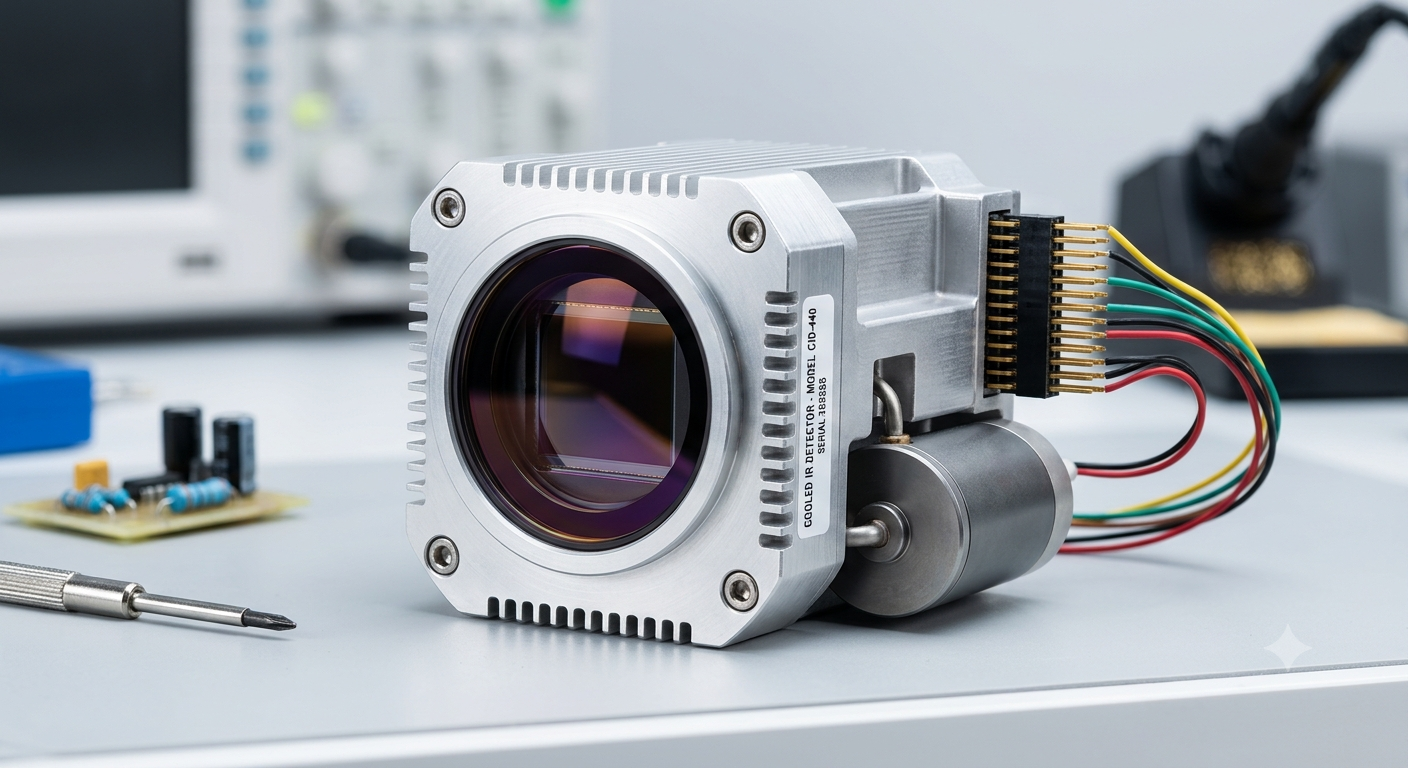
What Is a Cooled Infrared Detector?
A cooled infrared detector is a sensing component used in thermal imaging systems that operates at very low temperatures. A cryogenic cooling system reduces the detector temperature, minimizing thermally generated noise and improving the detector's ability to detect weak infrared signals.
Cooled infrared detectors are generally designed for applications where high sensitivity, fast response, long detection ranges, and precise thermal information are important. Compared with uncooled detectors, cooled systems can provide higher performance in demanding imaging environments, although they generally involve greater system complexity, power consumption, size, weight, and cost.
The performance advantage becomes particularly relevant when a thermal camera must identify small temperature differences or rapidly changing thermal events. Detector sensitivity is commonly evaluated using noise equivalent temperature difference (NETD), where a lower NETD generally indicates better thermal sensitivity.
How Does a Cooled Thermal Camera Detector Work?
A cooled thermal camera combines an infrared detector, optical system, readout electronics, signal processing, and a cooling mechanism. Infrared radiation emitted or reflected by an object enters the camera through specialized optics and reaches the detector.
The detector converts the incoming infrared energy into an electrical signal. The camera's electronics then process this information to generate a thermal image.
The cooling mechanism is an important part of the architecture. By lowering the detector temperature, the system reduces certain sources of thermal noise. This enables the detector to identify weaker infrared signals and capture detailed thermal information.
Cooled detector systems are commonly associated with MWIR and LWIR imaging, depending on the detector material, optical design, and application requirements. Cooled detectors can also support high-speed imaging and specialized spectral filtering applications.
Download PDF Brochure - https://www.marketsandmarkets.com/pdfdownloadNew.asp?id=161116561
Cooled vs. Uncooled Infrared Detectors
Both cooled and uncooled infrared detectors are used to measure infrared energy, but their architectures and performance characteristics differ.
| Parameter | Cooled Infrared Detector | Uncooled Infrared Detector |
|---|---|---|
| Operating condition | Cryogenically cooled | Ambient temperature |
| Sensitivity | Very high | Generally lower |
| Response speed | Suitable for high-speed imaging | Suitable for many general imaging applications |
| System complexity | Higher | Lower |
| Power consumption | Higher | Lower |
| Size and weight | Generally larger | Generally more compact |
| Cost | Higher | Lower |
| Typical applications | Defense, aerospace, scientific research, high-performance imaging | Security, industrial monitoring, automotive, smart buildings |
| Common wavelength applications | MWIR and LWIR | Primarily LWIR |
Uncooled technology is gaining adoption because of its compact design, cost advantages, and suitability for commercial applications. However, cooled systems continue to have an important role where high sensitivity, fast imaging, or demanding detection conditions are required.
Key Applications of Cooled Infrared Detectors
Defense and Aerospace
Defense remains an important application area for cooled infrared detectors. Thermal imaging systems can help detect and identify objects under low-light and challenging environmental conditions. High-performance cooled cameras can be integrated into surveillance systems, electro-optical systems, airborne platforms, targeting systems, and long-range observation equipment.
The ability to detect subtle temperature differences can be valuable for applications requiring target recognition and extended detection distances.
Security and Surveillance
The cooled infrared detector thermal camera detector market also benefits from increasing requirements for advanced surveillance. Thermal cameras can operate without depending on visible light, making infrared imaging useful for perimeter monitoring, border surveillance, critical infrastructure protection, and nighttime observation.
Cooled detectors are particularly relevant when surveillance systems require greater sensitivity or long-range imaging capabilities.
Industrial Inspection
Industrial facilities increasingly use thermal imaging for condition monitoring and inspection. Thermal cameras can help identify abnormal heat patterns associated with electrical equipment, mechanical components, manufacturing processes, and other assets.
Cooled thermal cameras can be particularly useful when inspection requires high sensitivity, rapid thermal response, or detection of small temperature variations.
Gas and Fire Detection
Infrared technology is also used for gas and fire detection. Certain gases absorb infrared radiation at specific wavelengths, allowing specialized optical systems to detect their presence.
Cooled detectors can support high-performance optical gas imaging and other applications where spectral sensitivity is important. Infrared detectors are used across industrial environments including oil and gas and manufacturing.
Scientific Research
Scientific research requires highly sensitive instruments capable of measuring small changes in thermal energy. Cooled infrared detectors are therefore used in research and development applications involving material analysis, combustion studies, electronics testing, spectroscopy, and thermal characterization.
High-speed imaging is another important capability because researchers may need to observe rapidly changing thermal events without significant motion blur.
Role of MWIR and LWIR Technology
Wavelength selection is an important factor in infrared detector development. Mid-wave infrared (MWIR) and long-wave infrared (LWIR) technologies are widely associated with thermal imaging.
MWIR systems can provide high sensitivity for specific applications and are commonly used in advanced imaging and detection systems. LWIR technology is widely used for thermal imaging, surveillance, temperature measurement, and smart building applications.
According to MarketsandMarkets, the LWIR segment accounted for the largest share of the infrared detector market in 2024, supported by applications including thermal imaging, surveillance, and smart building systems.
The selection between MWIR and LWIR depends on factors such as atmospheric conditions, target temperature, required detection range, spectral characteristics, optical design, and application requirements.
Market Growth Drivers
Several factors are supporting demand for infrared detector technologies.
Increasing thermal imaging adoption is one of the major growth drivers. Thermal cameras are being deployed across defense, surveillance, industrial inspection, automotive systems, and healthcare.
Defense modernization is also creating demand for high-performance infrared imaging systems. Governments are investing in advanced sensing, surveillance, and electro-optical technologies.
Industrial automation is another important factor. As factories adopt predictive maintenance and automated inspection, infrared sensing can provide non-contact monitoring of equipment and processes.
Automotive applications are also expanding. Infrared sensing can complement conventional automotive sensors and cameras in driver-assistance and vehicle perception systems.
Smart buildings and IoT are creating demand for compact infrared detectors used for occupancy detection, motion sensing, energy management, and automated building controls. MarketsandMarkets identifies people and motion sensing as a major infrared detector application.
Technological Trends
The cooled infrared detector thermal camera detector market is being influenced by several technology trends.
Miniaturization
Manufacturers are working to reduce the size and weight of thermal imaging systems while maintaining high performance. Smaller components can make infrared systems easier to integrate into airborne, vehicle-mounted, and portable platforms.
Higher Thermal Sensitivity
Improving detector sensitivity allows thermal cameras to identify smaller temperature differences. This is particularly important in defense, scientific research, industrial inspection, and specialized measurement applications.
Faster Imaging
High-speed thermal imaging is becoming increasingly important for capturing rapidly changing events. Cooled detectors can provide advantages for applications where fast frame rates and precise timing are required.
Advanced Signal Processing
Digital signal processing and AI-based image analysis are becoming increasingly relevant to thermal imaging. AI can assist with object detection, classification, anomaly identification, and automated interpretation of thermal images.
Spectral Filtering
Spectral filters can allow infrared cameras to focus on specific wavelength regions. This capability is useful for specialized temperature measurement, gas detection, and scientific applications.
Challenges in the Cooled Infrared Detector Market
Despite their performance advantages, cooled infrared detectors face several challenges.
The first is high system cost. Cooling mechanisms, specialized detector materials, vacuum packaging, optics, and supporting electronics increase system complexity and cost.
Another challenge is power consumption. Cryogenic cooling requires additional power compared with ambient-temperature detector systems.
Size and weight can also restrict deployment in applications where compact and lightweight designs are essential. Cooled cameras may require additional mechanical components and cooling infrastructure.
These limitations are encouraging manufacturers to improve cooling technologies, detector packaging, electronics, and overall system architecture.
Future Outlook
The future of the cooled infrared detector thermal camera detector market will be closely connected to advances in thermal imaging, defense electronics, industrial automation, scientific instrumentation, and intelligent sensing.
While uncooled detectors are expected to remain important for cost-sensitive and compact applications, cooled detectors will continue serving specialized applications where sensitivity, speed, and high-quality thermal information are priorities.
The broader infrared detector market is expected to reach USD 1.02 billion by 2030, up from USD 0.65 billion in 2025. MarketsandMarkets identifies increasing adoption across security and surveillance, industrial automation, healthcare, automotive, and smart buildings as important contributors to market growth.
Asia Pacific is projected to experience strong growth in the infrared detector market, supported by industrial automation, consumer electronics, automotive technologies, security systems, and defense investments.
Conclusion
The cooled infrared detector thermal camera detector market represents an important segment of advanced infrared sensing technology. Cooled detectors provide high sensitivity and fast imaging capabilities that make them suitable for demanding applications in defense, aerospace, surveillance, scientific research, industrial inspection, and specialized detection.
At the same time, improvements in detector materials, cooling systems, optics, signal processing, miniaturization, and AI-based image analysis are helping expand the capabilities of thermal imaging.
As organizations increasingly require reliable sensing in low-light, long-range, and challenging environments, cooled infrared detectors are expected to remain an important technology for high-performance thermal cameras and specialized infrared detection systems.
80% of the Forbes Global 2000 B2B companies rely on MarketsandMarkets to identify growth opportunities in emerging technologies and use cases that will have a positive revenue impact.
- Food Packaging Market Size Set for Strong Growth Through 2030 Amid Rising Demand for Convenience Foods
- Crop Protection Chemical Market Size, Share & Growth Forecast (2025–2030)
- Mulch Films Market: Driving Sustainable Agriculture Through Innovation
- Agricultural Adjuvants Market Analysis, Trends, and Growth Outlook (2026–2031)
- Japan Enterprise Asset Management Market Growth: AI and Smart Infrastructure Drive Demand

