
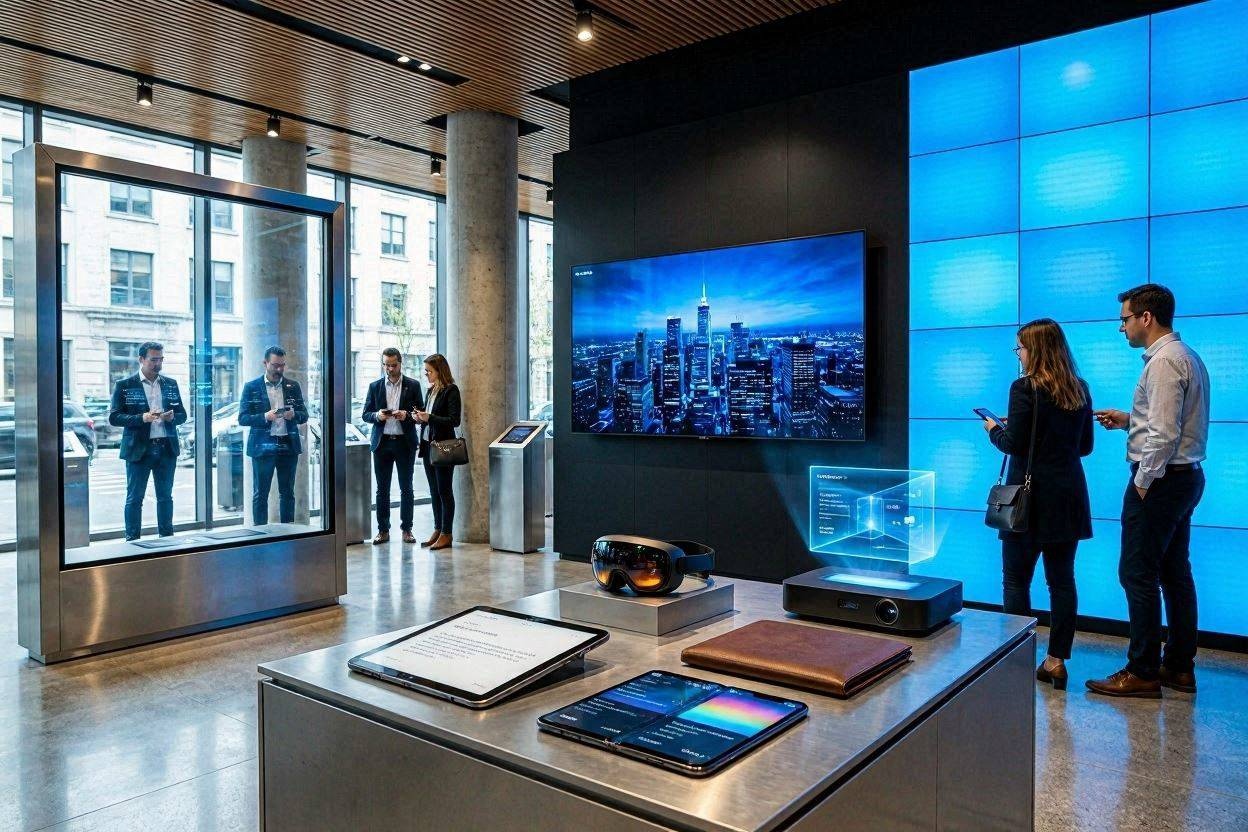
Display Innovation: Key Trends, Growth Drivers and Opportunities
Introduction to Display Innovation
Display innovation is fundamentally reshaping how individuals and organizations interact with digital information, transforming the global display industry through the convergence of advanced semiconductor materials, IoT connectivity, artificial intelligence, and novel form factors. Unlike conventional display technologies that primarily focused on basic image reproduction, modern display systems leverage OLED, Micro-LED, and quantum dot technologies to deliver unprecedented visual performance with superior energy efficiency. These intelligent display solutions automatically optimize brightness, color accuracy, and power consumption based on ambient conditions and content characteristics, enabling organizations to enhance user experiences while reducing operational costs. As governments and enterprises prioritize digital transformation and immersive technologies, advanced displays have become indispensable components of smart devices, autonomous vehicles, and next-generation communication platforms.
History of Display Technology Evolution
The evolution of display technology began with bulky cathode ray tubes (CRTs) that dominated televisions and computer monitors for decades, before accelerating with the introduction of liquid crystal displays (LCDs) that offered thinner, lighter, and more energy-efficient solutions . Early automation in display manufacturing relied on basic transistor technologies, but rapid advances in semiconductor fabrication and materials science enabled the development of active-matrix LCDs and subsequently organic light-emitting diode (OLED) displays. The emergence of flexible substrates, quantum dot enhancement films, and Micro-LED architectures transformed displays from simple output devices into sophisticated interactive interfaces . Today, AI-powered image processing, touch integration, and voice control allow users to interact with displays intuitively while enabling new applications across consumer electronics, automotive, healthcare, and industrial environments .
Benefits of Advanced Display Technologies
Modern display innovations deliver measurable value across multiple industries by improving visual quality, reducing energy consumption, and enhancing user engagement. Key benefits include:
- Superior image quality with higher resolution, deeper blacks, and wider color gamut through OLED and QD technologies
- Reduced power consumption through self-emissive pixels and intelligent brightness management
- Enhanced durability and longer lifespan with inorganic Micro-LED technology
- Flexible, foldable, and transparent form factors enabling new product categories
- Seamless integration with AI, IoT platforms, and interactive applications
Current Market Size and Growth Trends
According to MarketsandMarkets, the global display market was valued at USD 109.43 billion in 2026 and is projected to reach USD 137.83 billion by 2032, growing at a CAGR of 3.9% from 2026 to 2032 . Market growth is driven by the transition from traditional LCD to advanced technologies such as OLED, Mini-LED, and Micro-LED, which offer improved image quality, energy efficiency, and design flexibility . Consumer electronics, automotive displays, digital signage, and healthcare applications continue investing in innovative display solutions to enhance user experiences and support digital transformation. The Asia Pacific region is anticipated to record the highest CAGR of 4.5% during the forecast period, driven by the presence of major display manufacturers and extensive consumer electronics production ecosystems.
Download PDF Brochure @ https://www.marketsandmarkets.com/pdfdownloadNew.asp?id=925
Key Growth Drivers
Major growth drivers include rising consumer demand for high-resolution and premium displays, increasing adoption of OLED, Mini-LED, and Micro-LED technologies, and growing investments in smart devices and digital infrastructure . The proliferation of electric vehicles has transformed automotive interiors into display-heavy spaces, with every new vehicle generation requiring more display area than previous models . Government support for semiconductor and display manufacturing, coupled with rapid deployment of 5G networks and AR/VR platforms, further accelerates market expansion. Businesses increasingly use advanced display solutions to differentiate products, improve brand perception, and enable immersive customer experiences.
Emerging Trends in Display Technology
Human-centric lighting integration, Li-Fi communication, edge AI processing, flexible and foldable form factors, digital twins for manufacturing optimization, predictive maintenance, and cloud-based display management are shaping the future of the industry . Advanced analytics enable real-time image optimization while cybersecurity improvements strengthen connected display networks. Micro-LED technology is emerging as the fastest-growing display segment, offering superior brightness, contrast, and energy efficiency compared to existing technologies . Additionally, the development of transparent, rollable, and stretchable displays is creating new use cases across retail, automotive, and commercial applications .
Opportunities and Challenges in the Display Market
Smart displays present strong opportunities in consumer electronics, automotive cockpits, digital signage, healthcare imaging, and industrial automation . The aerospace and defense vertical is expected to witness the highest CAGR of 22.6%, driven by demand for advanced visualization systems in mission-critical applications . Microdisplays for AR/VR headsets and smart glasses represent another high-growth segment with a projected CAGR of 12.3% . Challenges include intense price competition and declining average selling prices, high manufacturing costs for advanced technologies, achieving cost-effective mass production of Micro-LED displays, and supply chain dependencies on critical materials . Continued standardization, declining hardware costs, and manufacturing yield improvements are expected to enhance adoption across all verticals.
Innovations and Technological Advancements
Manufacturers are introducing AI-powered display controllers, real-time occupancy analytics, adaptive refresh rate technologies, Bluetooth Mesh networking, and sensor-rich panels with integrated cameras and biometric sensors . These innovations improve energy efficiency while enabling predictive maintenance and data-driven facility management. Recent developments include Samsung Display's collaboration with Microsoft to integrate Copilot AI into smart monitors, LG Display's introduction of MAGNIT Active Micro LED for premium home cinema, and Sharp/NEC's third-generation dvLED FE Series with 60% energy reduction . OLED is projected to account for 67% of total display equipment spending from 2023 to 2030, reflecting the industry's commitment to next-generation display technologies .
Future Applications and Industry Impact
Display innovations will expand across smart cities, autonomous vehicles, telemedicine platforms, industrial IoT, retail environments, educational institutions, and residential communities . Integration with renewable energy systems, EV charging infrastructure, and building automation will further enhance value propositions. The convergence of displays with sensors, cameras, haptics, and edge processors is enabling new applications in augmented reality, virtual reality, and mixed-reality devices . As sustainability requirements push manufacturers to reduce power consumption and improve recyclability, the industry is increasingly focusing on energy-efficient, repairable, and circular design principles .
Regional Market Dynamics
Asia Pacific dominates the display market in terms of both market share and growth, driven by major manufacturers such as Samsung Display, LG Display, BOE Technology, and AUO Corporation . China has scaled LCD and OLED capacity, while South Korea remains influential in advanced OLED and premium display know-how. Japan continues to be important in materials, precision equipment, and imaging components, and India is building electronics manufacturing momentum through production-linked incentives . North America is driven by high-value demand in smartphones, gaming, aerospace, defense, and medical imaging, while Europe emphasizes automotive displays, sustainability compliance, and energy-efficient electronics .
Competitive Landscape
Key players in the display market include Samsung Display, LG Display, BOE Technology Group, AUO Corporation, Innolux Corporation, Sharp Corporation, Sony Group Corporation, and Visionox . These companies are investing heavily in fabrication facilities, process technologies, and research and development to improve resolution, brightness, energy efficiency, and form factors . Startups and SMEs such as Porotech, Aledia, and VueReal are gaining traction through focus on niche applications, rapid innovation, and customized solutions for wearables, smart glasses, automotive, and healthcare devices .
Display innovation is redefining how organizations and individuals interact with digital content across all aspects of modern life. Advanced display technologies support immersive user experiences, operational efficiency, and sustainability objectives while enabling new applications across consumer, commercial, automotive, and industrial sectors. With strong investment in digital infrastructure, increasing demand for premium visual experiences, and continuous technological advancements, the industry is expected to maintain robust growth throughout the forecast period. The transition from legacy LCD technologies to OLED, Mini-LED, and Micro-LED solutions represents a fundamental shift in the industry's value proposition, creating significant opportunities for innovation and market expansion .
Download Sample Research Report for Dispkay Market Future https://www.marketsandmarkets.com/Market-Reports/display-market-925.html
80% of the Forbes Global 2000 B2B companies rely on MarketsandMarkets to identify growth opportunities in emerging technologies and use cases that will have a positive revenue impact.
- Food Packaging Market Size Set for Strong Growth Through 2030 Amid Rising Demand for Convenience Foods
- Crop Protection Chemical Market Size, Share & Growth Forecast (2025–2030)
- Mulch Films Market: Driving Sustainable Agriculture Through Innovation
- Agricultural Adjuvants Market Analysis, Trends, and Growth Outlook (2026–2031)
- Japan Enterprise Asset Management Market Growth: AI and Smart Infrastructure Drive Demand


