

Automation Investments Boost Demand for Flexible Pneumatic Hose Systems in Smart Factories
Automation Investments Boost Demand for Flexible Pneumatic Hose Systems in Smart Factories
Introduction
Industrial automation is changing how manufacturers operate production facilities, manage equipment, and improve manufacturing consistency. Robotic arms, automated assembly stations, pick-and-place systems, packaging machinery, and pneumatic actuators are increasingly used to improve productivity and reduce repetitive manual tasks.
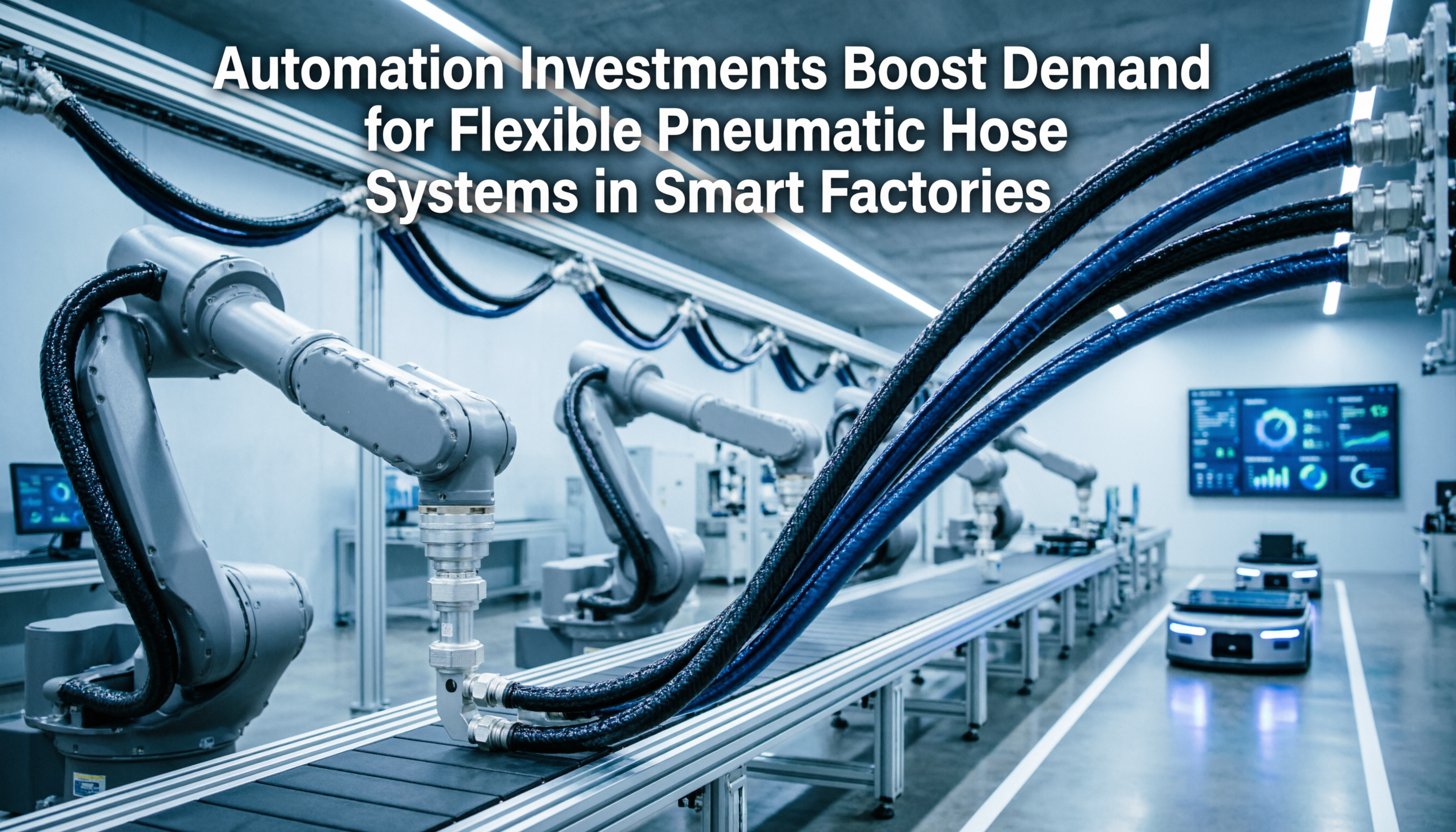
Within these applications, pneumatic hose systems provide an important connection between compressed-air supplies, control valves, cylinders, grippers, and other pneumatic components. Their flexibility, installation characteristics, and suitability for specific operating conditions make them essential components in many automated production environments.
Get More Information Download PDF Brochure @
https://www.marketsandmarkets.com/pdfdownloadNew.asp?id=8695843
As manufacturers modernize production lines, industrial hose suppliers have an opportunity to provide pneumatic hose products designed for reliability, efficient installation, and compatibility with automated equipment.
The Role of Pneumatic Hose in Factory Automation
Pneumatic systems use compressed air to create mechanical movement. They are widely used for clamping, positioning, gripping, sorting, packaging, and other operations that require controlled motion.
A pneumatic hose transfers compressed air between components. The hose must be compatible with the operating pressure, temperature, environment, and connection system. Its dimensions and flexibility also influence installation and performance.
In an automated factory, pneumatic hose may be routed through machine frames, cable carriers, robotic assemblies, or compact control panels. Poor routing can create unnecessary stress, restrict movement, or expose the hose to abrasion.
Selecting a suitable pneumatic hose is therefore not simply a matter of choosing a diameter. Manufacturers must consider the complete system, including fittings, motion patterns, environmental exposure, and maintenance access.
Major Applications in Smart Manufacturing
1. Robotic arms and automated handling
Robotic systems often use pneumatic grippers to pick up, hold, and release components. Pneumatic hoses connect these grippers to air supplies and control valves.
In moving applications, hoses must accommodate the required motion without exceeding their specified bend radius or experiencing excessive twisting. Suitable routing and protective measures can help limit wear.
Suppliers that understand robotic applications can support automation integrators with appropriately specified hose products, compatible fittings, and replacement components.
2. Automotive assembly lines
Automotive factories use pneumatic systems in component assembly, part positioning, fastening, and material handling.
Production lines may run for extended periods, making maintenance planning and component availability important. A damaged hose can disrupt an individual station and potentially affect downstream operations.
Industrial hose suppliers can support automotive manufacturers through documented product specifications, standardized assemblies, and inventory programs for frequently replaced components.
3. Food and packaging equipment
Packaging facilities use pneumatic actuators and grippers for product handling, carton forming, sealing, and sorting.
Hose selection must account for the surrounding environment, cleaning procedures, contact restrictions, and applicable regulatory requirements. Not every pneumatic hose is appropriate for food-related environments, and suitability should be verified against the specific application.
4. Electronics and precision manufacturing
Electronics factories use automated equipment to position small components, operate fixtures, and manage production workflows. Compact machinery can require hoses that fit restricted spaces while maintaining the required airflow and pressure performance.
Manufacturers should consider the complete system design, including hose routing, connection integrity, and any requirements relating to contamination or electrostatic discharge.
Why Flexibility Matters in Pneumatic Hose Design
Flexibility is valuable when equipment includes moving parts or limited installation space. However, a highly flexible hose is not automatically suitable for every automated application.
The required bend radius, pressure rating, temperature range, material compatibility, and expected movement must all be evaluated. Repeated flexing can cause fatigue, particularly when the hose is installed incorrectly or subjected to excessive twisting.
Common material choices include polyurethane, polyamide, rubber, and other engineered polymers. Each has different characteristics relating to flexibility, abrasion resistance, pressure capability, temperature limits, and chemical compatibility.
Polyurethane hose is often considered for compact pneumatic installations because of its flexibility and abrasion resistance. Nevertheless, the specific grade and manufacturer's specifications should determine whether it is suitable for the application.
Compressed-Air Efficiency and Leak Prevention
Compressed air is a useful industrial utility, but generating it can consume significant energy. Leaks, inappropriate pressure settings, poorly maintained components, and inefficient system design can increase operating costs.
Pneumatic hose systems are one part of this broader efficiency challenge.
Manufacturers can improve system performance by inspecting hoses and fittings, repairing leaks promptly, choosing appropriate internal diameters, and avoiding unnecessary restrictions. Pressure should be set according to equipment requirements rather than increased without analysis.
A hose that is too small for the required airflow can contribute to excessive pressure drop. Conversely, selecting a larger hose without considering system design may increase costs without providing a meaningful benefit.
Suppliers can create additional value by helping customers identify suitable products and maintain reliable connections.
Opportunities for Industrial Hose Manufacturers
Automation creates several potential growth opportunities for pneumatic hose suppliers.
Partner with automation integrators. Companies that design robotic cells and production lines can become repeat customers when suppliers provide reliable products and responsive technical support.
Develop application-based catalogues. Organizing pneumatic hose products by material, dimensions, pressure range, and operating environment can simplify selection.
Provide preconfigured assemblies. Correctly specified hose lengths and compatible fittings may reduce installation effort for machine builders.
Support maintenance teams. Replacement kits, identification systems, and readily available common sizes can help maintenance departments respond to wear or damage.
Improve online purchasing. Clear product information, technical documents, and quotation request forms can make suppliers easier to evaluate and contact.
Quality, Installation, and Maintenance
Pneumatic hoses must be compatible with the operating conditions of the system. Buyers should verify pressure ratings, temperature limits, connection specifications, and the manufacturer's instructions.
Installation teams should avoid sharp bends, excessive tension, twisting, and contact with sharp edges or hot surfaces. Hoses should be protected where machinery creates repeated movement or abrasion.
Maintenance teams should inspect for cracking, swelling, cuts, leaks, loose fittings, and other signs of deterioration. Replacement should follow appropriate isolation and depressurization procedures.
Compressed air can cause serious injuries if released improperly. Workers should follow site-specific safety procedures and never disconnect a pressurized hose without ensuring the system is safe.
Challenges in the Pneumatic Hose Market
Industrial hose suppliers face competition from established manufacturers, distributors, and low-cost alternatives. Buyers may also have different requirements across production environments, creating complexity in inventory management.
A supplier can address these challenges through reliable product documentation, consistent quality, technical support, and efficient order fulfilment.
Another important consideration is compatibility. Pneumatic hose, fittings, valves, and connectors should be selected as a system. Mixing incompatible components can lead to leaks or failures even when individual products appear suitable.
Conclusion
Pneumatic hose systems remain important to industrial automation because they connect compressed-air supplies with actuators, grippers, and other equipment that support manufacturing operations.
As factories adopt more robotics and automated handling systems, suppliers can pursue opportunities through application-specific products, flexible installation solutions, dependable replacement availability, and partnerships with machine builders.
For industrial hose manufacturers, understanding the needs of automation integrators and factory maintenance teams can help build stronger customer relationships and support sustainable B2B growth.
Frequently Asked Questions
1. What is a pneumatic hose used for?
It transfers compressed air between components such as compressors, valves, cylinders, and pneumatic grippers.
2. Which materials are commonly used for pneumatic hose?
Polyurethane, polyamide, rubber, and other engineered polymers are used depending on pressure, flexibility, temperature, and environmental requirements.
3. How can pneumatic hose systems improve factory efficiency?
Appropriate sizing, correct installation, leak prevention, and regular maintenance can help reduce compressed-air losses and avoid interruptions.
4. How can suppliers serve automation manufacturers?
They can offer documented specifications, compatible fittings, application guidance, preconfigured assemblies, and reliable delivery.
80% of the Forbes Global 2000 B2B companies rely on MarketsandMarkets to identify growth opportunities in emerging technologies and use cases that will have a positive revenue impact.
- Food Packaging Market Size Set for Strong Growth Through 2030 Amid Rising Demand for Convenience Foods
- Crop Protection Chemical Market Size, Share & Growth Forecast (2025–2030)
- Mulch Films Market: Driving Sustainable Agriculture Through Innovation
- Agricultural Adjuvants Market Analysis, Trends, and Growth Outlook (2026–2031)
- Japan Enterprise Asset Management Market Growth: AI and Smart Infrastructure Drive Demand

