

FPGA Design Tool Market Emerging Technologies, Innovation Trends, and Digital Transformation
The FPGA design tool market is becoming increasingly important as programmable hardware is adopted across communications, automotive electronics, industrial systems, aerospace, defense, data processing, and embedded computing. FPGA design tools provide the software environment required to transform hardware descriptions into functional programmable logic configurations. These tools support several stages of development, including design entry, simulation, synthesis, implementation, timing analysis, verification, and device programming. As FPGA architectures become more sophisticated, engineering teams increasingly depend on integrated tool environments to manage design complexity and improve development productivity. The evolution of these tools is closely connected with the growing need for flexible computing architectures and faster hardware development cycles.
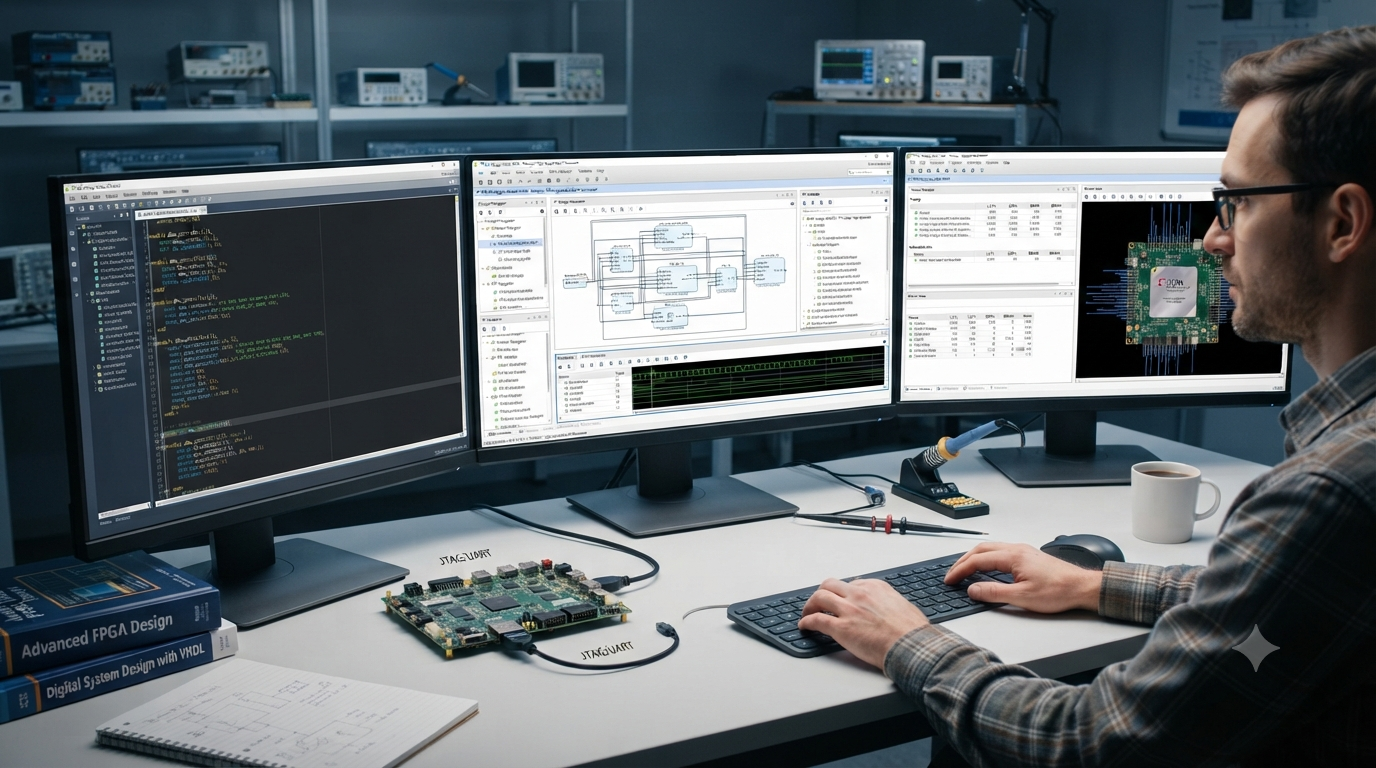
FPGA design tools differ from conventional software development environments because they help engineers create physical digital circuits rather than executable software alone. Hardware description languages such as Verilog, VHDL, and SystemVerilog are commonly used to describe the intended behavior and structure of digital systems. Simulation allows designers to examine functionality before hardware implementation, while synthesis converts the design into a technology specific representation suitable for the target device. Implementation then determines how logic elements and connections are mapped onto the FPGA architecture. This complete flow makes FPGA design tools essential for developing reliable and performance optimized programmable hardware.
According to Marketsandmarkets, the Field-Programmable Gate Array (FPGA) market size was valued at USD 11.73 billion in 2025 and is projected to reach USD 19.34 billion in 2030 from , growing at a CAGR of 10.5% from 2025 to 2030.
Download PDF Brochure @ https://www.marketsandmarkets.com/pdfdownloadNew.asp?id=194123367
Growing Importance of Integrated FPGA Development
The FPGA design tool market is being shaped by the increasing complexity of modern digital systems. Applications now require higher processing performance, lower latency, greater energy efficiency, and flexible hardware functionality. FPGA platforms can address these requirements by allowing developers to configure hardware according to application needs. However, creating sophisticated FPGA designs requires multiple engineering activities that must work together efficiently. Integrated design environments help connect design entry, simulation, synthesis, implementation, timing analysis, debugging, and programming within a coordinated workflow.
The growing use of hardware acceleration is also increasing the importance of efficient FPGA development environments. FPGAs are increasingly used for workloads involving signal processing, networking, artificial intelligence acceleration, image processing, industrial control, and real time computing. These applications often require precise timing and efficient resource utilization. Design tools therefore need to provide detailed visibility into logic utilization, memory resources, processing blocks, routing, power behavior, and timing performance. The ability to identify implementation problems early can reduce repeated design iterations and support faster development.
Design Automation Becomes a Central Technology
Automation is one of the most important developments influencing the FPGA design tool market. Traditional FPGA development can involve repeated synthesis, placement, routing, timing analysis, debugging, and optimization cycles. Automation can reduce manual intervention across these activities and help engineers evaluate different implementation approaches more efficiently. Modern design environments increasingly provide automated constraint handling, optimization capabilities, design analysis, and verification assistance. These functions allow engineering teams to concentrate more heavily on architecture and functionality rather than repetitive development tasks.
Design automation is particularly valuable for complex systems containing multiple processing blocks, memory interfaces, communication protocols, and hardware accelerators. Automated processes can identify resource utilization problems and highlight timing paths that require optimization. They can also help engineers manage design dependencies and repeatable build processes. As FPGA projects become larger, automation is expected to remain an important differentiator within the FPGA design tool market because development productivity increasingly depends on reducing unnecessary design iterations.
Artificial Intelligence Transforms FPGA Workflows
Artificial intelligence is introducing new possibilities across the FPGA design tool market. AI based capabilities can assist engineers with design exploration, optimization, verification, debugging, documentation, and automation. Machine learning techniques can analyze implementation information and identify patterns associated with timing problems, resource congestion, or inefficient configurations. Generative AI can also assist with hardware description development, testbench creation, scripting, and technical documentation. These capabilities can reduce repetitive engineering activities while allowing developers to spend more time on architecture and system level decisions.
AI adoption in FPGA development remains closely connected to verification and engineering oversight. Automatically generated hardware descriptions must be examined carefully because functional correctness, timing behavior, resource usage, and security requirements cannot be assumed. AI based assistance is therefore becoming more useful when integrated with established simulation and verification processes. Recent industry discussion also highlights growing interest in AI assistance for testbench development, automation scripts, design analysis, and verification workflows.
High Level Synthesis Expands Developer Accessibility
High level synthesis is another major trend influencing the FPGA design tool market. Traditional FPGA development relies heavily on hardware description languages, which require specialized knowledge of digital architecture and hardware timing. High level synthesis allows certain algorithms and system functions to be described using higher level programming approaches. The development environment can then translate these descriptions into hardware structures while applying optimization techniques such as pipelining and resource allocation.
The growing adoption of high level synthesis can make FPGA acceleration more accessible to engineers who have stronger software and algorithm development backgrounds. It can be particularly useful for computational workloads involving image processing, machine learning, signal processing, and mathematical operations. However, effective use still requires an understanding of hardware architecture because decisions related to memory access, parallelism, pipeline depth, and resource allocation strongly influence implementation results. As a result, the FPGA design tool market is evolving toward environments that bridge hardware and software development methodologies.
Verification Becomes More Critical
Verification is a fundamental component of the FPGA design tool market because functional errors can become difficult and expensive to identify after physical implementation. Simulation enables engineers to test hardware behavior using predefined scenarios and testbenches before programming the FPGA. Verification can examine state transitions, data paths, interfaces, control signals, and system behavior under different operating conditions. More advanced designs require broader verification coverage because they combine processors, memory, communication interfaces, accelerators, and external sensors.
The increasing complexity of FPGA applications is encouraging greater automation within verification workflows. Engineers can use automated test generation, assertions, coverage analysis, waveform inspection, and regression testing to identify problems earlier. Verification environments are also becoming more closely integrated with synthesis and implementation workflows. This integration allows developers to maintain greater visibility from functional design through physical implementation. Strong verification capabilities will therefore remain an important factor shaping the FPGA design tool market.
Simulation Supports Faster Design Validation
Simulation provides an important foundation for FPGA development because it allows designers to evaluate functionality without immediately moving to physical hardware. A hardware description can be tested through a dedicated testbench that provides input conditions and observes resulting outputs. Simulation can expose logic errors, incorrect state transitions, timing assumptions, and interface problems before implementation. This reduces the likelihood of discovering fundamental design issues only after a hardware build has been completed.
Modern FPGA design workflows commonly combine functional simulation with synthesis and implementation analysis. Simulation focuses primarily on logical behavior, while later stages evaluate physical characteristics such as resource utilization and timing. Maintaining a connection between these stages improves the overall development process. As FPGA systems become more sophisticated, the FPGA design tool market is increasingly emphasizing simulation environments that support large designs, reusable verification components, automation, and faster debugging.
Synthesis Drives Hardware Optimization
Synthesis is one of the central processes within FPGA development because it converts hardware descriptions into a structural representation suitable for implementation. During synthesis, the design is mapped to FPGA resources such as lookup tables, registers, memory blocks, arithmetic resources, and other device specific elements. The synthesis process can also optimize logic according to design constraints and target requirements. This stage has a major influence on the quality of the resulting implementation.
The FPGA design tool market is increasingly focused on synthesis optimization because designers need to balance performance, area, power consumption, and development time. A design that uses excessive logic resources may require architectural changes, while an inefficient implementation may create timing problems. Advanced synthesis capabilities can identify redundant logic, optimize arithmetic structures, and improve resource utilization. Efficient synthesis therefore contributes directly to the overall quality and reliability of FPGA development.
Placement and Routing Improve Physical Performance
After synthesis, implementation tools determine how the logical design is mapped onto the physical FPGA architecture. Placement assigns logical elements to physical resources, while routing establishes connections between those resources. These processes directly affect signal delays, congestion, power consumption, and timing performance. Poor physical implementation can prevent an otherwise functional design from achieving its required operating characteristics.
Timing closure is therefore a major consideration within the FPGA design tool market. Engineers analyze critical paths and timing reports to determine whether signals can propagate within the required clock period. Design changes may include modifying logic structures, adding pipeline stages, adjusting constraints, or improving resource placement. Modern tools increasingly automate portions of this process to reduce the number of manual optimization cycles. The ability to achieve timing closure efficiently remains a critical requirement for advanced FPGA applications.
Cloud Based Development Changes Collaboration
Cloud computing is creating new opportunities for the FPGA design tool market by providing scalable computing resources for demanding engineering workloads. FPGA compilation and implementation can require substantial processing capacity, particularly for complex designs. Cloud based environments can allow teams to access computational resources when needed rather than depending entirely on local infrastructure. This can support distributed engineering teams and make large scale design experimentation more practical.
Cloud based development can also improve collaboration by providing centralized project environments, shared design resources, automated build processes, and remote access. However, organizations must consider intellectual property protection, data security, licensing structures, network reliability, and compliance requirements. These factors influence how organizations adopt cloud based FPGA development. The combination of scalable computing and collaborative engineering is nevertheless becoming increasingly relevant to the future evolution of the FPGA design tool market.
Open Source Tools Encourage Broader Innovation
Open source development is another factor contributing to changes in the FPGA design tool market. Open source synthesis, simulation, and implementation projects provide developers with alternatives to traditional proprietary environments. These tools can be useful for education, research, experimentation, custom hardware development, and projects that require greater control over the development flow. Open source ecosystems can also encourage collaboration among hardware developers and researchers.
The increasing availability of open source components can support interoperability and experimentation across different FPGA architectures. Developers can examine tool behavior, modify workflows, and integrate specialized capabilities according to project requirements. However, commercial development often requires extensive device support, technical assistance, qualification, verification capabilities, and long term maintenance. The coexistence of open source and commercial approaches is therefore likely to remain an important characteristic of the FPGA design tool market.
Key Trends Shaping FPGA Design Tools
Several technology trends are influencing how engineers select and use FPGA development environments. These trends are connected with the need for faster development, improved automation, better verification, and greater integration between hardware and software engineering.
- Artificial intelligence is supporting design analysis, verification assistance, automation, and optimization activities.
- High level synthesis is connecting software oriented development with programmable hardware implementation.
- Cloud based workflows are improving access to scalable computing resources and collaborative development environments.
- Advanced verification is becoming more important as FPGA based systems grow in complexity.
- Automation is reducing repetitive implementation and optimization activities.
- Open source ecosystems are expanding opportunities for experimentation and customized development flows.
These developments are encouraging FPGA design environments to become more intelligent and integrated. Rather than functioning only as compilation platforms, modern tools increasingly support the complete development lifecycle. Engineers can move from architecture and design entry to verification, synthesis, implementation, debugging, and deployment within connected workflows. This evolution is creating opportunities for greater productivity while also increasing expectations for usability, interoperability, automation, and performance.
Applications Driving Technology Adoption
The FPGA design tool market supports a broad range of applications because programmable logic can be adapted to different computational and control requirements. Telecommunications systems use FPGA technology for high speed data processing, networking, signal processing, and protocol handling. Automotive applications use programmable hardware for advanced driver assistance, sensor processing, control systems, and hardware acceleration. Industrial applications use FPGAs for automation, machine vision, robotics, measurement, and real time control.
Data processing and artificial intelligence applications are also creating new opportunities for FPGA based acceleration. FPGAs can provide parallel processing capabilities while offering flexibility for changing workloads and algorithms. Aerospace and defense applications value programmable hardware for specialized processing, communication, control, and mission specific systems. Medical equipment, scientific instruments, and embedded electronics also benefit from configurable hardware architectures. These diverse applications continue to influence requirements within the FPGA design tool market.
Challenges Affecting FPGA Tool Adoption
Despite technological progress, several challenges can affect adoption and development efficiency. FPGA design requires specialized knowledge covering digital logic, hardware architecture, timing, verification, constraints, and physical implementation. New developers can face a steep learning curve when working with complex development environments. Tool interfaces and workflows can also become difficult to manage as projects expand.
Licensing costs, tool compatibility, device support, compilation time, and hardware debugging requirements can influence development decisions. Organizations also need to manage intellectual property and maintain consistent development environments across teams. AI assisted development introduces additional considerations because automatically generated hardware must be validated thoroughly. Addressing these challenges will be important for continued innovation across the FPGA design tool market.
Future Direction of FPGA Design Environments
The future direction of the FPGA design tool market is likely to center on greater automation, stronger intelligence, improved usability, and deeper hardware software integration. Development environments are moving toward workflows where engineers can describe system requirements at increasingly higher levels of abstraction. Tools can then assist with implementation, optimization, verification, and deployment while preserving detailed control for experienced hardware engineers.
Another important direction is the integration of AI with established engineering workflows. AI can help identify potential implementation issues, suggest optimization strategies, generate verification assets, and assist with repetitive coding tasks. However, successful adoption will depend on transparent outputs, reliable validation, protection of proprietary information, and human oversight. The objective is not simply to automate FPGA development but to create development environments that help engineers make better informed technical decisions.
Digital Transformation and FPGA Development
Digital transformation is increasing demand for computing architectures that can adapt to rapidly changing application requirements. FPGA technology fits this environment because hardware functionality can be modified after manufacturing. This flexibility makes FPGAs useful for applications where algorithms, communication standards, processing requirements, or system functions may evolve over time. Design tools are essential because they provide the bridge between changing system requirements and configurable hardware implementation.
The FPGA design tool market is therefore becoming part of a broader digital engineering ecosystem. Integration with software development, artificial intelligence, cloud computing, simulation, verification, and automated deployment is changing the traditional hardware development model. Future design environments are expected to emphasize interoperability and workflow continuity. This transformation can help organizations develop configurable hardware solutions while reducing unnecessary manual engineering effort.
Opportunities for Developers and System Designers
The changing FPGA development landscape creates opportunities for hardware engineers, embedded developers, system architects, verification specialists, and software professionals. Engineers with knowledge of HDL, computer architecture, embedded systems, and digital signal processing can benefit from the expanding range of FPGA applications. Developers who understand high level synthesis and hardware software co design can also contribute to projects where traditional boundaries between software and hardware are becoming less distinct.
Tool developers have opportunities to improve automation, simulation performance, verification capabilities, AI assistance, visualization, debugging, and cloud integration. There is also scope for developing specialized tools for particular applications such as artificial intelligence acceleration, networking, robotics, industrial automation, and advanced sensing. These opportunities are supporting continued innovation throughout the FPGA design tool market.
Conclusion
The FPGA design tool market is evolving as programmable hardware becomes increasingly important across advanced computing, communications, industrial automation, automotive electronics, aerospace, defense, and embedded applications. Design environments are expanding beyond basic synthesis and implementation to include advanced simulation, verification, optimization, automation, artificial intelligence assistance, and collaborative development. High level synthesis and cloud based workflows are also helping connect traditional hardware engineering with modern software development practices. These changes are making FPGA development more accessible while increasing the technical capabilities expected from modern toolchains.
The next phase of FPGA development will likely focus on intelligent automation, stronger verification, improved interoperability, and closer integration between hardware and software workflows. AI can assist engineers with repetitive and complex tasks, while advanced synthesis and implementation technologies can help optimize hardware performance. At the same time, human engineering expertise remains essential for architecture, validation, security, and system level decision making. As these technologies continue to develop, the FPGA design tool market will remain an important part of the evolving programmable hardware ecosystem.
FAQs
What is the FPGA design tool market?
The FPGA design tool market refers to the ecosystem of software tools used to create, simulate, synthesize, implement, verify, debug, and program FPGA based digital systems. These tools support engineers throughout the hardware development process.
What are FPGA design tools used for?
FPGA design tools are used to convert hardware descriptions into programmable digital circuits. They support activities such as design entry, simulation, synthesis, placement, routing, timing analysis, verification, debugging, and bitstream generation.
How is artificial intelligence affecting FPGA design tools?
Artificial intelligence is helping automate design analysis, verification, optimization, testbench development, scripting, and documentation. AI can assist engineers with repetitive activities while human validation remains necessary for functional and physical correctness.
What is high level synthesis in FPGA development?
High level synthesis converts algorithmic descriptions written using higher level programming approaches into hardware implementations. It can help software and algorithm developers participate in FPGA development while still requiring knowledge of hardware architecture and optimization.
Why is verification important for FPGA development?
Verification helps identify functional and design errors before hardware deployment. Simulation, automated testing, assertions, coverage analysis, and regression testing can help engineers validate increasingly complex FPGA designs.
What role does synthesis play in FPGA design?
Synthesis converts HDL descriptions into a structural representation that can be mapped to FPGA resources. It also performs optimization to help balance resource utilization, performance, and power requirements.
What is timing closure in FPGA development?
Timing closure is the process of ensuring that all critical signal paths satisfy the required timing constraints. It involves analyzing delays and optimizing logic, placement, routing, clocking, and architectural structures when necessary.
How are cloud technologies influencing FPGA development?
Cloud technologies can provide scalable computing resources for demanding compilation and implementation tasks. They can also support collaboration, centralized workflows, automated builds, and remote engineering environments.
What are the major applications of FPGA design tools?
Major application areas include telecommunications, networking, automotive electronics, industrial automation, artificial intelligence acceleration, data processing, aerospace, defense, medical systems, robotics, and embedded computing.
What is the future of FPGA design tools?
The future is expected to emphasize intelligent automation, AI assisted engineering, advanced verification, high level design methodologies, cloud collaboration, improved usability, and stronger integration between hardware and software development.
80% of the Forbes Global 2000 B2B companies rely on MarketsandMarkets to identify growth opportunities in emerging technologies and use cases that will have a positive revenue impact.
- Food Packaging Market Size Set for Strong Growth Through 2030 Amid Rising Demand for Convenience Foods
- Crop Protection Chemical Market Size, Share & Growth Forecast (2025–2030)
- Mulch Films Market: Driving Sustainable Agriculture Through Innovation
- Agricultural Adjuvants Market Analysis, Trends, and Growth Outlook (2026–2031)
- Japan Enterprise Asset Management Market Growth: AI and Smart Infrastructure Drive Demand

.jpg)
