
Home/ Semiconductor and Electronics / future-physical-ai-technology

Future Physical AI Technology: Key Trends, Growth Drivers, and Opportunities

MarketsandMarkets™ Research Private Ltd., 13 Jul 2026
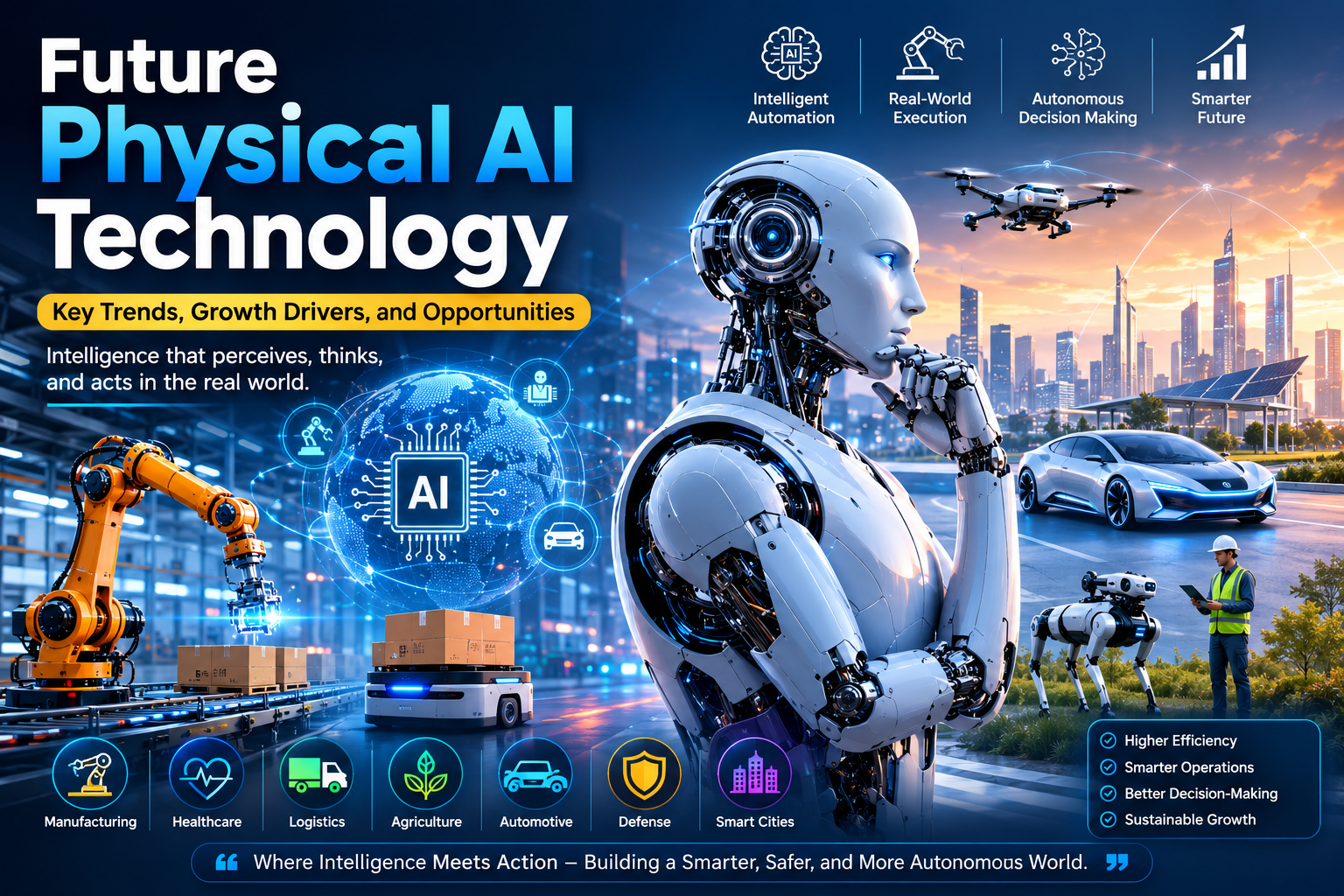
Physical Artificial Intelligence (Physical AI) is ushering in a new era where intelligent software no longer remains confined to computers and cloud platforms—it actively interacts with and transforms the physical world. From autonomous robots navigating warehouses to AI-powered surgical assistants and self-driving vehicles, Physical AI combines advanced machine learning, robotics, computer vision, and edge computing to enable machines to perceive, reason, and act autonomously in real-world environments.

As industries face increasing labor shortages, rising operational costs, and the need for greater automation, future Physical AI technlogy is emerging as one of the most transformative technologies of the decade. Organizations across manufacturing, logistics, healthcare, agriculture, defense, and smart infrastructure are investing heavily in intelligent robotic systems capable of making real-time decisions with minimal human intervention.

Future Physical AI Technology: Key Trends, Growth Drivers, and Opportunities

Introduction to Physical AI Technology

Physical AI refers to the integration of artificial intelligence with physical machines that can sense their surroundings, understand complex environments, and perform actions autonomously. Unlike traditional AI, which primarily analyzes digital data, Physical AI extends intelligence into the physical world through robotics, autonomous vehicles, drones, industrial automation systems, humanoid robots, and intelligent machines.

These systems combine multiple technologies, including:

  • Artificial Intelligence and Machine Learning
  • Robotics and Mechatronics
  • Computer Vision
  • Edge AI Computing
  • Sensor Fusion
  • Internet of Things (IoT)
  • Digital Twins
  • Reinforcement Learning
  • Autonomous Navigation

By integrating these technologies, Physical AI enables machines to continuously learn from their surroundings, adapt to changing conditions, and execute complex physical tasks with remarkable precision.

Current market size and growth trends of wireless charging industry

The physical AI market size Valued was USD 0.89 Billion and is projected to reach USD 15.24 billion by 2032, growing at a CAGR of 47.2% from 2026 to 2032. The market is driven by rapid advancements in edge AI computing, multimodal perception, and real-time decision-making capabilities in robots. Investments in humanoid robotics, AI-enabled autonomy, and simulation platforms are enabling scalable deployment. Additionally, rising labor shortages and increasing demand for automation across industries are accelerating adoption.

Evolution of Physical AI

The journey toward Physical AI has evolved over several decades.

Early industrial robots introduced automation into manufacturing by performing repetitive programmed tasks. However, these machines lacked intelligence and flexibility. The rise of deep learning during the 2010s dramatically improved computer vision, speech recognition, and decision-making capabilities. Simultaneously, advancements in GPUs, AI accelerators, and sensor technologies made real-time AI processing feasible.

Today, foundation AI models are extending beyond language understanding into robotics, enabling robots to learn multiple skills, understand natural language instructions, and generalize across different environments. This convergence is accelerating the commercialization of Physical AI across industries.

Current Market Growth of Physical AI

The Physical AI market is experiencing rapid expansion as enterprises increasingly deploy autonomous systems to improve productivity, workplace safety, and operational efficiency.

Several factors are contributing to this growth:

  • Growing investments in intelligent robotics
  • Rising demand for warehouse automation
  • Expansion of autonomous transportation
  • Increasing adoption of collaborative robots (cobots)
  • AI-enabled manufacturing initiatives
  • Growth of smart factories under Industry 4.0
  • Increasing deployment of healthcare robotics
  • Strong investments by major technology companies in foundation AI models for robotics

As AI becomes embedded into physical systems, organizations are shifting from traditional automation toward intelligent autonomous operations capable of continuous learning and adaptation.

Key Growth Drivers Shaping Future Physical AI Technology

1. Rising Adoption of Autonomous Robotics

Manufacturing, logistics, and warehouse operators are deploying autonomous mobile robots (AMRs) and robotic arms capable of handling complex tasks without constant human supervision.

These intelligent robots improve operational efficiency, reduce labor dependency, and operate continuously, making them essential for next-generation industrial automation.

2. Advancements in AI Chips and Edge Computing

Modern AI processors enable robots to process massive volumes of sensor data locally with ultra-low latency.

Instead of relying solely on cloud computing, edge AI allows machines to make real-time decisions, improving responsiveness, safety, and reliability in dynamic environments.

3. Labor Shortages Accelerating Automation

Many industries are experiencing significant workforce shortages.

Physical AI enables businesses to automate repetitive, hazardous, and physically demanding tasks while allowing human workers to focus on higher-value activities.

This trend is particularly evident in logistics, manufacturing, agriculture, and healthcare.

4. Industry 4.0 and Smart Manufacturing

Smart factories increasingly rely on AI-enabled robotics, predictive maintenance, machine vision, and digital twins to optimize production.

Physical AI allows factories to become adaptive systems capable of self-monitoring, self-optimization, and autonomous decision-making.

5. Increasing Investments by Technology Leaders

Global technology companies are investing billions of dollars in robotics foundation models, humanoid robots, autonomous vehicles, and AI infrastructure.

These investments are accelerating commercialization while reducing deployment costs for enterprise customers.

Emerging Trends in Future Physical AI Technology

Foundation Models for Robotics

Large AI foundation models are enabling robots to understand natural language, interpret visual information, and perform multiple tasks without extensive reprogramming.

This significantly reduces deployment time and increases robot versatility.

Humanoid Robots Entering Commercial Markets

Humanoid robots are moving beyond research laboratories into manufacturing, retail, healthcare, and hospitality.

These robots are designed to work safely alongside humans while performing a wide range of physical tasks.

AI-Powered Digital Twins

Digital twins provide virtual replicas of physical environments, allowing organizations to simulate robotic operations before real-world deployment.

This minimizes operational risks and improves system performance.

Human-Robot Collaboration

Collaborative robots (cobots) are becoming increasingly intelligent, allowing safe interaction with human workers.

AI enables cobots to recognize human behavior, avoid collisions, and assist workers in complex assembly operations.

Multi-Agent Autonomous Systems

Future Physical AI will involve multiple autonomous robots working collaboratively.

Warehouse robots, drones, and industrial machines will coordinate tasks through shared AI models, improving overall efficiency.

AI-Driven Predictive Maintenance

Physical AI continuously monitors equipment health using sensors and machine learning algorithms.

Organizations can predict failures before they occur, reducing downtime and maintenance costs.

Opportunities Across Industries

Manufacturing

  • Smart factories
  • Autonomous production lines
  • Quality inspection
  • Intelligent assembly
  • Predictive maintenance

Logistics

  • Autonomous warehouses
  • Robotic picking systems
  • Inventory management
  • Last-mile delivery robots
  • Automated fulfillment centers

Healthcare

  • Surgical robots
  • Patient monitoring
  • Hospital logistics
  • Rehabilitation robotics
  • Elderly care assistants

Agriculture

  • Autonomous tractors
  • Precision farming
  • AI-powered harvesting
  • Crop monitoring
  • Agricultural drones

Automotive

  • Self-driving vehicles
  • Autonomous mobility
  • Smart transportation
  • AI-assisted manufacturing

Defense

  • Autonomous surveillance
  • Unmanned ground vehicles
  • Intelligent drones
  • Disaster response robots

Challenges Facing Physical AI

Despite enormous potential, Physical AI still faces several challenges:

  • High deployment and infrastructure costs
  • Complex system integration
  • Safety and regulatory compliance
  • Ethical concerns surrounding autonomous decision-making
  • Cybersecurity risks for connected robots
  • Limited availability of high-quality real-world training data
  • Need for standardized AI safety frameworks

Addressing these challenges will be critical for achieving widespread enterprise adoption.

Future Outlook

The future of Physical AI extends far beyond automation. Over the coming decade, intelligent machines will increasingly collaborate with humans, perform complex reasoning, adapt to changing environments, and execute tasks that previously required human expertise.

Advances in multimodal AI, reinforcement learning, edge computing, robotics, and foundation models will continue to expand the capabilities of autonomous systems. As deployment costs decline and AI hardware becomes more powerful, Physical AI is expected to become a foundational technology across nearly every major industry.

Organizations that invest early in Physical AI technologies will be well-positioned to enhance productivity, improve operational resilience, and unlock new business models in the era of intelligent automation. 

 
DMCA.com Protection Status

