

How Can Manufacturers Implement AI Solutions Effectively?
Artificial Intelligence (AI) is rapidly becoming a cornerstone of modern manufacturing. According to the Artificial Intelligence in Manufacturing Market report by MarketsandMarkets, the global market is projected to grow from USD 34.18 billion in 2025 to USD 155.04 billion by 2030, registering a CAGR of 35.3%. This growth is driven by increasing adoption of smart factories, Industrial Internet of Things (IIoT) technologies, predictive analytics, and intelligent automation.
For manufacturers seeking to remain competitive, effective AI implementation requires a strategic approach that combines technology, data, and operational alignment.
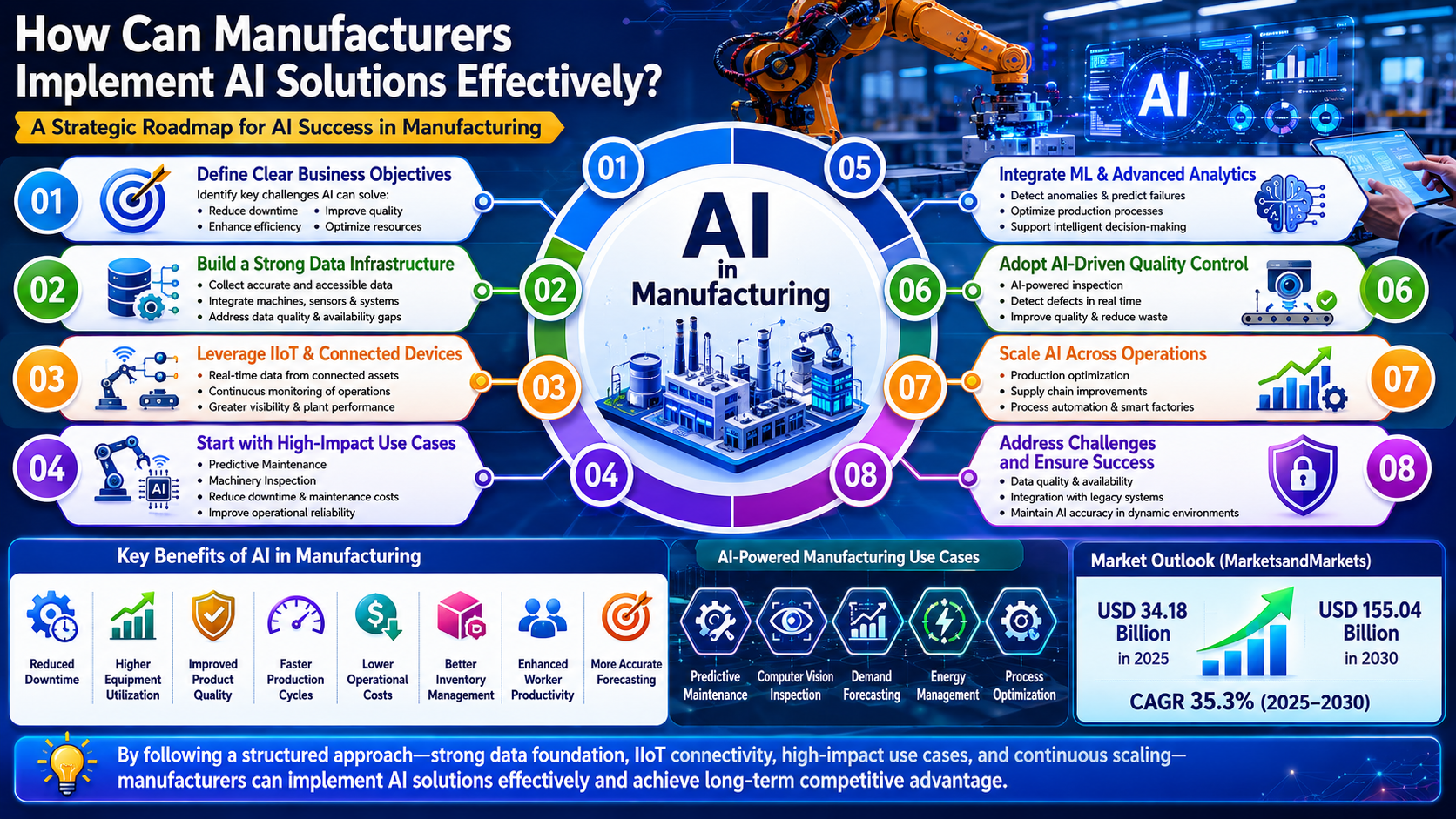
Define Clear Business Objectives
The first step in implementing AI successfully is identifying specific business challenges that AI can address. Manufacturers should focus on measurable objectives such as reducing downtime, improving product quality, enhancing production efficiency, and optimizing resource utilization.
AI technologies enable manufacturers to transform operational data into actionable insights, helping organizations improve decision-making and operational performance. Predictive maintenance and machinery inspection have emerged as some of the most widely adopted applications because they directly impact equipment reliability and productivity.
Build a Strong Data Infrastructure
AI systems rely on large volumes of accurate and accessible data. Manufacturers should ensure that operational data from machines, production lines, sensors, and enterprise systems is collected, standardized, and integrated.
The report identifies poor data integrity and data availability gaps in legacy systems as significant barriers to AI adoption. Establishing a strong data foundation is therefore critical before deploying AI models across manufacturing operations.
Request Sample on AI in Manufacturing - https://www.marketsandmarkets.com/requestsampleNew.asp?id=72679105
Leverage Industrial IoT and Connected Devices
One of the primary drivers of AI adoption in manufacturing is the increasing deployment of IIoT and connected devices across production facilities.
Connected equipment generates real-time operational data that AI systems can analyze to identify inefficiencies, predict failures, and optimize manufacturing processes. By integrating AI with IIoT infrastructure, manufacturers can achieve greater visibility across production environments and improve overall plant performance.
Start with High-Impact Use Cases
Manufacturers should begin AI implementation with applications that provide immediate business value. MarketsandMarkets identifies predictive maintenance and machinery inspection as the largest application segment within the AI manufacturing market.
These solutions help manufacturers:
-
Reduce unplanned equipment downtime
-
Extend asset life cycles
-
Lower maintenance costs
-
Improve operational efficiency
-
Enhance production reliability
Implementing AI in these areas allows organizations to demonstrate measurable ROI before expanding into broader applications.
Integrate Machine Learning and Advanced Analytics
Machine learning currently represents one of the leading technologies within the AI manufacturing ecosystem.
By analyzing historical and real-time operational data, machine learning models can:
-
Detect anomalies
-
Predict equipment failures
-
Optimize production processes
-
Improve quality control
-
Support intelligent decision-making
Continuous advancements in machine learning accuracy and scalability are making these capabilities increasingly valuable across manufacturing industries.
Adopt AI-Driven Quality Control Systems
Maintaining product quality is a critical priority for manufacturers. AI-powered inspection systems can analyze production outputs in real time and identify defects more efficiently than traditional inspection methods.
The combination of machine learning, computer vision, and intelligent analytics enables manufacturers to improve product consistency while reducing waste and rework costs. These capabilities support higher operational efficiency and improved customer satisfaction.
Scale AI Across Manufacturing Operations
Once initial projects prove successful, manufacturers can expand AI applications across additional operational areas.
The report highlights growing adoption of AI-powered analytics, automation platforms, and real-time data processing technologies that support:
-
Production optimization
-
Supply chain improvements
-
Resource allocation
-
Process automation
-
Smart factory initiatives
Organizations that successfully scale AI can create more flexible, resilient, and efficient manufacturing environments.
Address Implementation Challenges
Despite strong market growth, manufacturers must overcome several implementation challenges. MarketsandMarkets identifies the following obstacles:
-
Data quality issues
-
Data availability limitations
-
Enterprise-wide deployment barriers
-
Complexity of aligning AI outputs with dynamic manufacturing environments
-
Maintaining AI accuracy in changing production conditions
Addressing these challenges requires ongoing investment in data management, infrastructure modernization, and operational integration.
Conclusion
Manufacturers can implement AI solutions effectively by establishing clear objectives, building strong data foundations, leveraging IIoT infrastructure, and focusing on high-value applications such as predictive maintenance and machinery inspection. As smart factories and intelligent automation continue to expand, AI is becoming a critical technology for improving productivity, quality, and operational resilience.
With the AI in manufacturing market expected to reach USD 155.04 billion by 2030, organizations that develop comprehensive AI strategies today will be better positioned to achieve long-term competitive advantages in the evolving manufacturing landscape.
80% of the Forbes Global 2000 B2B companies rely on MarketsandMarkets to identify growth opportunities in emerging technologies and use cases that will have a positive revenue impact.
- Food Packaging Market Size Set for Strong Growth Through 2030 Amid Rising Demand for Convenience Foods
- Mulch Films Market: Driving Sustainable Agriculture Through Innovation
- Agricultural Adjuvants Market Analysis, Trends, and Growth Outlook (2026–2031)
- Crop Protection Chemical Market Size, Share & Growth Forecast (2025–2030)
- Japan Enterprise Asset Management Market Growth: AI and Smart Infrastructure Drive Demand

