

Industrial Hose Market Competition Shifts Toward Customized Hydraulic, Pneumatic, Rubber, and Polyurethane Solutions
Industrial Hose Market Competition Shifts Toward Customized Hydraulic, Pneumatic, Rubber, and Polyurethane Solutions
Industrial hoses are essential components in manufacturing, construction, mining, agriculture, material handling, and process industries. They transport fluids, compressed air, water, chemicals, and other materials while connecting different parts of industrial equipment and production systems.
As industrial customers seek reliable equipment performance, competitive pricing, and lower maintenance costs, industrial hose manufacturers are under pressure to differentiate their products and services. Standard product availability remains important, but customers may also require application-specific dimensions, specialized materials, compatible fittings, documented performance, and dependable replacement support.
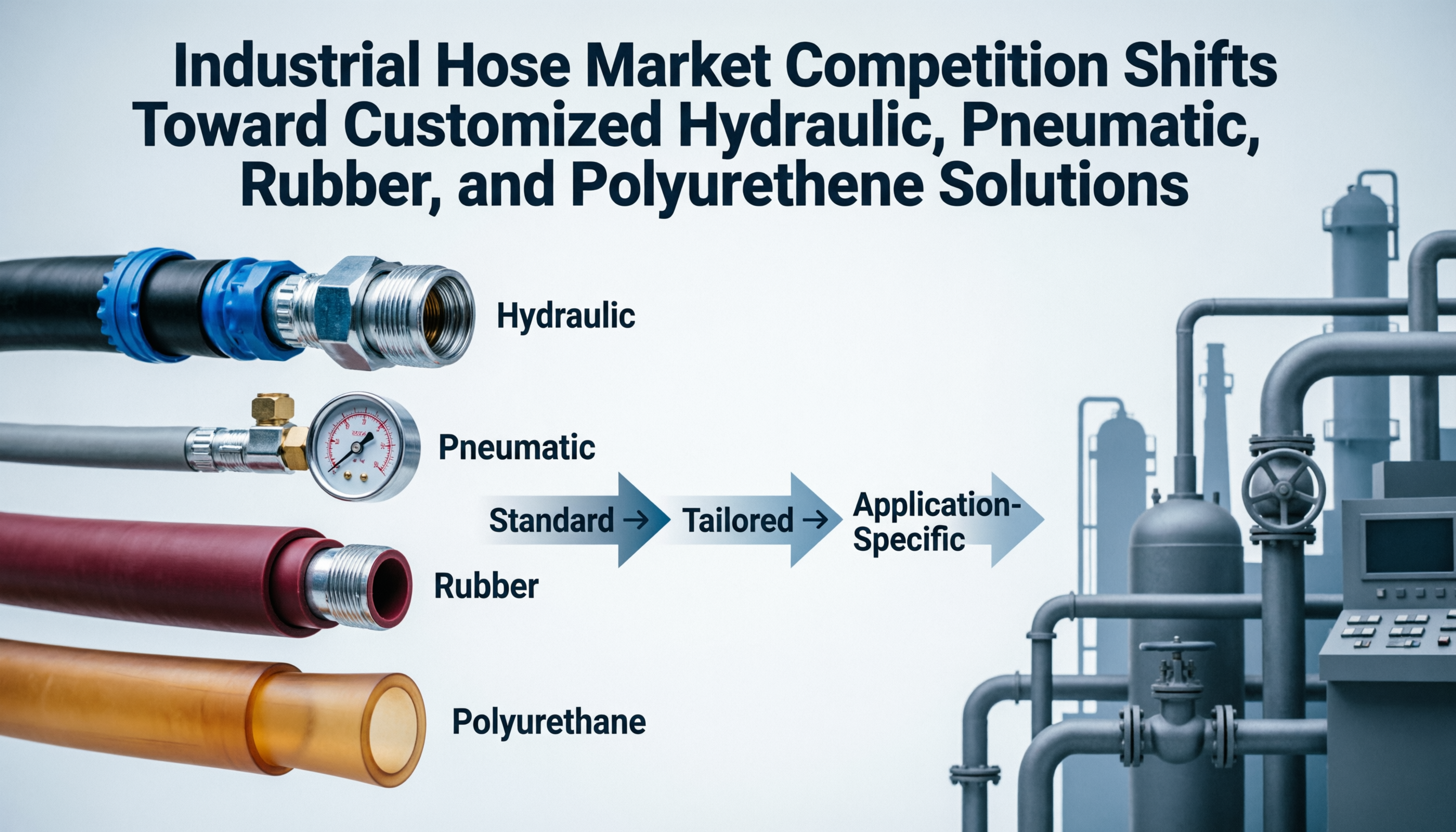
Hydraulic hose, pneumatic hose, rubber hose, and polyurethane hose each serve different requirements. Manufacturers that understand these differences can develop targeted product portfolios and pursue opportunities across multiple industrial sectors.
For companies operating in the industrial hose market, customization and technical expertise can help strengthen customer relationships, support product differentiation, and create additional revenue opportunities.
Get more Details Download PDF Brochure @
https://www.marketsandmarkets.com/pdfdownloadNew.asp?id=8695843
Understanding the Industrial Hose Market
The industrial hose market includes manufacturers, distributors, component suppliers, assembly specialists, and service providers. Competition varies according to product category, application, region, and customer requirements.
Some buyers prioritize large-volume supply and competitive pricing. Others focus on engineering support, product documentation, rapid replacement, or specialized operating performance.
Demand is influenced by several factors, including industrial production, infrastructure investment, manufacturing automation, mining activity, agricultural equipment requirements, and maintenance spending.
Replacement demand is also important because industrial hoses experience wear and deterioration over time. The timing of replacement depends on operating conditions, inspection findings, manufacturer guidance, and the requirements of the application.
For suppliers, understanding the purchasing priorities of each customer segment is essential for building an effective market strategy.
Four Important Industrial Hose Product Categories
1. Hydraulic hose: Supporting heavy-duty machinery
Hydraulic hose transfers pressurized fluid in machinery used across construction, mining, agriculture, manufacturing, and material handling.
These applications may require specific pressure ratings, reinforcement designs, temperature ranges, fluid compatibility, and fitting configurations.
Industrial hose suppliers can pursue opportunities by offering application-specific hydraulic hose assemblies, replacement products, identification services, and technical assistance.
Customers may value suppliers that can help identify the correct specifications and provide consistent product availability. However, every assembly must comply with the equipment manufacturer's requirements and applicable safety standards.
2. Pneumatic hose: Connecting automated equipment
Pneumatic hose transfers compressed air to cylinders, valves, grippers, and other equipment. It is widely used in automated production lines, packaging machinery, robotics, and assembly operations.
Customers may prioritize flexibility, abrasion resistance, suitable airflow, compatible connections, and reliable performance under repeated movement.
Suppliers can differentiate themselves by developing products for particular automation applications and working with machine builders, system integrators, and industrial maintenance teams.
Providing clearly documented dimensions, material properties, pressure limits, and connection options can simplify the purchasing process.
3. Rubber hose: Serving diverse industrial environments
Rubber hose is available in different constructions for fluid transfer, air handling, water movement, and other industrial duties.
The performance of a rubber hose depends on its compound, reinforcement, inner tube, outer cover, and operating environment. Chemical compatibility, temperature exposure, abrasion, and pressure requirements must be evaluated for each application.
Manufacturers can strengthen their market position by offering application-specific products and providing accurate technical information to customers.
Industrial buyers benefit from clear product specifications that help them compare suitable options without relying solely on price.
4. Polyurethane hose: Addressing flexibility and abrasion requirements
Polyurethane hose is often considered for applications where flexibility and abrasion resistance are important. Examples may include pneumatic systems, material handling, industrial vacuum applications, and selected conveying duties.
The material can be useful in compact equipment and applications involving movement, but performance varies by formulation and product construction.
Suppliers can target specialized applications by explaining the relevant performance characteristics and helping customers determine whether polyurethane hose is suitable for their operating conditions.
Why Customization Is Becoming a Competitive Strategy
Customization allows manufacturers and distributors to address requirements that standard products may not fully meet.
Common forms of customization include:
-
Hose lengths and connection configurations designed for specific equipment.
-
Selection of suitable materials for defined operating environments.
-
Compatible end fittings and accessories.
-
Protective sleeves and guards where appropriate.
-
Product identification and traceability information.
-
Assemblies prepared according to documented customer specifications.
For original equipment manufacturers, correctly configured assemblies can simplify installation and support consistent production. Maintenance teams may benefit from readily identifiable replacement products that match documented requirements.
However, customization introduces challenges. Manufacturers must control product variants, manage inventory, maintain accurate specifications, and ensure that each assembly meets the required technical criteria.
Effective product configuration systems and quality-control processes can help balance customization with operational efficiency.
Technology and Manufacturing Developments
Industrial hose manufacturers can explore several areas of product and process improvement.
Material engineering
Advances in elastomer formulations, thermoplastic materials, reinforcement, and protective covers may support improved performance for particular applications.
The benefits depend on the material and design, and claims about service life or chemical resistance should be supported by appropriate testing.
Automated assembly and quality control
Manufacturing automation can improve process consistency when correctly implemented. Controlled assembly procedures, appropriate crimping equipment, inspection processes, and traceable production records help support quality.
Digital product configuration
Online tools can allow customers to review dimensions, technical specifications, connection options, and application requirements before requesting a quotation.
Digital product catalogues can also make it easier for procurement teams to identify suitable products and submit technical enquiries.
Inventory and supply-chain management
Demand forecasting and better inventory visibility can help suppliers maintain availability without carrying excessive quantities of slow-moving products.
For customers, dependable delivery can be particularly valuable when replacement components are needed to restore production equipment.
Commercial Opportunities Across Industrial Sectors
Construction and infrastructure
Construction equipment relies heavily on hydraulic systems. Suppliers can target equipment manufacturers, rental businesses, contractors, and maintenance providers with appropriate hose products and replacement services.
Manufacturing and automation
Factories use both hydraulic and pneumatic hose systems. Suppliers can develop relationships with automation integrators, machine builders, plant engineering teams, and industrial distributors.
Mining and mineral processing
Mining operations require equipment capable of operating under demanding conditions. Product suitability, availability, and maintenance support can influence purchasing decisions.
Chemical and process industries
These customers may require application-specific hose materials and documentation. Chemical compatibility and operating limits must be verified before a product is selected.
Agriculture and material handling
Agricultural machinery, loaders, lifting equipment, and conveying systems use different hose categories depending on their functions. Suppliers can organize product portfolios around equipment applications to simplify customer selection.
How Industrial Hose Companies Can Increase Revenue
A successful growth strategy should combine product quality, customer service, and targeted marketing.
Build industry-specific product pages. Develop separate pages for hydraulic hose, pneumatic hose, rubber hose, and polyurethane hose. Include application information, product specifications, and clear enquiry options.
Target OEMs and distributors. Establish relationships with equipment manufacturers, maintenance contractors, system integrators, and regional distributors.
Offer value-added services. Where qualified, provide assembly configuration, product identification, technical documentation, inspection support, and replacement planning.
Strengthen after-sales service. Responsive technical assistance and reliable replacement availability can encourage repeat purchases.
Improve digital lead generation. Use search-optimized content, technical articles, application guides, and downloadable product documentation to attract relevant business enquiries.
Measure commercial performance. Track qualified enquiries, quotation conversion, repeat orders, average order value, customer retention, and product-category profitability.
These measures help businesses identify which applications and customer segments offer the strongest commercial opportunities.
Challenges and Competitive Risks
Industrial hose businesses face several challenges, including raw material price volatility, intense competition, customer price sensitivity, product qualification requirements, and supply-chain disruptions.
Customization can also increase operational complexity if product specifications and assembly records are poorly managed.
Companies should avoid making unsupported claims about hose life, pressure capabilities, chemical resistance, or universal compatibility. Product selection must be supported by documented specifications and manufacturer guidance.
Another risk is treating all industrial hose products as interchangeable. Hydraulic hose, pneumatic hose, rubber hose, and polyurethane hose serve overlapping but distinct applications, and each product must be evaluated according to its intended use.
Businesses that combine competitive pricing with dependable quality and credible technical support may be better positioned to build lasting customer relationships.
Conclusion
Competition in the industrial hose market creates opportunities for companies that move beyond a generic product-selling approach. Customized hydraulic hose assemblies, application-specific pneumatic hose products, appropriately engineered rubber hose, and polyurethane hose designed for suitable operating conditions can help suppliers address diverse industrial requirements.
Product differentiation alone is not sufficient. Manufacturers and distributors also need consistent quality, clear documentation, dependable delivery, and effective customer support.
By developing industry-focused product portfolios, improving digital product discovery, building OEM partnerships, and tracking qualified B2B leads, industrial hose companies can pursue sustainable growth while helping customers improve equipment reliability and maintenance efficiency.
Frequently Asked Questions
1. What are the main types of industrial hose?
Major categories include hydraulic hose, pneumatic hose, rubber hose, polyurethane hose, and other specialized hose constructions.
2. Why do industrial customers choose customized hose solutions?
Customization can address specific dimensions, fittings, operating conditions, installation requirements, and equipment compatibility.
3. How can industrial hose manufacturers differentiate their products?
They can focus on technical expertise, documented product quality, application-specific solutions, dependable delivery, and responsive service.
4. Which industries offer opportunities for industrial hose suppliers?
Construction, mining, manufacturing, automation, agriculture, material handling, and chemical processing are important application sectors.
5. How can SEO support industrial hose business growth?
Industry-specific content, optimized product pages, application guides, technical documentation, and clear enquiry forms can attract relevant B2B prospects.
80% of the Forbes Global 2000 B2B companies rely on MarketsandMarkets to identify growth opportunities in emerging technologies and use cases that will have a positive revenue impact.
- Food Packaging Market Size Set for Strong Growth Through 2030 Amid Rising Demand for Convenience Foods
- Crop Protection Chemical Market Size, Share & Growth Forecast (2025–2030)
- Mulch Films Market: Driving Sustainable Agriculture Through Innovation
- Agricultural Adjuvants Market Analysis, Trends, and Growth Outlook (2026–2031)
- Japan Enterprise Asset Management Market Growth: AI and Smart Infrastructure Drive Demand

