

Industrial Hose Suppliers Expand Custom Hydraulic Hose Assemblies for Mining and Infrastructure Projects
Industrial Hose Suppliers Expand Custom Hydraulic Hose Assemblies for Mining and Infrastructure Projects
Introduction
Mining, construction, and infrastructure development depend on heavy machinery that must operate reliably under demanding conditions. Excavators, drilling rigs, wheel loaders, cranes, dump trucks, and material-handling equipment use hydraulic systems to generate and control mechanical force. Within these systems, the hydraulic hose plays an essential role by transporting pressurized fluid between pumps, valves, cylinders, and motors.
As equipment manufacturers and industrial operators seek greater productivity, the demand for application-specific hydraulic hose assemblies is creating opportunities for industrial hose suppliers. Instead of relying exclusively on standard hose products, buyers increasingly need assemblies designed around equipment specifications, operating pressure, temperature, fluid compatibility, routing requirements, and installation conditions.
For industrial hose manufacturers and distributors, this shift creates opportunities to provide engineered solutions, technical support, replacement services, and customized product portfolios.
Why Hydraulic Hose Assemblies Matter in Heavy Industries
Hydraulic systems enable heavy equipment to perform tasks that require substantial force and precise movement. A hydraulic hose assembly typically includes a hose, compatible end fittings, and appropriate connections. Depending on the application, it may also incorporate protective sleeves, guards, or other accessories.
The performance of the assembly depends on the compatibility of these components. A hose that is suitable for one machine may not meet the pressure, temperature, bend-radius, or fluid requirements of another.
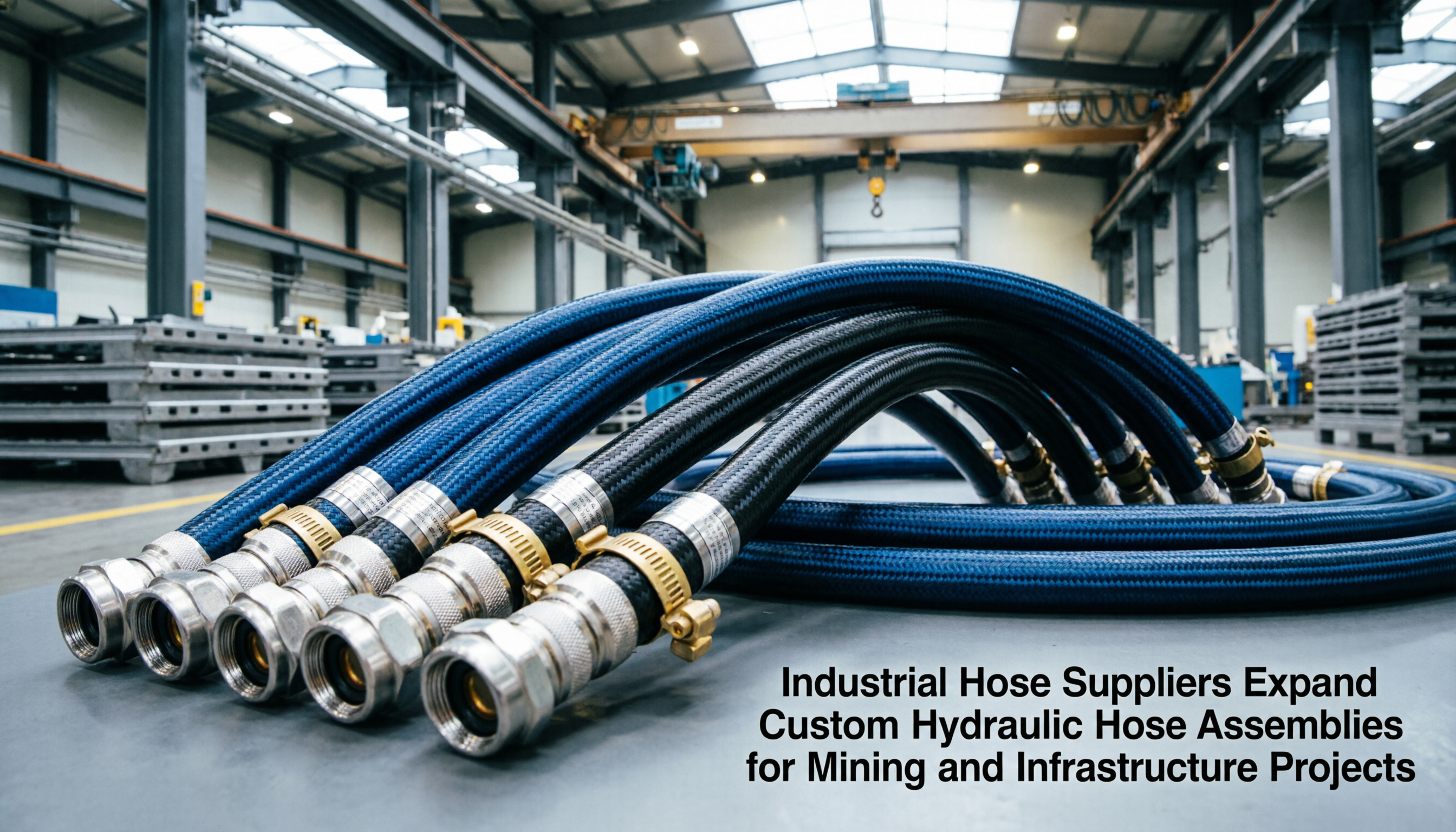
Mining equipment presents particularly demanding operating conditions. Hydraulic hoses may encounter vibration, abrasive materials, restricted installation spaces, and changing temperatures. Construction equipment faces similar challenges, especially when machines operate continuously at infrastructure sites.
Get More Details from PDF Brochure:
https://www.marketsandmarkets.com/pdfdownloadNew.asp?id=8695843
Custom hydraulic hose assemblies help equipment operators select suitable components for the specific operating environment. Properly engineered assemblies can support equipment reliability, reduce avoidable maintenance interruptions, and simplify replacement procedures.
Key Applications Across Mining and Infrastructure
1. Mining and mineral processing
Mining operations use hydraulic systems in drilling machinery, underground equipment, loaders, excavators, and other mobile machinery. Hose assemblies must be selected according to pressure requirements, abrasion exposure, fluid compatibility, and the equipment manufacturer's specifications.
Industrial hose suppliers can serve this sector by offering application-specific assemblies, protective accessories, identification labels, and replacement support. Reliable sourcing is particularly valuable when equipment downtime affects production schedules.
2. Construction and earthmoving equipment
Excavators, bulldozers, wheel loaders, and backhoe loaders rely on hydraulic power for lifting, digging, steering, and other functions.
Equipment manufacturers and maintenance contractors require hoses that fit the original routing configuration and meet the specified performance requirements. Custom assemblies can help avoid installation problems caused by unsuitable lengths, fittings, or bend configurations.
3. Roads, bridges, and infrastructure projects
Road construction, bridge development, tunnelling, and foundation engineering use machinery equipped with hydraulic systems. These projects may involve remote work locations, challenging access conditions, and tight maintenance schedules.
Suppliers that provide dependable delivery, clearly documented specifications, and replacement assemblies can strengthen relationships with equipment rental businesses, contractors, and infrastructure operators.
4. Material handling and lifting systems
Cranes, lifting platforms, forklifts, and industrial handling equipment use hydraulic circuits for controlled movement. Appropriate hose selection and inspection are important for maintaining system integrity and supporting safe operation.
Hose assemblies must be designed and maintained in accordance with the relevant equipment and safety requirements.
How Customization Creates Business Opportunities
Customization allows industrial hose suppliers to compete on more than price. Buyers may need a combination of suitable hose construction, compatible fittings, installation expertise, and dependable service.
Several factors influence purchasing decisions:
-
Pressure requirements: The assembly must meet the specified working pressure and applicable pressure-pulse requirements.
-
Temperature exposure: Materials must be suitable for the expected operating and environmental temperature range.
-
Fluid compatibility: The hose's inner tube and other wetted components must be compatible with the hydraulic fluid.
-
Routing and flexibility: Bend radius, movement, vibration, and installation space affect assembly selection.
-
Environmental protection: Abrasion covers, guards, and protective sleeves may be necessary in demanding conditions.
-
Traceability: Product identification and assembly records can simplify maintenance and replacement.
Suppliers that understand these requirements can offer value-added services, including hose measurement, assembly configuration, inventory management, and maintenance planning.
Technology and Quality Considerations
Hydraulic hose manufacturing involves material selection, reinforcement design, fitting compatibility, and controlled assembly processes. Depending on the application, products may use textile reinforcement, braided steel wire, or spiral wire reinforcement.
However, no single hose construction is appropriate for every application. Selection should follow equipment requirements and applicable standards rather than assumptions based on appearance or general product categories.
Industrial buyers should evaluate documented working pressure, temperature range, minimum bend radius, fluid compatibility, and the manufacturer's instructions. Assemblies should be manufactured, inspected, and tested using suitable procedures and equipment.
Incorrect crimping, incompatible fittings, damaged reinforcement, or unsuitable routing can undermine an otherwise suitable hose. Quality assurance therefore needs to cover the complete assembly rather than the hose alone.
Strategies for Industrial Hose Suppliers
Companies looking to expand in mining and infrastructure markets can adopt several practical strategies.
Develop application-specific product ranges. Organize hydraulic hose assemblies by equipment type, pressure requirements, and operating environment. Clear product documentation helps buyers identify suitable options.
Strengthen distributor and OEM relationships. Collaborating with equipment manufacturers, service centres, rental businesses, and maintenance contractors can generate repeat business.
Improve replacement availability. Maintaining appropriate inventory of commonly required hoses and fittings can help customers reduce maintenance delays.
Provide technical support. Guidance on specifications, identification, routing, inspection, and replacement can differentiate suppliers from businesses competing exclusively on price.
Build digital product discovery. Online catalogues with clear specifications, compatibility information, and enquiry forms can help procurement teams identify products and request quotations efficiently.
Challenges and Risk Management
The market presents challenges, including fluctuating raw material costs, competitive pricing, counterfeit or poorly documented products, and inconsistent demand across construction cycles.
Suppliers must also manage the risks associated with incorrect product selection. Hydraulic systems can operate at dangerous pressures, and fluid injection injuries can occur when pressurized leaks penetrate the skin. Workers should never search for leaks with their hands or attempt repairs while systems remain pressurized.
Appropriate training, isolation procedures, inspections, and compliance with manufacturer guidance are essential.
Conclusion
Custom hydraulic hose assemblies offer industrial hose suppliers an opportunity to serve mining, construction, and infrastructure customers with products tailored to demanding operating conditions. Buyers increasingly need reliable components, documented specifications, dependable delivery, and technical assistance.
Companies that combine suitable hydraulic hose products with quality-controlled assembly, responsive replacement services, and strong customer relationships can improve their competitive position. For manufacturers and distributors, the opportunity extends beyond selling individual hoses to providing dependable solutions that help industrial equipment operate safely and efficiently.
Frequently Asked Questions
1. What is a hydraulic hose assembly?
It is a complete fluid-transfer component consisting of a compatible hydraulic hose and its end fittings, assembled for a specific application.
2. Which industries use hydraulic hose assemblies?
Mining, construction, agriculture, material handling, manufacturing, and infrastructure development are major application areas.
3. How should buyers select an industrial hydraulic hose?
Buyers should verify working pressure, temperature, fluid compatibility, bend radius, fittings, routing, and applicable manufacturer specifications.
4. How can industrial hose suppliers gain more B2B customers?
They can focus on application expertise, product availability, technical support, OEM partnerships, and convenient quotation services.
80% of the Forbes Global 2000 B2B companies rely on MarketsandMarkets to identify growth opportunities in emerging technologies and use cases that will have a positive revenue impact.
- Food Packaging Market Size Set for Strong Growth Through 2030 Amid Rising Demand for Convenience Foods
- Crop Protection Chemical Market Size, Share & Growth Forecast (2025–2030)
- Mulch Films Market: Driving Sustainable Agriculture Through Innovation
- Agricultural Adjuvants Market Analysis, Trends, and Growth Outlook (2026–2031)
- Japan Enterprise Asset Management Market Growth: AI and Smart Infrastructure Drive Demand

