

Machine Vision Revenue & Investment: Market AI Growth and Trends
Machine Vision Revenue and Investment: Market Growth, Trends, Opportunities, and Future Outlook
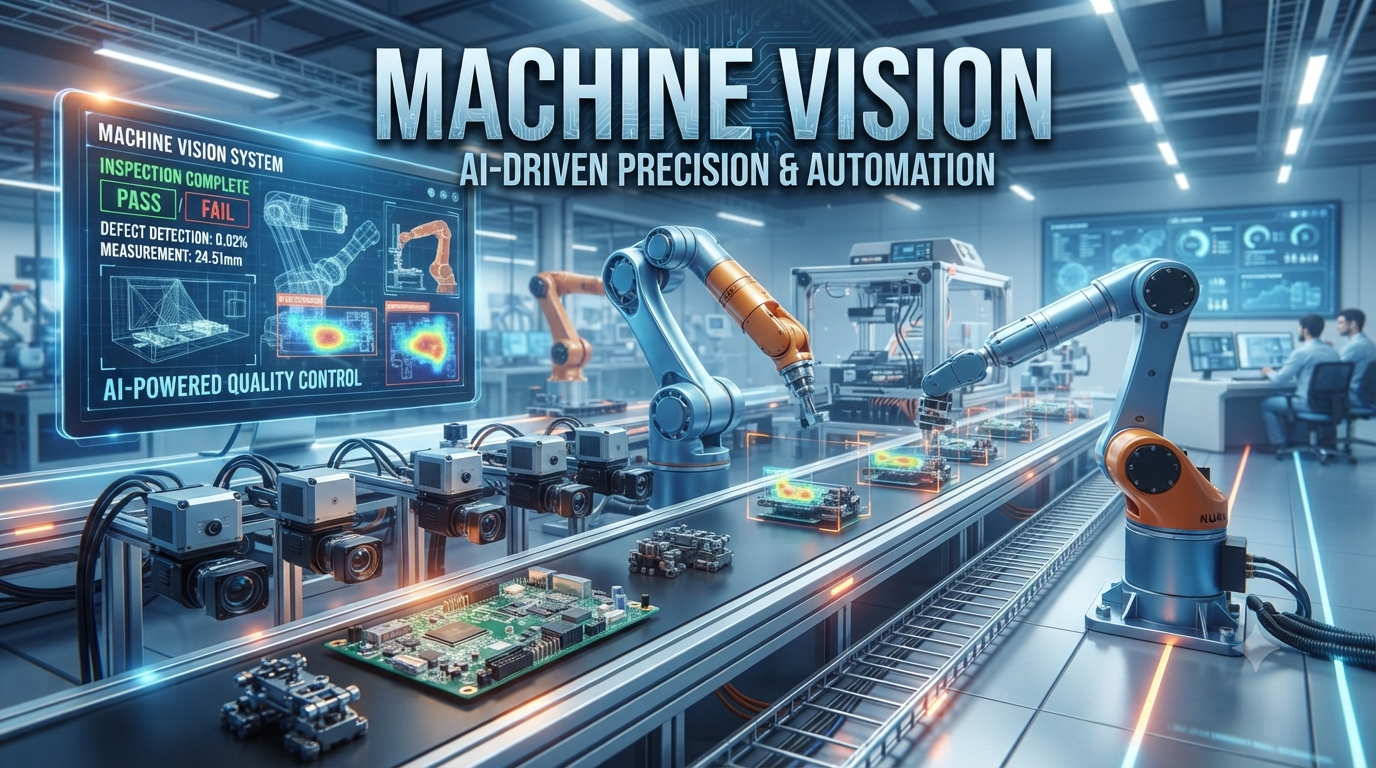
Artificial intelligence (AI) is transforming machine vision from a traditional image-processing technology into an intelligent, software-driven platform for industrial automation. By enabling cameras and vision systems to recognize patterns, identify defects, interpret complex visual information, and make decisions in real time, AI is expanding the applications and economic value of machine vision across manufacturing and other industries..
Machine vision has become a critical technology for modern industrial automation, enabling machines and production systems to interpret visual information and make automated decisions. From inspecting automotive components to identifying defects in semiconductor wafers, machine vision systems are helping manufacturers improve quality, increase productivity, reduce waste, and maintain consistent production standards.
Get Details Download PDF Brochure:
https://www.marketsandmarkets.com/pdfdownloadNew.asp?id=234246734
Traditional machine vision systems generally rely on predefined rules, thresholds, patterns, and image-processing algorithms. These approaches can work effectively in highly controlled production environments but may require significant engineering effort when products, lighting conditions, materials, or defect characteristics change.
AI introduces a more flexible approach. Deep learning and machine learning models can be trained using images to recognize complex patterns and distinguish between acceptable and defective products. This reduces dependence on manually programmed inspection rules and can make machine vision easier to deploy across changing production environments.
The combination of AI and edge computing is another important growth area. Rather than sending every image to a remote cloud server, manufacturers can process visual data directly on smart cameras, industrial PCs, GPUs, or edge AI devices.
Machine Vision Revenue Is Expanding
Machine vision revenue is generated across a broad ecosystem that includes cameras, sensors, lighting systems, frame grabbers, processors, software, machine vision platforms, and system integration services.
The growing adoption of automated inspection is one of the strongest contributors to market revenue. Manufacturers are increasingly replacing manual inspection processes with automated systems capable of examining thousands of products per hour.
Demand is particularly strong in industries where product quality and precision are critical, including:
-
Automotive
-
Electronics
-
Semiconductor
-
Pharmaceuticals
-
Food and beverage
-
Consumer goods
-
Aerospace
-
Battery manufacturing
-
Logistics and packaging
The expansion of these industries' production capacity creates additional demand for machine vision equipment and software.
Automation Is Driving Investment
Industrial automation is one of the most important investment drivers for machine vision. Manufacturers face increasing pressure to improve productivity while controlling operating costs and maintaining consistent quality.
Machine vision enables automated systems to perform tasks such as:
-
Defect detection
-
Product identification
-
Barcode and QR-code reading
-
Dimensional measurement
-
Assembly verification
-
Surface inspection
-
Object positioning
-
Robotic guidance
As factories become more automated, machine vision increasingly acts as the “eyes” of automated production systems.
Investment in robotics is also supporting machine vision demand. Robots require accurate visual information to locate, identify, pick, place, inspect, and manipulate objects. This is creating opportunities for companies developing integrated robotic vision solutions.
AI Is Increasing the Value of Machine Vision
Artificial intelligence is changing the machine vision market by improving the ability of systems to recognize complex visual patterns.
Traditional machine vision often depends on predefined rules. AI-powered vision systems can instead learn from large collections of images and identify patterns associated with acceptable and defective products.
This is particularly valuable when manufacturers inspect products with natural variations or complex surfaces.
AI-powered machine vision can help detect:
-
Small cracks
-
Scratches
-
Surface imperfections
-
Missing components
-
Incorrect assembly
-
Contamination
-
Color variations
-
Manufacturing defects
The increasing integration of AI is also shifting revenue toward software. Machine vision companies can generate additional revenue through AI models, analytics, cloud platforms, software subscriptions, and machine-learning services.
Smart Cameras Create New Revenue Opportunities
Smart cameras are becoming increasingly important within the machine vision ecosystem.
Traditional machine vision systems may require separate cameras, processors, computers, and software. Smart cameras combine imaging, processing, communication, and AI capabilities into a more integrated device.
This can simplify deployment and reduce system complexity.
Smart cameras are particularly attractive for applications such as:
-
Production-line inspection
-
Packaging verification
-
Object recognition
-
Barcode reading
-
Robot guidance
-
Warehouse automation
-
Safety monitoring
As edge AI processors become more powerful, smart cameras can increasingly perform sophisticated visual analysis without relying entirely on centralized computing infrastructure.
3D Machine Vision Opens New Markets
Two-dimensional imaging remains widely used, but 3D machine vision is opening additional opportunities.
3D systems capture depth information, allowing machines to understand the shape, height, volume, and spatial position of objects.
This makes 3D machine vision useful for:
-
Robotic picking
-
Bin picking
-
Dimensional inspection
-
Automotive manufacturing
-
Logistics
-
Warehouse automation
-
Electronics inspection
-
Packaging
The combination of 3D vision, robotics, and AI could become an important investment area as manufacturers seek greater flexibility from automated systems.
Machine Vision Investment Across Manufacturing
Manufacturers are investing in machine vision because the technology can deliver measurable operational benefits.
Automated inspection can operate continuously and maintain consistent inspection standards. It can also help manufacturers identify defects earlier in the production process.
For manufacturers, the investment case can include:
Higher productivity: Automated inspection can operate at high production speeds.
Improved quality: Vision systems can identify defects consistently.
Lower waste: Early defect detection can reduce material and production losses.
Better traceability: Vision systems can capture and store inspection information.
Labor optimization: Automation can reduce the need for repetitive manual inspection tasks.
Real-time decision-making: Vision systems can immediately identify problems and trigger corrective actions.
These benefits make machine vision attractive not only as a quality-control technology but also as a broader manufacturing optimization platform.
North America Supports Strong Investment
North America is an important market for machine vision because of its advanced manufacturing ecosystem, automation adoption, robotics deployment, and investment in AI.
The region is seeing increasing adoption of automated inspection in automotive, electronics, food processing, logistics, and other industries.
The Association for Advancing Automation reported approximately $789 million in North American machine vision sales in the first quarter of 2026, highlighting continued demand for vision technologies.
Investment in reshoring and advanced manufacturing is also creating opportunities. As manufacturers establish or expand production facilities, automated inspection and machine vision can become important components of modern production lines.
Asia-Pacific Remains a Major Opportunity
Asia-Pacific represents another important investment region because of its large manufacturing base.
Countries such as China, Japan, South Korea, Taiwan, and India have significant electronics, semiconductor, automotive, consumer electronics, and industrial manufacturing activities.
The increasing use of automation in these industries is supporting machine vision adoption.
Semiconductor and electronics manufacturing are particularly attractive markets because products require extremely precise inspection. As component sizes become smaller and production complexity increases, automated visual inspection becomes increasingly important.
Software and Services Could Capture More Value
A significant change in the machine vision market is the growing importance of software and services.
Hardware remains essential, but manufacturers increasingly require complete solutions rather than individual cameras or sensors.
This is creating opportunities for companies offering:
-
Vision software
-
AI inspection platforms
-
Cloud-based analytics
-
Edge computing
-
System integration
-
Machine vision consulting
-
Predictive maintenance
-
Remote monitoring
-
Vision-as-a-Service
Recurring software revenue could become increasingly important as machine vision suppliers transition from one-time hardware sales toward long-term technology platforms.
Challenges for Machine Vision Investment
Despite its growth potential, machine vision investment involves several challenges.
Initial deployment costs can be significant, particularly for complex production environments. Companies may need specialized cameras, lighting, computing systems, software, and integration services.
Another challenge is data quality. AI-based vision systems require representative image datasets to operate effectively. Poor lighting, changing production conditions, camera positioning, and product variations can affect system performance.
There is also a shortage of professionals with expertise across machine vision, AI, robotics, industrial automation, and manufacturing processes.
Successful machine vision vendors will therefore need to provide technologies that are easier to deploy, train, integrate, and maintain.
Future Outlook for Machine Vision Revenue and Investment
The future of machine vision is closely connected with the development of AI, robotics, edge computing, Industrial IoT, and smart manufacturing.
As factories become more autonomous, visual intelligence will become increasingly important. Machine vision systems will move beyond simple inspection toward real-time decision-making and process optimization.
Future systems could identify defects, understand production conditions, communicate with robots, analyze manufacturing data, and automatically adjust production processes.
This evolution could expand machine vision from a specialized inspection technology into a core component of intelligent manufacturing infrastructure.
Machine vision revenue and investment are benefiting from the global transition toward automated and intelligent manufacturing. Automation, robotics, AI, smart cameras, 3D imaging, and edge computing are expanding the technology's applications across multiple industries.
While hardware remains a major part of the market, software, AI, analytics, and integrated services are expected to capture an increasing share of the industry's value.
For investors and technology companies, the most attractive opportunities may lie at the intersection of machine vision + AI + robotics + edge computing. As manufacturers continue investing in productivity, quality, and autonomous operations, machine vision is positioned to remain an important growth market in the global industrial technology landscape.
80% of the Forbes Global 2000 B2B companies rely on MarketsandMarkets to identify growth opportunities in emerging technologies and use cases that will have a positive revenue impact.
- Food Packaging Market Size Set for Strong Growth Through 2030 Amid Rising Demand for Convenience Foods
- Crop Protection Chemical Market Size, Share & Growth Forecast (2025–2030)
- Mulch Films Market: Driving Sustainable Agriculture Through Innovation
- Agricultural Adjuvants Market Analysis, Trends, and Growth Outlook (2026–2031)
- Japan Enterprise Asset Management Market Growth: AI and Smart Infrastructure Drive Demand

