

People Counting System Technology Innovation: Key Trends, Growth Drivers and Opportunities
Introduction to People Counting System Technology
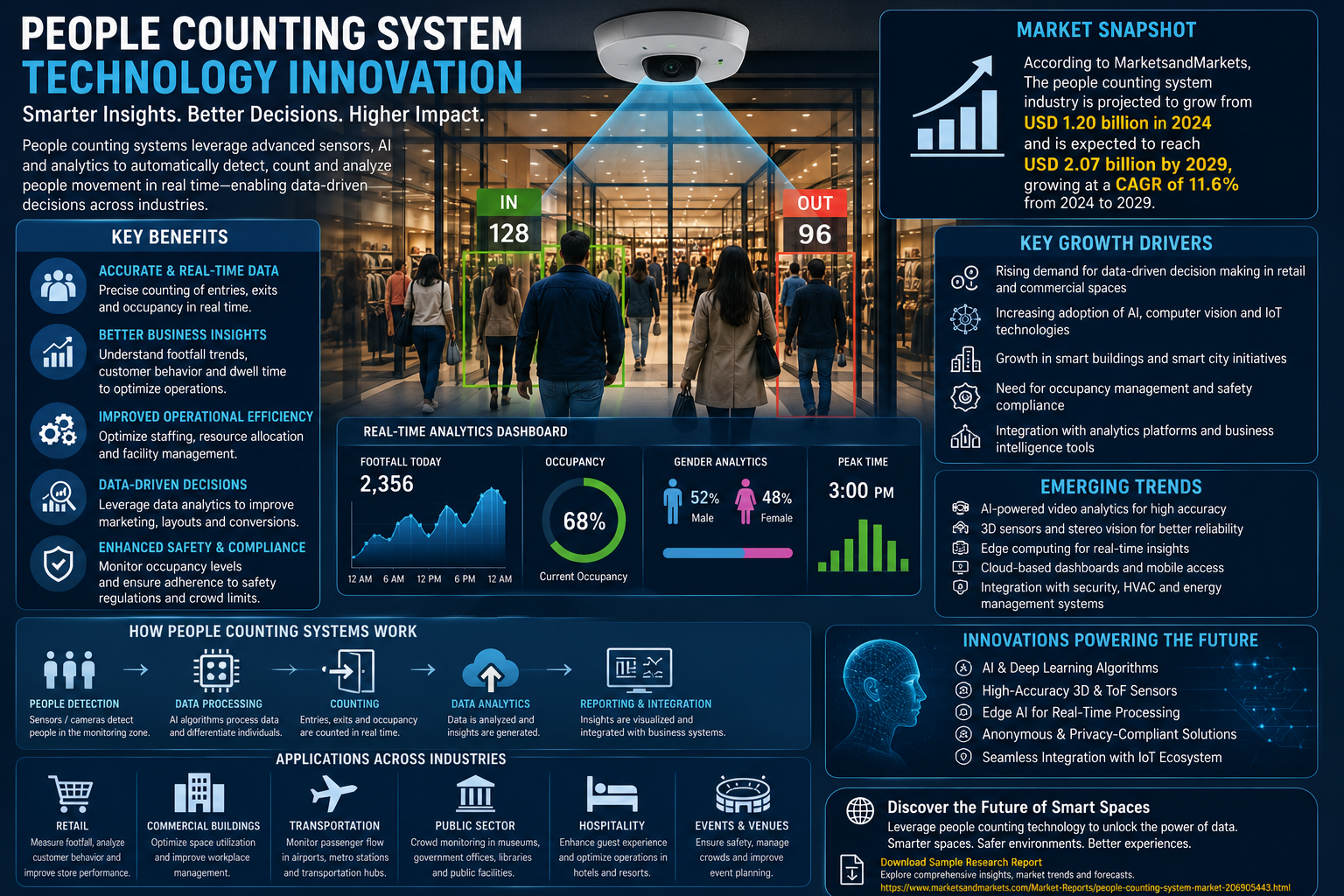
People counting systems use AI, computer vision, infrared, thermal imaging, and sensor technologies to accurately measure foot traffic and occupancy in real time. They help retailers, airports, transportation hubs, smart buildings, and public venues optimize operations, improve customer experiences, and enhance safety.
History of People Counting Systems
People counting evolved from manual tally methods to infrared beam counters and now AI-powered vision analytics integrated with IoT and cloud platforms for real-time occupancy intelligence.
Benefits of People Counting Systems
Key benefits include improved operational efficiency, optimized staffing, enhanced space utilization, better customer insights, regulatory compliance, and data-driven decision-making.
Current market size and growth trends of the people counting system industry
According to MarketsandMarkets, the people counting system market is projected to grow from USD 1.20 billion in 2024 and is expected to reach USD 2.07 billion by 2029, growing at a CAGR of 11.6% from 2024 to 2029. Market growth is driven by increasing adoption of AI-powered analytics, smart retail solutions, occupancy monitoring, and smart building initiatives across commercial and public infrastructure.
This rapid growth can be attributed to several factors, including:
- Growing adoption of AI-powered people counting and occupancy analytics.
- Rising demand for customer behavior insights in retail environments.
- Increasing deployment in airports, transportation hubs, and smart buildings.
- Expansion of IoT-enabled facility management and security solutions.
- Advancements in computer vision, edge AI, and cloud-based analytics.
Key drivers and factors influencing the future
Digital transformation, smart city projects, labor optimization, and real-time occupancy intelligence are accelerating market adoption.
Emerging trends
AI vision analytics, anonymous tracking, edge computing, thermal sensing, and predictive analytics are reshaping the industry.
Opportunities and challenges
Retail, healthcare, hospitality, transportation, and commercial buildings present strong opportunities, while privacy regulations, integration complexity, and upfront costs remain challenges.
Innovations and advancements
3D stereo vision, LiDAR, AI cameras, cloud dashboards, and multi-sensor fusion continue to improve counting accuracy.
Future applications
Smart cities, malls, stadiums, airports, hospitals, corporate offices, educational campuses, and public transport will increasingly deploy these systems.
Conclusion
People counting systems are becoming essential for data-driven facility management and customer intelligence.
Learn more at:
https://www.marketsandmarkets.com/Market-Reports/people-counting-system-market-206905443.html
80% of the Forbes Global 2000 B2B companies rely on MarketsandMarkets to identify growth opportunities in emerging technologies and use cases that will have a positive revenue impact.
- Food Packaging Market Size Set for Strong Growth Through 2030 Amid Rising Demand for Convenience Foods
- Mulch Films Market: Driving Sustainable Agriculture Through Innovation
- Agricultural Adjuvants Market Analysis, Trends, and Growth Outlook (2026–2031)
- Crop Protection Chemical Market Size, Share & Growth Forecast (2025–2030)
- Japan Enterprise Asset Management Market Growth: AI and Smart Infrastructure Drive Demand

