How Physical AI Is Transforming the Future of Autonomous Industries
The global Physical AI market is entering a transformative growth phase as artificial intelligence increasingly moves beyond digital environments and into physical systems such as robots, autonomous vehicles, industrial machines, drones, and smart infrastructure. Unlike traditional software-based AI models that operate in virtual environments, Physical AI enables machines to perceive, reason, interact, and act within real-world environments using sensors, computer vision, edge computing, and autonomous decision-making capabilities.
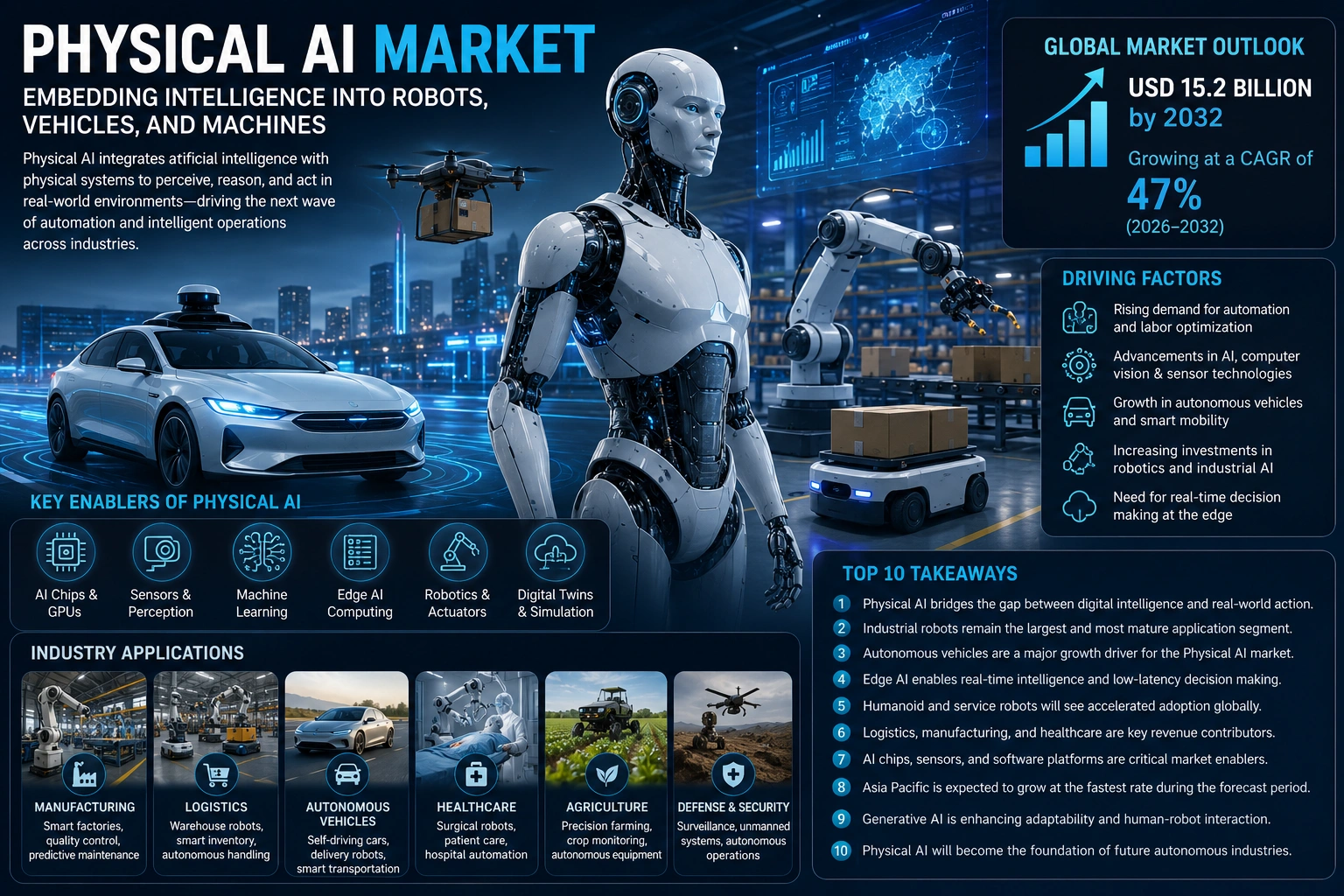
Physical AI combines robotics, machine learning, computer vision, generative AI, digital twins, and real-time analytics to create intelligent machines capable of operating with minimal human intervention. From factory automation and warehouse robotics to autonomous mobility and healthcare robots, Physical AI is redefining how industries operate, optimize productivity, and reduce operational costs.
The market is experiencing rapid momentum due to growing investments in industrial automation, smart manufacturing, autonomous transportation, and AI-powered robotics. Advancements in GPUs, AI processors, memory systems, LiDAR, sensors, and edge AI platforms are accelerating the deployment of Physical AI systems globally. As industries seek higher efficiency, predictive operations, and intelligent automation, Physical AI is becoming a strategic technology foundation for the next generation of connected enterprises.
What Is Physical AI?
Physical AI refers to artificial intelligence systems embedded into physical machines that can interact with and respond to the real world autonomously. These systems integrate AI software with robotic hardware, actuators, sensors, processors, and real-time communication technologies to perform physical actions intelligently.
Unlike conversational AI or generative AI platforms that mainly process digital data, Physical AI enables machines to understand environments, navigate spaces, manipulate objects, and make decisions independently.
Key Components of Physical AI
-
AI-powered processors and GPUs
-
Sensors and computer vision systems
-
Robotics and autonomous machines
-
Edge AI computing platforms
-
Digital twin technologies
-
Real-time data analytics
-
Machine learning algorithms
-
Autonomous control systems
Physical AI is increasingly being integrated into industrial robots, autonomous delivery vehicles, warehouse automation systems, agricultural equipment, humanoid robots, defense systems, and healthcare devices.
Why the Global Physical AI Market Is Growing Rapidly
The growth of the Physical AI market is strongly linked to the increasing adoption of intelligent automation across industries. Businesses are under pressure to improve efficiency, reduce labor dependency, and optimize operations through autonomous technologies.
Rising Demand for Industrial Automation
Manufacturing companies are deploying AI-powered robots and intelligent machines to automate repetitive tasks, improve production accuracy, and reduce downtime. Smart factories powered by Physical AI are enabling predictive maintenance, autonomous material handling, and adaptive manufacturing systems.
Industrial robots equipped with AI vision systems can now identify defects, analyze production quality, and make operational decisions in real time. This is significantly increasing operational efficiency across automotive, electronics, semiconductor, and heavy machinery sectors.
Expansion of Autonomous Vehicles
Self-driving technologies are another major growth driver for Physical AI. Autonomous vehicles rely heavily on embedded AI systems capable of analyzing road conditions, recognizing objects, and making instant navigation decisions.
Physical AI technologies are enabling:
-
Autonomous cars
-
Smart logistics vehicles
-
Delivery robots
-
Agricultural tractors
-
Mining vehicles
-
Autonomous drones
The increasing integration of AI into mobility ecosystems is expected to create substantial opportunities for Physical AI solution providers over the next decade.
Growth in Warehouse and Logistics Automation
The logistics sector is rapidly adopting Physical AI solutions to address labor shortages and rising e-commerce demand. AI-powered warehouse robots can optimize inventory movement, identify packages, and perform automated sorting operations with minimal human involvement.
Major logistics providers are investing in:
-
Autonomous mobile robots (AMRs)
-
AI-driven warehouse systems
-
Smart inventory management
-
Intelligent fulfillment centers
-
Robotic picking systems
These technologies are improving supply chain efficiency while reducing operational costs.
Physical AI in Robotics
Industrial Robots
Industrial robots remain the largest application segment within the Physical AI market. AI-enabled robotic systems are increasingly used in welding, assembly, painting, packaging, and inspection operations.
Physical AI helps industrial robots:
-
Learn from operational data
-
Adapt to dynamic production lines
-
Collaborate safely with humans
-
Improve precision and efficiency
-
Reduce production downtime
Smart robotic systems are particularly gaining adoption in automotive manufacturing, electronics assembly, semiconductor fabrication, and aerospace industries.
Humanoid Robots
Humanoid robots represent one of the most exciting segments of the Physical AI market. These robots are designed to mimic human movement, communication, and interaction capabilities.
Recent advancements in generative AI, computer vision, and motion intelligence are accelerating the development of humanoid robots capable of:
-
Customer service
-
Warehouse operations
-
Elderly care
-
Security assistance
-
Household support
Technology companies and robotics startups are heavily investing in next-generation humanoid systems that can perform complex physical tasks autonomously.
Service Robots
Professional and personal service robots are increasingly becoming part of everyday life. AI-powered service robots are now being used in:
-
Hospitals
-
Hotels
-
Airports
-
Retail stores
-
Restaurants
-
Smart homes
These robots can navigate environments, interact with users, and provide intelligent assistance using embedded AI systems.
Physical AI in Autonomous Vehicles
The integration of Physical AI into transportation is reshaping the future of mobility. Autonomous systems use AI algorithms, sensors, radar, LiDAR, and computer vision to interpret surroundings and make driving decisions.
Applications of Physical AI in Mobility
-
Self-driving passenger vehicles
-
Autonomous trucking
-
Smart public transportation
-
Last-mile delivery robots
-
Autonomous drones
-
Smart traffic management
AI-powered mobility systems improve transportation efficiency while reducing human error and operational risks.
Automotive manufacturers are increasingly partnering with AI chipmakers and robotics companies to accelerate the commercialization of autonomous transportation technologies.
Edge AI and Real-Time Intelligence
One of the most important trends in the Physical AI market is the rise of edge AI computing. Physical AI systems require low-latency processing because machines must respond instantly to changing environments.
Edge AI enables data processing directly on devices rather than relying entirely on cloud computing. This significantly improves:
-
Real-time decision-making
-
Data privacy
-
System reliability
-
Autonomous responsiveness
-
Energy efficiency
AI chips, SoCs, and edge processors are therefore becoming critical components of Physical AI infrastructure.
Industry Applications of Physical AI
Manufacturing
Smart manufacturing is one of the biggest adopters of Physical AI technologies. AI-powered robotics and intelligent machines help manufacturers improve:
-
Productivity
-
Quality control
-
Predictive maintenance
-
Operational efficiency
-
Energy optimization
Healthcare
Physical AI is transforming healthcare through robotic surgery systems, rehabilitation robots, patient monitoring devices, and autonomous hospital logistics systems.
AI-powered healthcare robots assist medical professionals in repetitive and precision-based tasks while improving patient care efficiency.
Agriculture
Autonomous tractors, AI-powered harvesting systems, and precision agriculture robots are helping farmers optimize crop management and reduce labor dependency.
Physical AI enables:
-
Smart irrigation
-
Crop monitoring
-
Soil analysis
-
Autonomous harvesting
-
Livestock monitoring
Defense and Security
Defense organizations are increasingly deploying AI-enabled autonomous systems for surveillance, reconnaissance, logistics, and unmanned operations.
Applications include:
-
Autonomous drones
-
Robotic defense systems
-
Smart surveillance robots
-
AI-powered military vehicles
Regional Outlook of the Physical AI Market
North America
North America currently dominates the Physical AI market due to strong investments in AI infrastructure, robotics innovation, and autonomous vehicle development.
The region benefits from:
-
Advanced semiconductor ecosystem
-
Strong AI startup funding
-
Industrial automation adoption
-
Presence of leading AI companies
Asia Pacific
Asia Pacific is expected to witness the fastest market growth during the forecast period. Countries such as China, Japan, and South Korea are heavily investing in robotics, smart manufacturing, and AI infrastructure.
China particularly remains a major manufacturing hub for industrial robots and autonomous systems.
Europe
Europe is focusing on AI regulations, industrial automation, and sustainable smart manufacturing initiatives. The region is seeing growing adoption of collaborative robots and AI-driven industrial systems.
Emerging Trends Shaping the Physical AI Market
AI-Powered Humanoid Robotics
Humanoid robots are gaining significant attention from investors and enterprises. These systems are expected to play important roles in labor-intensive industries and service applications.
Generative AI Integration
Generative AI models are being integrated into Physical AI systems to improve reasoning, adaptability, and natural human-machine interaction.
Digital Twin Technology
Digital twins allow organizations to simulate physical environments and optimize machine performance using AI-driven analytics.
AI Semiconductor Innovation
Advanced GPUs, AI accelerators, and custom AI chips are enabling faster and more energy-efficient Physical AI systems.
Human-Robot Collaboration
Collaborative robots, also known as cobots, are increasingly working alongside humans in manufacturing and logistics environments.
Challenges in the Physical AI Market
Despite strong growth potential, the market faces several challenges.
High Development Costs
Building autonomous physical systems requires significant investment in hardware, software, and AI training infrastructure.
Safety and Regulatory Concerns
Governments and regulators are still developing policies related to autonomous robotics, AI ethics, and machine safety.
Data Processing Complexity
Physical AI systems generate massive amounts of real-time data that require advanced processing and storage capabilities.
Cybersecurity Risks
Connected autonomous systems remain vulnerable to cyberattacks and data breaches.
Future Outlook of the Physical AI Market
The future of the Physical AI market looks highly promising as industries increasingly move toward intelligent automation and autonomous operations. Over the next decade, Physical AI is expected to become a foundational technology across manufacturing, logistics, healthcare, mobility, agriculture, and smart cities.
The convergence of robotics, AI, edge computing, IoT, and digital twins will continue to accelerate innovation in autonomous systems. Enterprises that invest early in Physical AI technologies are likely to gain significant competitive advantages through higher efficiency, reduced operational costs, and improved productivity.
As AI models become more capable of understanding physical environments, the boundary between digital intelligence and physical machines will continue to disappear. Physical AI is not only shaping the future of robotics but also redefining how humans interact with intelligent machines in everyday life.
Top 10 Key Takeaways from the Physical AI Market
-
Physical AI enables machines to interact intelligently with real-world environments.
-
Industrial robots remain the largest application segment in the market.
-
Autonomous vehicles are accelerating demand for embedded AI systems.
-
Edge AI computing is becoming essential for real-time autonomous decision-making.
-
Humanoid robots are emerging as a high-growth segment.
-
Logistics and warehouse automation are major revenue contributors.
-
AI-powered sensors and GPUs are critical components of Physical AI systems.
-
Asia Pacific is expected to witness the fastest market growth.
-
Generative AI integration is enhancing robot reasoning and adaptability.
-
Physical AI will become a core technology for future smart industries and autonomous infrastructure.
Frequently Asked Questions (FAQ)
What is the Physical AI market?
The Physical AI market refers to the industry focused on embedding artificial intelligence into robots, autonomous vehicles, machines, and physical systems that interact with real-world environments.
What are the major applications of Physical AI?
Major applications include industrial robotics, autonomous vehicles, warehouse automation, healthcare robots, smart manufacturing, agriculture automation, and defense systems.
Why is Physical AI important?
Physical AI improves automation, operational efficiency, decision-making, and productivity by enabling machines to operate autonomously in physical environments.
Which industries are adopting Physical AI the fastest?
Manufacturing, logistics, automotive, healthcare, agriculture, and defense sectors are among the fastest adopters of Physical AI technologies.
What technologies support Physical AI systems?
Key technologies include machine learning, computer vision, edge AI, sensors, robotics, GPUs, digital twins, LiDAR, and autonomous control systems.



