

Physical AI Market: Major Mergers and Acquisitions, Strategic Deals, and Key Companies - SoftBank Group Agrees to Acquire ABB Robotics
The global Physical AI market is witnessing increasing merger and acquisition (M&A) activity as technology companies, robotics manufacturers, semiconductor developers, and artificial intelligence (AI) startups compete to develop intelligent systems capable of interacting with the physical world. Physical AI combines artificial intelligence, machine learning, computer vision, robotics, autonomous navigation, and real-time decision-making to enable machines to perceive, understand, and perform tasks in real-world environments.
The growing adoption of humanoid robots, autonomous mobile robots (AMRs), industrial robots, autonomous vehicles, and intelligent machines is encouraging companies to pursue strategic acquisitions and technology partnerships. Unlike conventional software-based AI, Physical AI requires integration between AI models, sensors, actuators, robotic hardware, edge computing, and advanced control systems.
Consequently, established technology companies are acquiring specialized robotics startups and AI software developers to accelerate innovation, strengthen intellectual property portfolios, and expand their presence in emerging markets. Major companies, including SoftBank Group, Mobileye, Qualcomm, and other technology players, are using M&A strategies to establish competitive advantages in the rapidly evolving Physical AI ecosystem.
The physical AI market size was USD 0.89 billion in 2025 and is expected to reach USD 15.24 billion by 2032, growing at a CAGR of 47.2% during the forecast period 2026 to 2032 The growth rate of physical AI market is in the research report. The market is driven by fast development of edge AI computing, multi-modal perception and real-time decision-making capability in robots. Investment in humanoid robotics, AI-enabled autonomy, and simulation platforms enables scalable deployment. In addition, soaring demand for automation in industries and rising labour shortages are helping accelerate adoption.
Physical AI Market Size, Share, Technology & Trends:
Download Free pages Sample @
https://www.marketsandmarkets.com/pdfdownloadNew.asp?id=240269196
Major Mergers and Acquisitions in the Physical AI Market
The Physical AI industry is attracting significant corporate investments and strategic acquisitions. Recent transactions demonstrate how companies are combining robotics hardware, AI software, autonomous systems, and advanced computing technologies to develop next-generation intelligent machines.
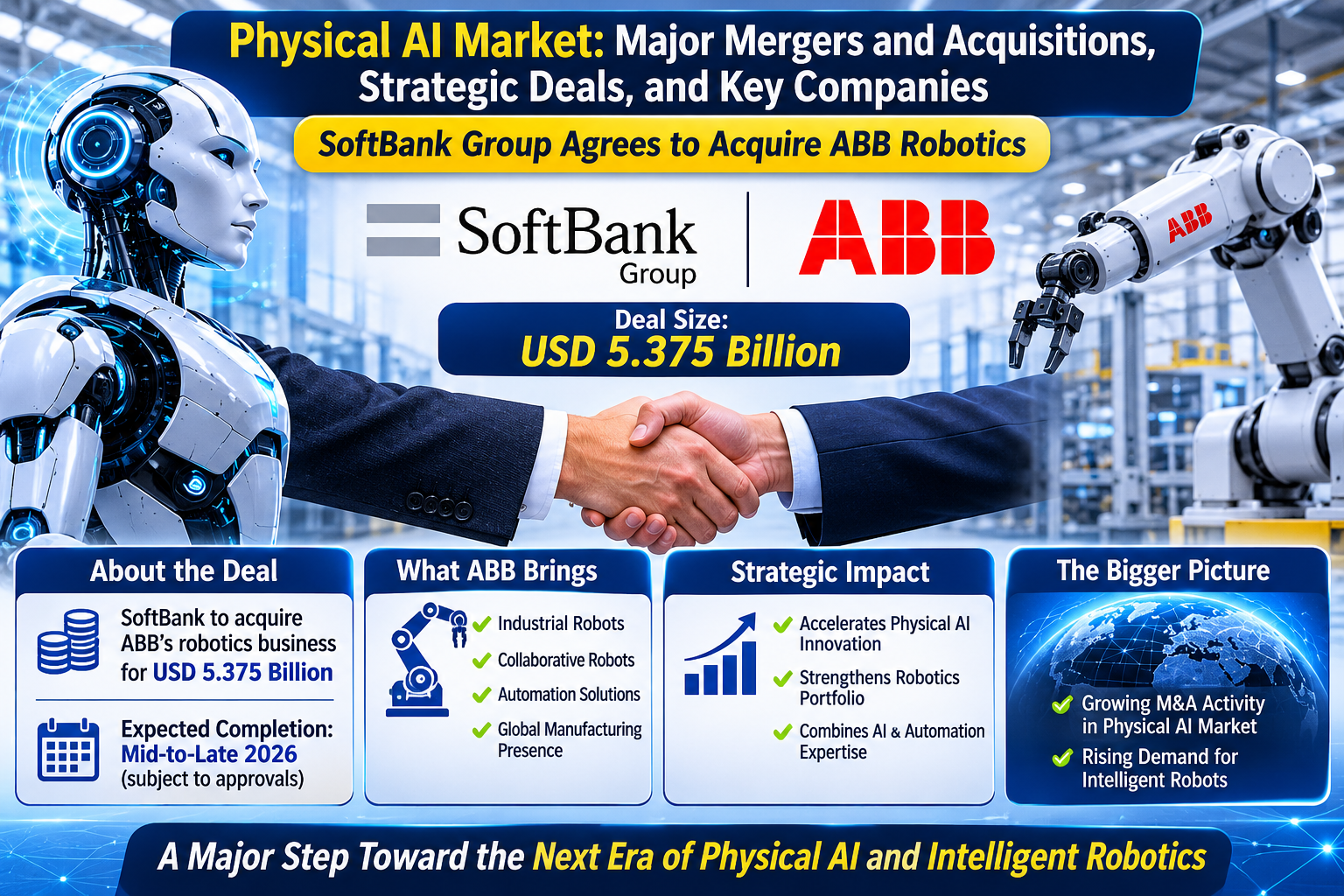
SoftBank Group Agrees to Acquire ABB Robotics
One of the most significant transactions connected to Physical AI is SoftBank Group’s agreement to acquire the robotics business of ABB for approximately USD 5.375 billion, announced in October 2025.
The transaction aims to combine ABB's established industrial robotics portfolio with SoftBank's investments and capabilities in artificial intelligence, robotics, and next-generation computing. ABB Robotics provides industrial robotic arms, collaborative robots, automated manufacturing solutions, and robotic systems for material handling and assembly operations.
The acquisition is strategically important because Physical AI requires the integration of intelligent software with physical machines capable of performing real-world tasks. SoftBank intends to combine ABB's industrial automation expertise with its broader AI ecosystem to accelerate the development of intelligent robotic systems.
The transaction is subject to regulatory approvals and customary closing conditions, with completion originally expected in mid-to-late 2026.
Mobileye Acquires Mentee Robotics
In January 2026, Mobileye announced an agreement to acquire Mentee Robotics for approximately USD 900 million in cash and stock. The acquisition was completed on February 3, 2026, according to Mobileye's subsequent SEC filing.
Mentee Robotics specializes in developing AI-powered humanoid robots designed to understand instructions, navigate physical environments, and perform tasks autonomously. Its technology combines advanced AI models, robotic hardware, simulation-based training, and autonomous task execution.
Mobileye brings expertise in autonomous driving, computer vision, sensor technologies, and AI-based decision-making. Integrating these capabilities with Mentee's humanoid robotics platform is expected to strengthen Mobileye's position in Physical AI.
The acquisition demonstrates the growing convergence between autonomous vehicles and humanoid robotics, where both technologies depend on perception, environmental understanding, motion planning, and real-time decision-making.
In September 2026, Qualcomm announced an agreement to acquire PickNik Robotics, a robotics software developer and steward of the widely used MoveIt open-source manipulation framework.
The acquisition supports Qualcomm's strategy to strengthen its robotics computing ecosystem through the integration of advanced software, edge AI processing, and robotic control technologies.
PickNik's MoveIt framework supports robotic motion planning, manipulation, perception, and kinematics. These capabilities are essential for developing intelligent machines that can interact with objects and perform complex physical operations.
Qualcomm plans to integrate PickNik's technologies more closely with its Dragonwing robotics platforms, creating opportunities for developers to build intelligent robots with advanced AI computing and real-time control capabilities.
This transaction highlights the importance of robotics software and edge computing in the development of Physical AI applications. The announced agreement remains subject to customary closing conditions.
In February 2026, Ouster completed its acquisition of StereoLabs, strengthening its position in Physical AI sensing and perception technologies.
StereoLabs develops advanced 3D vision solutions, stereo cameras, and AI-based perception software used in robotics, industrial automation, and smart infrastructure applications.
The acquisition combines Ouster's digital lidar technology with StereoLabs' computer vision capabilities, enabling an integrated platform covering cameras, lidar, AI computing, sensor fusion, and perception software.
This integration is particularly relevant to Physical AI because autonomous robots require accurate environmental perception to navigate spaces, identify objects, avoid obstacles, and perform tasks safely.
Ouster completed the acquisition on February 4, 2026, using approximately USD 35 million in cash and 1.8 million shares.
In May 2026, DIMAAG announced the acquisition of Akridata, a specialist in AI vision systems and edge-to-core AI infrastructure.
Akridata provides computer vision, intelligent data capture, edge processing, and AI-powered inspection technologies. Its solutions support applications across automotive, manufacturing, logistics, healthcare, and industrial inspection.
The acquisition strengthens DIMAAG's Physical AI capabilities by integrating advanced visual intelligence and AI infrastructure into its industrial technology portfolio.
The transaction reflects a broader trend in the Physical AI market: companies are acquiring specialized AI vision and data-processing businesses to improve the intelligence, reliability, and operational capabilities of autonomous machines.
In November 2026, Agility Robotics completed its business combination with Churchill Capital Corp XI.
The transaction represents an important financing and public-market development for the humanoid robotics industry. Agility Robotics develops Digit, a humanoid robot designed for manufacturing, warehouse operations, and logistics applications.
The company has already established commercial deployments with industrial customers, including GXO, Schaeffler, and Toyota Motor Manufacturing Canada.
Following the transaction's completion on November 4, 2026, the combined company was expected to begin trading on Nasdaq under the ticker symbol AGLT on November 5, 2026.
The business combination provides Agility with access to public capital markets to support humanoid robot manufacturing, commercial deployment, and Physical AI technology development. Unlike a conventional acquisition, this transaction represents a SPAC business combination.
Several companies are shaping the competitive landscape through acquisitions, business combinations, and strategic technology integration.
|
Acquiring company |
Target company |
Strategic technology focus |
|---|---|---|
|
SoftBank Group |
ABB Robotics |
Industrial robotics and AI |
|
Mobileye |
Mentee Robotics |
Humanoid robotics and autonomous AI |
|
Qualcomm |
PickNik Robotics |
Robotics software and edge AI |
|
Ouster |
StereoLabs |
LiDAR, 3D vision, and perception |
|
DIMAAG |
Akridata |
AI vision and industrial intelligence |
|
Agility Robotics / Churchill Capital XI |
Business combination |
Humanoid robotics commercialization |
Strategic Factors Driving Mergers and Acquisitions in the Physical AI Market
Several factors are accelerating M&A activities across the Physical AI ecosystem.
-
Humanoid Robotics Development: Companies are acquiring humanoid robotics startups to gain access to advanced locomotion, robotic manipulation, and autonomous task execution technologies.
-
AI Software Integration: Acquisitions of AI software companies enable manufacturers to integrate vision-language models, machine learning, and intelligent decision-making into physical systems.
-
Advanced Sensor Technologies: Computer vision, lidar, radar, and sensor fusion are attracting acquisition interest because they improve robotic perception and environmental awareness.
-
Edge AI Computing: Semiconductor companies are expanding robotics portfolios through acquisitions that support real-time processing, autonomous navigation, and low-latency robotic control.
-
Industrial Automation Expansion: Established manufacturers are strengthening their robotics portfolios to address growing demand for autonomous manufacturing, warehouse automation, and intelligent material handling.
Future Outlook for Mergers and Acquisitions in the Physical AI Market
M&A activity in the Physical AI market is expected to remain an important strategy as companies compete to develop autonomous machines capable of operating in complex real-world environments. The convergence of generative AI, foundation models, computer vision, robotics hardware, and edge computing is creating new acquisition opportunities across the technology ecosystem.
Humanoid robotics is likely to attract further strategic investments and acquisitions as companies seek to commercialize general-purpose robots for manufacturing, logistics, healthcare, and commercial applications. Similarly, AI perception, robotic manipulation, autonomous navigation, and sensor fusion technologies are expected to remain attractive acquisition targets.
Semiconductor manufacturers and technology companies are also likely to pursue acquisitions to strengthen their Physical AI computing platforms and robotics software ecosystems. Companies such as SoftBank, Qualcomm, Mobileye, and Ouster illustrate how strategic consolidation can accelerate technology development and expand commercial opportunities.
Going forward, companies with integrated AI models, advanced sensors, robotic hardware, and scalable computing infrastructure are expected to gain competitive advantages. Consequently, mergers, acquisitions, and strategic business combinations will play an important role in shaping the competitive landscape of the global Physical AI market.
80% of the Forbes Global 2000 B2B companies rely on MarketsandMarkets to identify growth opportunities in emerging technologies and use cases that will have a positive revenue impact.
- Food Packaging Market Size Set for Strong Growth Through 2030 Amid Rising Demand for Convenience Foods
- Crop Protection Chemical Market Size, Share & Growth Forecast (2025–2030)
- Mulch Films Market: Driving Sustainable Agriculture Through Innovation
- Agricultural Adjuvants Market Analysis, Trends, and Growth Outlook (2026–2031)
- Japan Enterprise Asset Management Market Growth: AI and Smart Infrastructure Drive Demand