

Predictive Maintenance Technologies Help Industrial Hose Operators Reduce Unplanned Downt
Predictive Maintenance Technologies Help Industrial Hose Operators Reduce Unplanned Downtime
Introduction
Unplanned equipment downtime is a major operational challenge for manufacturing plants, mining operations, chemical facilities, and other industrial businesses. A failed hose can interrupt production, cause fluid loss, damage nearby equipment, and create safety hazards. Even when the failed component is inexpensive, the resulting downtime and maintenance work can be costly.
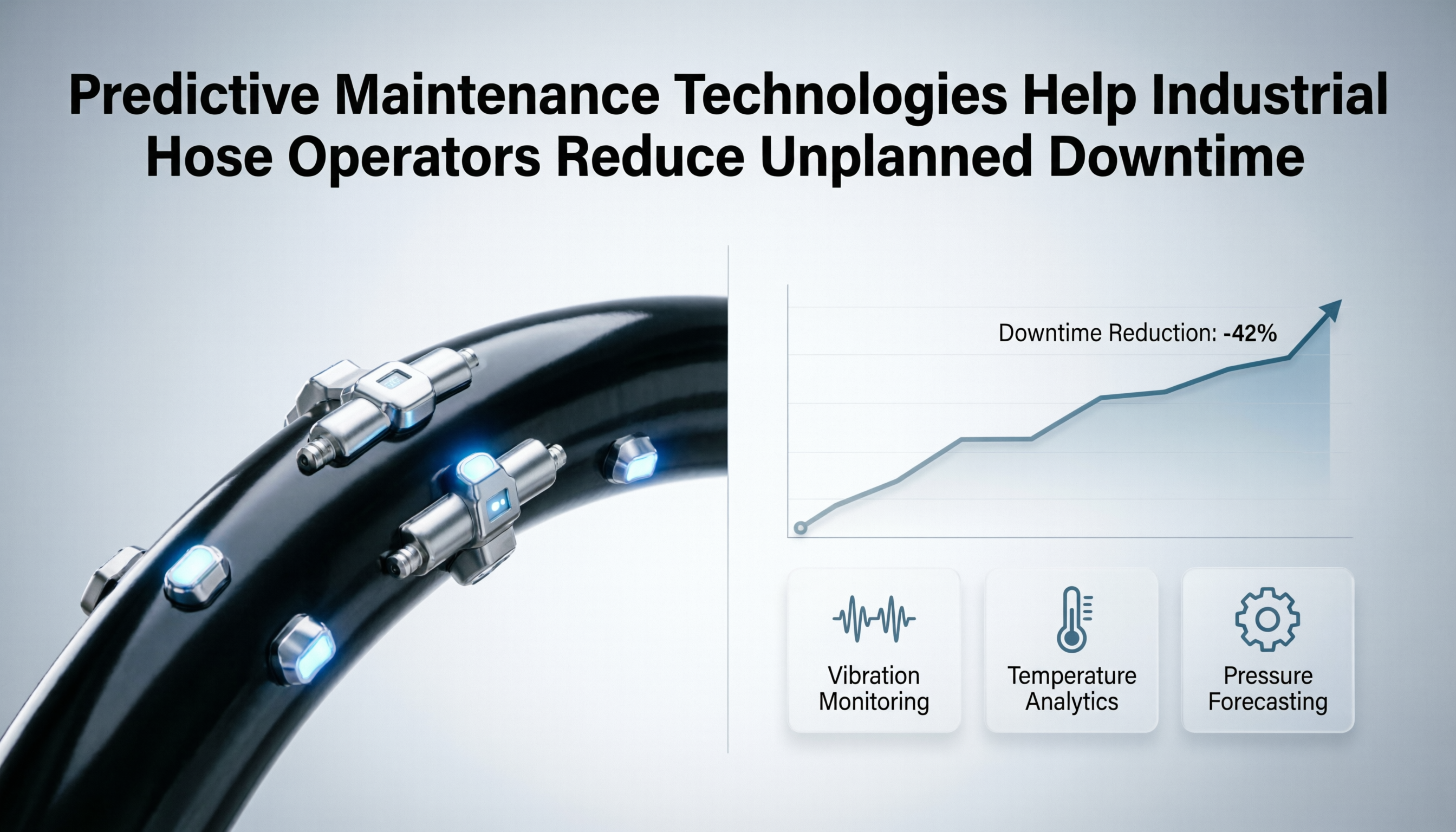
Industrial hose systems play an important role in transferring hydraulic fluids, compressed air, water, chemicals, and other materials throughout industrial facilities. Their performance depends on correct selection, installation, operating conditions, and maintenance.
As industrial operators adopt data-driven maintenance practices, predictive maintenance offers an opportunity to improve hose system reliability. By combining inspection records, operating data, maintenance history, and suitable monitoring technologies, businesses can identify potential problems and plan interventions before failures disrupt operations.
Get more Details Download PDF Brochure @
https://www.marketsandmarkets.com/pdfdownloadNew.asp?id=8695843
For industrial hose manufacturers and suppliers, this development creates opportunities to provide technical services, replacement programs, maintenance documentation, and application-specific products.
Why Industrial Hose Reliability Matters
Industrial hoses operate in a variety of demanding environments. Hydraulic hose may experience pressure fluctuations, vibration, and repeated movement. Pneumatic hose can deteriorate through abrasion, bending, or unsuitable installation. Rubber hose may face temperature changes, environmental exposure, or chemical contact, while polyurethane hose may be selected for applications requiring flexibility and abrasion resistance.
Every hose has defined operating limits. Exceeding those limits or using an incompatible product can increase the risk of premature failure.
Common warning signs include visible cracking, cuts, bulges, blistering, leakage, exposed reinforcement, damaged fittings, and unusual deformation. However, not all failures provide obvious advance warnings. Inspection must therefore be combined with appropriate maintenance procedures and an understanding of operating conditions.
What Is Predictive Maintenance?
Predictive maintenance uses information about equipment condition and performance to estimate when maintenance may be required. It differs from purely reactive maintenance, which takes place after a failure, and time-based preventive maintenance, which follows predetermined schedules.
A predictive maintenance program may combine several information sources:
-
Inspection results and photographs.
-
Hose installation dates and service histories.
-
Pressure and temperature records.
-
Equipment operating cycles and vibration data.
-
Previous failures and replacement intervals.
-
Manufacturer recommendations and maintenance records.
These inputs help maintenance teams identify patterns, prioritize inspections, and plan replacements more effectively.
Importantly, predictive maintenance does not guarantee that every hose failure can be forecast. It is a risk-management approach that complements engineering controls, scheduled inspections, and safe operating procedures.
How Predictive Maintenance Can Support Hydraulic Hose Systems
Hydraulic systems are used in industrial presses, injection moulding machines, construction equipment, mining machinery, and material-handling equipment.
Hose assemblies must withstand the specified pressure, temperature, fluid exposure, and movement. Pressure surges, excessive bending, abrasion, and incorrect assembly can contribute to premature deterioration.
Maintenance teams can improve visibility by recording the location, specification, installation date, and inspection history of each critical assembly.
Where appropriate, system pressure and temperature monitoring can reveal unusual operating conditions. Repeated abnormal readings may indicate that the equipment requires investigation, although they do not automatically prove that a particular hose is failing.
Hose replacement decisions should be based on the manufacturer's guidance, inspection findings, service conditions, and applicable safety requirements.
Pneumatic Hose Monitoring in Automated Factories
Pneumatic hose is widely used in automated production lines, packaging machinery, robotic systems, and assembly operations. Leaks in compressed-air systems can waste energy and reduce the effectiveness of pneumatic equipment.
A structured maintenance program can help detect damaged hoses, loose fittings, pressure losses, and deterioration before they cause substantial operational disruption.
Facilities may use pressure sensors, flow monitoring, ultrasonic leak detection, and maintenance software to investigate compressed-air losses. These tools monitor different aspects of system performance and should be selected according to the application's needs.
For industrial hose suppliers, offering inspection services and helping customers document replacement requirements can create opportunities beyond one-time product sales.
The Role of Digital Tools and Industrial IoT
Industrial Internet of Things technologies make it easier to collect and analyze equipment data. Sensors can record operating parameters, while maintenance platforms organize work orders, inspection results, and service histories.
For hose systems, digital tools can be useful when they provide actionable information. Examples include:
Digital hose registers: A record of hose location, specifications, fitting details, installation dates, and maintenance history.
QR-code identification: A code attached to an appropriate identification tag can direct authorized personnel to product specifications and replacement records.
Maintenance alerts: Software can remind teams about inspections or flag unusual operating conditions.
Asset criticality rankings: Facilities can prioritize hose assemblies according to safety implications, production impact, replacement lead time, and operating conditions.
Failure analysis: Historical records can help identify recurring issues, such as abrasion caused by routing or repeated failures associated with a specific application.
These technologies are most useful when data is accurate, inspection procedures are consistent, and maintenance teams have clear response protocols.
Opportunities for Industrial Hose Manufacturers and Suppliers
Predictive maintenance can create new business models for hose suppliers.
1. Hose inspection and replacement services
Suppliers may offer scheduled inspections, identification services, replacement planning, and technical documentation where they have the appropriate training and capability.
Such services help customers manage complex hose inventories and identify components that need further evaluation.
2. Maintenance kits and replacement inventories
Facilities often need commonly used hose assemblies, fittings, and accessories available without delay. Suppliers can develop customer-specific inventories based on documented demand and criticality.
This approach may improve service levels while helping customers manage procurement and storage costs.
3. Technical training
Training can cover hose identification, visual inspection, routing, storage, handling, and safe replacement practices. Specialized hydraulic systems may require additional training and approved procedures.
4. Digital product information
Clear online catalogues, technical datasheets, product identification systems, and quotation tools make it easier for maintenance teams to find compatible replacement products.
5. Partnerships with maintenance providers
Collaboration with industrial maintenance contractors, equipment manufacturers, and system integrators can help suppliers reach customers that need ongoing support.
Safety and Implementation Challenges
Predictive maintenance should not be used to justify extending a hose beyond its approved service limits. A sensor reading that appears normal does not establish that an assembly is safe.
Hydraulic hose failures can release high-pressure fluid, creating serious injury risks. Pneumatic systems also present hazards from unexpected movement and pressurized air.
Maintenance work must follow appropriate isolation, depressurization, and verification procedures. Workers should never use their hands to locate a high-pressure leak.
Other challenges include sensor costs, inconsistent records, limited technical expertise, and difficulty distinguishing normal variations from genuine warning signs. Businesses can address these issues by starting with critical assets, improving inspection records, and selecting monitoring methods appropriate to the system.
Measuring Business Value
Industrial operators can evaluate maintenance programs using metrics such as unplanned downtime, emergency replacement frequency, maintenance response time, repeat failures, spare-parts availability, and total maintenance expenditure.
These measurements should be tracked consistently over time. Improvements cannot be attributed to predictive maintenance alone unless other factors, including equipment changes and production conditions, are considered.
For suppliers, customer retention, repeat service contracts, replacement order frequency, and technical service revenue can help evaluate the commercial performance of maintenance offerings.
Conclusion
Predictive maintenance provides industrial operators with a structured approach to managing hose reliability, planning inspections, and reducing avoidable disruptions. Digital records, suitable monitoring tools, and well-defined maintenance procedures can improve visibility across hydraulic and pneumatic systems.
Industrial hose suppliers can benefit by combining dependable products with inspection support, replacement planning, training, and digital product information. The strongest opportunities come from helping customers manage risk and maintain equipment effectively—not from promising that technology can eliminate every hose failure.
Frequently Asked Questions
1. What is predictive maintenance for industrial hoses?
It is a maintenance approach that uses condition information, inspection records, and operating history to help identify potential problems and plan interventions.
2. Can sensors predict every hose failure?
No. Monitoring can reveal abnormal operating conditions, but many forms of deterioration require inspection and engineering assessment.
3. Which technologies support industrial hose maintenance?
Depending on the application, facilities may use pressure sensors, temperature monitoring, leak detection, digital asset registers, and maintenance management software.
4. How can hose suppliers benefit from predictive maintenance?
They can offer inspection support, replacement planning, technical training, customer-specific inventories, and ongoing maintenance services.
80% of the Forbes Global 2000 B2B companies rely on MarketsandMarkets to identify growth opportunities in emerging technologies and use cases that will have a positive revenue impact.
- Food Packaging Market Size Set for Strong Growth Through 2030 Amid Rising Demand for Convenience Foods
- Crop Protection Chemical Market Size, Share & Growth Forecast (2025–2030)
- Mulch Films Market: Driving Sustainable Agriculture Through Innovation
- Agricultural Adjuvants Market Analysis, Trends, and Growth Outlook (2026–2031)
- Japan Enterprise Asset Management Market Growth: AI and Smart Infrastructure Drive Demand

