

Quantum Cryogenics Technology Innovation: Key Trends, Growth Drivers and Opportunities
Introduction to Quantum Cryogenics Technology
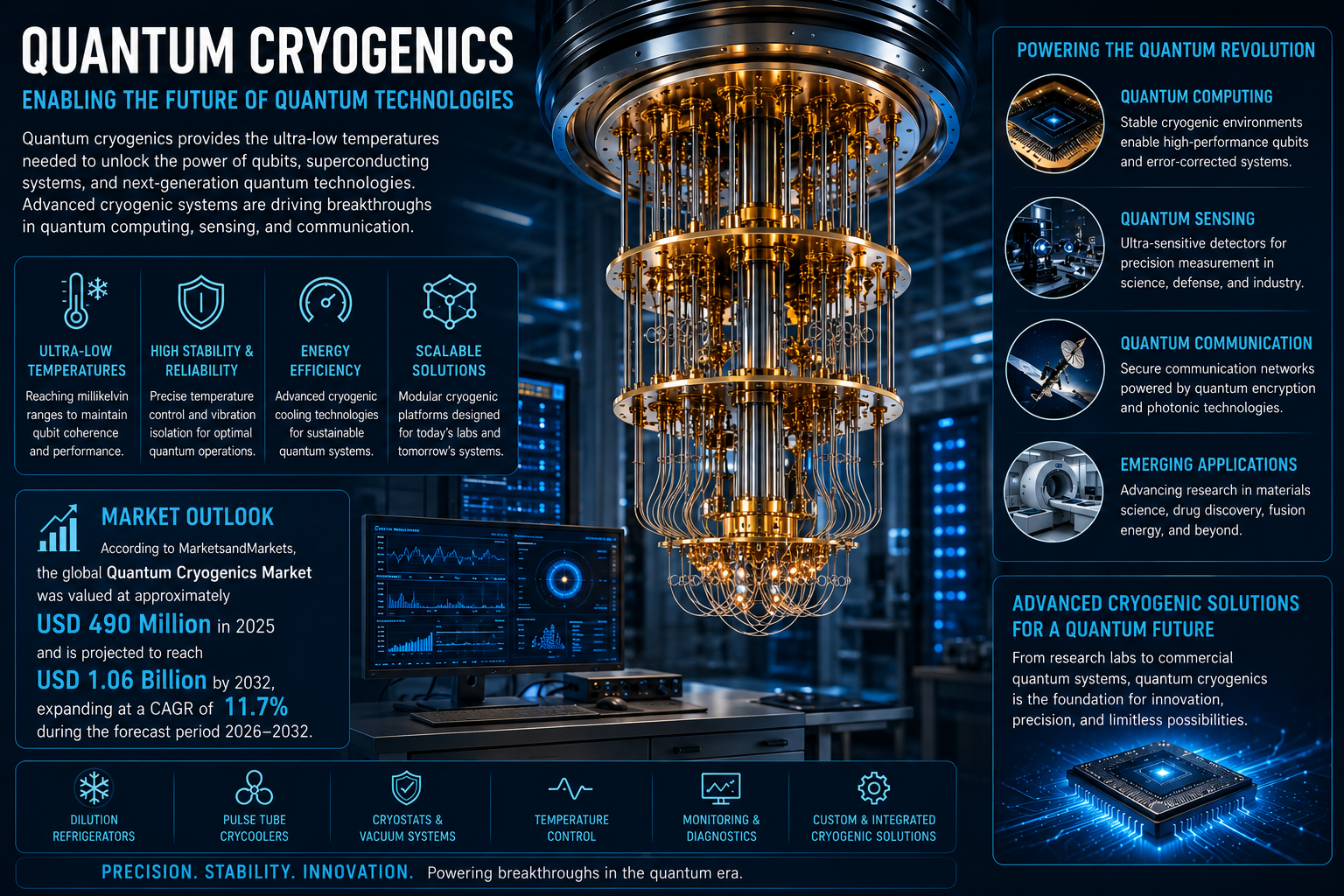
Quantum cryogenics technology is becoming a critical enabler of next-generation quantum computing, quantum communication, and advanced scientific research by providing the ultra-low temperature environments required for quantum devices to operate with high precision and stability. Cryogenic systems cool quantum processors to temperatures close to absolute zero, minimizing thermal noise and preserving quantum coherence. As governments, research institutions, and technology companies continue investing in quantum technologies, the demand for advanced cryogenic solutions is accelerating. Continuous innovations in dilution refrigerators, cryocoolers, and cryogenic control systems are improving scalability, energy efficiency, and reliability, making quantum cryogenics a foundational technology for the future of quantum ecosystems.
History of Quantum Cryogenics Technology
Quantum cryogenics has its origins in low-temperature physics research conducted during the early twentieth century, where scientists explored the behavior of materials at extremely low temperatures. The development of superconductivity and advances in cryogenic refrigeration laid the foundation for modern quantum technologies. Over the past two decades, rapid progress in quantum computing has significantly increased the demand for sophisticated cryogenic systems capable of maintaining stable millikelvin temperatures. Today, quantum cryogenics supports cutting-edge research and commercial deployments across computing, healthcare, telecommunications, aerospace, and defense.
Benefits of Quantum Cryogenics Technology
Quantum cryogenics enables stable operating environments that are essential for quantum processors, superconducting circuits, and highly sensitive scientific instruments. By maintaining extremely low temperatures, cryogenic systems improve quantum coherence, reduce thermal interference, and enhance the accuracy of quantum operations. These capabilities are accelerating innovation across multiple industries while supporting the commercialization of quantum technologies.
Key Benefits Include:
- Maintains ultra-low temperatures required for quantum computing systems.
- Improves quantum coherence and computational accuracy.
- Reduces thermal noise and signal interference.
- Supports superconducting qubits and advanced quantum processors.
- Enhances reliability of quantum communication systems.
- Enables high-precision scientific research and experimentation.
- Improves performance of advanced medical imaging and sensing technologies.
- Supports next-generation defense and aerospace applications.
Current Market Size and Growth Trends of the Quantum Cryogenics Market
The quantum cryogenics market is experiencing strong growth as investments in quantum computing, quantum communication, and advanced research infrastructure continue to increase worldwide. Governments, technology companies, and research organizations are investing heavily in quantum ecosystems, creating significant demand for high-performance cryogenic systems capable of maintaining ultra-low operating temperatures. Continuous advancements in cryogenic refrigeration technologies, superconducting quantum processors, and scalable cooling solutions are further driving market expansion across commercial and research applications.
According to MarketsandMarkets, the global quantum cryogenics market was valued at approximately USD 490 million in 2025 and is projected to reach USD 1.06 billion by 2032, growing at a CAGR of 11.7% during the forecast period (2026–2032).
Download PDF Brochure: https://www.marketsandmarkets.com/pdfdownloadNew.asp?id=113685541
Key Market Growth Drivers
- Increasing investments in quantum computing research and commercialization.
- Growing deployment of superconducting quantum processors.
- Rising government funding for national quantum technology programs.
- Expansion of quantum communication and secure networking initiatives.
- Growing adoption of advanced cryogenic systems in scientific laboratories.
- Continuous innovation in dilution refrigerators and cryocooler technologies.
- Increasing demand for ultra-low temperature environments across research and industrial applications.
Key Drivers and Factors Influencing the Future of Quantum Cryogenics Technology
The future of quantum cryogenics technology is being shaped by rapid advancements in quantum computing, increasing investments in national quantum initiatives, and the growing demand for ultra-low temperature environments. As quantum processors become more powerful and complex, reliable cryogenic systems are essential for maintaining quantum coherence and minimizing thermal interference. Continuous innovation in cryogenic refrigeration, superconducting technologies, and precision cooling systems is accelerating the adoption of quantum cryogenics across research institutions, technology companies, and government laboratories.
Key Growth Drivers
- Rising investments in quantum computing research and commercial deployment.
- Growing demand for superconducting quantum processors requiring millikelvin temperatures.
- Expansion of government-funded quantum technology initiatives worldwide.
- Increasing adoption of quantum communication and secure quantum networks.
- Continuous advancements in dilution refrigerators and cryocooler technologies.
- Growing collaboration between research institutions, universities, and technology companies.
Emerging Trends in Quantum Cryogenics Technology
Quantum cryogenics technology is evolving rapidly with innovations focused on improving cooling efficiency, scalability, and system integration. Manufacturers are developing compact, energy-efficient cryogenic platforms capable of supporting larger quantum processors while reducing operational complexity. At the same time, the integration of automation, remote monitoring, and AI-based system optimization is improving the performance and reliability of cryogenic infrastructure for both research and commercial applications.
Key Emerging Trends
- Development of next-generation dilution refrigerators with higher cooling capacity.
- Increasing use of closed-cycle cryogenic cooling systems to improve operational efficiency.
- Integration of AI-based monitoring and predictive maintenance for cryogenic equipment.
- Growing focus on scalable cryogenic platforms for large-scale quantum computers.
- Advancements in cryogenic control electronics for improved system performance.
- Expansion of cryogenic solutions supporting quantum networking and quantum sensing applications.
Opportunities and Challenges in the Quantum Cryogenics Market
The quantum cryogenics market offers substantial opportunities as governments, research organizations, and technology companies accelerate investments in quantum technologies. Growing commercialization of quantum computing, increasing demand for precision scientific instruments, and expanding applications in healthcare, aerospace, and defense are creating long-term market potential. However, achieving reliable ultra-low temperature operation, reducing system costs, and scaling cryogenic infrastructure remain significant industry challenges.
Key Opportunities
- Commercial expansion of quantum computing and cloud-based quantum services.
- Increasing deployment of quantum communication infrastructure.
- Growing demand for quantum sensing and advanced scientific instrumentation.
- Rising investments in national quantum research laboratories.
- Expanding applications across healthcare, aerospace, defense, and advanced manufacturing.
Key Challenges
- High cost of advanced cryogenic systems and infrastructure.
- Complex installation and maintenance requirements.
- Limited availability of specialized cryogenic engineering expertise.
- Scalability challenges for supporting large quantum processors.
- High energy consumption and operational costs associated with ultra-low temperature systems.
Innovations and Advancements in Quantum Cryogenics Technology
Continuous innovation is improving the efficiency, scalability, and reliability of quantum cryogenics systems, enabling the commercialization of next-generation quantum technologies. Advances in cryogenic refrigeration, superconducting materials, precision temperature control, and intelligent monitoring are helping researchers and manufacturers overcome performance limitations. These developments are creating more robust cryogenic platforms capable of supporting increasingly sophisticated quantum computing and sensing applications.
Recent Innovations
- Advanced high-capacity dilution refrigerators for larger quantum processors.
- Energy-efficient pulse tube cryocoolers requiring minimal maintenance.
- AI-powered remote monitoring and predictive diagnostics for cryogenic systems.
- Development of compact modular cryogenic platforms for scalable quantum computing.
- Improved superconducting materials with enhanced thermal stability.
- Advanced cryogenic wiring, interconnects, and shielding technologies for higher system reliability.
Future Applications and Industries That Will Benefit from Quantum Cryogenics Technology
Quantum cryogenics technology is expected to become a fundamental component of the global quantum ecosystem by enabling stable ultra-low temperature environments for quantum computers, superconducting electronics, and advanced scientific instruments. As quantum technologies transition from research laboratories to commercial deployment, demand for reliable and scalable cryogenic systems will continue to grow. The integration of advanced refrigeration technologies, AI-driven system monitoring, and energy-efficient cooling solutions will further expand the adoption of quantum cryogenics across multiple industries.
Key Future Applications
- Quantum Computing: Supports superconducting quantum processors by maintaining millikelvin temperatures required for reliable quantum operations and improved computational accuracy.
- Quantum Communication: Enables secure quantum communication networks, quantum encryption systems, and next-generation secure data transmission infrastructure.
- Scientific Research: Provides ultra-low temperature environments for particle physics, materials science, superconductivity research, and advanced laboratory experiments.
- Healthcare & Medical Imaging: Enhances MRI systems, cryogenic detectors, and advanced diagnostic equipment requiring highly stable cooling environments.
- Aerospace & Defense: Supports quantum sensing, navigation systems, satellite communication, radar technologies, and defense research requiring high-precision cryogenic platforms.
- Semiconductor Manufacturing: Enables testing and development of advanced semiconductor materials and superconducting electronic components.
- Industrial Metrology & Precision Measurement: Supports highly sensitive measurement instruments used in calibration laboratories and industrial quality control.
- Academic & Government Research Institutions: Facilitates quantum technology research, prototype development, and innovation programs funded by governments and universities.
As quantum technologies continue to mature, quantum cryogenics will serve as the enabling infrastructure that supports commercialization, scalability, and long-term reliability across emerging quantum applications.
Conclusion: The Promising Future of Quantum Cryogenics Technology
Quantum cryogenics technology is rapidly becoming an essential foundation for the advancement of quantum computing, quantum communication, superconducting electronics, and precision scientific research. By enabling ultra-low temperature environments that preserve quantum coherence and minimize thermal interference, cryogenic systems are unlocking new possibilities for next-generation computing and sensing technologies. As investments in quantum research and commercialization continue to accelerate, the importance of advanced cryogenic infrastructure will grow significantly.
Continuous innovations in dilution refrigerators, cryocoolers, superconducting materials, and intelligent monitoring systems are improving cooling efficiency, operational reliability, and scalability. These advancements are helping technology providers overcome key technical challenges while supporting the deployment of increasingly powerful quantum processors and research platforms.
Find More Information on Quantum Cryogenics Technology Innovation @ https://www.marketsandmarkets.com/Market-Reports/quantum-cryogenics-market-113685541.html
80% of the Forbes Global 2000 B2B companies rely on MarketsandMarkets to identify growth opportunities in emerging technologies and use cases that will have a positive revenue impact.
- Food Packaging Market Size Set for Strong Growth Through 2030 Amid Rising Demand for Convenience Foods
- Mulch Films Market: Driving Sustainable Agriculture Through Innovation
- Agricultural Adjuvants Market Analysis, Trends, and Growth Outlook (2026–2031)
- Crop Protection Chemical Market Size, Share & Growth Forecast (2025–2030)
- Japan Enterprise Asset Management Market Growth: AI and Smart Infrastructure Drive Demand

