



Cryocooler Market Size, Share & Trends
Report Code
SE 4258
Published in
Sep, 2025, By MarketsandMarkets™
Cryocooler Market Size, Share & Trends by Recuperative Heat Exchanger, Regenerative Heat Exchanger, Heat Dissipation Pipe, Preventive Maintenance Services, Gifford-McMahon Cryocoolers, Stirling Cryocoolers, Joule Thomson Cryocoolers, Military, Space - Global Forecast to 2030

USD 4.90 BN
MARKET SIZE, 2030

CAGR 7.1%
(2025-2030)

265
REPORT PAGES

225
MARKET TABLES
CRYOCOOLER MARKET SIZE, SHARE & TRENDS
According to Marketsandmarkets; The cryocooler market is expected to be valued at USD 3.48 billion in 2025 and USD 4.90 billion by 2030. It is expected to register a CAGR of 7.1% during the forecast period. This is driven by the rising demand for compact, energy-efficient cooling technologies that support advanced aerospace, defense, and medical applications. Increasing focus on satellite missions, coupled with advancements in infrared detectors, superconducting magnets, and quantum devices, accelerate adoption. Cryocooler solutions offer improved thermal stability, vibration-free operation, and long operational lifespans, enabling reliable performance in critical environments.CRYOCOOLER MARKET SCOPE
| REPORT METRIC | DETAILS |
|---|---|
| Market Size Value in 2025 | USD 3.48 BN |
| Revenue Forecast in 2030 | USD 4.90 BN |
| Growth Rate | 7.10% |
| Years Considered | 2021–2030 |
| Base Year | 2024 |
| Forecast Period | 2025–2030 |
| Units Considered | Value (USD Billion) and Volume (Thousand Units) |
| Report Coverage | Revenue Forecast, Company Ranking, Competitive Landscape, Growth Factors, and Trends |
| Top Companies |
|
| Growth Driver |
|
| Segments Covered | • By Cryocooler Type: Gifford-McMahon Cryocoolers, Pulse Tube Cryocoolers, Stirling Cryocoolers, Joule–Thomson Cryocoolers, and Brayton Cryocoolers • By Offering: Hardware and Services • By Heat Exchanger Type: Recuperative Heat Exchanger and Regenerative |
| Regional Scope | North America, Europe, Asia Pacific, and RoW |
CRYOCOOLER Market Size & Forecast
• 2025 Market Size: USD 3.48 Billion
• 2030 Projected Market Size: USD 4.90 Billion
• CAGR (2025-2030): 7.1%
• Military Applications Segments: Hold largest share
• North America: estimated share of 35.4%
KEY TAKEAWAYS
- By region, North America is estimated to dominate the cryocooler market with a share of 35.4% in 2024.
- By cryocooler type, the pulse tube cryocooler segment is projected to grow at the highest CAGR of 8.3% during the forecast period.
- By offering, the hardware segment is accounted for a share of 84% in 2024.
- By heat exchnager type, regenerative heat exchanger segment is estimated to dominate the cryocooler market with a share of 93.6% in 2024.
- By operating cycle, the closed-loop cycle segment is projected to grow at the highest CAGR o f7.5% during the forecast period.
- By temperature range, the 50K - 150K segment is accounted for a share of 55% in 2024.
- By application, the space segment is projected to grow at the highest CAGR of 10% during the forecast period.
- Thales (France), Northrop Grumman (US), AMETEK.Inc. (US) were identified as star players in the crycocooler market, given their strong global brand presence, extensive product portfolios, and continuous focus on innovation. Creare and Fabrum have emerged as the startups and SMEs driving technological innovation and market agility in the crycocooler market.
The cryocooler market is projected to expand significantly in the coming years, driven by the accelerating demand in the aerospace & defense space, which is catalyzing sustained cryocooler adoption, the rapid expansion of quantum computing, which is creating the need for advanced low-temperature thermal management solutions, and the transformation of the healthcare sector, which is fueling the adoption of helium-free MRI systems across global institutions. In addition, the strong focus on space exploration and satellite deployment, along with the rising importance of cryogenic cooling in superconducting technologies, is expected to create growth opportunities. Continuous technological advancements aimed at improving energy efficiency and reducing operational costs further strengthen the market adoption.
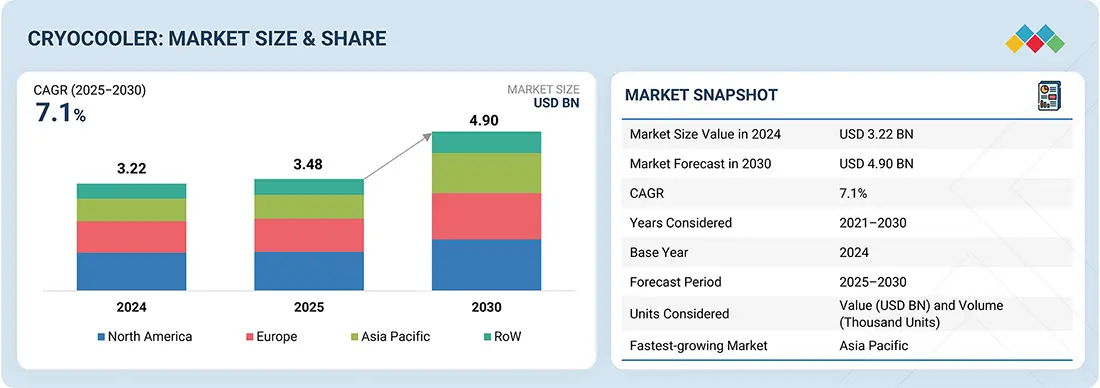
Source: Secondary Research, Interviews with Experts, MarketsandMarkets Analysis
TRENDS & DISRUPTIONS IMPACTING CUSTOMERS' CUSTOMERS
This section outlines the key trends and disruptions shaping customer operations in the cryocooler market. The growing demand for advanced cooling technologies in quantum computing, space exploration, and semiconductor manufacturing is expected to create strong growth opportunities for cryocooler manufacturers over the forecast period. Increasing investments in quantum computing infrastructure and the commercialization of large-scale quantum processors augment the need for ultra-low-temperature cryogenic systems. Additionally, the cryocooler market is witnessing expanded adoption in aerospace, defense, and satellite communication, where miniaturized cryocoolers enable enhanced infrared imaging, navigation, and surveillance capabilities. In the medical sector, the shift toward helium-free MRI systems and cryogenic solutions for advanced diagnostics reduces operational costs while improving energy efficiency. Cryocoolers are also becoming essential for supporting emerging applications, such as superconducting electronics, particle physics research, and hydrogen energy storage, reflecting their versatility across industries. As cryogenic R&D accelerates and IoT-enabled predictive maintenance technologies improve system performance, cryocooler suppliers will have increasing opportunities to expand their presence in high-tech and commercial markets globally.
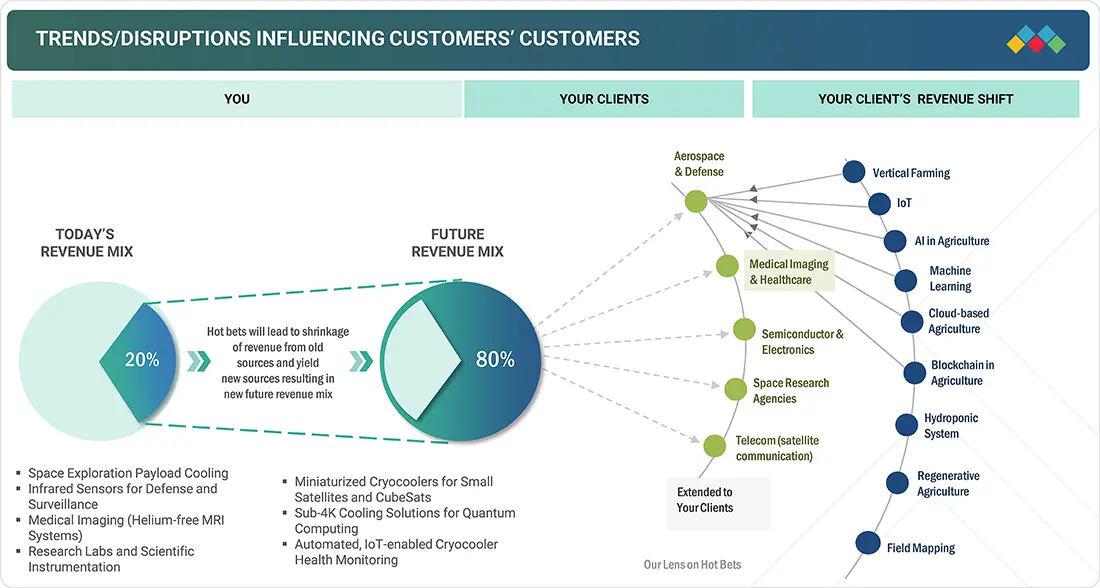
Source: Secondary Research, Interviews with Experts, MarketsandMarkets Analysis
CRYOCOOLER MARKET DYNAMICS

Drivers
Impact
Level
Level
-
Accelerating cryocooler demand from aerospace & defense and healthcare sectors

-
Surging adoption of quantum computing technology


RESTRAINTS
Impact
Level
Level
-
Low adoption in cost-sensitive markets due to high upfront costs and extended payback

-
Maintenance-driven expenditure and workforce skill gaps


OPPORTUNITIES
Impact
Level
Level
-
Emergence of sub-4K pre-coolers tailored for quantum data centers

-
Commercialization of small satellites


CHALLENGES
Impact
Level
Level
-
Limited thermal tolerance and reliability issues in high-density cryocooler arrays

Source: Secondary Research, Interviews with Experts, MarketsandMarkets Analysis
Driver: Accelerating cryocooler demand from aerospace & defense and healthcare sectors
Growing requirements for low-temperature applications in aerospace, defense, and healthcare fuel cryocooler demand. Increasing adoption in quantum computing, superconducting technologies, and medical imaging systems reinforces the need for reliable, compact, and energy-efficient cryocoolers across critical industries.
Restraint: High capital intensity constrains scalability across cost-sensitive customer segments
Despite ongoing innovation, high initial investment and complex integration requirements remain key barriers. Cost-sensitive customers, especially in emerging regions, face slower adoption due to limited subsidies or financing mechanisms. Performance constraints in thermal management, vibration control, and device longevity also restrict deployment in certain industrial and commercial applications.
Opportunity: Quantum computing scale-up driving sub-4K pre-cooler demand surges
The rapid scale-up of quantum computing boosts the demand for sub-4K cryocoolers. Increasing investments in quantum hardware require reliable low-temperature pre-cooling solutions. Growth in research labs and commercial quantum centers globally drives the adoption. Advancements in cryocooler efficiency further accelerate market uptake.
Challenge: Geopolitical risks destabilize specialized component sourcing across the critical region
Geopolitical tensions are disrupting the supply of specialized cryocooler components. Critical regions face export restrictions and supply chain uncertainties. Dependence on limited high-tech suppliers increases vulnerability. These factors can delay production and elevate costs, restraining market growth.
Cryocooler Market: COMMERCIAL USE CASES ACROSS INDUSTRIES
| COMPANY | USE CASE DESCRIPTION | BENEFITS |
|---|---|---|
 |
Deployed long-life cryocoolers on space telescopes and satellite instruments to achieve deep cryogenic cooling of infrared sensors | Enabled ultra-sensitive IR imaging | Reduced dependency on expendable cryogens | Extended mission lifetimes | Ensured reliable performance in harsh space environments |
 |
Implemented sorption and mechanical cryocoolers in missions such as Herschel and Planck for sub-Kelvin detector cooling | Delivered stable low-temperature environments for astrophysics instruments | Improved measurement precision | Increased observational sensitivity | Supported multi-year mission operations |
 |
Integrated cryogen-free cryocooler systems to maintain dilution refrigerators for quantum computing platforms | Provided continuous ultra-low temperature operation without liquid helium | Improved uptime and scalability of quantum processors | Reduced operating costs for superconducting qubit research |
 |
Utilized miniature Stirling cryocoolers in cooled infrared imaging systems for defense, aerospace, and industrial monitoring | Achieved superior thermal sensitivity | Extended detection range | Enhanced image quality in challenging conditions | Improved reliability with compact, rugged cooling units |
Logos and trademarks shown above are the property of their respective owners. Their use here is for informational and illustrative purposes only.
CRYOCOOLER MARKET ECOSYSTEM
The cryocooler market operates within a highly specialized and interconnected ecosystem that includes a range of stakeholders spanning multiple industries. From cryogenic component manufacturers, refrigeration system integrators, and material suppliers to software developers, automation solution providers, and service organizations, every participant plays a key role in advancing cryocooler design, deployment, and lifecycle management. This ecosystem also integrates research institutes, aerospace and defense contractors, semiconductor manufacturers, and healthcare providers, reflecting the technology’s cross-industry relevance. With rising demand for compact, energy-efficient, and high-reliability cooling systems across applications such as quantum computing, satellite payload cooling, superconducting systems, and advanced medical imaging, the ecosystem is rapidly evolving. Companies are increasingly incorporating AI-based performance monitoring, predictive maintenance platforms, and advanced simulation tools to optimize cryocooler performance and reliability. The market further involves collaborations between aerospace and defense firms, robotics and automation specialists, and niche cryogenic research service providers. This interconnected landscape emphasizes cross-domain synergies that drive innovation, reduce system complexity, and improve operational efficiency. By leveraging advancements in materials science, manufacturing precision, and smart diagnostics, stakeholders are creating a more resilient, scalable, and sustainable cryocooling infrastructure to meet future demands in space exploration, energy research, and healthcare innovation.
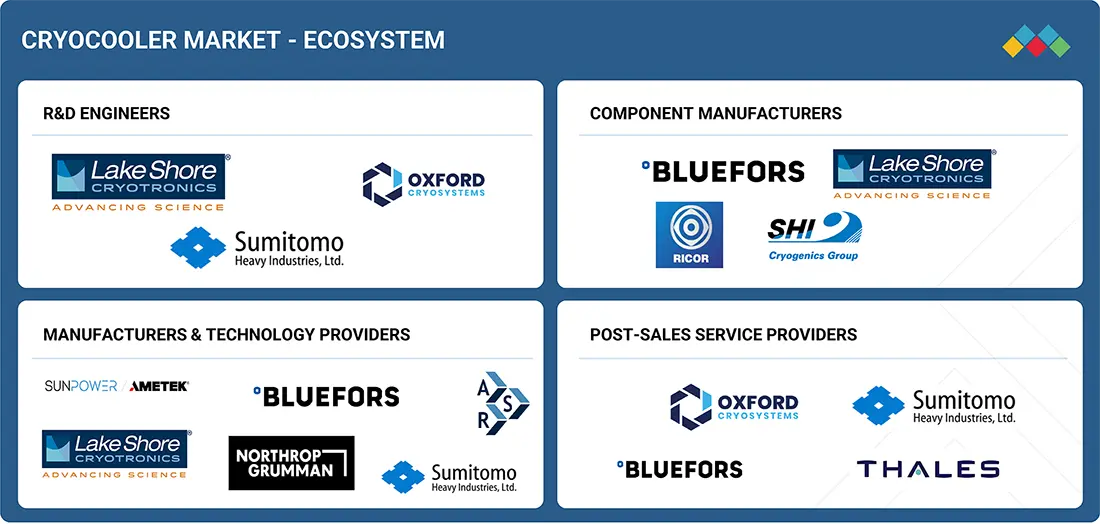
Logos and trademarks shown above are the property of their respective owners. Their use here is for informational and illustrative purposes only.
CRYOCOOLER MARKET SEGMENTS
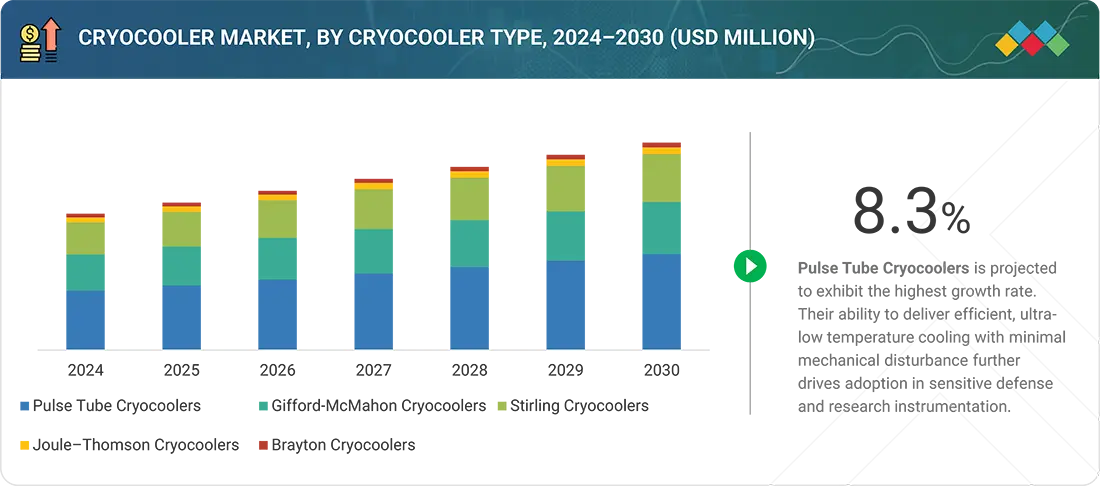
Source: Secondary Research, Interviews with Experts, MarketsandMarkets Analysis
Cryocooler Market, By Cryocooler Type
The pulse tube cryocoolers segment accounted for a significant share in 2024. Its growth is due to the adoption in space research, medical imaging, and defense systems due to their vibration-free operation, high reliability, and long operational life. Their ability to deliver stable cooling without moving parts makes them especially suitable for sensitive instruments, ensuring lower maintenance costs and enhanced performance.
Cryocooler Market, By Offering
In 2024, hardware offering accounted for the largest share of the global market. These systems provide a balance of performance and cost, making them ideal for applications such as satellite instruments, medical diagnostics, defense technologies, and sensitive electronics cooling, with their adaptability ensuring sustained demand across industries.
Cryocooler Market, By Heat Exchanger Type
The regenerative heat exchanger segment held the largest share in 2024, driven by broad adoption in aerospace, healthcare, and research applications. Regenerative heat exchangers enable faster cooling, lower energy use, and improved reliability compared with conventional technologies, making them vital in advanced operational environments.
Cryocooler Market, By Operating Cycle
The closed-loop cycle segment captured the largest market share in 2024, backed by strong demand from aerospace, defense, and electronics industries. Closed-loop cryocoolers are favored for their energy efficiency, compact design, and seamless integration into automated systems, helping reduce costs while boosting output.
Cryocooler Market, By Temperature Range
The market for >50–150 K segment is capturing largest share in 2024. High demand from medical imaging, space exploration, and defense applications is driving adoption in the >50–150 K range, where cryocoolers deliver efficiency, compact sizing, and compatibility with automated systems translating to cost benefits and higher performance.
Cryocooler Market, By Application
The market for military segment held the largest share in 2024. In the military sector, cryocoolers are increasingly adopted for their efficiency, reliability, and ability to support mission-critical systems such as infrared sensors, satellite payloads, and surveillance equipment, enabling enhanced performance and cost-effective operation.
REGION
Asia Pacific to be fastest-growing region in global cryocooler market during forecast period
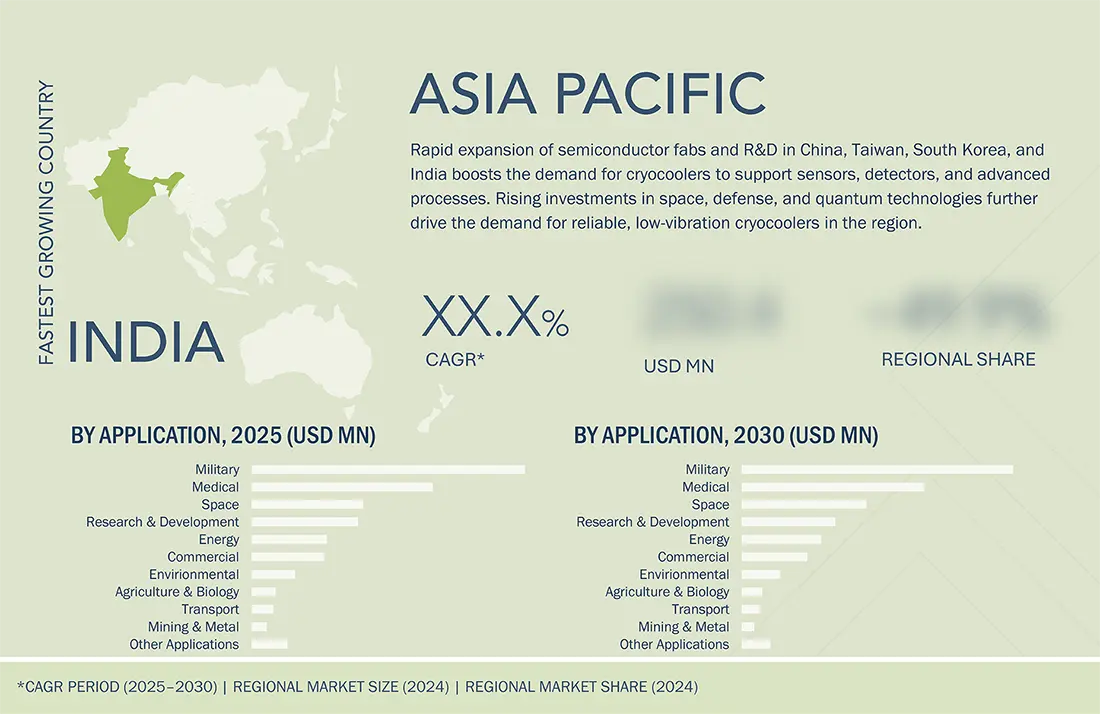
Asia Pacific is projected to capture the largest market share of the cryocooler industry in 2030. The regional growth is due to the rapid industrialization, growing aerospace and defense programs, rising demand in healthcare, and increasing investment in advanced research infrastructure. Additionally, government initiatives, such as India’s defense offset policies promoting local production of Stirling cryocoolers, and Japan’s AIST collaboration with Bluefors to co-develop advanced cryogenic refrigerators, accelerate innovation and regional self-reliance.
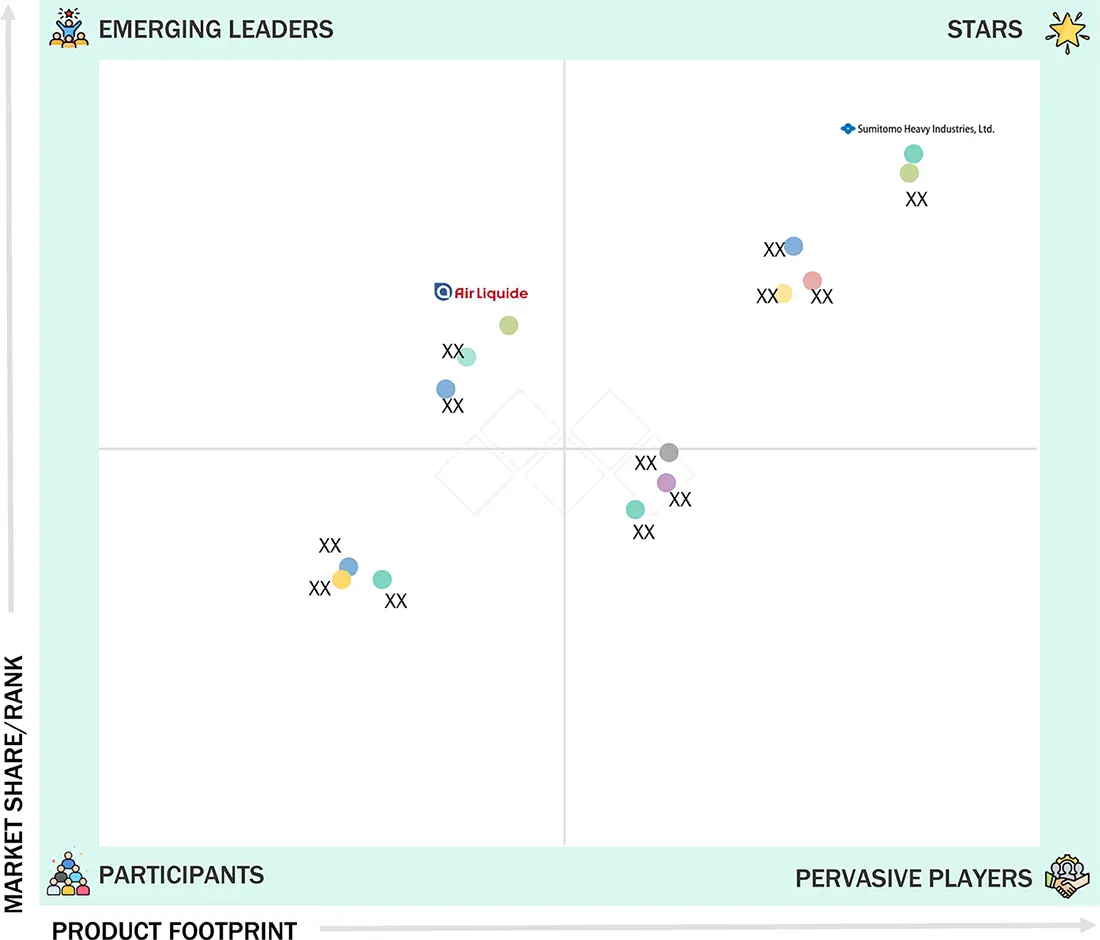
Cryocooler Market: COMPANY EVALUATION MATRIX
In the cryocooler companies matrix, Sumitomo Heavy Industries, Ltd. (Star) leads with a strong market presence and a broad portfolio serving applications in medical imaging, space research, and defense systems. The company drives large-scale adoption through continuous innovation, global partnerships, and extensive distribution networks. Air Liquide Advanced Technologies(Emerging Leader) is steadily strengthening its position by expanding offerings for industrial and research applications.
Source: Secondary Research, Interviews with Experts, MarketsandMarkets Analysis
KEY MARKET PLAYERS
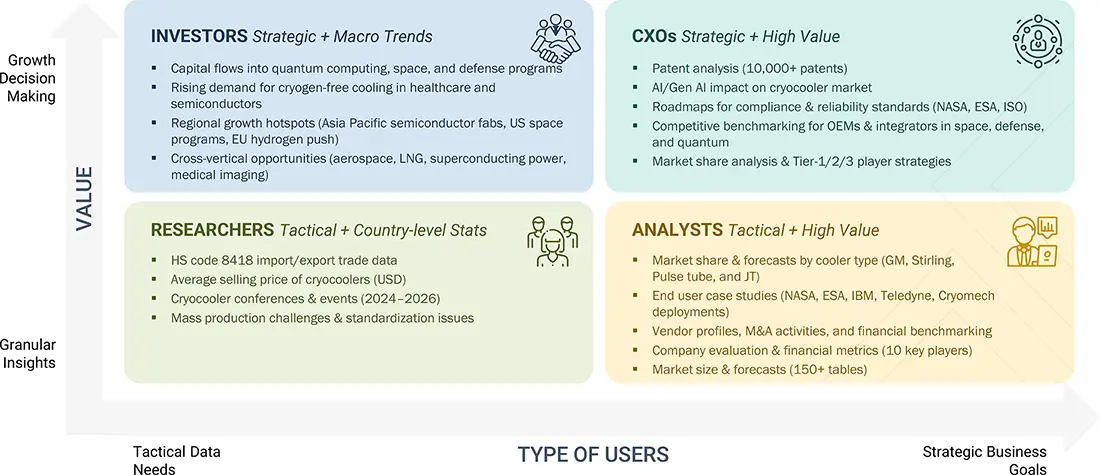
WHAT IS IN IT FOR YOU: Cryocooler Market REPORT CONTENT GUIDE
DELIVERED CUSTOMIZATIONS
We have successfully delivered the following deep-dive customizations:
| CLIENT REQUEST | CUSTOMIZATION DELIVERED | VALUE ADDS |
|---|---|---|
| Aerospace & Defense Contractor | • Competitive benchmarking of cryocooler technologies (Stirling, Pulse Tube, Gifford-McMahon, and JT) • Mapping suppliers by defense-grade certifications • Lifecycle cost and | • Identify most cost-effective and reliable solutions for mission-critical payloads • Shortlist suppliers for long-term defense contracts • Support technology selection for satellite & infrared systems |
| Medical Imaging OEM (MRI Manufacturer) | • End-use adoption trends of cryocoolers in MRI • Evaluation of oil-free vs. conventional systems • Market sizing of helium-free cryocoolers | • Support strategic transition to helium-free systems • Enable competitive positioning vs. incumbents • Highlight growth opportunities in high-demand MRI markets |
| Cryocooler Component Supplier | • Supply chain mapping for compressors, heat exchangers, and cold heads • Cost–benefit analysis of localized vs. imported sourcing • Partnership and distribution network analysis | • Pinpoint niche opportunities for component supply • Build regional presence via strategic alliances • Optimize sourcing strategies to reduce costs |
| Energy & Industrial Gas Company | • Cryocooler adoption roadmap in LNG, hydrogen, and superconductivity applications • Technical feasibility study for large-scale deployments • ROI benchmarking across industrial verticals | • Support investment in emerging cryogenic applications • Enable diversification into clean energy and superconductivity markets • Identify high-growth regional demand pockets |
| Research Institution / University Lab | • Database of cryocooler suppliers offering R&D-grade units • Comparative performance analysis (cooling power, base temperature, vibration levels) • Funding & grant opportunity mapping | • Provide clarity for equipment procurement • Optimize R&D budgets with supplier benchmarking • Unlock collaboration opportunities in government-funded projects |
RECENT DEVELOPMENTS
- September 2026: Sumitomo Heavy Industries, Ltd (Japan) received publication of a new patent application for a cryocooler displacer assembly designed to improve gas-flow control within the cryocooler during intake and exhaust processes. The invention uses first and second displacers, an expansion chamber, radial clearance and a bypass flow path that is selectively opened and closed during operation, representing a new technical development in cryocooler architecture.
- August 2026: Edwards Vacuum (Atlas Copco Group) (UK) launched its complete cryogenic product portfolio globally, bringing together ECC helium compressors, ECH Gifford-McMahon cold heads, ECP cryogenic vacuum pumps, cryo-panel solutions and integrated cryogenic systems. The expanded portfolio provides cryogenic cooling components and integrated systems for applications including particle accelerators, superconducting magnets, space simulation and scientific research.
- June 2025 : Sumitomo Heavy Industries released its highest-capacity single-stage cryocoolers, CH-160D3LT and CH-160D3 Series. These cryocoolers utilize Whisper technology for quieter operation and a Displex pneumatic drive system, which minimizes moving parts and wear.
- March 2025 : Bluefors launched the PT205, a compact, high-performance two-stage pulse tube cryocooler designed specifically for advanced scientific applications and superconducting technologies like superconducting nanowire single-photon detectors.
- January 2024 : Sumitomo Heavy Industries launched the RJT-100 4K GM-JT Cryocooler, the highest-capacity 4 K cryocooler, delivering up to 9.0 W at 4.2 K (50/60 Hz). Its innovative hybrid design combines a Joule-Thomson cryocooler with a two-stage Gifford-McMahon cryocooler for pre-cooling helium gas, providing superior efficiency, temperature stability, and reduced maintenance needs compared to standard 4 K cryocoolers.
Table of Contents
 Exclusive indicates content/data unique to MarketsandMarkets and not available with any competitors.
TITLE
PAGE NO
1
INTRODUCTION
26
2
RESEARCH METHODOLOGY
32
3
EXECUTIVE SUMMARY
44
4
PREMIUM INSIGHTS
50
5
MARKET OVERVIEW
Surging cryocooler demand driven by aerospace, quantum computing, and helium-free MRI innovations.
54
5.1
INTRODUCTION
5.2
MARKET DYNAMICS
5.2.1
DRIVERS
5.2.1.1
Accelerating cryocooler demand from aerospace & defense sector
5.2.1.2
Surging adoption of quantum computing technology
5.2.1.3
Escalating demand for helium-free MRI systems by healthcare providers
5.2.2
RESTRAINTS
5.2.2.1
Low adoption in cost-sensitive markets due to high upfront costs and extended payback
5.2.2.2
Maintenance-driven expenditure and workforce skill gaps
5.2.3
OPPORTUNITIES
5.2.3.1
Emergence of sub-4K pre-coolers tailored for quantum data centers
5.2.3.2
Commercialization of small satellites
5.2.4
CHALLENGES
5.2.4.1
Geopolitical risks impacting specialized component sourcing
5.2.4.2
Commercial-scale expansion barriers due to performance-cost trade-offs
5.3
TRENDS/DISRUPTIONS IMPACTING CUSTOMER BUSINESS
5.4
PRICING ANALYSIS
5.4.1
PRICING RANGE OF CRYOCOOLERS, BY KEY PLAYER, 2024
5.4.2
AVERAGE SELLING PRICE TREND OF CRYOCOOLERS, BY REGION, 2021–2024
5.5
VALUE CHAIN ANALYSIS
5.6
ECOSYSTEM ANALYSIS
5.7
TECHNOLOGY ANALYSIS
5.7.1
KEY TECHNOLOGIES
5.7.1.1
Pulse tube cryocoolers
5.7.1.2
Stirling cryocoolers
5.7.2
COMPLEMENTARY TECHNOLOGIES
5.7.2.1
Thermal management & insulation
5.7.2.2
Cryogenic sensors & instrumentation
5.7.3
ADJACENT TECHNOLOGIES
5.7.3.1
Thermoelectric coolers (Peltier devices)
5.7.3.2
Quantum technologies
5.8
PATENT ANALYSIS
5.9
TRADE ANALYSIS
5.9.1
IMPORT SCENARIO (HS CODE 8418)
5.9.2
EXPORT SCENARIO (HS CODE 8418)
5.10
KEY CONFERENCES AND EVENTS, 2025–2026
5.11
CASE STUDY ANALYSIS
5.11.1
SHI’S HIGH-CAPACITY 4 KGM-JT RJT-100 CRYOCOOLER SYSTEM FOR INDUSTRIAL SRF ACCELERATORS
5.11.2
CRYOR’S FLEXIBLE AND ADAPTABLE CRYOCOOLER SOLUTION FOR RESEARCH LABORATORIES
5.11.3
CREARE’S MECHANICAL CRYOCOOLER FOR NICMOS INFRARED VISION RECOVERY ON HUBBLE SPACE TELESCOPE
5.11.4
BLUEFOR’ PT450 PULSE TUBE CRYOCOOLER MEETING PERFORMANCE AND ENERGY EFFICIENCY GOALS
5.12
INVESTMENT AND FUNDING SCENARIO
5.13
REGULATORY LANDSCAPE
5.13.1
REGULATORY BODIES, GOVERNMENT AGENCIES, AND OTHER ORGANIZATIONS
5.13.2
KEY REGULATIONS
5.14
PORTER’S FIVE FORCES ANALYSIS
5.14.1
INTENSITY OF COMPETITIVE RIVALRY
5.14.2
THREAT OF SUBSTITUTES
5.14.3
BARGAINING POWER OF BUYERS
5.14.4
BARGAINING POWER OF SUPPLIERS
5.14.5
THREAT OF NEW ENTRANTS
5.15
KEY STAKEHOLDERS AND BUYING CRITERIA
5.15.1
KEY STAKEHOLDERS IN BUYING PROCESS
5.15.2
BUYING CRITERIA
5.16
IMPACT OF GEN AI/AI ON CRYOCOOLER MARKET
5.17
2025 US TARIFF IMPACT ON CRYOCOOLER MARKET
5.17.1
INTRODUCTION
5.17.2
KEY TARIFF RATES
5.17.3
PRICE IMPACT ANALYSIS
5.17.4
IMPACT ON COUNTRIES/REGIONS
5.17.4.1
US
5.17.4.2
Europe
5.17.4.3
Asia Pacific
5.17.5
IMPACT ON APPLICATIONS
6
CRYOCOOLER MARKET, BY OFFERING
Market Size & Growth Rate Forecast Analysis to 2030 in USD Million and Units | 8 Data Tables
92
6.1
INTRODUCTION
6.2
HARDWARE
6.2.1
COMPRESSOR
6.2.1.1
Ability to minimize vibration and acoustic interference in sensitive systems to accelerate demand
6.2.2
COLD HEAD
6.2.2.1
Extended maintenance-free operation to boost demand
6.2.3
HEAT DISSIPATION PIPE
6.2.3.1
Rising use of additive manufacturing to fabricate complex heat pipe geometries to fuel segmental growth
6.2.4
POWER CONDITIONING UNIT
6.2.4.1
Ability to withstand radiation and voltage fluctuations to propel market
6.2.5
OTHER HARDWARE TYPES
6.3
SERVICES
6.3.1
TECHNICAL SUPPORT
6.3.1.1
Need for on-demand expertise to ensure operational continuity to push segmental growth
6.3.2
PRODUCT REPAIR & REFURBISHMENT
6.3.2.1
Rising focus on extending product lifecycle and maximizing ROI to boost demand
6.3.3
PREVENTIVE MAINTENANCE
6.3.3.1
Significant focus on reducing downtime and avoiding costly system failures to surge demand
6.3.4
CUSTOMER TRAINING
6.3.4.1
Requirement to keep customers updated with latest operational practices to spike demand
7
CRYOCOOLER MARKET, BY HEAT EXCHANGER TYPE
Market Size & Growth Rate Forecast Analysis to 2030 in USD Million | 2 Data Tables
102
7.1
INTRODUCTION
7.2
RECUPERATIVE HEAT EXCHANGER
7.2.1
INCREASING CRYOGENIC ADOPTION IN SPACE PROGRAMS TO SUPPORT SEGMENTAL GROWTH
7.3
REGENERATIVE HEAT EXCHANGER
7.3.1
SUPERIOR THERMAL STABILITY AND BETTER UNIFORMITY TO BOOST DEMAND
8
CRYOCOOLER MARKET, BY OPERATING CYCLE
Market Size & Growth Rate Forecast Analysis to 2030 in USD Million | 2 Data Tables
106
8.1
INTRODUCTION
8.2
OPEN-LOOP CYCLE
8.2.1
EXCELLENCE IN HANDLING HIGH THROUGHPUT AND ADAPTING TO VARYING PROCESS REQUIREMENTS TO SPIKE DEMAND
8.3
CLOSED-LOOP CYCLE
8.3.1
REDUCED VIBRATION, LOWER MAINTENANCE, AND HIGHER RELIABILITY THAN OPEN-LOOP SYSTEMS TO ACCELERATE ADOPTION
9
CRYOCOOLER MARKET, BY CRYOCOOLER TYPE
Market Size & Growth Rate Forecast Analysis to 2030 in USD Million | 52 Data Tables
111
9.1
INTRODUCTION
9.2
GIFFORD–MCMAHON CRYOCOOLERS
9.2.1
SUITABILITY FOR APPLICATIONS REQUIRING CONTINUOUS AND STABLE COOLING TO BOOST DEMAND
9.3
PULSE TUBE CRYOCOOLERS
9.3.1
ABILITY TO DELIVER VIBRATION-FREE, MAINTENANCE-FREE, AND SPACE-COMPATIBLE COOLING SOLUTIONS TO INCREASE DEMAND
9.4
STIRLING CRYOCOOLERS
9.4.1
RISING USE IN SPACE APPLICATIONS TO DRIVE MARKET
9.5
JOULE–THOMSON CRYOCOOLERS
9.5.1
WIDESPREAD USE IN GAS LIQUEFACTION, CRYOGENIC RESEARCH, AND MEDICAL IMAGING TO PROPEL MARKET
9.6
BRAYTON CRYOCOOLERS
9.6.1
INCREASING DEMAND IN AEROSPACE, DEFENSE, AND HIGH-POWER INDUSTRIAL APPLICATIONS TO FOSTER MARKET GROWTH
10
CRYOCOOLER MARKET, BY TEMPERATURE RANGE
Market Size & Growth Rate Forecast Analysis to 2030 in USD Million | 2 Data Tables
136
10.1
INTRODUCTION
10.2
1–50 K
10.2.1
RISING USE IN ULTRA-LOW-NOISE DETECTION AND QUANTUM COMPUTING APPLICATIONS TO FACILITATE SEGMENTAL GROWTH
10.3
>50–150 K
10.3.1
ELEVATING DEMAND FOR FIELD-DEPLOYABLE DEFENSE SYSTEMS TO ACCELERATE SEGMENTAL GROWTH
10.4
ABOVE 150 K
10.4.1
ESCALATING USE IN INDUSTRIAL LIQUEFACTION AND HIGH-TEMPERATURE SUPERCONDUCTING APPLICATIONS TO BOOST SEGMENTAL GROWTH
11
CRYOCOOLER MARKET, BY APPLICATION
Market Size & Growth Rate Forecast Analysis to 2030 in USD Million | 24 Data Tables
140
11.1
INTRODUCTION
11.2
MILITARY
11.2.1
ESCALATING USE OF UAVS AND DRONES IN BATTLEFIELD SURVEILLANCE TO DRIVE MARKET
11.2.2
IR SENSORS FOR MISSILE GUIDANCE
11.2.3
IR SENSORS FOR SATELLITE-BASED SURVEILLANCE
11.3
MEDICAL
11.3.1
PRESSING NEED TO REDUCE DOWNTIME IN CRITICAL HEALTHCARE INFRASTRUCTURE TO CONTRIBUTE TO MARKET GROWTH
11.3.2
MRI SYSTEMS
11.3.3
LIQUEFACTION OF OXYGEN FOR STORAGE
11.3.4
CRYOSURGERY AND PROTON THERAPY
11.4
COMMERCIAL
11.4.1
EXPANSION OF INDUSTRIAL-SCALE GAS LIQUEFACTION PLANTS TO FACILITATE DEMAND
11.4.2
SEMICONDUCTOR FABRICATION
11.4.3
HIGH-TEMPERATURE SUPERCONDUCTORS FOR CELL PHONE BASE STATIONS
11.4.4
IR SENSORS FOR NDE AND PROCESS MONITORING
11.5
ENVIRONMENTAL
11.5.1
RISING FOCUS ON TRACKING POLLUTION SOURCES AND IMPROVING URBAN AIR QUALITY TO SUPPORT MARKET GROWTH
11.5.2
IR SENSORS FOR ATMOSPHERIC STUDIES ON OZONE HOLE AND GREENHOUSE EFFECT
11.5.3
IR SENSORS FOR POLLUTION MONITORING
11.6
ENERGY
11.6.1
GREATER EMPHASIS ON REDUCING ENERGY LOSSES DURING TRANSMISSION TO FOSTER MARKET GROWTH
11.6.2
IR SENSORS FOR THERMAL LOSS MEASUREMENTS
11.6.3
SUPERCONDUCTING MAGNETIC ENERGY STORAGE FOR PEAK SHAVING
11.7
TRANSPORT
11.7.1
ELEVATING DEMAND FOR HYDROGEN-POWERED SHIPS AND SUBMARINES TO CREATE GROWTH OPPORTUNITIES
11.7.2
SUPERCONDUCTING MAGNETS IN MAGLEV TRAINS
11.7.3
LNG FOR FLEET VEHICLES
11.8
RESEARCH & DEVELOPMENT
11.8.1
RAPID INNOVATIONS IN SENSORS, NANOTECHNOLOGY, AND SUPERCONDUCTING ELECTRONICS TO PROMOTE MARKET GROWTH
11.8.2
NUCLEAR MAGNETIC RESONANCE
11.8.3
ELECTRON PARAMAGNETIC RESONANCE
11.9
SPACE
11.9.1
EARTH OBSERVATION, ASTROPHYSICS, AND DEEP-SPACE EXPLORATION MISSIONS TO SPUR DEMAND
11.9.2
SPACE ASTRONOMY
11.9.3
PLANETARY SCIENCE
11.10
AGRICULTURE & BIOLOGY
11.10.1
REQUIREMENT TO PRESERVE SEEDS, GENETIC MATERIALS, AND BIOLOGICAL SAMPLES TO ENCOURAGE ADOPTION
11.10.2
STORAGE OF BIOLOGICAL CELLS AND SPECIMENS
11.11
MINING & METAL
11.11.1
LEVERAGING CRYOCOOLERS TO ENHANCE CORROSION RESISTANCE AND WEAR PERFORMANCE
11.11.2
METAL TEMPERING
11.11.3
SHRINK FITTING
11.12
OTHER APPLICATIONS
12
CRYOCOOLER MARKET, BY REGION
Market Size & Growth Rate Forecast Analysis to 2030 in USD Million | 80 Data Tables
161
12.1
INTRODUCTION
12.2
NORTH AMERICA
12.2.1
MACROECONOMIC OUTLOOK FOR NORTH AMERICA
12.2.2
US
12.2.2.1
Well-established military industry and high expenditure on healthcare equipment to drive market
12.2.3
CANADA
12.2.3.1
Growing medical and healthcare expenditure to spur demand
12.2.4
MEXICO
12.2.4.1
Emerging industrial applications to drive demand
12.3
EUROPE
12.3.1
MACROECONOMIC OUTLOOK FOR EUROPE
12.3.2
GERMANY
12.3.2.1
Thriving healthcare sector and government support for cryogenic research to foster market growth
12.3.3
UK
12.3.3.1
Government efforts toward defense system enhancement to fuel market growth
12.3.4
FRANCE
12.3.4.1
Emphasis on innovation and technological advancement to facilitate market growth
12.3.5
ITALY
12.3.5.1
Rising use of cryogenic technology in MRI and cancer treatment applications to support market growth
12.3.6
NETHERLANDS
12.3.6.1
Partnerships between cryogenic technology providers and research institutions to expedite market growth
12.3.7
POLAND
12.3.7.1
Surging deployment of cooling systems in electronic devices and automotive systems to accelerate market growth
12.3.8
NORDICS
12.3.8.1
Significant focus on sustainability and cryogenic research synergies to propel market
12.3.9
REST OF EUROPE
12.4
ASIA PACIFIC
12.4.1
MACROECONOMIC OUTLOOK FOR ASIA PACIFIC
12.4.2
JAPAN
12.4.2.1
Surging demand from universities, national laboratories, and research centers to develop innovative products to drive market
12.4.3
CHINA
12.4.3.1
Adoption of clean energy objectives to promote demand for cooling systems
12.4.4
SOUTH KOREA
12.4.4.1
Escalating demand for cryopumps from semiconductor manufacturers to fuel market growth
12.4.5
INDIA
12.4.5.1
Booming healthcare industry to intensify demand
12.4.6
AUSTRALIA
12.4.6.1
Healthcare, space, and defense verticals to contribute most to market growth
12.4.7
INDONESIA
12.4.7.1
Introduction of I-NCAP plan to ensure sustainable cooling practices to stimulate demand
12.4.8
MALAYSIA
12.4.8.1
Rising focus on adopting energy-efficient cooling and modernizing air conditioning standards to spike demand
12.4.9
THAILAND
12.4.9.1
Heightened demand for high-performance cryogenic systems across industrial and healthcare sectors to propel market
12.4.10
VIETNAM
12.4.10.1
Expansion of digital infrastructure due to rapid industrialization to create growth opportunities
12.4.11
REST OF ASIA PACIFIC
12.5
ROW
12.5.1
MACROECONOMIC OUTLOOK FOR ROW
12.5.2
MIDDLE EAST
12.5.2.1
Bahrain
12.5.2.2
Kuwait
12.5.2.3
Oman
12.5.2.4
Qatar
12.5.2.5
Saudi Arabia
12.5.2.6
UAE
12.5.2.7
Rest of Middle East
12.5.3
AFRICA
12.5.3.1
South Africa
12.5.3.2
Other African countries
12.5.4
SOUTH AMERICA
12.5.4.1
Brazil
12.5.4.2
Argentina
12.5.4.3
Rest of South America
13
COMPETITIVE LANDSCAPE
Discover top strategies and market dominance of key players and emerging leaders.
209
13.1
OVERVIEW
13.2
KEY PLAYER STRATEGIES/RIGHT TO WIN, 2021–2025
13.3
MARKET SHARE ANALYSIS, 2024
13.4
REVENUE ANALYSIS, 2021–2024
13.5
COMPANY VALUATION AND FINANCIAL METRICS
13.6
BRAND COMPARISON
13.7
COMPANY EVALUATION MATRIX: KEY PLAYERS, 2024
13.7.1
STARS
13.7.2
EMERGING LEADERS
13.7.3
PERVASIVE PLAYERS
13.7.4
PARTICIPANTS
13.7.5
COMPANY FOOTPRINT: KEY PLAYERS, 2024
13.7.5.1
Company footprint
13.7.5.2
Region footprint
13.7.5.3
Cryocooler type footprint
13.7.5.4
Temperature range footprint
13.7.5.5
Application footprint
13.8
COMPANY EVALUATION MATRIX: STARTUPS/SMES, 2024
13.8.1
PROGRESSIVE COMPANIES
13.8.2
RESPONSIVE COMPANIES
13.8.3
DYNAMIC COMPANIES
13.8.4
STARTING BLOCKS
13.8.5
COMPETITIVE BENCHMARKING: STARTUPS/SMES, 2024
13.8.5.1
Detailed list of key startups/SMEs
13.8.5.2
Competitive benchmarking of key startups/SMEs
13.9
COMPETITIVE SCENARIO
13.9.1
PRODUCT LAUNCHES
13.9.2
DEALS
14
COMPANY PROFILES
In-depth Company Profiles of Leading Market Players with detailed Business Overview, Product and Service Portfolio, Recent Developments, and Unique Analyst Perspective (MnM View)
224
14.1
KEY PLAYERS
14.1.1
SUMITOMO HEAVY INDUSTRIES, LTD.
14.1.1.1
Business overview
14.1.1.2
Products/Solutions/Services offered
14.1.1.3
Recent developments
14.1.1.4
MnM view
14.1.2
THALES
14.1.3
EDWARDS VACUUM (ATLAS COPCO GROUP)
14.1.4
AMETEK.INC.
14.1.5
CHART INDUSTRIES, INC.
14.1.6
BLUEFORS
14.1.7
NORTHROP GRUMMAN
14.1.8
ADVANCED RESEARCH SYSTEMS
14.1.9
RICOR
14.1.10
AIR LIQUIDE ADVANCED TECHNOLOGIES
14.2
OTHER PLAYERS
14.2.1
LAKE SHORE CRYOTRONICS
14.2.2
CREARE
14.2.3
LIHAN CRYOGENICS CO., LTD.
14.2.4
TRISTAN TECHNOLOGIES, INC.
14.2.5
VACREE TECHNOLOGIES CO., LTD.
14.2.6
HONEYWELL INTERNATIONAL INC.
14.2.7
BRIGHT INSTRUMENT CO. LTD.
14.2.8
ABSOLUT SYSTEM
14.2.9
FABRUM
14.2.10
CRYOSPECTRA GMBH
14.2.11
ULVAC CRYOGENICS INC.
14.2.12
OXFORD CRYOSYSTEMS LTD.
14.2.13
HYCON LTD.
14.2.14
RIX INDUSTRIES
14.2.15
AIM INFRAROT-MODULE GMBH
15
APPENDIX
258
15.1
INSIGHTS FROM INDUSTRY EXPERTS
15.2
DISCUSSION GUIDE
15.3
KNOWLEDGESTORE: MARKETSANDMARKETS’ SUBSCRIPTION PORTAL
15.4
CUSTOMIZATION OPTIONS
15.5
RELATED REPORTS
15.6
AUTHOR DETAILS
LIST OF TABLES
TABLE 1
CRYOCOOLER MARKET: INCLUSIONS AND EXCLUSIONS
TABLE 2
LIST OF SECONDARY SOURCES
TABLE 3
INTENDED PARTICIPANTS AND MAJOR OPINION LEADERS
TABLE 4
CRYOCOOLER MARKET: RISK ANALYSIS
TABLE 5
PRICING RANGE OF CRYOCOOLERS PROVIDED BY KEY PLAYERS, 2024 (USD)
TABLE 6
AVERAGE SELLING PRICE TREND OF CRYOCOOLERS, BY REGION, 2021–2024 (USD)
TABLE 7
ROLE OF KEY PLAYERS IN ECOSYSTEM
TABLE 8
LIST OF MAJOR PATENTS, 2022–2024
TABLE 9
IMPORT DATA FOR HS CODE 8418-COMPLIANT PRODUCTS, BY COUNTRY, 2020–2024 (USD MILLION)
TABLE 10
EXPORT DATA FOR HS CODE 8418-COMPLIANT PRODUCTS, BY COUNTRY, 2020–2024 (USD MILLION)
TABLE 11
MAJOR CONFERENCES AND EVENTS RELATED TO CRYOCOOLERS IN DIFFERENT REGIONS, 2025–2026
TABLE 12
NORTH AMERICA: REGULATORY BODIES, GOVERNMENT AGENCIES, AND OTHER ORGANIZATIONS
TABLE 13
EUROPE: REGULATORY BODIES, GOVERNMENT AGENCIES, AND OTHER ORGANIZATIONS
TABLE 14
ASIA PACIFIC: REGULATORY BODIES, GOVERNMENT AGENCIES, AND OTHER ORGANIZATIONS
TABLE 15
ROW: REGULATORY BODIES, GOVERNMENT AGENCIES, AND OTHER ORGANIZATIONS
TABLE 16
CRYOCOOLER MARKET: REGULATORY LANDSCAPE
TABLE 17
CRYOCOOLER MARKET: IMPACT OF PORTER’S FIVE FORCES
TABLE 18
INFLUENCE OF STAKEHOLDERS ON BUYING PROCESS FOR OFFERINGS
TABLE 19
KEY BUYING CRITERIA, BY APPLICATION
TABLE 20
US-ADJUSTED RECIPROCAL TARIFF RATES
TABLE 21
CRYOCOOLER MARKET, BY OFFERING, 2021–2024 (USD MILLION)
TABLE 22
CRYOCOOLER MARKET, BY OFFERING, 2025–2030 (USD MILLION)
TABLE 23
CRYOCOOLER MARKET, 2021–2024 (THOUSAND UNITS)
TABLE 24
CRYOCOOLER MARKET, 2025–2030 (THOUSAND UNITS)
TABLE 25
CRYOCOOLER MARKET, BY HARDWARE TYPE, 2021–2024 (USD MILLION)
TABLE 26
CRYOCOOLER MARKET, BY HARDWARE TYPE, 2025–2030 (USD MILLION)
TABLE 27
CRYOCOOLER MARKET, BY TYPE, 2021–2024 (USD MILLION)
TABLE 28
CRYOCOOLER MARKET, BY TYPE, 2025–2030 (USD MILLION)
TABLE 29
CRYOCOOLER MARKET, BY HEAT EXCHANGER TYPE, 2021–2024 (USD MILLION)
TABLE 30
CRYOCOOLER MARKET, BY HEAT EXCHANGER TYPE, 2025–2030 (USD MILLION)
TABLE 31
CRYOCOOLER MARKET, BY OPERATING CYCLE, 2021–2024 (USD MILLION)
TABLE 32
CRYOCOOLER MARKET, BY OPERATING CYCLE, 2025–2030 (USD MILLION)
TABLE 33
CRYOCOOLER MARKET, BY TYPE, 2021–2024 (USD MILLION)
TABLE 34
CRYOCOOLER MARKET, BY TYPE, 2025–2030 (USD MILLION)
TABLE 35
GIFFORD–MCMAHON CRYOCOOLERS: CRYOCOOLER MARKET, BY REGION, 2021–2024 (USD MILLION)
TABLE 36
GIFFORD–MCMAHON CRYOCOOLERS: CRYOCOOLER MARKET, BY REGION, 2025–2030 (USD MILLION)
TABLE 37
GIFFORD–MCMAHON CRYOCOOLERS: CRYOCOOLER MARKET IN NORTH AMERICA, BY COUNTRY, 2021–2024 (USD MILLION)
TABLE 38
GIFFORD–MCMAHON CRYOCOOLERS: CRYOCOOLER MARKET IN NORTH AMERICA, BY COUNTRY, 2025–2030 (USD MILLION)
TABLE 39
GIFFORD–MCMAHON CRYOCOOLERS: CRYOCOOLER MARKET IN EUROPE, BY COUNTRY, 2021–2024 (USD MILLION)
TABLE 40
GIFFORD–MCMAHON CRYOCOOLERS: CRYOCOOLER MARKET IN EUROPE, BY COUNTRY, 2025–2030 (USD MILLION)
TABLE 41
GIFFORD–MCMAHON CRYOCOOLERS: CRYOCOOLER MARKET IN ASIA PACIFIC, BY COUNTRY, 2021–2024 (USD MILLION)
TABLE 42
GIFFORD–MCMAHON CRYOCOOLERS: CRYOCOOLER MARKET IN ASIA PACIFIC, BY COUNTRY, 2025–2030 (USD MILLION)
TABLE 43
GIFFORD–MCMAHON CRYOCOOLERS: CRYOCOOLER MARKET IN ROW, BY REGION, 2021–2024 (USD MILLION)
TABLE 44
GIFFORD–MCMAHON CRYOCOOLERS: CRYOCOOLER MARKET IN ROW, BY REGION, 2025–2030 (USD MILLION)
TABLE 45
PULSE TUBE CRYOCOOLERS: CRYOCOOLER MARKET, BY REGION, 2021–2024 (USD MILLION)
TABLE 46
PULSE TUBE CRYOCOOLERS: CRYOCOOLER MARKET, BY REGION, 2025–2030 (USD MILLION)
TABLE 47
PULSE TUBE CRYOCOOLERS: CRYOCOOLER MARKET IN NORTH AMERICA, BY COUNTRY, 2021–2024 (USD MILLION)
TABLE 48
PULSE TUBE CRYOCOOLERS: CRYOCOOLER MARKET IN NORTH AMERICA, BY COUNTRY, 2025–2030 (USD MILLION)
TABLE 49
PULSE TUBE CRYOCOOLERS: CRYOCOOLER MARKET IN EUROPE, BY COUNTRY, 2021–2024 (USD MILLION)
TABLE 50
PULSE TUBE CRYOCOOLERS: CRYOCOOLER MARKET IN EUROPE, BY COUNTRY, 2025–2030 (USD MILLION)
TABLE 51
PULSE TUBE CRYOCOOLERS: CRYOCOOLER MARKET IN ASIA PACIFIC, BY COUNTRY, 2021–2024 (USD MILLION)
TABLE 52
PULSE TUBE CRYOCOOLERS: CRYOCOOLER MARKET IN ASIA PACIFIC, BY COUNTRY, 2025–2030 (USD MILLION)
TABLE 53
PULSE TUBE CRYOCOOLERS: CRYOCOOLER MARKET IN ROW, BY REGION, 2021–2024 (USD MILLION)
TABLE 54
PULSE TUBE CRYOCOOLERS: CRYOCOOLER MARKET IN ROW, BY REGION, 2025–2030 (USD MILLION)
TABLE 55
STIRLING CRYOCOOLERS: CRYOCOOLER MARKET, BY REGION, 2021–2024 (USD MILLION)
TABLE 56
STIRLING CRYOCOOLERS: CRYOCOOLER MARKET, BY REGION, 2025–2030 (USD MILLION)
TABLE 57
STIRLING CRYOCOOLERS: CRYOCOOLER MARKET IN NORTH AMERICA, BY COUNTRY, 2021–2024 (USD MILLION)
TABLE 58
STIRLING CRYOCOOLERS: CRYOCOOLER MARKET IN NORTH AMERICA, BY COUNTRY, 2025–2030 (USD MILLION)
TABLE 59
STIRLING CRYOCOOLERS: CRYOCOOLER MARKET IN EUROPE, BY COUNTRY, 2021–2024 (USD MILLION)
TABLE 60
STIRLING CRYOCOOLERS: CRYOCOOLER MARKET IN EUROPE, BY COUNTRY, 2025–2030 (USD MILLION)
TABLE 61
STIRLING CRYOCOOLERS: CRYOCOOLER MARKET IN ASIA PACIFIC, BY COUNTRY, 2021–2024 (USD MILLION)
TABLE 62
STIRLING CRYOCOOLERS: CRYOCOOLER MARKET IN ASIA PACIFIC, BY COUNTRY, 2025–2030 (USD MILLION)
TABLE 63
STIRLING CRYOCOOLERS: CRYOCOOLER MARKET IN ROW, BY REGION, 2021–2024 (USD MILLION)
TABLE 64
STIRLING CRYOCOOLERS: CRYOCOOLER MARKET IN ROW, BY REGION, 2025–2030 (USD MILLION)
TABLE 65
JOULE–THOMSON CRYOCOOLERS: CRYOCOOLER MARKET, BY REGION, 2021–2024 (USD MILLION)
TABLE 66
JOULE–THOMSON CRYOCOOLERS: CRYOCOOLER MARKET, BY REGION, 2025–2030 (USD MILLION)
TABLE 67
JOULE–THOMSON CRYOCOOLERS: CRYOCOOLER MARKET IN NORTH AMERICA, BY COUNTRY, 2021–2024 (USD MILLION)
TABLE 68
JOULE–THOMSON CRYOCOOLERS: CRYOCOOLER MARKET IN NORTH AMERICA, BY COUNTRY, 2025–2030 (USD MILLION)
TABLE 69
JOULE–THOMSON CRYOCOOLERS: CRYOCOOLER MARKET IN EUROPE, BY COUNTRY, 2021–2024 (USD MILLION)
TABLE 70
JOULE–THOMSON CRYOCOOLERS: CRYOCOOLER MARKET IN EUROPE, BY COUNTRY, 2025–2030 (USD MILLION)
TABLE 71
JOULE–THOMSON CRYOCOOLERS: CRYOCOOLER MARKET IN ASIA PACIFIC, BY COUNTRY, 2021–2024 (USD MILLION)
TABLE 72
JOULE–THOMSON CRYOCOOLERS: CRYOCOOLER MARKET IN ASIA PACIFIC, BY COUNTRY, 2025–2030 (USD MILLION)
TABLE 73
JOULE–THOMSON CRYOCOOLERS: CRYOCOOLER MARKET IN ROW, BY REGION, 2021–2024 (USD MILLION)
TABLE 74
JOULE–THOMSON CRYOCOOLERS: CRYOCOOLER MARKET IN ROW, BY REGION, 2025–2030 (USD MILLION)
TABLE 75
BRAYTON CRYOCOOLERS: CRYOCOOLER MARKET, BY REGION, 2021–2024 (USD MILLION)
TABLE 76
BRAYTON CRYOCOOLERS: CRYOCOOLER MARKET, BY REGION, 2025–2030 (USD MILLION)
TABLE 77
BRAYTON CRYOCOOLERS: CRYOCOOLER MARKET IN NORTH AMERICA, BY COUNTRY, 2021–2024 (USD MILLION)
TABLE 78
BRAYTON CRYOCOOLERS: CRYOCOOLER MARKET IN NORTH AMERICA, BY COUNTRY, 2025–2030 (USD MILLION)
TABLE 79
BRAYTON CRYOCOOLERS: CRYOCOOLER MARKET IN EUROPE, BY COUNTRY, 2021–2024 (USD MILLION)
TABLE 80
BRAYTON CRYOCOOLERS: CRYOCOOLER MARKET IN EUROPE, BY COUNTRY, 2025–2030 (USD MILLION)
TABLE 81
BRAYTON CRYOCOOLERS: CRYOCOOLER MARKET IN ASIA PACIFIC, BY COUNTRY, 2021–2024 (USD MILLION)
TABLE 82
BRAYTON CRYOCOOLERS: CRYOCOOLER MARKET IN ASIA PACIFIC, BY COUNTRY, 2025–2030 (USD MILLION)
TABLE 83
BRAYTON CRYOCOOLERS: CRYOCOOLER MARKET IN ROW, BY REGION, 2021–2024 (USD MILLION)
TABLE 84
BRAYTON CRYOCOOLERS: CRYOCOOLER MARKET IN ROW, BY REGION, 2025–2030 (USD MILLION)
TABLE 85
CRYOCOOLER MARKET, BY TEMPERATURE RANGE, 2021–2024 (USD MILLION)
TABLE 86
CRYOCOOLER MARKET, BY TEMPERATURE RANGE, 2025–2030 (USD MILLION)
TABLE 87
CRYOCOOLER MARKET, BY APPLICATION, 2021–2024 (USD MILLION)
TABLE 88
CRYOCOOLER MARKET, BY APPLICATION, 2025–2030 (USD MILLION)
TABLE 89
MILITARY: CRYOCOOLER MARKET, BY REGION, 2021–2024 (USD MILLION)
TABLE 90
MILITARY: CRYOCOOLER MARKET, BY REGION, 2025–2030 (USD MILLION)
TABLE 91
MEDICAL: CRYOCOOLER MARKET, BY REGION, 2021–2024 (USD MILLION)
TABLE 92
MEDICAL: CRYOCOOLER MARKET, BY REGION, 2025–2030 (USD MILLION)
TABLE 93
COMMERCIAL: CRYOCOOLER MARKET, BY REGION, 2021–2024 (USD MILLION)
TABLE 94
COMMERCIAL: CRYOCOOLER MARKET, BY REGION, 2025–2030 (USD MILLION)
TABLE 95
ENVIRONMENTAL: CRYOCOOLER MARKET, BY REGION, 2021–2024 (USD MILLION)
TABLE 96
ENVIRONMENTAL: CRYOCOOLER MARKET, BY REGION, 2025–2030 (USD MILLION)
TABLE 97
ENERGY: CRYOCOOLER MARKET, BY REGION, 2021–2024 (USD MILLION)
TABLE 98
ENERGY: CRYOCOOLER MARKET, BY REGION, 2025–2030 (USD MILLION)
TABLE 99
TRANSPORT: CRYOCOOLER MARKET, BY REGION, 2021–2024 (USD MILLION)
TABLE 100
TRANSPORT: CRYOCOOLER MARKET, BY REGION, 2025–2030 (USD MILLION)
TABLE 101
RESEARCH & DEVELOPMENT: CRYOCOOLER MARKET, BY REGION, 2021–2024 (USD MILLION)
TABLE 102
RESEARCH & DEVELOPMENT: CRYOCOOLER MARKET, BY REGION, 2025–2030 (USD MILLION)
TABLE 103
SPACE: CRYOCOOLER MARKET, BY REGION, 2021–2024 (USD MILLION)
TABLE 104
SPACE: CRYOCOOLER MARKET, BY REGION, 2025–2030 (USD MILLION)
TABLE 105
AGRICULTURE & BIOLOGY: CRYOCOOLER MARKET, BY REGION, 2021–2024 (USD MILLION)
TABLE 106
AGRICULTURE & BIOLOGY: CRYOCOOLER MARKET, BY REGION, 2025–2030 (USD MILLION)
TABLE 107
MINING & METAL: CRYOCOOLER MARKET, BY REGION, 2021–2024 (USD MILLION)
TABLE 108
MINING & METAL: CRYOCOOLER MARKET, BY REGION, 2025–2030 (USD MILLION)
TABLE 109
OTHER APPLICATIONS: CRYOCOOLER MARKET, BY REGION, 2021–2024 (USD MILLION)
TABLE 110
OTHER APPLICATIONS: CRYOCOOLER MARKET, BY REGION, 2025–2030 (USD MILLION)
TABLE 111
CRYOCOOLER MARKET, BY REGION, 2021–2024 (USD MILLION)
TABLE 112
CRYOCOOLER MARKET, BY REGION, 2025–2030 (USD MILLION)
TABLE 113
NORTH AMERICA: CRYOCOOLER MARKET, BY APPLICATION, 2021–2024 (USD MILLION)
TABLE 114
NORTH AMERICA: CRYOCOOLER MARKET, BY APPLICATION, 2025–2030 (USD MILLION)
TABLE 115
NORTH AMERICA: CRYOCOOLER MARKET, BY CRYOCOOLER TYPE, 2021–2024 (USD MILLION)
TABLE 116
NORTH AMERICA: CRYOCOOLER MARKET, BY CRYOCOOLER TYPE, 2025–2030 (USD MILLION)
TABLE 117
NORTH AMERICA: CRYOCOOLER MARKET, BY COUNTRY, 2021–2024 (USD MILLION)
TABLE 118
NORTH AMERICA: CRYOCOOLER MARKET, BY COUNTRY, 2025–2030 (USD MILLION)
TABLE 119
US: CRYOCOOLER MARKET, BY CRYOCOOLER TYPE, 2021–2024 (USD MILLION)
TABLE 120
US: CRYOCOOLER MARKET, BY CRYOCOOLER TYPE, 2025–2030 (USD MILLION)
TABLE 121
CANADA: CRYOCOOLER MARKET, BY CRYOCOOLER TYPE, 2021–2024 (USD MILLION)
TABLE 122
CANADA: CRYOCOOLER MARKET, BY CRYOCOOLER TYPE, 2025–2030 (USD MILLION)
TABLE 123
MEXICO: CRYOCOOLER MARKET, BY CRYOCOOLER TYPE, 2021–2024 (USD MILLION)
TABLE 124
MEXICO: CRYOCOOLER MARKET, BY CRYOCOOLER TYPE, 2025–2030 (USD MILLION)
TABLE 125
EUROPE: CRYOCOOLER MARKET, BY CRYOCOOLER TYPE, 2021–2024 (USD MILLION)
TABLE 126
EUROPE: CRYOCOOLER MARKET, BY CRYOCOOLER TYPE, 2025–2030 (USD MILLION)
TABLE 127
EUROPE: CRYOCOOLER MARKET, BY APPLICATION, 2021–2024 (USD MILLION)
TABLE 128
EUROPE: CRYOCOOLER MARKET, BY APPLICATION, 2025–2030 (USD MILLION)
TABLE 129
EUROPE: CRYOCOOLER MARKET, BY COUNTRY, 2021–2024 (USD MILLION)
TABLE 130
EUROPE: CRYOCOOLER MARKET, BY COUNTRY, 2025–2030 (USD MILLION)
TABLE 131
GERMANY: CRYOCOOLER MARKET, BY CRYOCOOLER TYPE, 2021–2024 (USD MILLION)
TABLE 132
GERMANY: CRYOCOOLER MARKET, BY CRYOCOOLER TYPE, 2025–2030 (USD MILLION)
TABLE 133
UK: CRYOCOOLER MARKET, BY CRYOCOOLER TYPE, 2021–2024 (USD MILLION)
TABLE 134
UK: CRYOCOOLER MARKET, BY CRYOCOOLER TYPE, 2025–2030 (USD MILLION)
TABLE 135
FRANCE: CRYOCOOLER MARKET, BY CRYOCOOLER TYPE, 2021–2024 (USD MILLION)
TABLE 136
FRANCE: CRYOCOOLER MARKET, BY CRYOCOOLER TYPE, 2025–2030 (USD MILLION)
TABLE 137
ITALY: CRYOCOOLER MARKET, BY CRYOCOOLER TYPE, 2021–2024 (USD MILLION)
TABLE 138
ITALY: CRYOCOOLER MARKET, BY CRYOCOOLER TYPE, 2025–2030 (USD MILLION)
TABLE 139
NETHERLANDS: CRYOCOOLER MARKET, BY CRYOCOOLER TYPE, 2021–2024 (USD MILLION)
TABLE 140
NETHERLANDS: CRYOCOOLER MARKET, BY CRYOCOOLER TYPE, 2025–2030 (USD MILLION)
TABLE 141
POLAND: CRYOCOOLER MARKET, BY CRYOCOOLER TYPE, 2021–2024 (USD MILLION)
TABLE 142
POLAND: CRYOCOOLER MARKET, BY CRYOCOOLER TYPE, 2025–2030 (USD MILLION)
TABLE 143
NORDICS: CRYOCOOLER MARKET, BY CRYOCOOLER TYPE, 2021–2024 (USD MILLION)
TABLE 144
NORDICS: CRYOCOOLER MARKET, BY CRYOCOOLER TYPE, 2025–2030 (USD MILLION)
TABLE 145
REST OF EUROPE: CRYOCOOLER MARKET, BY CRYOCOOLER TYPE, 2021–2024 (USD MILLION)
TABLE 146
REST OF EUROPE: CRYOCOOLER MARKET, BY CRYOCOOLER TYPE, 2025–2030 (USD MILLION)
TABLE 147
ASIA PACIFIC: CRYOCOOLER MARKET, BY CRYOCOOLER TYPE, 2021–2024 (USD MILLION)
TABLE 148
ASIA PACIFIC: CRYOCOOLER MARKET, BY CRYOCOOLER TYPE, 2025–2030 (USD MILLION)
TABLE 149
ASIA PACIFIC: CRYOCOOLER MARKET, BY APPLICATION, 2021–2024 (USD MILLION)
TABLE 150
ASIA PACIFIC: CRYOCOOLER MARKET, BY APPLICATION, 2025–2030 (USD MILLION)
TABLE 151
ASIA PACIFIC: CRYOCOOLER MARKET, BY COUNTRY, 2021–2024 (USD MILLION)
TABLE 152
ASIA PACIFIC: CRYOCOOLER MARKET, BY COUNTRY, 2025–2030 (USD MILLION)
TABLE 153
JAPAN: CRYOCOOLER MARKET, BY CRYOCOOLER TYPE, 2021–2024 (USD MILLION)
TABLE 154
JAPAN: CRYOCOOLER MARKET, BY CRYOCOOLER TYPE, 2025–2030 (USD MILLION)
TABLE 155
CHINA: CRYOCOOLER MARKET, BY CRYOCOOLER TYPE, 2021–2024 (USD MILLION)
TABLE 156
CHINA: CRYOCOOLER MARKET, BY CRYOCOOLER TYPE, 2025–2030 (USD MILLION)
TABLE 157
SOUTH KOREA: CRYOCOOLER MARKET, BY CRYOCOOLER TYPE, 2021–2024 (USD MILLION)
TABLE 158
SOUTH KOREA: CRYOCOOLER MARKET, BY CRYOCOOLER TYPE, 2025–2030 (USD MILLION)
TABLE 159
INDIA: CRYOCOOLER MARKET, BY CRYOCOOLER TYPE, 2021–2024 (USD MILLION)
TABLE 160
INDIA: CRYOCOOLER MARKET, BY CRYOCOOLER TYPE, 2025–2030 (USD MILLION)
TABLE 161
AUSTRALIA: CRYOCOOLER MARKET, BY CRYOCOOLER TYPE, 2021–2024 (USD MILLION)
TABLE 162
AUSTRALIA: CRYOCOOLER MARKET, BY CRYOCOOLER TYPE, 2025–2030 (USD MILLION)
TABLE 163
INDONESIA: CRYOCOOLER MARKET, BY CRYOCOOLER TYPE, 2021–2024 (USD MILLION)
TABLE 164
INDONESIA: CRYOCOOLER MARKET, BY CRYOCOOLER TYPE, 2025–2030 (USD MILLION)
TABLE 165
MALAYSIA: CRYOCOOLER MARKET, BY CRYOCOOLER TYPE, 2021–2024 (USD MILLION)
TABLE 166
MALAYSIA: CRYOCOOLER MARKET, BY CRYOCOOLER TYPE, 2025–2030 (USD MILLION)
TABLE 167
THAILAND: CRYOCOOLER MARKET, BY CRYOCOOLER TYPE, 2021–2024 (USD MILLION)
TABLE 168
THAILAND: CRYOCOOLER MARKET, BY CRYOCOOLER TYPE, 2025–2030 (USD MILLION)
TABLE 169
VIETNAM: CRYOCOOLER MARKET, BY CRYOCOOLER TYPE, 2021–2024 (USD MILLION)
TABLE 170
VIETNAM: CRYOCOOLER MARKET, BY CRYOCOOLER TYPE, 2025–2030 (USD MILLION)
TABLE 171
REST OF ASIA PACIFIC: CRYOCOOLER MARKET, BY CRYOCOOLER TYPE, 2021–2024 (USD MILLION)
TABLE 172
REST OF ASIA PACIFIC: CRYOCOOLER MARKET, BY CRYOCOOLER TYPE, 2025–2030 (USD MILLION)
TABLE 173
ROW: CRYOCOOLER MARKET, BY APPLICATION, 2021–2024 (USD MILLION)
TABLE 174
ROW: CRYOCOOLER MARKET, BY APPLICATION, 2025–2030 (USD MILLION)
TABLE 175
ROW: CRYOCOOLER MARKET, BY CRYOCOOLER TYPE, 2021–2024 (USD MILLION)
TABLE 176
ROW: CRYOCOOLER MARKET, BY CRYOCOOLER TYPE, 2025–2030 (USD MILLION)
TABLE 177
ROW: CRYOCOOLER MARKET, BY REGION, 2021–2024 (USD MILLION)
TABLE 178
ROW: CRYOCOOLER MARKET, BY REGION, 2025–2030 (USD MILLION)
TABLE 179
MIDDLE EAST: CRYOCOOLER MARKET, BY CRYOCOOLER TYPE, 2021–2024 (USD MILLION)
TABLE 180
MIDDLE EAST: CRYOCOOLER MARKET, BY CRYOCOOLER TYPE, 2025–2030 (USD MILLION)
TABLE 181
MIDDLE EAST: CRYOCOOLER MARKET, BY COUNTRY, 2021–2024 (USD MILLION)
TABLE 182
MIDDLE EAST: CRYOCOOLER MARKET, BY COUNTRY, 2025–2030 (USD MILLION)
TABLE 183
AFRICA: CRYOCOOLER MARKET, BY CRYOCOOLER TYPE, 2021–2024 (USD MILLION)
TABLE 184
AFRICA: CRYOCOOLER MARKET, BY CRYOCOOLER TYPE, 2025–2030 (USD MILLION)
TABLE 185
AFRICA: CRYOCOOLER MARKET, BY COUNTRY, 2021–2024 (USD MILLION)
TABLE 186
AFRICA: CRYOCOOLER MARKET, BY COUNTRY, 2025–2030 (USD MILLION)
TABLE 187
SOUTH AMERICA: CRYOCOOLER MARKET, BY COUNTRY, 2021–2024 (USD MILLION)
TABLE 188
SOUTH AMERICA: CRYOCOOLER MARKET, BY COUNTRY, 2025–2030 (USD MILLION)
TABLE 189
SOUTH AMERICA: CRYOCOOLER MARKET, BY CRYOCOOLER TYPE, 2021–2024 (USD MILLION)
TABLE 190
SOUTH AMERICA: CRYOCOOLER MARKET, BY CRYOCOOLER TYPE, 2025–2030 (USD MILLION)
TABLE 191
CRYOCOOLER MARKET: OVERVIEW OF STRATEGIES ADOPTED BY KEY PLAYERS, 2020–2025
TABLE 192
CRYOCOOLER MARKET: DEGREE OF COMPETITION, 2024
TABLE 193
CRYOCOOLER MARKET: REGION FOOTPRINT
TABLE 194
CRYOCOOLER MARKET: CRYOCOOLER TYPE FOOTPRINT
TABLE 195
CRYOCOOLER MARKET: TEMPERATURE RANGE FOOTPRINT
TABLE 196
CRYOCOOLER MARKET: APPLICATION FOOTPRINT
TABLE 197
CRYOCOOLER MARKET: LIST OF KEY STARTUPS/SMES
TABLE 198
CRYOCOOLER MARKET: COMPETITIVE BENCHMARKING OF KEY STARTUPS/SMES
TABLE 199
CRYOCOOLER MARKET: PRODUCT LAUNCHES, JUNE 2021–JULY 2025
TABLE 200
CRYOCOOLER MARKET: DEALS, JUNE 2021–JULY 2025
TABLE 201
SUMITOMO HEAVY INDUSTRIES, LTD.: COMPANY OVERVIEW
TABLE 202
SUMITOMO HEAVY INDUSTRIES, LTD.: PRODUCTS/SOLUTIONS/SERVICES OFFERED
TABLE 203
SUMITOMO HEAVY INDUSTRIES, LTD.: PRODUCT LAUNCHES
TABLE 204
THALES: COMPANY OVERVIEW
TABLE 205
THALES: PRODUCTS/SOLUTIONS/SERVICES OFFERED
TABLE 206
EDWARDS VACUUM: COMPANY OVERVIEW
TABLE 207
EDWARDS VACUUM: PRODUCTS/SOLUTIONS/SERVICES OFFERED
TABLE 208
AMETEK.INC.: COMPANY OVERVIEW
TABLE 209
AMETEK.INC.: PRODUCTS/SOLUTIONS/SERVICES OFFERED
TABLE 210
CHART INDUSTRIES, INC.: COMPANY OVERVIEW
TABLE 211
CHART INDUSTRIES, INC.: PRODUCTS/SOLUTIONS/SERVICES OFFERED
TABLE 212
BLUEFORS: COMPANY OVERVIEW
TABLE 213
BLUEFORS: PRODUCTS/SOLUTIONS/SERVICES OFFERED
TABLE 214
BLUEFORS: PRODUCT LAUNCHES
TABLE 215
BLUEFORS: DEALS
TABLE 216
BLUEFORS: EXPANSIONS
TABLE 217
NORTHROP GRUMMAN: COMPANY OVERVIEW
TABLE 218
NORTHROP GRUMMAN: PRODUCTS/SOLUTIONS/SERVICES OFFERED
TABLE 219
NORTHROP GRUMMAN: DEALS
TABLE 220
ADVANCED RESEARCH SYSTEMS: COMPANY OVERVIEW
TABLE 221
ADVANCED RESEARCH SYSTEMS: PRODUCTS/SERVICES/SOLUTIONS OFFERED
TABLE 222
RICOR: COMPANY OVERVIEW
TABLE 223
RICOR: PRODUCTS/SOLUTIONS/SERVICES OFFERED
TABLE 224
AIR LIQUIDE ADVANCED TECHNOLOGIES: COMPANY OVERVIEW
TABLE 225
AIR LIQUIDE ADVANCED TECHNOLOGIES: PRODUCTS/SOLUTIONS/SERVICES OFFERED
LIST OF FIGURES
FIGURE 1
CRYOCOOLER MARKET SEGMENTATION AND REGIONAL SCOPE
FIGURE 2
DURATION CONSIDERED
FIGURE 3
CRYOCOOLER MARKET: RESEARCH DESIGN
FIGURE 4
CRYOCOOLER MARKET: RESEARCH APPROACH
FIGURE 5
KEY DATA SOURCED FROM SECONDARY LITERATURE
FIGURE 6
PRIMARY BREAKDOWN, BY COMPANY TYPE, DESIGNATION, AND REGION
FIGURE 7
DATA DERIVED FROM PRIMARY SOURCES
FIGURE 8
KEY INSIGHTS FROM INDUSTRY EXPERTS
FIGURE 9
REVENUE OF KEY PLAYERS VS. REVENUE OF OTHER PLAYERS
FIGURE 10
REGIONAL MARKET SIZE ESTIMATION, BY OFFERING
FIGURE 11
CRYOCOOLER MARKET: SUPPLY-SIDE ANALYSIS
FIGURE 12
CRYOCOOLER MARKET: BOTTOM-UP APPROACH
FIGURE 13
CRYOCOOLER MARKET: TOP-DOWN APPROACH
FIGURE 14
CRYOCOOLER MARKET: DATA TRIANGULATION
FIGURE 15
CRYOCOOLER MARKET, 2021–2030 (USD BILLION)
FIGURE 16
PULSE TUBE CRYOCOOLERS TO WITNESS HIGHEST CAGR IN CRYOCOOLER MARKET FROM 2025 TO 2030
FIGURE 17
REGENERATIVE HEAT EXCHANGER SEGMENT TO RECORD HIGHER CAGR IN CRYOCOOLER MARKET FROM 2025 TO 2030
FIGURE 18
SERVICES SEGMENT TO REGISTER HIGHER CAGR DURING FORECAST PERIOD
FIGURE 19
SPACE APPLICATIONS TO RECORD HIGHEST CAGR IN CRYOCOOLER MARKET DURING FORECAST PERIOD
FIGURE 20
CLOSED-LOOP CYCLE SEGMENT TO RECORD HIGHER CAGR IN CRYOCOOLER MARKET DURING FORECAST PERIOD
FIGURE 21
1–50 K SEGMENT TO REGISTER HIGHEST CAGR DURING FORECAST PERIOD
FIGURE 22
ASIA PACIFIC TO BE FASTEST-GROWING MARKET FOR CRYOCOOLERS FROM 2025 TO 2030
FIGURE 23
QUANTUM COMPUTING EXPANSION NECESSITATING ADVANCED LOW-TEMPERATURE THERMAL MANAGEMENT SOLUTIONS TO DRIVE MARKET
FIGURE 24
CLOSED-LOOP CYCLE TO COMMAND CRYOCOOLER MARKET IN 2025
FIGURE 25
1–50 K SEGMENT TO REGISTER HIGHEST CAGR IN CRYOCOOLER MARKET DURING FORECAST PERIOD
FIGURE 26
POWER CONDITIONING UNIT SEGMENT TO RECORD HIGHEST CAGR IN CRYOCOOLER MARKET FOR HARDWARE OFFERINGS FROM 2025 TO 2030
FIGURE 27
CRYOCOOLER MARKET IN INDIA TO EXPAND AT HIGHEST CAGR DURING FORECAST PERIOD
FIGURE 28
ASIA PACIFIC TO SECURE LARGEST SHARE OF CRYOCOOLER MARKET, IN TERMS OF VALUE, IN 2030
FIGURE 29
INDIA TO RECORD HIGHEST CAGR IN GLOBAL CRYOCOOLER MARKET DURING FORECAST PERIOD
FIGURE 30
CRYOCOOLER MARKET: DRIVERS, RESTRAINTS, OPPORTUNITIES, AND CHALLENGES
FIGURE 31
DRIVERS: CRYOCOOLER MARKET
FIGURE 32
RESTRAINTS: CRYOCOOLER MARKET
FIGURE 33
OPPORTUNITIES: CRYOCOOLER MARKET
FIGURE 34
CHALLENGES: CRYOCOOLER MARKET
FIGURE 35
TRENDS/DISRUPTIONS INFLUENCING CUSTOMER BUSINESS
FIGURE 36
AVERAGE SELLING PRICE TREND OF CRYOCOOLERS, BY REGION, 2021–2024
FIGURE 37
CRYOCOOLER VALUE CHAIN ANALYSIS
FIGURE 38
KEY PLAYERS IN CRYOCOOLER ECOSYSTEM
FIGURE 39
NUMBER OF PATENTS GRANTED FOR CRYOCOOLERS, 2015–2024
FIGURE 40
JURISDICTION-BASED ANALYSIS OF CRYOCOOLER-RELATED PATENTS, 2015–2024
FIGURE 41
IMPORT SCENARIO FOR HS CODE 8418-COMPLIANT PRODUCTS IN TOP 5 COUNTRIES, 2020–2024
FIGURE 42
EXPORT SCENARIO FOR HS CODE 8418-COMPLIANT PRODUCTS IN TOP 5 COUNTRIES, 2020–2024
FIGURE 43
INVESTMENT AND FUNDING SCENARIO, 2021–2024
FIGURE 44
CRYOCOOLER MARKET: PORTER’S FIVE FORCES ANALYSIS
FIGURE 45
INFLUENCE OF STAKEHOLDERS ON BUYING PROCESS FOR OFFERINGS
FIGURE 46
KEY BUYING CRITERIA FOR OFFERINGS
FIGURE 47
IMPACT OF GEN AI/AI ON CRYOCOOLER MARKET
FIGURE 48
SERVICES SEGMENT TO EXHIBIT HIGHER CAGR THAN HARDWARE SEGMENT DURING FORECAST PERIOD
FIGURE 49
REGENERATIVE HEAT EXCHANGERS TO DOMINATE CRYOCOOLER MARKET FROM 2025 TO 2030
FIGURE 50
CLOSED-LOOP CYCLE SEGMENT TO LEAD CRYOCOOLER MARKET THROUGHOUT FORECAST PERIOD
FIGURE 51
PULSE TUBE CRYOCOOLERS TO HOLD LARGEST MARKET SHARE IN 2025
FIGURE 52
>50–150 K SEGMENT TO LEAD CRYOCOOLER MARKET IN 2030
FIGURE 53
MILITARY APPLICATIONS TO HOLD LARGEST SHARE OF CRYOCOOLER MARKET IN 2030
FIGURE 54
ASIA PACIFIC TO LEAD CRYOCOOLER MARKET IN 2030
FIGURE 55
SNAPSHOT OF CRYOCOOLER MARKET IN NORTH AMERICA
FIGURE 56
PULSE TUBE CRYOCOOLERS TO CAPTURE LARGEST MARKET SHARE OF NORTH AMERICAN MARKET IN 2030
FIGURE 57
SNAPSHOT OF CRYOCOOLER MARKET IN EUROPE
FIGURE 58
STIRLING CRYOCOOLERS TO EXHIBIT HIGHEST CAGR IN EUROPEAN MARKET DURING FORECAST PERIOD
FIGURE 59
SNAPSHOT OF CRYOCOOLER MARKET IN ASIA PACIFIC
FIGURE 60
PULSE TUBE CRYOCOOLERS TO SECURE LARGEST MARKET SHARE OF ASIA PACIFIC IN 2030
FIGURE 61
SNAPSHOT OF CRYOCOOLER MARKET IN ROW
FIGURE 62
PULSE TUBE CRYOCOOLERS TO SECURE LARGEST MARKET SHARE OF ROW REGION IN 2030
FIGURE 63
CRYOCOOLER MARKET SHARE ANALYSIS, 2024
FIGURE 64
REVENUE ANALYSIS OF FIVE KEY PLAYERS IN CRYOCOOLER MARKET, 2020–2024
FIGURE 65
COMPANY VALUATION
FIGURE 66
FINANCIAL METRICS (EV/EBITDA)
FIGURE 67
BRAND COMPARISON
FIGURE 68
CRYOCOOLER MARKET: COMPANY EVALUATION MATRIX (KEY PLAYERS), 2024
FIGURE 69
CRYOCOOLER MARKET: COMPANY FOOTPRINT
FIGURE 70
CRYOCOOLER MARKET: COMPANY EVALUATION MATRIX (STARTUPS/SMES), 2024
FIGURE 71
SUMITOMO HEAVY INDUSTRIES, LTD.: COMPANY SNAPSHOT
FIGURE 72
THALES: COMPANY SNAPSHOT
FIGURE 73
AMETEK.INC.: COMPANY SNAPSHOT
FIGURE 74
CHART INDUSTRIES, INC.: COMPANY SNAPSHOT
FIGURE 75
NORTHROP GRUMMAN: COMPANY SNAPSHOT
Methodology
The research study involved four major activities in estimating the size of the cryocooler market. Exhaustive secondary research has been done to collect important information about the market and peer markets. The validation of these findings, assumptions, and sizing with the help of primary research with industry experts across the value chain has been the next step. Both top-down and bottom-up approaches have been used to estimate the market size. The market breakdown and data triangulation have been adopted to estimate the market sizes of segments and sub-segments.
Secondary Research
In the secondary research process, various secondary sources have been referred to for identifying and collecting information required for this study. The secondary sources include annual reports, press releases, investor presentations of companies, white papers, and articles from recognized authors. Secondary research has been mainly done to obtain key information about the market’s value chain, the pool of key market players, market segmentation according to industry trends, regional outlook, and developments from both market and technology perspectives.
In the cryocooler market report, the global market size has been estimated using both the top-down and bottom-up approaches, along with several other dependent submarkets. The major players in the market were identified using extensive secondary research, and their presence in the market was determined using secondary and primary research. All the percentage shares, splits, and breakdowns have been determined using secondary sources and verified through primary sources. .
Primary Research
Extensive primary research has been conducted after understanding the cryocooler market scenario through secondary research. Several primary interviews have been conducted with key opinion leaders from demand- and supply-side vendors across four major regions—North America, Europe, Asia Pacific, and the Rest of the World. Approximately 25% of the primary interviews have been conducted with the demand-side vendors and 75% with the supply-side vendors. Primary data has been collected mainly through telephonic interviews, which consist of 80% of the total primary interviews; questionnaires and emails have also been used to collect the data.
After successfully interacting with industry experts, brief sessions were conducted with highly experienced independent consultants to reinforce the findings of our primary research. This, along with the opinions of the in-house subject matter experts, has led us to the findings described in the report.
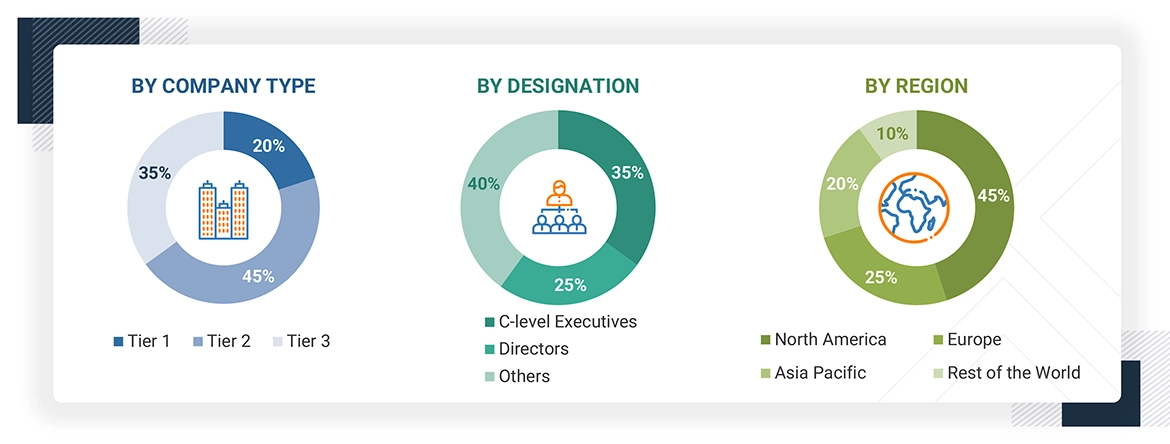
Note: “Others” includes sales, marketing, and product managers.
To know about the assumptions considered for the study, download the pdf brochure
Market Size Estimation
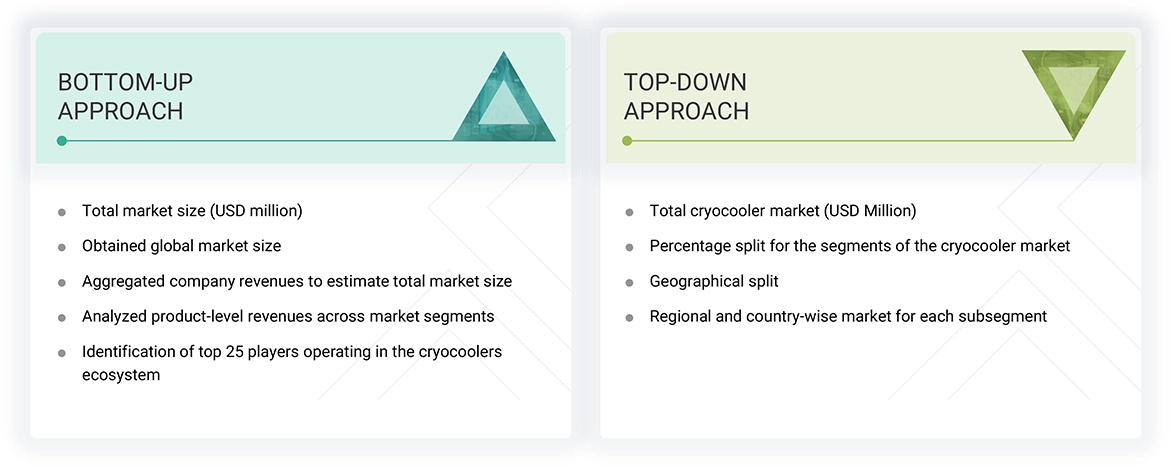
In the market engineering process, both top-down and bottom-up approaches, along with data triangulation methods, have been used to estimate and validate the size of the cryocooler market and other dependent submarkets. The research methodology used to estimate the market sizes includes the following:
- Identifying the players in the cryocooler market, along with their offerings
- Analyzing each country, along with the presence of related major companies and system integrators in the countries, and identifying the service providers in the cryocooler market
- Identifying the market for each type of cryocooler (Gifford-McMahon Cryocoolers, Pulse-Tube Cryocoolers, Stirling Cryocoolers, Joule Thomson Cryocoolers, Brayton Cryocoolers) in each country and globally
- Identifying the major applications of cryocoolers, along with the types of cryocoolers required for various applications
- Estimating total cryocooler unit shipment globally by adding regional data (North America, Europe, Asia Pacific, and RoW)
- Estimating the weighted average cost of cryocoolers
- Verifying and cross-checking the estimates at every level by discussing with key opinion leaders, such as CXOs, directors, and operations managers, and finally with the domain experts in MarketsandMarkets
- Studying various paid and unpaid sources of information, such as annual reports, press releases, white papers, and databases
Cryocooler Market: Top-Down and Bottom-Up Approach
Data Triangulation
After arriving at the overall market size through the market size estimation process explained in the earlier section, the overall cryocooler market has been divided into several segments and subsegments. To complete the overall market engineering process and arrive at the exact statistics for all segments, the data triangulation and market breakdown procedures have been used, wherever applicable. The data has been triangulated by studying various factors and trends from both the demand and supply sides. Along with data triangulation and market breakdown, the market has been validated through the top-down and bottom-up approaches.
Market Definition
A cryocooler is a device that provides active cooling at cryogenic temperatures. According to the Cryogenic Society of America, a cryocooler is designed to allow active cooling at a temperature of about -150 degrees centigrade or lower. A cryocooler system uses the flow of gas inside the closed tube, which absorbs the heat and radiates it outside.
It is a mechanical device that generates low temperatures, similar to a domestic refrigerator. It consists of a compressor, a heat exchanger, an expansion device, and an evaporator. Cryocoolers help in mitigating the usage of cryogens such as liquid helium and liquid nitrogen and are capable of producing temperatures as low as 77 K or 4.2 K. Some of the basic features of a cryocooler include less weight, fast cool-down time, and vibration-less operation. The popular types of cryocoolers available worldwide include Stirling cryocoolers, Gifford McMahon (G-M) cryocoolers, Pulse Tube cryocoolers, Joule Thomson (J-T) cryocoolers, and Brayton cryocoolers.
Key Stakeholders
- End users of cryocoolers in various sectors such as military, medical, transport and logistics, energy, agriculture and biology, and environmental
- Hardware component (valves, compressors, cold heads, and power circuit boards for cryocoolers) manufacturers
- Service providers of cryocooler equipment manufacturers
- Research organizations and consulting companies
- Associations, organizations, forums, and alliances related to cryocoolers
- Government bodies, such as regulating authorities and policymakers
Report Objectives
- To describe and forecast the size of the cryocooler market by offering, cryocooler type, heat exchanger type, operating cycle, temperature range, application, and region, in terms of value
- To describe and forecast the market size of various segments across four key regions—North America, Europe, Asia Pacific, and Rest of the World (RoW), in terms of value
- To forecast the size of the cryocooler market, in terms of volume
- To provide detailed information regarding the drivers, restraints, opportunities, and challenges influencing the growth of the cryocooler market
- To analyze the cryocooler value chain and ecosystem, along with the average selling price of cryocoolers
- To strategically analyze the regulatory landscape, tariffs, standards, patents, Porter’s five forces, import and export scenarios, AI/Gen AI impact, trade values, the 2025 US Tariff, and case studies pertaining to the market under study
- To strategically analyze micromarkets1 with regard to individual growth trends, prospects, and contributions to the overall market
- To analyze opportunities in the market for stakeholders by identifying high-growth segments
- To provide details of the competitive landscape for market leaders
- To provide details of the macroeconomic outlook for regions
- To analyze strategies such as product launches, collaborations, and acquisitions adopted by players in the cryocooler market
- To profile key players in the cryocooler market and comprehensively analyze their market ranking based on their revenue, market share, and core competencies2
Available Customizations
With the given market data, MarketsandMarkets offers customizations according to the specific requirements of companies. The following customization options are available for the report:
Country-wise Information:
- Country-wise breakdown for North America, Europe, Asia Pacific, and Rest of the World
Company Information:
- Detailed analysis and profiling of additional market players (up to five)
Key Questions Addressed by the Report
1
What is the projected size of the Cryocooler Market by 2030?
2
What is driving the growth of the Cryocooler Market?
3
Which region dominates the Cryocooler Market?
4
Which region is expected to witness the fastest growth?
5
Which application segment holds the largest market share?
6
What is the fastest-growing cryocooler type?
7
Which heat exchanger segment dominates the market?
8
Who are the leading companies in the Cryocooler Market?
9
What are the major trends shaping the Cryocooler industry?
10
What opportunities exist in the Cryocooler Market?
Fact checked
Personalize This Research
- Triangulate with your Own Data
- Get Data as per your Format and Definition
- Gain a Deeper Dive on a Specific Application, Geography, Customer or Competitor
- Any level of Personalization
Let Us Help You
- What are the Known and Unknown Adjacencies Impacting the Cryocooler Market
- What will your New Revenue Sources be?
- Who will be your Top Customer; what will make them switch?
- Defend your Market Share or Win Competitors
- Get a Scorecard for Target Partners

Custom Market Research Services
We Will Customise The Research For You, In Case The Report Listed Above Does Not Meet With Your Requirements
Get 10% Free CustomisationTESTIMONIALS

Tetsuya Ohhira
Business Development Manager-Technology Business
Nikon Corporation,
Leading Japanese MNC specializing in optics and imaging productswww.nikon.com
MarketsandMarkets™ response
is quick. Their attitude is flexible and positive. Analyst Insights are globally considered and
significant. Client Services quickly respond to our inquiry and demand. Their wide range of global
surveys help us make our strategic plan.
We hope Knowledge Store will be easier to search
for a report.
VP - Marketing & Business Development
Leading Provider of Process Control Solutions
We engaged with MarketsandMarkets on a study to perform an analysis and recommend a Go-To-Market strategy for metrology and process control in the semiconductor market. The study was tailored to our targets and needs with well-defined milestones. Our overall experience with the MarketsandMarkets team was very good throughout the project in all aspects including the analysis methodologies used, the quality and depth of primary and secondary data sets, the professionalism and flexibility of the team and the ability to meet the target schedule and milestones. We want to thank MarketsandMarkets team for a job well done.
- South Korea Cryocooler Market
- India Cryocooler Market
- Australia Cryocooler Market
- Indonesia Cryocooler Market
- Malaysia Cryocooler Market
- Thailand Cryocooler Market
- Vietnam Cryocooler Market
- Nordics Cryocooler Market
- Rest Of Europe Cryocooler Market
- Rest Of Asia Pacific Cryocooler Market
- US Cryocooler Market
- Canada Cryocooler Market
- Mexico Cryocooler Market
- Germany Cryocooler Market
- UK Cryocooler Market
- France Cryocooler Market
- Italy Cryocooler Market
- Netherlands Cryocooler Market
- Poland Cryocooler Market
- Japan Cryocooler Market
- China Cryocooler Market
Growth opportunities and latent adjacency in Cryocooler Market






Elijah
Apr, 2026
How does temperature range selection vary across industries such as healthcare, space, and industrial applications?.
Nathan
Apr, 2026
How is the cryocooler market expected to evolve over the next 5–10 years in terms of new applications, cost reductions, and technological breakthroughs.