

Robotics Actuators Market: Emerging Technologies, Innovation Trends, and Digital Transformation
The robotics actuators market is becoming increasingly important as robots move from traditional manufacturing environments into logistics, healthcare, electronics, agriculture, laboratories, and other applications. Actuators provide the physical movement required for robots to perform tasks such as positioning, lifting, gripping, rotating, assembling, and transporting objects. An actuator essentially converts an energy source and control signal into controlled mechanical motion or force, creating the physical connection between digital intelligence and robotic movement. As robotics systems become more precise and intelligent, actuator performance is increasingly connected with overall robot efficiency, accuracy, safety, and flexibility. This evolution is encouraging innovation in electric, hydraulic, pneumatic, mechanical, and emerging soft actuation technologies.
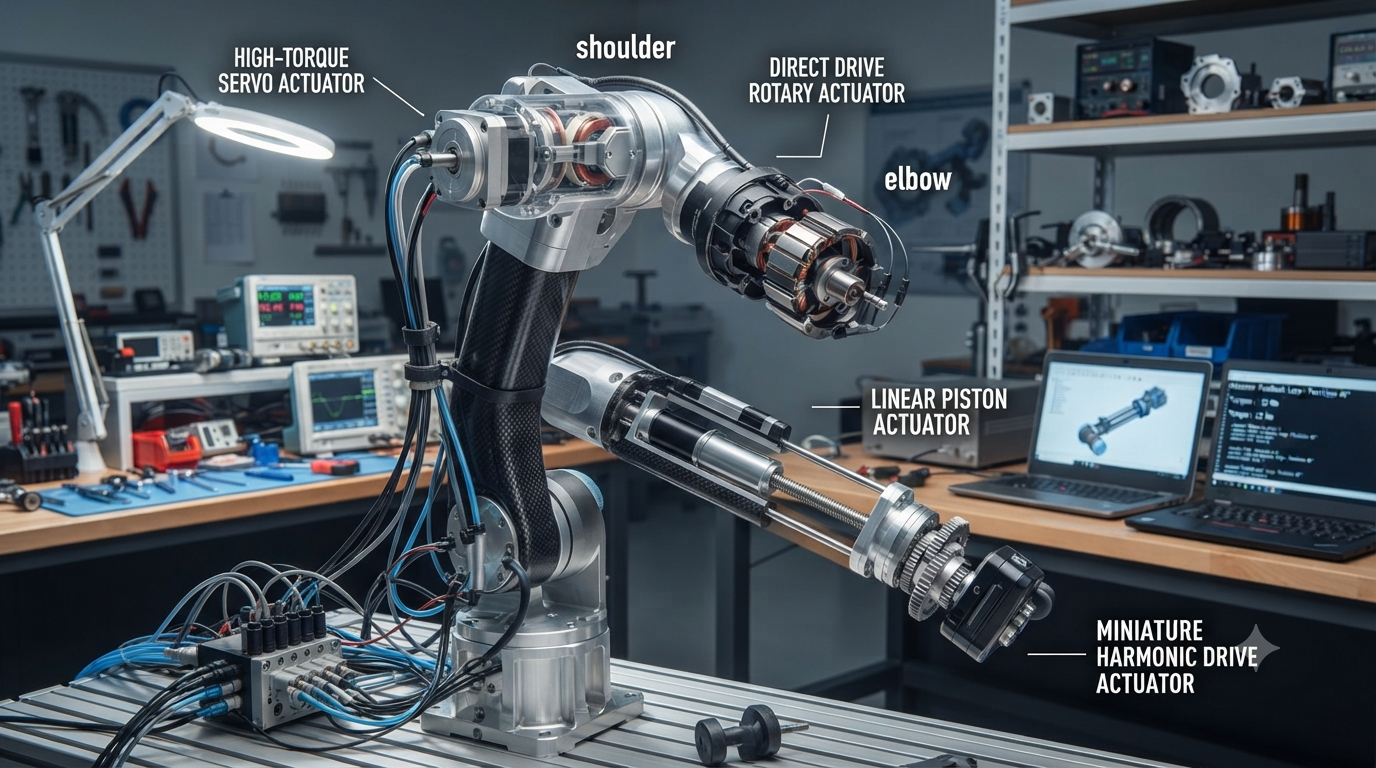
The growing use of automation is creating new requirements for compact, efficient, responsive, and highly controllable actuator systems. Conventional robotic applications often prioritized repeatability and durability, while newer systems increasingly require sensing, adaptive control, low energy consumption, compact construction, and smooth motion. These requirements are particularly important for collaborative robots, mobile robots, medical robots, and advanced manufacturing systems. The robotics actuators market is therefore moving toward integrated solutions that combine motors, gears, sensors, controllers, and communication capabilities. This transition is also increasing the importance of actuator design in determining the performance of complete robotic platforms.
According to Marketsandmarkets, the global actuators market size was valued at USD 71.22 billion in 2025 and is projected to reach USD 100.41 billion by 2030, growing at a CAGR of 7.1% from 2025 to 2030.
Download PDF Brochure @ https://www.marketsandmarkets.com/pdfdownloadNew.asp?id=59465451
Role of Actuators in Modern Robotics
Actuators are fundamental components of robotic systems because they transform commands from control systems into physical movement. A robotic controller may determine where an arm needs to move, how quickly it should move, and how much force should be applied, but the actuator performs the actual mechanical action. Depending on the architecture, an actuator can generate rotary motion around a joint or linear movement along an axis. Actuator selection therefore directly influences the robot's speed, torque, precision, energy consumption, payload capability, and operating range.
Modern robots increasingly require coordinated movement across several axes, making actuator synchronization particularly important. An articulated robot, for example, may use multiple rotary actuators to control individual joints while a Cartesian robot may rely heavily on linear actuation. Collaborative robots require additional attention to torque control, force limitation, and sensing because they are designed to operate closer to people. Research on collaborative robotics highlights the importance of force sensing, safety systems, adaptable control, and human robot interaction in these environments.
Electric Actuators Drive Robotics Innovation
Electric actuation is becoming increasingly important because it provides precise control over position, speed, torque, and acceleration. Electric systems can be integrated with digital controllers, sensors, encoders, and software platforms, making them suitable for applications requiring programmable and repeatable motion. Servo motors, stepper motors, direct drive systems, linear motors, and integrated motor actuator modules are increasingly used across different robotic architectures. Their controllability also supports advanced motion profiles that can be adjusted according to changing production requirements.
The growing emphasis on energy efficiency is another factor supporting electric actuator development. Electric systems can provide controlled motion without requiring continuous operation of centralized fluid power systems. They can also support regenerative functions in selected applications, depending on system architecture and control design. As factories increasingly connect machines through digital networks, electric actuators can become part of broader data driven automation systems. This creates opportunities to monitor actuator performance, identify abnormal operating conditions, and optimize motion profiles through software.
Rotary Actuators Support Robotic Joint Movement
Rotary actuators play a major role in robots that depend on articulated movement. Robotic arms commonly require rotational movement at their joints to position tools and components across three dimensional workspaces. Rotary actuation can provide controlled torque while working with gear reduction systems to achieve the required speed and positioning characteristics. Precision gears are particularly important because backlash, transmission efficiency, mechanical stiffness, and positioning accuracy can affect the performance of robotic joints.
The robotics actuators market is seeing increased attention toward compact rotary actuator modules that combine multiple functions within a smaller package. These integrated systems can include a motor, reducer, encoder, brake, torque sensing, and control electronics. Such integration can reduce system complexity and improve packaging efficiency. Compact joint modules are especially relevant for collaborative robots, mobile manipulators, wearable robots, and humanoid systems where weight and available installation space are important design considerations.
Linear Actuators Expand Robotic Movement Capabilities
Linear actuators are essential for applications requiring straight line movement. They are widely used in Cartesian robots, gantry systems, automated handling equipment, machine tending platforms, robotic lifting systems, and positioning equipment. Linear motion can be generated using electric motors combined with screws, belts, racks, linear motors, or other mechanical transmission mechanisms. The selection depends on requirements related to stroke length, speed, load, precision, acceleration, and operating environment.
The increasing use of automated material handling is creating greater demand for flexible linear motion systems. Warehouses and production facilities often require robots to move objects vertically and horizontally across different workstations. Linear actuators can provide the movement required for lifting, transferring, positioning, and indexing operations. Their modular nature also makes them suitable for automation platforms that need to be reconfigured as production requirements change. This flexibility is becoming increasingly important as manufacturers adopt more adaptable automation systems.
Smart Actuators Transform Robotic Systems
Smart actuators represent an important development in the robotics actuators market because they combine mechanical movement with sensing, processing, and communication capabilities. Conventional actuators primarily receive commands and produce motion, while smart actuator systems can provide information about position, torque, temperature, vibration, current consumption, and operating conditions. This additional information allows robotic systems to respond more intelligently to changes in their environment and mechanical condition.
Embedded sensing can also support predictive maintenance strategies. An actuator that continuously monitors temperature, vibration, current, and mechanical load can provide useful information about potential deterioration. Maintenance teams can use this data to identify unusual behavior before a failure affects production. Such capabilities are particularly valuable in highly automated facilities where unexpected downtime can interrupt multiple interconnected processes. Smart actuator technology therefore connects mechanical components with broader industrial digitalization initiatives.
Artificial Intelligence Enhances Actuator Control
Artificial intelligence is creating new opportunities for improving robotic movement and actuator management. AI based systems can analyze sensor information and identify relationships between actuator behavior, robot motion, environmental conditions, and task requirements. Machine learning techniques can support adaptive control by helping robotic systems modify movement according to changing loads or operating conditions. This can improve flexibility in applications where robots encounter variable objects or unpredictable environments.
AI can also contribute to actuator diagnostics and optimization. Historical operating data can be analyzed to identify patterns associated with excessive vibration, temperature increases, unusual current consumption, or changes in motion accuracy. Controllers can potentially use these insights to adjust operating parameters or trigger maintenance alerts. As AI becomes more closely integrated with robotic control architectures, actuators are increasingly becoming data generating components rather than simple motion devices.
Collaborative Robots Create New Actuator Requirements
Collaborative robots are changing actuator design because these systems are intended to operate in environments where humans and robots may share working spaces. Such applications require carefully controlled motion, force limitation, sensing, and responsive control. Actuator systems must therefore deliver precise torque and speed management while maintaining smooth and predictable movement. IEEE describes collaborative robots in terms of their ability to use sensing and control behavior to manage interactions with people.
The growing use of collaborative robots is encouraging actuator manufacturers and system designers to focus on compact and lightweight architectures. Excessive actuator weight can increase the mechanical burden on robotic joints and reduce overall efficiency. At the same time, actuators must deliver sufficient torque for the intended payload and movement. This creates a design balance between torque density, weight, size, energy consumption, thermal performance, and safety. The robotics actuators market is therefore increasingly influenced by the technical requirements of human centered automation.
Soft Actuators Enable Flexible Robotics
Soft actuation is another emerging technology influencing robotics development. Unlike conventional rigid actuators, soft actuators use flexible or deformable materials to generate movement. Examples include pneumatic artificial muscles, dielectric elastomer systems, and shape memory based technologies. These approaches can provide compliant movement that is useful for applications involving delicate objects, human interaction, wearable robotics, and biomimetic systems.
Soft actuator development is particularly relevant to robots that need to interact with irregular objects or human users. Traditional rigid mechanisms can provide high force and precision, but they may require sophisticated sensing and control when dealing with fragile or unpredictable environments. Soft systems can introduce mechanical compliance directly into the actuator structure. This can potentially improve adaptability and reduce the risk of excessive contact forces. However, durability, controllability, response speed, manufacturing complexity, and energy efficiency remain important considerations.
Robotics Actuators in Manufacturing
Manufacturing continues to represent a major application area for robotic actuation. Industrial robots perform welding, assembly, painting, packaging, inspection, material handling, machining, and machine tending tasks. Each application requires specific combinations of torque, speed, precision, payload, and repeatability. Actuators must operate reliably under repetitive cycles while maintaining consistent performance throughout extended operating periods.
Modern manufacturing is also becoming more flexible because production systems increasingly need to handle multiple products and shorter production cycles. This requirement is encouraging the adoption of programmable motion systems that can be quickly adjusted through software. Electric actuators are particularly suitable for such environments because their movement parameters can be digitally controlled. Integrated sensing further enables manufacturers to collect operational information and optimize robotic processes.
Important application areas include:
- Robotic assembly and component positioning
- Automated material handling and machine tending
- Packaging, palletizing, and sorting operations
- Inspection, testing, and precision manufacturing
These applications require different actuator characteristics, demonstrating why actuator selection remains closely connected to the specific robot architecture and task requirements.
Robotics Actuators in Healthcare and Medical Applications
Healthcare robotics introduces demanding requirements for actuator precision, compactness, reliability, and controlled movement. Surgical robots, rehabilitation devices, laboratory automation systems, prosthetic technologies, and assistive robots all depend on carefully controlled mechanical motion. In medical environments, actuator movement may need to be extremely smooth because uncontrolled motion can affect patient safety, procedure accuracy, or device performance.
Medical robotics also creates opportunities for smaller actuator architectures. Devices designed for minimally invasive procedures or wearable applications may have limited space for motors and mechanical components. This encourages research into miniature motors, compact gear systems, piezoelectric technologies, soft actuators, and advanced sensing. The robotics actuators market can benefit from these developments as actuator technology becomes increasingly adaptable to specialized medical applications.
Robotics Actuators in Logistics and Warehousing
The expansion of warehouse automation is increasing the need for reliable motion systems capable of operating continuously. Robots used for picking, sorting, transporting, lifting, and placing products require actuators that can handle repeated movement while maintaining predictable performance. Linear actuators are useful for lifting and positioning, while rotary systems support robotic arms, wheels, joints, and gripping mechanisms.
Energy efficiency is becoming increasingly important in mobile robotics because battery powered systems must balance movement performance with operating time. Lightweight actuators can reduce the energy required for movement and increase the efficiency of mobile platforms. Integrated motors, controllers, and sensors can also simplify robot architecture and reduce the number of external components. These developments are creating new design opportunities across warehouse and logistics automation.
Key Trends Shaping the Robotics Actuators Market
Several technology trends are influencing actuator development as robotics moves toward more connected, flexible, and intelligent systems. Actuator manufacturers and robotic system designers are focusing on improving torque density, precision, energy efficiency, sensing, thermal management, and digital connectivity. These developments are being influenced by applications ranging from industrial automation to collaborative robotics and emerging humanoid systems.
Key trends include:
- Increasing adoption of compact electric actuator systems
- Integration of sensors directly into actuator modules
- Greater use of AI supported motion control
- Development of lightweight and high torque density designs
- Growing interest in soft and compliant actuation
- Expansion of actuator based predictive maintenance
These trends indicate that actuator technology is moving beyond basic mechanical movement toward intelligent motion platforms. The ability to combine mechanical performance with sensing and digital control is becoming an important part of modern robotic architecture.
Energy Efficiency Becomes a Major Design Priority
Energy consumption is increasingly considered during robot and actuator design. Robots may perform thousands or millions of movement cycles during their operating life, making actuator efficiency an important factor in overall system performance. Designers are therefore evaluating motor efficiency, mechanical transmission losses, heat generation, regenerative capabilities, and standby consumption when selecting actuator architectures.
Electric actuator systems can support more precise energy management because power delivery can be controlled according to the required movement. Advanced control systems can reduce unnecessary acceleration and deceleration while optimizing movement trajectories. Lightweight mechanical components can further reduce energy requirements. As sustainability becomes a larger consideration in industrial automation, actuator efficiency is expected to remain an important technology development area.
Challenges Affecting Actuator Development
Despite rapid innovation, actuator design continues to involve several engineering challenges. High performance actuators often require advanced materials, precision manufacturing, sophisticated electronics, and complex control algorithms. Increasing torque density can create thermal management challenges because smaller components may need to dissipate significant amounts of heat. Designers must therefore balance power output with size, weight, temperature, reliability, and service life.
Cost is another consideration for robotics developers. High precision motors, reducers, sensors, and controllers can increase the overall cost of robotic systems. For applications with relatively simple movement requirements, pneumatic or conventional mechanical solutions may remain attractive. Selecting the appropriate technology therefore depends on the total operating requirements rather than relying on a single actuator architecture.
Opportunities for Innovation in Robotics Actuators
The robotics actuators market offers opportunities for innovation across both hardware and software. Integrated actuator modules can simplify robot construction by combining motors, gearing, sensing, electronics, and communication interfaces into a single package. This approach can reduce wiring complexity and make robotic systems easier to assemble and maintain.
Another opportunity involves developing application specific actuators. Different robots require different combinations of torque, speed, precision, compliance, and environmental resistance. Instead of using standardized components for every application, manufacturers can develop specialized actuator architectures for medical robotics, collaborative systems, mobile robots, agricultural automation, and advanced manufacturing. This specialization can support new robotic designs while improving performance in demanding environments.
Digital Twins and Predictive Maintenance
Digital twin technologies are creating another potential development area for actuator systems. A digital representation of a robotic mechanism can incorporate information about actuator position, load, temperature, vibration, and operating cycles. This information can help engineers understand how the physical system behaves under different operating conditions. Digital twins are increasingly discussed alongside collaborative robotics and smart manufacturing as tools for improving system optimization and monitoring.
Predictive maintenance can benefit from this connected architecture. Instead of relying entirely on fixed maintenance schedules, robotic systems can use actuator condition information to identify abnormal behavior. This can help maintenance teams investigate potential problems before a major failure occurs. The combination of sensors, connectivity, analytics, and intelligent control can therefore make actuator systems more valuable within digitally connected production environments.
Future Direction of Robotic Actuation Technology
The future development of actuator technology is expected to focus increasingly on intelligence, compactness, efficiency, and adaptability. Robotic systems are becoming more diverse, moving beyond fixed industrial arms toward mobile, collaborative, medical, agricultural, logistics, and human centered applications. Each category introduces different mechanical requirements, which encourages continued diversification of actuator technologies.
Humanoid robotics is also increasing attention toward high torque density joint systems, compact transmissions, lightweight structures, and integrated sensing. However, the actuator requirements of humanoid robots differ significantly from conventional industrial robots because movement involves many coordinated joints and dynamic balance. Continued advances in motors, materials, sensors, control algorithms, and power electronics will influence how these systems develop.
Conclusion
The robotics actuators market is evolving alongside the broader transformation of robotics and automation. Actuators are no longer viewed simply as mechanical components that generate movement. They are becoming intelligent motion systems that combine mechanical power, sensing, control, communication, and data capabilities. Electric actuation, smart sensors, AI supported control, soft robotics, compact joint modules, and energy efficient designs are contributing to this transformation.
The increasing adoption of collaborative robots, mobile robots, medical systems, warehouse automation, and flexible manufacturing is creating diverse requirements for actuator technology. Future innovation will depend on achieving the right balance between precision, torque, speed, weight, energy efficiency, safety, reliability, and cost. As robotics becomes increasingly connected and adaptive, advanced actuator systems will remain an essential technology for converting digital intelligence into accurate and useful physical movement.
FAQs
What is the robotics actuators market?
The robotics actuators market refers to the ecosystem surrounding actuator technologies used to generate controlled movement in robotic systems. It includes electric, hydraulic, pneumatic, mechanical, and emerging actuation technologies used for rotary and linear motion.
Why are actuators important in robotics?
Actuators convert energy and control commands into physical movement. They determine important robotic characteristics such as speed, torque, positioning accuracy, payload capability, and movement flexibility.
What are the major types of robotics actuators?
Major actuator categories include electric, hydraulic, pneumatic, mechanical, piezoelectric, and soft actuators. Electric systems are widely used where programmable and precise movement is required, while other technologies remain relevant for specific force, speed, environmental, or compliance requirements.
How is AI influencing robotics actuators?
AI can analyze actuator sensor data and support adaptive motion control, condition monitoring, anomaly detection, and maintenance planning. This can help robotic systems respond more effectively to changing operating conditions.
Why are electric actuators gaining attention?
Electric actuators provide precise digital control of position, speed, torque, and acceleration. They can also integrate with sensors, controllers, communication networks, and software based automation systems.
What role do actuators play in collaborative robots?
Actuators enable controlled joint movement and help collaborative robots regulate speed, torque, and force. Their performance is particularly important when robots operate near people and require responsive sensing and control.
Are soft actuators important for future robotics?
Soft actuators have potential in applications requiring flexible, compliant, and human friendly movement. They are being explored for wearable robotics, medical devices, delicate object handling, and systems that need adaptable physical interaction.
What factors should be considered when selecting a robotic actuator?
Important factors include required torque or force, speed, precision, stroke or rotation range, payload, energy consumption, size, weight, operating environment, control requirements, reliability, and maintenance needs.
How does predictive maintenance benefit actuator systems?
Predictive maintenance uses operational information such as temperature, vibration, current, position, and load to identify unusual actuator behavior. This can help maintenance teams detect potential problems earlier and reduce unexpected interruptions.
What is the future of robotics actuator technology?
Future actuator development is likely to emphasize compact designs, higher torque density, integrated sensing, intelligent control, energy efficiency, soft actuation, digital connectivity, and application specific architectures for emerging robotic systems.
80% of the Forbes Global 2000 B2B companies rely on MarketsandMarkets to identify growth opportunities in emerging technologies and use cases that will have a positive revenue impact.
- Food Packaging Market Size Set for Strong Growth Through 2030 Amid Rising Demand for Convenience Foods
- Crop Protection Chemical Market Size, Share & Growth Forecast (2025–2030)
- Mulch Films Market: Driving Sustainable Agriculture Through Innovation
- Agricultural Adjuvants Market Analysis, Trends, and Growth Outlook (2026–2031)
- Japan Enterprise Asset Management Market Growth: AI and Smart Infrastructure Drive Demand

.jpg)
