
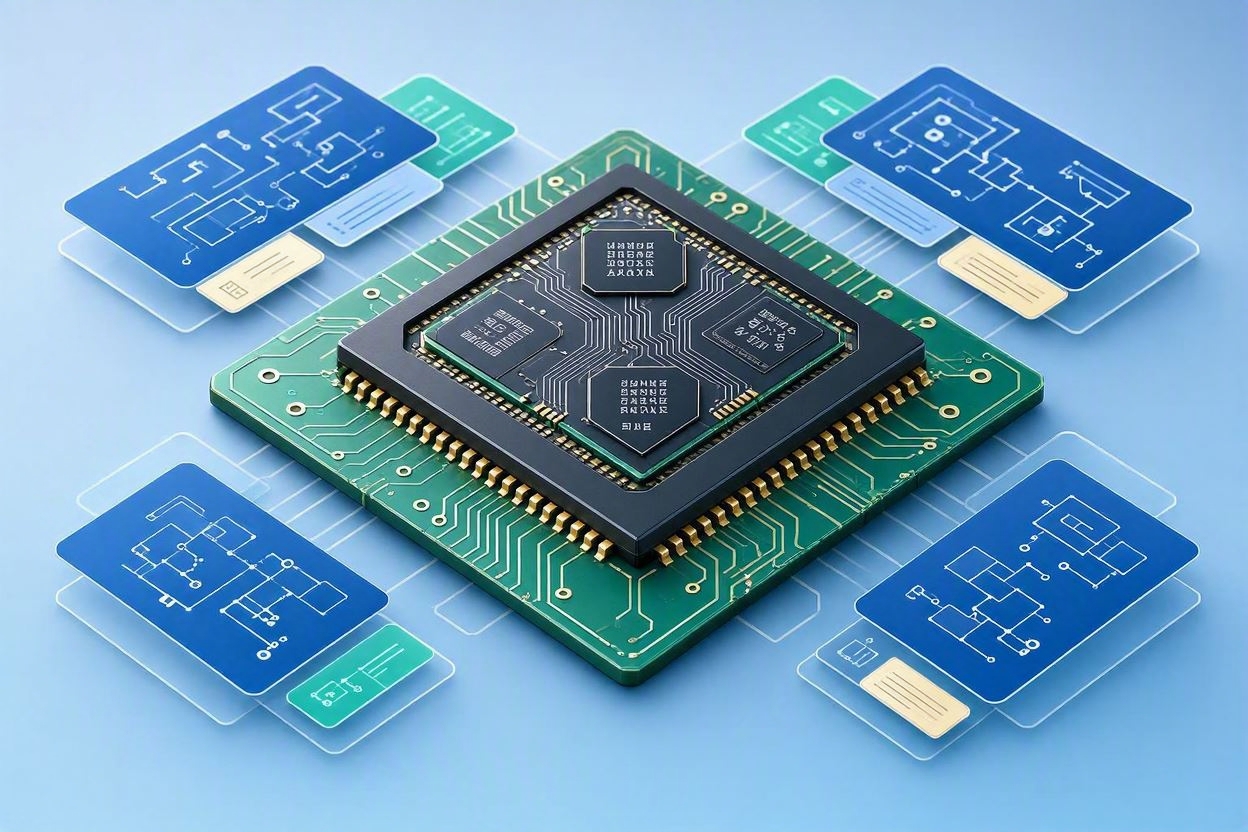
The Role of Semiconductor IP in Advanced SoC Development
The semiconductor industry is currently experiencing a transformative period driven by the unrelenting demand for more powerful, energy-efficient, and feature-rich electronic devices. At the heart of this technological evolution lies the System on Chip, a complex integrated circuit that consolidates multiple components of a computer or electronic system onto a single chip. The development of these advanced SoCs is a monumental engineering challenge, and it is made possible through the strategic use of Semiconductor IP. These pre designed and pre verified functional blocks serve as the essential building blocks for modern chips, allowing designers to manage complexity and focus on innovation rather than reinventing fundamental circuits.
Semiconductor IP, often referred to as Silicon IP or IP cores, encompasses a wide range of functional blocks including processor cores, memory controllers, interface protocols, and specialized accelerators for artificial intelligence and digital signal processing. The semiconductor IP market was estimated at USD 9.30 billion in 2025 and is projected to reach USD 18.64 billion by 2032, growing at a CAGR of 10.2% from 2026 to 2032. This growth is a direct reflection of how central Semiconductor IP has become to the economics and feasibility of advanced chip design, as it enables companies to assemble increasingly complex systems within shrinking product development cycles.
Download PDF Brochure @ https://www.marketsandmarkets.com/pdfdownloadNew.asp?id=651
The Foundation of Modern Chip Design
The fundamental premise behind using Semiconductor IP in advanced SoC development is the principle of design reuse. Instead of dedicating engineering resources to designing every transistor and logic gate from scratch, development teams can license proven IP blocks from specialist vendors or leverage internal libraries of reusable components. This approach is not merely a matter of convenience but is an operational necessity, as modern flagship SoCs integrate upward of 50 IP blocks, each spanning multiple voltage islands and asynchronous clock domains . Without the availability of these pre-verified components, the design and verification of a single chip would be an impossibly time-consuming and financially prohibitive endeavor.
For a practical understanding, modern SoC designs are often structured around a heterogeneous compute cluster. This architecture is composed of general-purpose central processing units, digital signal processors, graphics processing units, and dedicated neural processing units . Each of these components is typically sourced as a separate piece of Semiconductor IP. By integrating these specialized blocks, designers can achieve order of magnitude improvements in performance per watt for specific workloads, such as AI inference at the edge, where tight power, performance, and size constraints are paramount .
Furthermore, the value of Semiconductor IP extends beyond just processors; it includes foundational IP like logic libraries, embedded memories, and I/O blocks that are pre-validated for specific process nodes. This foundation IP is critical for achieving best in class power, performance, and area targets, which are the three pillars of effective chip design. The use of this optimized and process-specific IP eliminates the cost and effort of developing foundational blocks in-house, allowing designers to shorten schedules and reduce risk from the very first day of the project .
The Economic and Strategic Imperative
The strategic importance of Semiconductor IP is deeply intertwined with the economics of semiconductor manufacturing. As process nodes shrink below 10 nanometers and into the single digits, the cost of a single chip tape-out can run into tens of millions of dollars. This financial risk creates a powerful incentive for designers to rely on proven IP blocks rather than developing custom solutions that carry a higher risk of failure and expensive re-spins. Integrating pre-verified and silicon-proven Semiconductor IP is a primary strategy for buying down risk, as it transfers the cost and burden of verification to the IP provider .
A significant portion of modern SoCs, estimated between 60 and 80 percent, consists of reused IP blocks . This reuse not only accelerates development and reduces costs but also improves product reliability. When an IP block is silicon-proven, it means it has been previously manufactured in a real chip and its performance characteristics are well understood. This maturity dramatically reduces the design risk for the system integrator, ensuring a higher probability of first-pass silicon success. The licensing model also allows fabless companies and system integrators to focus their internal engineering efforts on product differentiation, such as developing unique AI engines or advanced security features, while licensing commodity Semiconductor IP for standard functionalities .
The financial models of the Semiconductor IP market are also evolving to meet the needs of a broader range of companies. While traditional upfront licensing fees combined with per-unit royalties create a barrier for startups, a shift towards service-related payments and hybrid licensing models is occurring . Revenue-sharing, subscription-based licensing, and platform subscriptions that include continuous performance tuning are becoming more common. This evolution helps align supplier incentives with customer production milestones and makes advanced Semiconductor IP more accessible, thereby stimulating innovation across the entire semiconductor ecosystem .
Navigating the Challenges of Integration
While the benefits of using Semiconductor IP are clear, its integration into an advanced SoC presents a complex set of challenges that require careful management and sophisticated tools. The process of selecting, incorporating, validating, and monitoring IP blocks is a multi-faceted problem that can significantly impact a project's timeline and budget if not handled correctly. One of the primary challenges is the sheer difficulty of choosing the appropriate Semiconductor IP for a given application, which involves a detailed assessment of design requirements, process technology compatibility, quality, licensing, and performance .
Once selected, the integration of diverse internal and third-party Semiconductor IP cores requires significant effort to ensure compatibility. Designers must ensure that IP blocks from different vendors can communicate seamlessly over a communication bus or a network-on-chip. Issues can arise from mismatches in power management schemes, clock domains, and bus protocols . To address these challenges, teams are increasingly relying on purpose-built IP catalog tools. These centralized digital repositories contain detailed metadata about every IP block, including information about the foundry, technology node, timing, area, power requirements, and dependency information, enabling efficient search, comparison, and reuse across the enterprise .
Another critical challenge is protecting the integrity of the Semiconductor IP throughout the design flow. Because IP cores are often delivered in a "black box" format and are expected to remain unchanged, any unintentional modification during physical design stages can lead to functional failures. Traditional verification methods like standard design rule checking (DRC) often fail to catch these subtle but critical issues, such as misplaced routing or unintended metal fills inside the IP block . Therefore, advanced automated checking solutions are necessary to ensure that every instance of an IP in the SoC matches its golden reference, preserving both functional performance and foundry requirements and preventing costly late-stage iterations .
The Integral Role of IP in Software and System Evolution
The influence of Semiconductor IP extends beyond hardware design to profoundly impact the software ecosystem and the overall system architecture. The instruction set architecture of a processor IP, for instance, determines the software tools, compilers, and operating systems that can run on the chip. This creates a powerful lock-in effect, where a dominant Semiconductor IP ecosystem, such as Arm for mobile devices, reinforces its position through a vast network of software support. However, the semiconductor industry is currently experiencing a significant shift with the rise of open-source hardware, particularly the RISC-V architecture, which is disrupting traditional licensing models .
This expansion of the Semiconductor IP landscape gives SoC architects more choices than ever before, allowing them to tailor their systems more precisely to their target applications. The decision to use a general-purpose CPU, a domain-specific DSP, or a custom AI accelerator IP has profound implications for the chip's power budget, performance profile, and the software development effort required to bring the product to market. As artificial intelligence workloads demand efficient matrix multiplication and convolution operations, domain-specific IP for AI is becoming a critical differentiator, making the strategic selection of Semiconductor IP a key business decision that determines a product's competitive edge .
Moreover, the integration of advanced Semiconductor IP is crucial for meeting the stringent requirements of key end-markets like automotive and industrial automation. These sectors demand functional safety IP that is compliant with standards such as ISO 26262 . Such IP blocks come with published safety artifacts and are pre-verified to handle failures, ensuring the reliability and safety of the final system. This shows how the role of Semiconductor IP has evolved from simply saving time to becoming an essential enabler for entering new, high-growth markets where safety, security, and reliability are non-negotiable .
Looking Ahead: The Future of SoC Development
As we look to the future, the role of Semiconductor IP in advanced SoC development is set to become even more critical. The industry is moving towards chiplet based designs, where instead of a single monolithic die, an SoC is constructed from multiple smaller dies connected together. This approach accelerates the move toward heterogeneous integration, where different chiplets can be manufactured using different process technologies best suited for their function . For this model to succeed, the role of interface IP is paramount, as it must adhere to chiplet communication standards like UCIe to ensure that heterogeneous dies can interoperate across vendor boundaries .
The growing complexity of SoCs, coupled with the rising adoption of high-level synthesis design methodologies, is also driving a need for more robust verification strategies. Traditional verification methods are often insufficient for complex designs, which is why teams are shifting verification "left," meaning it starts much earlier in the design cycle. This involves using reference models to validate the intent of the design before final RTL is generated, ensuring that architectural and algorithmic bugs are caught early . This proactive approach to verification is essential for the successful deployment of increasingly complex Semiconductor IP in production silicon.
In conclusion, Semiconductor IP is the cornerstone of modern and future SoC development. It is not just a tool for reducing time to market and development costs; it is the very mechanism that allows the industry to continue innovating in the face of staggering complexity and financial risk. From processor cores to chiplet interfaces, the strategic selection, careful integration, and rigorous verification of Semiconductor IP determine the success or failure of a chip. As the industry marches toward the AI era and beyond, Semiconductor IP will remain the engine of innovation, enabling the creation of the sophisticated, high-performance, and reliable silicon that powers the digital world.
80% of the Forbes Global 2000 B2B companies rely on MarketsandMarkets to identify growth opportunities in emerging technologies and use cases that will have a positive revenue impact.
- Food Packaging Market Size Set for Strong Growth Through 2030 Amid Rising Demand for Convenience Foods
- Crop Protection Chemical Market Size, Share & Growth Forecast (2025–2030)
- Mulch Films Market: Driving Sustainable Agriculture Through Innovation
- Agricultural Adjuvants Market Analysis, Trends, and Growth Outlook (2026–2031)
- Japan Enterprise Asset Management Market Growth: AI and Smart Infrastructure Drive Demand


