

Transportation Infrastructure Market: Trends, Growth Drivers, Opportunities, and Future Outlook
The transportation infrastructure market is undergoing significant transformation as governments, transportation authorities, and private infrastructure developers invest in modernizing roads, railways, airports, ports, bridges, and intelligent transportation systems. Rapid urbanization, population growth, increasing mobility requirements, and the expansion of international trade are creating sustained demand for efficient and resilient transportation networks. At the same time, digital technologies, electrification, automation, and smart infrastructure are changing how transportation assets are designed, constructed, operated, and maintained. These developments are creating new opportunities across the transportation infrastructure market.
According MarketsandMarkets, the intelligent transportation system market size is projected to reach USD 55.36 billion by 2030 from USD 42.55 billion in 2025, at a CAGR of 5.4% during the forecast period. The market growth is driven by increasing urbanization, rising traffic congestion, and the growing need for road safety and efficient traffic management solutions. AI-based traffic analytics and smart sensors enhance real-time data processing and decision-making. Furthermore, government initiatives to improve transportation infrastructure, reduce emissions, and implement smart city projects are significantly accelerating the adoption of ITS solutions across developed and developing regions globally.
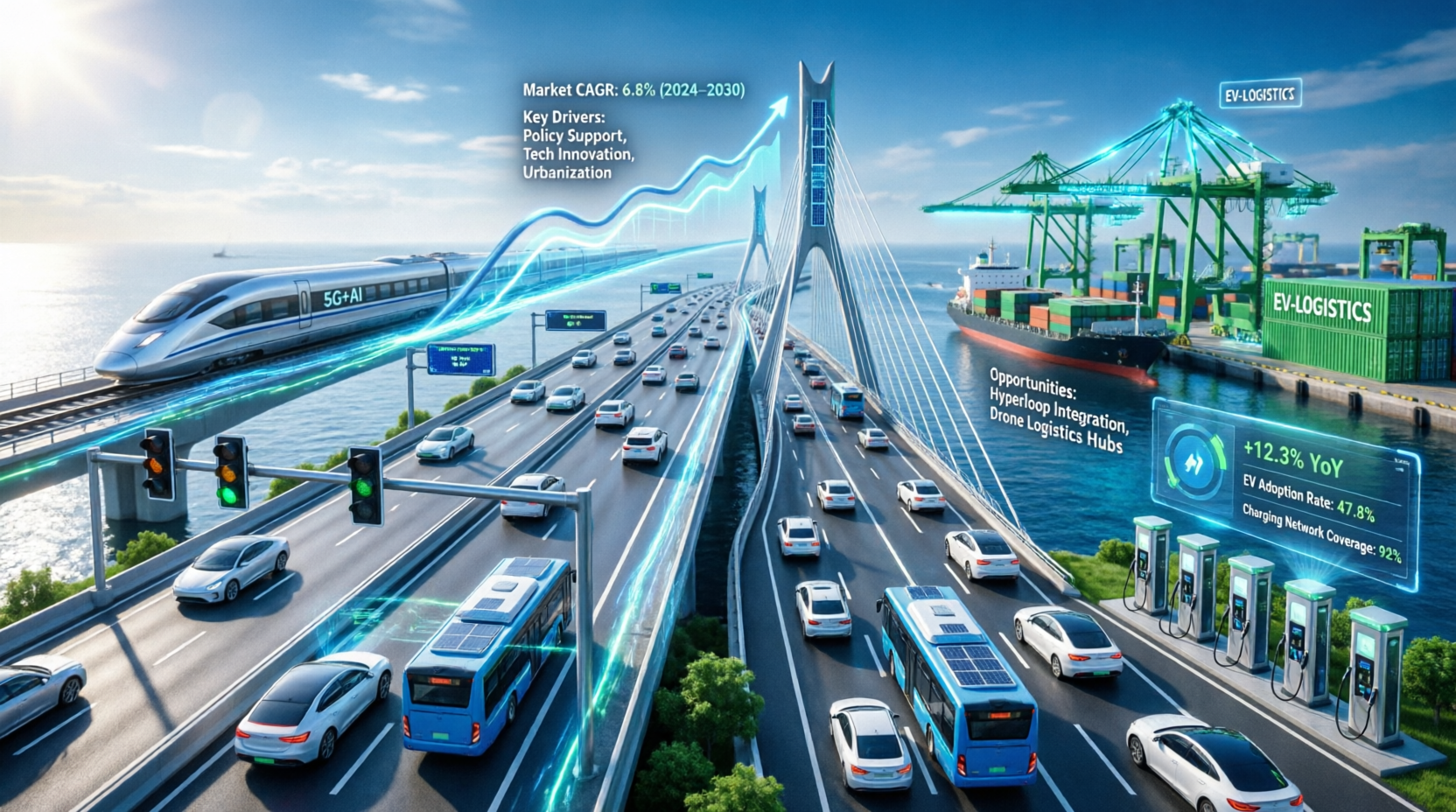
Growing Investment in Transportation Infrastructure
Infrastructure investment remains a major priority for countries seeking to improve economic competitiveness and connectivity. Governments are allocating substantial resources to highways, expressways, rail networks, metro systems, airports, and ports to support increasing passenger and freight movement. Developing economies are particularly focused on expanding basic transportation infrastructure, while developed markets are emphasizing modernization, capacity expansion, and replacement of aging assets. Public-private partnerships (PPPs) are also becoming increasingly important for financing large-scale transportation projects.
Urbanization Driving Demand for Smart Mobility Infrastructure
Rapid urbanization is increasing pressure on existing transportation networks. Growing cities face challenges such as traffic congestion, limited road capacity, air pollution, and inefficient public transportation. As a result, urban authorities are investing in metro rail, light rail, bus rapid transit, intelligent traffic management, smart parking, connected intersections, and multimodal transportation systems. Smart infrastructure allows transportation agencies to monitor traffic conditions, optimize vehicle flows, and provide travelers with real-time information. This transition toward connected mobility is expected to support opportunities across the transportation infrastructure market.
Road Infrastructure Remains a Major Segment
Roads and highways continue to represent a significant component of global transportation infrastructure investment. Increasing vehicle ownership, expanding logistics networks, and rising freight transportation are encouraging investments in new roads as well as rehabilitation of existing infrastructure. Governments are adopting technologies such as electronic toll collection, intelligent traffic signals, automated incident detection, and road condition monitoring to improve road efficiency and safety. Smart roads incorporating sensors, connectivity, and digital monitoring capabilities are also emerging as an important area of infrastructure development.
Expansion of Rail and Public Transportation Networks
Rail infrastructure is gaining importance as governments seek efficient, sustainable, and high-capacity transportation solutions. Investments in high-speed rail, metro systems, commuter rail, freight railways, and railway electrification are increasing across several regions. Rail systems can transport large numbers of passengers and substantial freight volumes while supporting efforts to reduce road congestion. Modern railway infrastructure is increasingly integrated with signaling systems, automated fare collection, predictive maintenance technologies, and digital passenger information platforms.
Airport Infrastructure Modernization
The recovery and long-term growth of air passenger and cargo transportation are encouraging airports to expand and modernize their infrastructure. Airport operators are investing in additional terminals, runways, baggage-handling systems, passenger processing facilities, parking infrastructure, and digital technologies. Automation is increasingly being deployed for check-in, security processing, baggage management, and passenger movement. Smart airport infrastructure can improve operational efficiency while helping airports accommodate increasing passenger volumes without proportional increases in manual processes.
Port and Maritime Infrastructure Development
Growing international trade and the expansion of global supply chains are driving investments in ports and maritime infrastructure. Ports are expanding container terminals, cargo-handling capacity, storage facilities, access roads, and rail connections to accommodate increasing freight volumes. Digitalization is also becoming a major focus, with ports adopting automated cranes, smart gates, digital documentation, real-time tracking, and connected logistics platforms. Investments in resilient port infrastructure are particularly important as supply chains become increasingly dependent on efficient maritime transportation.
Digitalization and Intelligent Transportation Systems
Digital technologies are becoming an integral part of modern transportation infrastructure. Intelligent Transportation Systems (ITS) use sensors, cameras, communications networks, data analytics, artificial intelligence, and cloud platforms to improve transportation management. Traffic management centers can analyze real-time information to identify congestion, accidents, and changing traffic patterns. Predictive analytics can also support infrastructure maintenance by identifying potential failures before they become major operational problems. The integration of physical infrastructure with digital platforms is creating a more connected transportation ecosystem.
Sustainability and Green Transportation Infrastructure
Environmental sustainability is becoming an important consideration in transportation infrastructure development. Governments and infrastructure operators are investing in electric vehicle charging networks, railway electrification, low-emission public transportation, renewable-energy integration, and energy-efficient facilities. Road and rail projects are also incorporating sustainable construction materials and energy-efficient technologies. The expansion of electric mobility is creating demand for charging infrastructure along highways, in parking facilities, at commercial locations, and within urban transportation networks.
Public-Private Partnerships Creating Investment Opportunities
Large transportation infrastructure projects often require significant capital, long development periods, and complex regulatory processes. Public-private partnerships provide an alternative mechanism for financing, constructing, and operating transportation assets. Under PPP models, private companies can participate in projects involving highways, airports, railways, ports, and urban transit systems. These arrangements can create opportunities for infrastructure developers, engineering companies, technology providers, construction firms, and financial institutions. However, successful projects require appropriate risk allocation, regulatory frameworks, and long-term financial planning.
Infrastructure Maintenance and Asset Management
Maintaining existing infrastructure is becoming as important as building new transportation assets. Aging roads, bridges, railway systems, tunnels, airports, and ports require continuous inspection, repair, and modernization. Digital asset management platforms can help infrastructure operators monitor asset conditions and prioritize maintenance activities. Technologies such as drones, IoT sensors, digital twins, machine vision, and predictive analytics are increasingly being used to identify structural and operational issues. This shift from reactive maintenance toward predictive asset management can create significant opportunities for technology and service providers.
Regional Growth Opportunities
Growth opportunities in the transportation infrastructure market vary across regions. Asia-Pacific is witnessing substantial infrastructure development due to urbanization, industrialization, population growth, and expanding trade networks. Countries across the region are investing in highways, high-speed rail, metro systems, airports, and ports. North America and Europe are placing greater emphasis on modernization, sustainability, electrification, and smart transportation technologies. Meanwhile, emerging markets in Latin America, the Middle East, and Africa are investing in transportation connectivity to support economic development, trade, tourism, and urban expansion.
Challenges Facing the Transportation Infrastructure Market
Despite strong investment opportunities, the transportation infrastructure market faces several challenges. High construction costs, financing constraints, lengthy approval processes, land acquisition issues, supply-chain disruptions, and regulatory complexity can delay infrastructure projects. Large projects may also face cost overruns and construction delays. Climate-related risks, including flooding, extreme temperatures, storms, and other environmental events, are increasing the need for resilient infrastructure designs. Addressing these challenges requires effective planning, advanced project management, appropriate financing models, and collaboration among governments and private-sector stakeholders.
Future Outlook
The future of the transportation infrastructure market will increasingly depend on the convergence of physical infrastructure and digital technologies. Smart roads, connected vehicles, intelligent railways, automated ports, electric mobility infrastructure, and digitally enabled airports are expected to become more common. Artificial intelligence, IoT, cloud computing, digital twins, and advanced analytics will support better planning, monitoring, and asset management. At the same time, sustainability and resilience will remain important priorities as transportation authorities seek to reduce environmental impact and prepare infrastructure for changing climate conditions.
Conclusion
The transportation infrastructure market is moving beyond traditional construction toward a more integrated, intelligent, sustainable, and connected ecosystem. Investments in roads, railways, airports, ports, and urban mobility infrastructure will continue to be supported by urbanization, economic development, trade, technological advancement, and the need to modernize aging transportation networks. Companies operating across engineering, construction, infrastructure development, automation, software, and transportation technology are likely to find opportunities as infrastructure owners increasingly combine physical assets with digital capabilities. As governments and private organizations pursue smarter and more resilient transportation networks, the market is expected to remain an important area of investment and technological innovation.
80% of the Forbes Global 2000 B2B companies rely on MarketsandMarkets to identify growth opportunities in emerging technologies and use cases that will have a positive revenue impact.
- Food Packaging Market Size Set for Strong Growth Through 2030 Amid Rising Demand for Convenience Foods
- Crop Protection Chemical Market Size, Share & Growth Forecast (2025–2030)
- Mulch Films Market: Driving Sustainable Agriculture Through Innovation
- Agricultural Adjuvants Market Analysis, Trends, and Growth Outlook (2026–2031)
- Japan Enterprise Asset Management Market Growth: AI and Smart Infrastructure Drive Demand

