

Underfloor Heating Market: Growth, Trends, Technology, and Forecast to 2032
Underfloor Heating Market Overview
The global underfloor heating market is expanding as residential, commercial, and industrial buildings increasingly adopt energy efficient heating technologies. Underfloor heating distributes heat through heating elements or water based pipes installed beneath the floor, creating more uniform indoor temperatures than many conventional heating approaches. The technology is becoming increasingly relevant to modern building designs because of its compatibility with low temperature heating systems, heat pumps, smart thermostats, and building automation.
According to MarketsandMarkets, the global underfloor heating market is projected to grow from USD 6.13 billion in 2026 to USD 9.26 billion by 2032, registering a CAGR of 7.1% from 2026 to 2032. The market was valued at USD 5.73 billion in 2025. Growing demand for energy efficient heating systems, the adoption of heat pumps, smart home technologies, stringent building energy standards, and renovation activity are among the factors supporting market growth.
Underfloor heating systems are available in two major configurations: hydronic and electric. Hydronic systems circulate heated water through pipes installed beneath the floor, while electric systems use heating cables or mats to generate radiant heat. The choice between these systems depends on building design, installation requirements, available energy sources, floor construction, and heating requirements.
What Is Underfloor Heating?
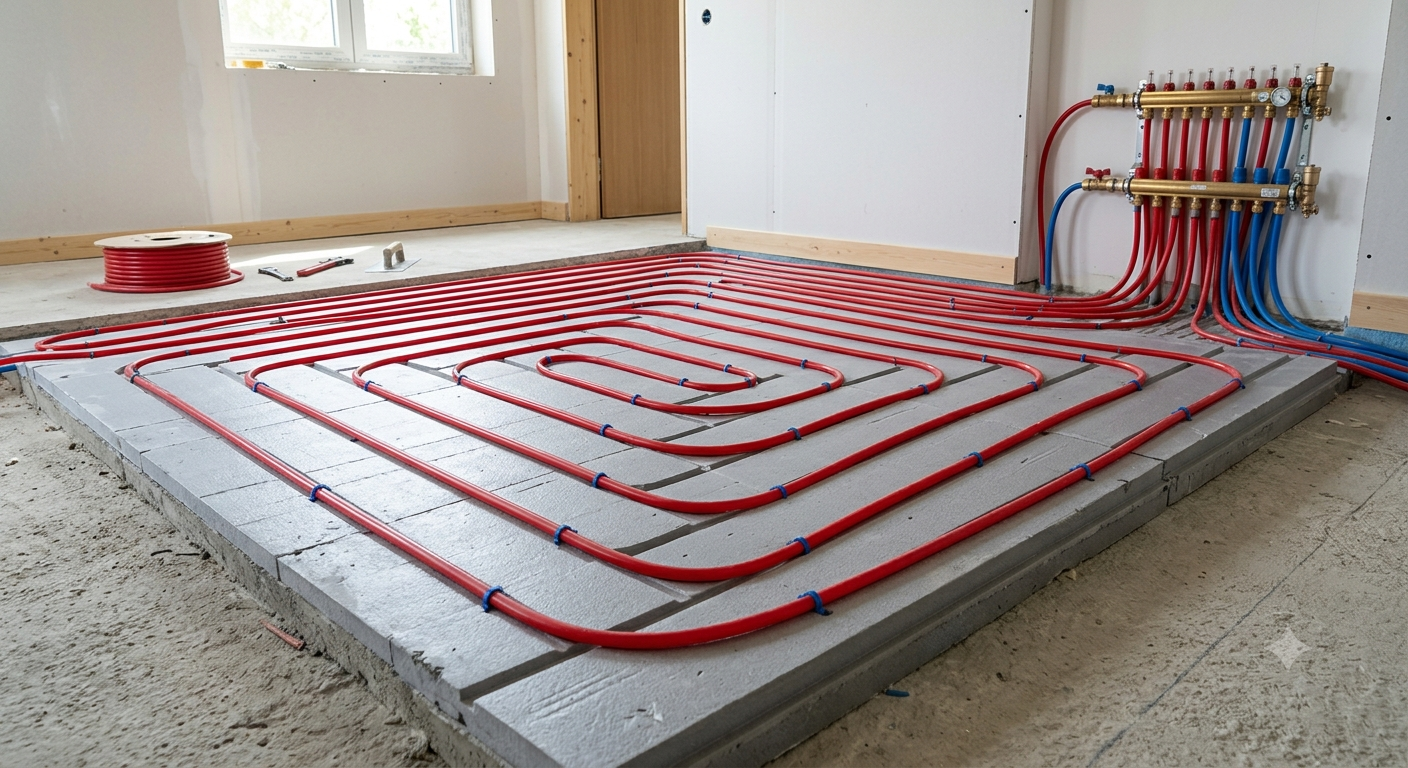
Underfloor heating is a radiant heating technology that provides indoor warmth through heating components installed below or within the floor structure. Instead of depending primarily on wall mounted radiators or forced air systems, underfloor heating distributes thermal energy across a larger floor surface.
The two major types are hydronic underfloor heating and electric underfloor heating.
Hydronic systems use pipes through which warm water circulates. These systems can be connected to boilers, heat pumps, and other heating sources. They are particularly suitable for larger residential and commercial buildings where centralized heating is required.
Electric underfloor heating uses heating cables, mats, or related electrical elements. These systems can be useful for targeted applications and renovation projects because they can be installed in specific rooms or floor areas.
Modern underfloor heating solutions can also include thermostats, sensors, manifolds, valves, actuators, wiring centers, and connected control systems.
Why Is the Underfloor Heating Market Growing?
The growth of the underfloor heating market is closely connected with the transition toward energy efficient buildings and low temperature heating technologies. Building owners and developers are increasingly looking for heating systems that can operate effectively with modern HVAC infrastructure and renewable energy technologies.
One important growth driver is the increasing adoption of heat pumps. Heat pumps generally operate effectively with lower temperature heating systems, making hydronic underfloor heating a suitable technology for buildings using air to water or other heat pump configurations.
Smart home adoption is another important factor. Connected thermostats and sensors enable users to control temperature by room or zone, automate heating schedules, and monitor heating performance. IoT enabled controls can also support more efficient operation by adjusting heating according to occupancy, schedules, and temperature conditions.
Building decarbonization initiatives are also influencing heating technology selection. Governments, building owners, and developers are increasingly focused on reducing energy consumption and emissions from buildings. Underfloor heating can support these objectives when combined with efficient heat sources and suitable building insulation.
Renovation and retrofit activity represents another opportunity. Existing buildings often require upgrades to improve energy performance and indoor comfort. Low profile underfloor heating products and retrofit solutions can make installation more practical in selected renovation projects.
Download PDF brochure https://www.marketsandmarkets.com/pdfdownloadNew.asp?id=167464533
Key Growth Drivers in the Underfloor Heating Market
Increasing Demand for Energy Efficient Heating
Energy efficiency is one of the primary factors supporting demand for underfloor heating. Radiant floor systems can provide consistent heat distribution across a room while operating with lower water temperatures in suitable hydronic configurations. This makes them attractive for buildings designed around modern energy efficiency requirements.
Rising Adoption of Heat Pumps
The increasing deployment of heat pumps is creating opportunities for low temperature heating technologies. Hydronic underfloor heating can work alongside heat pump systems, allowing buildings to use a large radiant surface for indoor temperature management.
Growth of Smart Home Technology
Smart thermostats, sensors, connected controllers, and building automation platforms are changing how heating systems are managed. Underfloor heating can be divided into multiple zones, allowing different rooms to maintain different temperature settings.
Stricter Building Energy Standards
Energy efficiency standards and decarbonization targets are encouraging developers to consider heating technologies that support lower energy consumption and improved building performance. This trend is particularly relevant in regions where energy performance requirements are becoming more stringent.
Increasing Renovation and Retrofit Activity
Older buildings often require modernization of their heating infrastructure. Retrofit friendly underfloor heating products, including low profile systems and electric mats, can provide solutions for selected renovation applications.
Hydronic Underfloor Heating Is a Major Market Segment
Hydronic underfloor heating is expected to maintain a leading position in the global market during the forecast period. The system uses a network of pipes installed beneath the floor through which heated water circulates.
Hydronic systems are particularly suitable for large residential properties, commercial buildings, healthcare facilities, and other applications requiring centralized temperature management. Their compatibility with heat pumps is also contributing to their relevance in energy efficient building projects.
MarketsandMarkets identifies hydronic underfloor heating as the dominant product type during the 2026 to 2032 forecast period.
The system typically includes components such as heating pipes, manifolds, valves, thermal actuators, thermostats, sensors, and controllers. Proper hydraulic balancing is important because it helps distribute heating output across different circuits.
Smart Underfloor Heating and IoT Integration
Smart technology is becoming increasingly important in the underfloor heating market. Connected thermostats and sensors allow users to monitor and adjust heating conditions through digital interfaces.
IoT integration can support multi zone temperature control. A residential property, for example, can have separate heating schedules for bedrooms, living areas, bathrooms, and other spaces. Commercial buildings can similarly manage heating according to occupancy patterns and operational schedules.
Smart systems can also integrate with broader home automation platforms. This creates opportunities for automated heating control based on temperature, occupancy, time, and other building conditions.
MarketsandMarkets identifies IoT based smart thermostats and home automation as an important opportunity for the underfloor heating industry.
Underfloor Heating Market by Installation Type
The market is divided into new installations and retrofit installations.
New installations represented 72.5% of the market in 2025, according to MarketsandMarkets. New construction provides greater flexibility because heating pipes, electrical components, insulation, floor structures, and control systems can be incorporated into the building design from the beginning.
Retrofit installations are also gaining attention as building owners modernize existing properties. However, retrofit projects can involve technical challenges such as floor height limitations, structural restrictions, door modifications, and compatibility with existing flooring materials.
Low profile and dry installation systems can help address some of these challenges.
Residential Applications Are Creating Growth Opportunities
Residential buildings represent an important application area for underfloor heating. Homeowners are increasingly interested in comfortable indoor temperatures, smart climate control, energy efficiency, and modern heating technologies.
Underfloor heating is particularly relevant to new homes and high efficiency residential developments. It can also be installed in specific areas such as bathrooms, kitchens, living rooms, and bedrooms.
The residential segment is expected to register the highest CAGR in the underfloor heating market between 2026 and 2032, according to MarketsandMarkets.
Commercial applications are also significant. Offices, hotels, healthcare facilities, educational buildings, and other commercial properties can use zoned radiant heating systems to manage indoor temperatures across different spaces.
Regional Outlook for the Underfloor Heating Market
Europe is an important regional market for underfloor heating. MarketsandMarkets expects Europe to register a 7.8% CAGR during the forecast period from 2026 to 2032. The region's focus on building energy efficiency, heating modernization, and decarbonization supports demand for advanced heating technologies.
North America is also adopting underfloor heating across residential and commercial applications, particularly where energy efficient building systems and smart home technologies are being deployed.
Asia Pacific offers opportunities associated with urbanization, new construction, increasing building standards, and the modernization of HVAC infrastructure. Demand patterns vary across countries because of differences in climate, construction practices, energy costs, and heating requirements.
Major Companies in the Underfloor Heating Market
The competitive landscape includes established heating, HVAC, controls, and building technology companies. MarketsandMarkets identifies Uponor Corporation, Danfoss, REHAU, Resideo Technologies, and Watts among the key companies operating in the global underfloor heating market.
These companies are developing products and solutions covering hydronic heating, manifolds, thermostats, controllers, pipes, actuators, smart controls, and related infrastructure.
The market also includes specialized companies focusing on electric heating systems, retrofit solutions, installation technologies, smart controls, and application specific products.
Challenges in the Underfloor Heating Market
Despite its growth potential, underfloor heating faces several challenges. High initial installation costs can restrict adoption, especially in cost sensitive construction projects. Hydronic systems can require specialized installation, floor preparation, piping, manifolds, controls, and commissioning.
Retrofit installation can be particularly challenging in older buildings. Changes to floor height, structural conditions, existing heating infrastructure, and flooring materials can increase project complexity.
Another consideration is thermal response time. Underfloor heating can respond more slowly than some conventional heating technologies because heat is distributed through the floor structure. Proper system design and smart controls can help manage this characteristic.
Future Trends in the Underfloor Heating Market
The future of the underfloor heating market is increasingly connected to smart buildings, renewable energy, heat pumps, and building automation.
Heat pump integration is likely to remain an important technology trend as building owners seek lower temperature heating solutions. Smart thermostats and connected sensors will also support more precise zone control.
Another emerging trend is the development of retrofit friendly products. Low profile panels, dry installation systems, improved heating mats, and flexible installation approaches can help expand the technology into existing buildings.
Predictive maintenance and intelligent control could also become more important as connected heating systems generate operational data. Building owners may increasingly use digital platforms to monitor system performance and identify potential issues.
Underfloor Heating Market Outlook to 2032
The global underfloor heating market is positioned for continued expansion as buildings move toward energy efficient heating, smart climate management, and low temperature HVAC systems.
MarketsandMarkets forecasts the market to reach USD 9.26 billion by 2032 from USD 6.13 billion in 2026, representing a CAGR of 7.1%. Hydronic systems are expected to remain a leading product segment, while residential applications and smart heating technologies create additional growth opportunities.
The combination of heat pumps, IoT enabled thermostats, building automation, energy efficiency requirements, and renovation activity is expected to influence the next phase of industry development.
Frequently Asked Questions About the Underfloor Heating Market
What is the size of the underfloor heating market?
The global underfloor heating market is projected to reach USD 9.26 billion by 2032, increasing from USD 6.13 billion in 2026, according to MarketsandMarkets.
What is the CAGR of the underfloor heating market?
The global underfloor heating market is projected to grow at a 7.1% CAGR from 2026 to 2032.
What are the main types of underfloor heating?
The two major types are hydronic underfloor heating and electric underfloor heating. Hydronic systems circulate heated water through pipes, while electric systems use heating cables or mats.
Which type of underfloor heating dominates the market?
Hydronic underfloor heating is expected to dominate the market between 2026 and 2032.
What are the main drivers of the underfloor heating market?
Major drivers include demand for energy efficient heating, heat pump adoption, smart home technology, stringent building energy standards, decarbonization initiatives, and renovation activity.
Which application is expected to grow fastest?
The residential application segment is expected to register the highest CAGR from 2026 to 2032, according to MarketsandMarkets.
Which region is growing rapidly in the underfloor heating market?
Europe is expected to register a 7.8% CAGR during the forecast period from 2026 to 2032.
What are the major components used in underfloor heating systems?
Major components include heating pipes, manifolds, valves, thermal actuators, heating cables, mats, thermostats, sensors, and wiring centers.
Can underfloor heating work with heat pumps?
Yes. Hydronic underfloor heating can be integrated with heat pump systems and is particularly suitable for low temperature heating applications.
What are the major challenges in the underfloor heating market?
High initial installation costs, longer thermal response times, retrofit complexity, floor structure limitations, and compatibility with different flooring materials are among the major challenges.
Conclusion
Underfloor heating is evolving from a specialized comfort technology into an important component of modern energy efficient building systems. The combination of hydronic heating, heat pumps, smart thermostats, IoT connectivity, and building automation is creating new opportunities across residential and commercial applications.
With the global market projected to reach USD 9.26 billion by 2032, the industry is expected to benefit from continued investment in energy efficient construction, building renovation, smart home infrastructure, and decarbonization. The ability to integrate heating systems with connected controls and renewable energy technologies will remain an important factor shaping the future of the underfloor heating market.
80% of the Forbes Global 2000 B2B companies rely on MarketsandMarkets to identify growth opportunities in emerging technologies and use cases that will have a positive revenue impact.
- Food Packaging Market Size Set for Strong Growth Through 2030 Amid Rising Demand for Convenience Foods
- Crop Protection Chemical Market Size, Share & Growth Forecast (2025–2030)
- Mulch Films Market: Driving Sustainable Agriculture Through Innovation
- Agricultural Adjuvants Market Analysis, Trends, and Growth Outlook (2026–2031)
- Japan Enterprise Asset Management Market Growth: AI and Smart Infrastructure Drive Demand

