
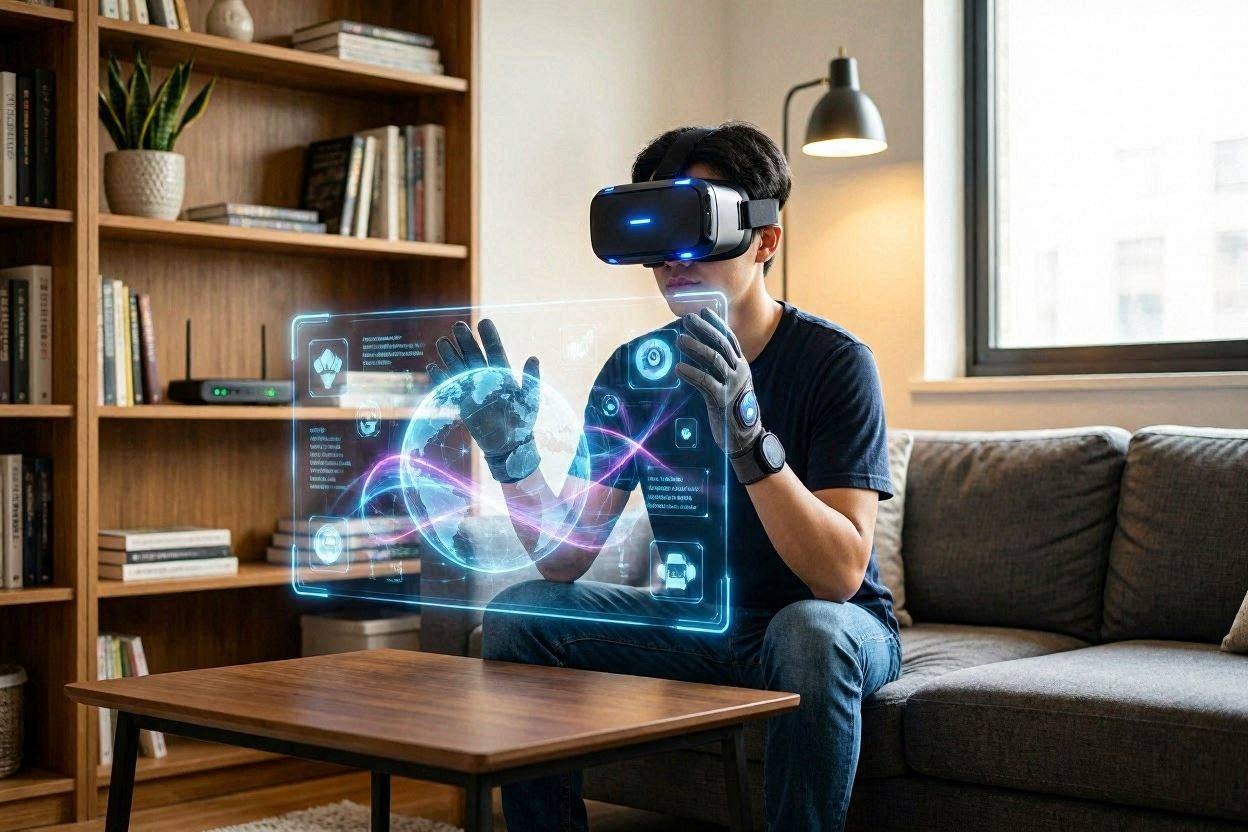
Virtual Reality Innovation: Key Trends, Growth Drivers and Opportunities
Introduction to Virtual Reality Innovation
Virtual Reality (VR) innovation is fundamentally reshaping how industries operate by creating immersive digital environments that simulate physical presence in real or imagined worlds. By combining advanced head-mounted displays, motion tracking systems, haptic feedback, spatial audio, and real-time rendering engines, VR technology transports users into fully interactive three-dimensional spaces . Unlike traditional screen-based media, virtual reality systems create a profound sense of presence by responding naturally to user movements and actions, enabling organizations to revolutionize training, design, healthcare, entertainment, and collaboration. As governments and enterprises prioritize digital transformation and remote capabilities, VR has emerged as a cornerstone technology for the metaverse and next-generation computing platforms .
Evolution of Virtual Reality
The journey of virtual reality began decades ago with early flight simulators and academic research, but accelerated dramatically with consumer-grade headsets entering the mainstream in the 2010s. Initially positioned as a niche gaming accessory, VR rapidly expanded beyond entertainment as hardware costs declined and technological capabilities improved . Early systems required expensive PCs and external sensors, but standalone headsets with integrated processing and inside-out tracking transformed accessibility. The emergence of platforms like Oculus Quest, PlayStation VR, and HTC Vive established VR as a viable consumer and enterprise technology. Today, AI-powered content creation, 5G connectivity, cloud rendering, and advanced haptics are enabling unprecedented levels of immersion and interactivity across residential, commercial, and industrial environments .
Benefits of Virtual Reality
Virtual reality delivers measurable value across multiple sectors by improving training outcomes, reducing operational costs, and enhancing user engagement. Key benefits include:
- Immersive training simulations that reduce workplace accidents and accelerate skill development .
- Remote collaboration and virtual meetings that eliminate travel costs and enable global teamwork .
- Enhanced product design and prototyping through interactive 3D visualization .
- Improved patient outcomes through surgical planning, therapy, and rehabilitation applications .
- Engaging entertainment experiences that offer unmatched levels of interactivity and presence .
Current Market Size and Growth Trends
According to MarketsandMarkets, the global Virtual Reality market was valued at USD 15.9 billion in 2024 and is projected to grow from USD 20.48 billion in 2025 to USD 38.0 billion by 2029, registering a compound annual growth rate (CAGR) of 19.1% during the forecast period . Market expansion is driven by increasing adoption of VR in healthcare, gaming, and entertainment sectors, continuous technological advancements in motion tracking and haptic technology, and rising investments in metaverse infrastructure . The hardware segment, particularly head-mounted displays, dominates current revenue, while software is expected to grow at the highest CAGR as content ecosystems and enterprise applications expand . Asia Pacific is projected to witness the fastest growth at 28.1% CAGR, fueled by technological advancements in education, healthcare, and gaming across the region .
Download PDF Brochure @ https://www.marketsandmarkets.com/pdfdownloadNew.asp?id=458
Key Drivers
Major growth drivers include the expanding penetration of the metaverse, rapid digital technology adoption in healthcare and gaming, potential for transformative change across numerous industries, significant adoption of head-mounted displays, and emergence of virtual classrooms offering immersive learning experiences . The growing demand for live virtual entertainment, including VR concerts and events, is further propelling consumer adoption . Organizations across manufacturing, retail, automotive, and defense sectors are leveraging VR for workforce training, remote audits, design simulations, and marketing visualization, substantially expanding the addressable market .
Emerging Trends
Human-centric lighting, Li-Fi communication, edge AI, wireless lighting controls, digital twins, predictive maintenance, and cloud-based lighting management are shaping the future. Advanced analytics enable real-time optimization while cybersecurity improvements strengthen connected lighting networks.
Key trends shaping VR innovation include integration of generative AI for automated content creation, real-time cloud rendering and edge computing, advanced haptic feedback and gesture tracking, photorealistic avatars with facial expression capture, enterprise metaverse applications, spatial computing with 6DoF tracking, and convergence with 5G and high-speed networking . The emergence of virtual classrooms and telemedicine applications is opening new avenues for market expansion .
Opportunities and Challenges
Smart lighting presents strong opportunities in commercial buildings, infrastructure modernization, industrial automation, and residential smart homes. Challenges include high initial investment, interoperability issues, cybersecurity risks, and integration with legacy infrastructure. Continued standardization and declining hardware costs are expected to improve adoption.
VR presents substantial opportunities in healthcare for surgical training and patient therapy, enterprise training and simulation, education through immersive learning, retail virtual showrooms, and real estate virtual property tours . However, challenges persist including latency issues and high energy consumption, health concerns from prolonged use (motion sickness, eye strain), creating user-friendly interfaces, display latency and limited field of view, and developing compelling content ecosystems that drive sustained engagement .
Innovations and Advancements
Manufacturers are introducing AI-powered VR controllers, advanced motion tracking, mixed reality passthrough, wireless streaming, eye-tracking with foveated rendering, and haptic gloves for realistic touch feedback . These innovations improve user immersion while enabling enterprise applications such as remote expert guidance, virtual prototyping, and immersive collaboration. Continuous developments in 5G technology are paving the way for optimized distribution of processing capabilities, enabling real-time cloud rendering and edge computing that reduce latency and improve device efficiency .
Future Applications
Virtual reality will expand across healthcare facilities for surgical planning and patient therapy, educational institutions for immersive learning, manufacturing plants for workforce training, retail stores for virtual shopping, real estate for property viewing, transportation hubs for simulation, and residential communities for entertainment and social interaction . Integration with AI, cloud computing, blockchain for digital asset ownership, and building automation systems will further enhance value . The convergence of VR with the metaverse is expected to revolutionize social interaction, media consumption, education, work, and business through immersive experiences .
Virtual reality innovation is redefining how organizations train employees, design products, collaborate globally, and engage with customers. Intelligent VR systems support operational efficiency, enhanced learning outcomes, and immersive user experiences. With strong investment in digital infrastructure and increasing demand for immersive technologies, the industry is expected to maintain robust growth throughout the forecast period. As VR technology continues to evolve, its potential to redefine user experiences and operational efficiencies across sectors remains immense, promising a dynamic future for the VR market landscape .
Download Sample Research Report for Virtual Reality Market Future: https://www.marketsandmarkets.com/Market-Reports/reality-applications-market-458.html
80% of the Forbes Global 2000 B2B companies rely on MarketsandMarkets to identify growth opportunities in emerging technologies and use cases that will have a positive revenue impact.
- Food Packaging Market Size Set for Strong Growth Through 2030 Amid Rising Demand for Convenience Foods
- Crop Protection Chemical Market Size, Share & Growth Forecast (2025–2030)
- Mulch Films Market: Driving Sustainable Agriculture Through Innovation
- Agricultural Adjuvants Market Analysis, Trends, and Growth Outlook (2026–2031)
- Japan Enterprise Asset Management Market Growth: AI and Smart Infrastructure Drive Demand

