

Electronic Warfare Market: From Platform-Level Jamming to AI-Enabled Spectrum Dominance
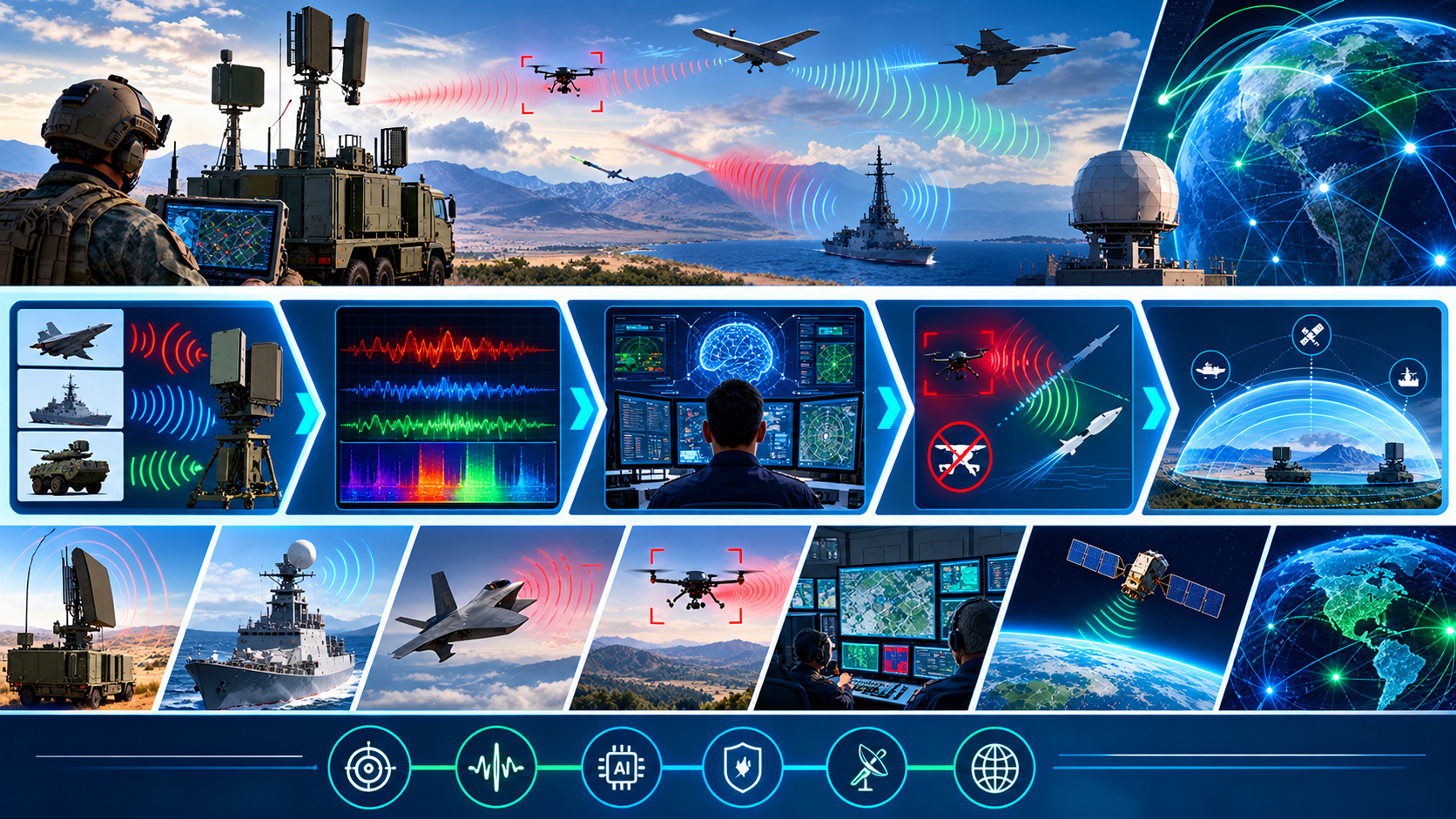
Recent developments, technology trends, and product decision implications
The Electronic Warfare Market is entering a new phase as defense forces move from platform-level jamming and signal detection toward integrated, software-defined, and AI-enabled electromagnetic spectrum operations. Electronic warfare is no longer a specialist capability deployed only on select aircraft, naval vessels, or ground platforms. It is becoming a core operational layer across air, land, naval, space, cyber, unmanned systems, counter-drone missions, integrated air defense, and multi-domain operations.
The market is being shaped by the growing dependence of modern warfare on radar, communications, navigation, datalinks, satellites, targeting systems, and networked weapons. If military forces cannot detect, protect, deceive, or disrupt signals, they lose speed, situational awareness, targeting effectiveness, and command-and-control reliability. This makes EW central to future force survivability and operational advantage.
The market is therefore shifting from the question “Which EW suite should we install on a platform?” to “How should electronic support, electronic attack, electronic protection, AI analytics, software-defined upgrades, and spectrum operations work together across the force?”
MarketsandMarkets Market Sizing & Forecast
According to MarketsandMarkets, the global Electronic Warfare Market is estimated at USD 32.35 billion in 2026 and is projected to reach USD 64.66 billion by 2031, growing at a CAGR of 14.9% during the forecast period. MarketsandMarkets identifies the market by offerings such as receivers, jammers, anti-jam systems, EW suites, and software; by capability across electronic support, electronic attack, and electronic protection; and by platform and region.
This market trajectory provides a strong quantitative basis for assessing product attractiveness and prioritizing investment across EW technologies. The forecast indicates a rapidly expanding addressable market in which suppliers can pursue growth through signal intelligence, RF sensing, jamming, anti-jam systems, electronic protection, cognitive EW, spectrum analytics, software-defined EW, counter-drone EW, and platform-integrated EW suites.
Key Trends Shaping the Electronic Warfare Market
1. Shift Toward AI-Enabled and Cognitive EW
The market is moving from manually configured EW systems toward AI-enabled and cognitive EW architectures. Traditional EW systems often rely on known signal libraries and preconfigured responses. Future EW systems need to detect unfamiliar emitters, classify signals faster, recommend responses, and adapt to changing electromagnetic environments.
AI can support signal classification, emitter identification, pattern recognition, jamming optimization, anomaly detection, and operator decision support. This creates opportunities for software firms, AI analytics providers, signal-processing companies, and defense primes developing next-generation EW systems.
2. Counter-Drone EW Becoming a High-Urgency Sub-Market
Drone warfare has made electronic warfare more urgent. Many drones depend on RF control links, GNSS navigation, video transmission, or datalinks that can be disrupted or exploited. This makes RF jamming, GNSS denial, spoofing, signal detection, and electronic attack critical layers in counter-drone architectures.
Counter-drone EW is especially attractive because it sits at the intersection of the Electronic Warfare Market and the Counter-UAS Market. Buyers increasingly want EW systems that can work with radar, EO/IR, RF detection, C2 software, directed energy, and kinetic interceptors to defeat drones at scale.
3. Electronic Protection and Anti-Jam Systems Moving Up the Priority List
As adversaries invest in jamming and electronic attack, electronic protection is becoming as important as offensive EW. Militaries need resilient communications, protected navigation, anti-jam datalinks, frequency agility, low-probability-of-intercept waveforms, and spectrum-aware networking.
This creates opportunities in anti-jam systems, protected communications, resilient positioning/navigation/timing, software-defined radios, adaptive waveforms, and electronic protection upgrades for aircraft, ships, vehicles, satellites, UAVs, and command networks.
4. Software-Defined EW Creating Upgrade-Led Revenue
The market is shifting from hardware replacement cycles toward software-defined EW upgrades. Software-defined systems allow faster threat-library updates, new waveform support, mission-specific configurations, and improved response logic without full hardware replacement.
This is important for suppliers because it creates recurring revenue opportunities around software upgrades, mission data files, signal libraries, training, system integration, sustainment, and lifecycle modernization.
5. EW Becoming Integrated with C2, Cyber, Space, and Unmanned Systems
Electronic warfare is becoming more integrated with command and control, cyber operations, air defense, space systems, and unmanned platforms. EW data can support situational awareness, targeting, intelligence, and decision support, while C2 systems can coordinate electronic attack and electronic protection effects.
This creates opportunities for companies that can integrate EW into broader digital battle networks rather than sell EW as a standalone platform subsystem.
Recent Electronic Warfare Developments
|
Period |
Development |
Market Signal |
|
2026 |
MarketsandMarkets projected the EW market to grow from USD 32.35B in 2026 to USD 64.66B by 2031 |
EW is entering a nearly 2x growth phase |
|
2026 |
Market segmentation includes receivers, jammers, anti-jam systems, EW suites, and software |
Software and anti-jam systems are becoming core offering areas |
|
2026 |
Market drivers include unmanned systems and integration of EW into broader military operations |
EW is becoming central to drones, C-UAS, and multi-domain operations |
|
2026 |
AI, cognitive EW, and spectrum analytics are highlighted as future-facing EW themes |
Decision speed and signal intelligence are becoming differentiators |
|
2026 |
Counter-drone EW demand continues to rise |
RF disruption and GNSS denial are key C-UAS layers |
Product Opportunity Areas
The market is shifting from the question “Which EW equipment should we procure?” to “How should spectrum sensing, jamming, protection, AI analytics, C2 integration, and software upgrades work together to deliver operational advantage?” This creates opportunities across:
- Electronic support systems and RF sensing
- Electronic attack and jamming systems
- Anti-jam systems and electronic protection
- Software-defined EW suites
- AI-enabled spectrum analytics
- Cognitive EW and adaptive response systems
- Counter-drone EW and RF disruption
- GNSS jamming, spoofing, and protection technologies
- EW payloads for UAVs and unmanned systems
- Signal libraries, mission data files, and software updates
- EW integration with C2, cyber, ISR, and air defense systems
- Platform-integrated EW for aircraft, ships, vehicles, satellites, and drones
How the Electronic Warfare Market Report Supports Product Decisions
Product Portfolio Decisions: Identify which EW offerings show the strongest demand across receivers, jammers, anti-jam systems, EW suites, software, counter-drone EW, and platform-integrated systems.
Technology Investment Prioritization: Compare EW technologies by adoption, maturity, procurement activity, operational relevance, software-upgrade potential, competitive intensity, and future growth outlook.
Target Customer Identification: Assess demand across air forces, navies, armies, cyber commands, space commands, drone operators, C-UAS buyers, defense ministries, and system integrators.
Competitive Positioning: Benchmark leading companies across electronic support, electronic attack, electronic protection, AI-enabled EW, signal processing, anti-jam systems, software-defined radios, and EW payloads.
Partnership and M&A Strategy: Map ecosystem gaps and identify complementary partners, for example, RF hardware providers with AI analytics firms, platform OEMs with EW payload suppliers, or C2 companies with spectrum operations software providers.
Program and Procurement Prioritization: Track modernization programs, tenders, trials, electronic protection upgrades, counter-drone EW deployments, and spectrum operations initiatives to distinguish active procurement opportunities from technology hype.
Product Roadmap Development: Translate market direction from standalone jamming toward AI-enabled, software-defined, integrated spectrum operations into future product requirements.
Conclusion
Electronic warfare is evolving from platform-level jamming into a broader mission layer for spectrum dominance. The market is being reshaped by drone warfare, AI-enabled signal processing, contested communications, GPS jamming, electronic protection, software-defined upgrades, and integration with C2, cyber, air defense, space, and unmanned systems.
For technology providers, the opportunity extends beyond EW hardware to software, AI analytics, mission data, signal libraries, counter-drone EW, anti-jam systems, protected communications, and integration services. A detailed Electronic Warfare Market report can help companies determine which EW capability to develop, where to deploy it, which customer segment to target, which programs to track, and which partners or acquisition targets to pursue.
|
Metric |
2026 |
2031 |
2026–2031 CAGR |
|
Global Electronic Warfare Market |
USD 32.35 Billion |
USD 64.66 Billion |
14.9% |
Market sizing source: MarketsandMarkets. Figures are reproduced from MarketsandMarkets published market outlook.
80% of the Forbes Global 2000 B2B companies rely on MarketsandMarkets to identify growth opportunities in emerging technologies and use cases that will have a positive revenue impact.
- Food Packaging Market Size Set for Strong Growth Through 2030 Amid Rising Demand for Convenience Foods
- Crop Protection Chemical Market Size, Share & Growth Forecast (2025–2030)
- Mulch Films Market: Driving Sustainable Agriculture Through Innovation
- Agricultural Adjuvants Market Analysis, Trends, and Growth Outlook (2026–2031)
- Japan Enterprise Asset Management Market Growth: AI and Smart Infrastructure Drive Demand


