

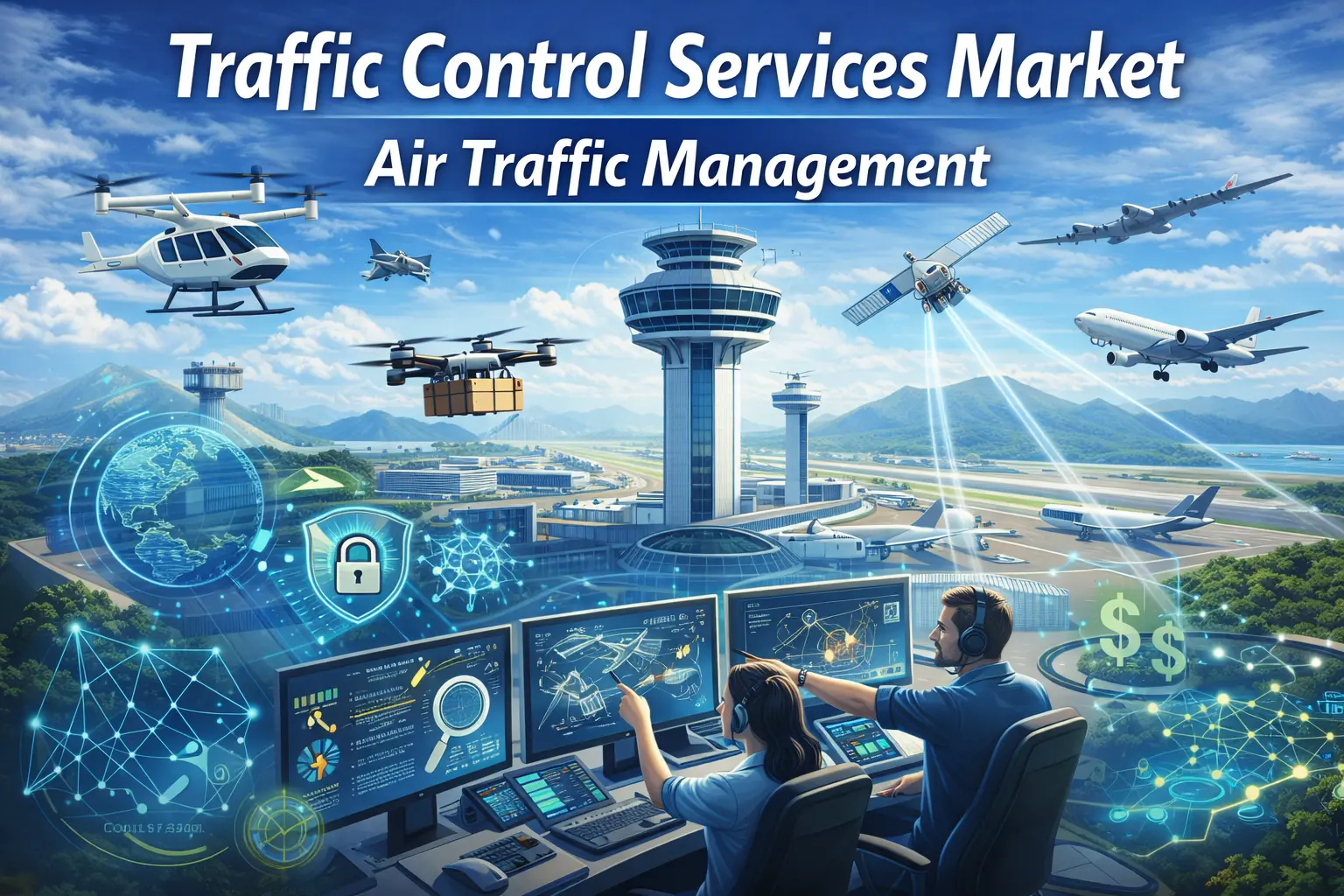
The Traffic Control Services Market for Air Traffic Management (ATM) is entering a transformative phase driven by rising global air passenger traffic, modernization of aviation infrastructure, and rapid technological advancements. As airspace congestion increases and safety regulations become more stringent, the demand for advanced traffic control services is expanding across commercial aviation, defense aviation, and unmanned aerial systems. The market is evolving from traditional radar-based monitoring systems to digital, satellite-enabled, and AI-powered traffic management platforms.
Download PDF Brochure :
https://www.marketsandmarkets.com/pdfdownloadNew.asp?id=160955838
Air traffic management plays a critical role in ensuring safe, orderly, and efficient movement of aircraft within controlled airspace. With increasing flight frequencies across major international hubs, the Traffic Control Services Market is witnessing strong investments from airport authorities, aviation regulators, and private service providers. The growing complexity of airspace, especially with the integration of drones and urban air mobility vehicles, is further accelerating the need for advanced traffic control solutions.
Key Takeaways: Traffic Control Services Market for Air Traffic Management
-
The Traffic Control Services Market is expanding due to rising global air passenger and cargo traffic.
-
Modernization programs are accelerating the shift from legacy radar systems to digital and satellite-based air traffic management platforms.
-
AI and automation are improving real-time decision-making, predictive traffic flow, and operational efficiency.
-
Satellite-based technologies such as ADS-B are enhancing aircraft tracking and expanding coverage in remote regions.
-
Government-led initiatives are playing a critical role in upgrading national airspace infrastructure.
-
Private sector participation and public-private partnerships are increasing innovation and cost efficiency in traffic control services.
-
Expansion of airport infrastructure in emerging economies is creating strong growth opportunities.
-
Integration of drones and urban air mobility vehicles is driving demand for advanced Unmanned Traffic Management (UTM) systems.
-
Cybersecurity and regulatory compliance are becoming top priorities in air traffic management systems.
-
The future of the Traffic Control Services Market will be shaped by automation, digital towers, AI integration, and interconnected global airspace networks.
Rising Global Air Traffic Driving Market Expansion
The steady growth of global passenger and cargo air traffic is a primary driver of the Traffic Control Services Market. According to aviation trends, international travel demand continues to recover and expand, placing pressure on existing air traffic control (ATC) infrastructure. Major aviation hubs in North America, Europe, and Asia-Pacific are upgrading control towers, radar systems, and communication networks to handle increased air traffic volumes.
As airline fleets expand and new routes are introduced, efficient air traffic management becomes critical to avoid delays, congestion, and safety risks. The Traffic Control Services Market is benefiting from government-backed modernization programs aimed at upgrading legacy systems to next-generation airspace management frameworks.
Modernization Initiatives and Digital Transformation
Government aviation authorities worldwide are implementing modernization initiatives to improve airspace efficiency. Programs such as the Next Generation Air Transportation System (NextGen) led by the Federal Aviation Administration and the Single European Sky ATM Research (SESAR) initiative under the European Union Aviation Safety Agency are transforming traditional traffic control systems into digital, performance-based networks.
These initiatives focus on satellite-based navigation, real-time data exchange, advanced automation, and predictive analytics. The Traffic Control Services Market is increasingly shifting toward data-driven decision-making platforms that enhance situational awareness and reduce operational bottlenecks. Digital towers and remote tower services are also emerging as cost-effective solutions for regional airports.
Integration of AI and Automation in Air Traffic Management
Artificial intelligence and automation are reshaping the Traffic Control Services Market. AI-driven systems can analyze vast volumes of flight data, weather patterns, and aircraft performance metrics in real time. This enables predictive traffic flow management and optimized routing, minimizing fuel consumption and delays.
Automation tools assist air traffic controllers by reducing manual workload and improving operational accuracy. Advanced decision-support systems enhance safety by identifying potential conflicts before they occur. As automation becomes more reliable, the Traffic Control Services Market is expected to witness increased adoption of AI-powered platforms across both civilian and military aviation sectors.
Satellite-Based Navigation and Surveillance Systems
The transition from ground-based radar to satellite-based surveillance is a major trend in the Traffic Control Services Market. Automatic Dependent Surveillance–Broadcast (ADS-B) technology enables precise aircraft tracking using satellite signals, improving coverage even in remote or oceanic regions.
Satellite-enabled systems enhance efficiency, reduce separation distances between aircraft, and improve overall airspace capacity. Countries investing in advanced navigation infrastructure are gaining operational advantages in managing crowded skies. The integration of satellite communication systems is therefore becoming a strategic priority within the Traffic Control Services Market.
Growing Role of Private Sector Participation
Traditionally, air traffic control services have been managed by government agencies. However, the Traffic Control Services Market is gradually witnessing private sector participation through outsourcing models, public-private partnerships, and managed service contracts.
Private technology providers are offering integrated ATM solutions, including communication, navigation, and surveillance (CNS) systems. This shift enables faster innovation cycles and reduces financial burdens on public aviation authorities. As operational efficiency and cost optimization become central objectives, private participation in the Traffic Control Services Market is expected to expand further.
Expansion of Airport Infrastructure
The construction of new airports and the expansion of existing facilities are contributing significantly to the growth of the Traffic Control Services Market. Emerging economies in Asia-Pacific and the Middle East are investing heavily in aviation infrastructure to support tourism and trade.
New control towers, radar installations, and digital communication networks are being deployed to ensure seamless airspace management. Airport modernization projects often include integrated traffic management platforms that connect ground operations with airborne systems. As airport capacity increases globally, the Traffic Control Services Market will experience sustained demand.
Unmanned Aerial Systems and Urban Air Mobility
The integration of drones and electric vertical take-off and landing eVTOL aircraft is introducing new challenges and opportunities for the Traffic Control Services Market. Managing low-altitude airspace for unmanned aerial systems requires advanced traffic coordination platforms.
Unmanned Traffic Management (UTM) systems are being developed to ensure safe coexistence between traditional aircraft and drones. The emergence of urban air mobility solutions further complicates airspace management, requiring real-time data sharing and automated separation protocols. As drone deliveries and air taxis gain momentum, the Traffic Control Services Market will expand to accommodate next-generation airspace users.
Regional Market Outlook
North America holds a dominant position in the Traffic Control Services Market due to strong aviation infrastructure, technological leadership, and early adoption of modernization programs. The presence of major aviation authorities and advanced research initiatives supports regional growth.
Europe is advancing through collaborative airspace management reforms, while Asia-Pacific is emerging as a high-growth region due to expanding passenger traffic and airport construction projects. Countries such as China and India are investing significantly in aviation modernization to manage rapidly growing air traffic volumes.
The Middle East is also becoming a strategic aviation hub, with major international airports enhancing their traffic control capabilities to manage transit traffic effectively.
Safety Regulations and Compliance Standards
Safety remains the cornerstone of the Traffic Control Services Market. International aviation standards set by global regulatory bodies require continuous upgrades and compliance monitoring. Advanced monitoring systems, redundancy mechanisms, and cybersecurity protocols are being implemented to safeguard communication networks.
As cyber threats increase, protecting air traffic management systems from digital vulnerabilities becomes essential. The Traffic Control Services Market is therefore incorporating robust cybersecurity frameworks to ensure uninterrupted and secure operations.
Challenges in the Traffic Control Services Market
Despite strong growth prospects, the Traffic Control Services Market faces several challenges. High capital expenditure for infrastructure upgrades, lengthy regulatory approvals, and the need for skilled air traffic controllers may limit short-term expansion.
Integration of legacy systems with modern digital platforms can also create operational complexities. Additionally, global economic uncertainties and fluctuating airline profitability may impact investment timelines. However, long-term demand for safe and efficient airspace management remains strong.
Future Outlook of the Traffic Control Services Market
The future of the Traffic Control Services Market will be shaped by digital transformation, AI integration, and satellite-enabled technologies. By 2035, air traffic management systems are expected to become more autonomous, predictive, and interconnected. Real-time data analytics will optimize traffic flow, reduce emissions, and enhance passenger experience.
As aviation ecosystems evolve to include drones, eVTOL aircraft, and hybrid-electric planes, traffic control services will play a critical role in maintaining safety and efficiency. Continuous collaboration between regulators, technology providers, and airport operators will drive innovation and standardization.
In conclusion, the Traffic Control Services Market for Air Traffic Management is positioned for long-term growth supported by modernization initiatives, increasing global air traffic, and rapid technological advancements. The integration of AI, automation, and satellite-based systems will redefine how airspace is managed, ensuring safer and more efficient skies in the decades ahead.

