

ZeroGPT and the Future of AI Detection: Safeguarding Authenticity in the Era of Synthetic Media
The AI detector market is rapidly evolving into a critical infrastructure layer for digital trust, providing software and platform capabilities that can identify and analyze AI-generated or AI-manipulated text, images, audio, and video in real time and at scale. These systems combine probabilistic classification, forensic artifact analysis, audio liveness and cloning detection, and provenance verification to assess content authenticity. Deployed across diverse domains from content platforms and enterprise trust-and-safety operations to KYC workflows, ad verification, and public-sector information defense AI detectors are becoming embedded, API-first services. Their accuracy continues to improve through multi-modal fusion, ensemble modeling, adversarial training, and continuous evaluation against new model families.
Commercial differentiation now depends on robustness under compression and re-encoding, low-latency performance, explainability, operator tooling, and seamless policy integration for automated or human-in-the-loop moderation. The market’s strongest catalyst is the shift from isolated misuse to persistent, industrial-scale adversarial campaigns that weaponize synthetic media for fraud, misinformation, and impersonation. As attackers innovate rapidly using accessible AI models and cloning tools, enterprises are increasingly treating detection as a high-availability control, governed by risk, security, and compliance teams—rather than experimental research.
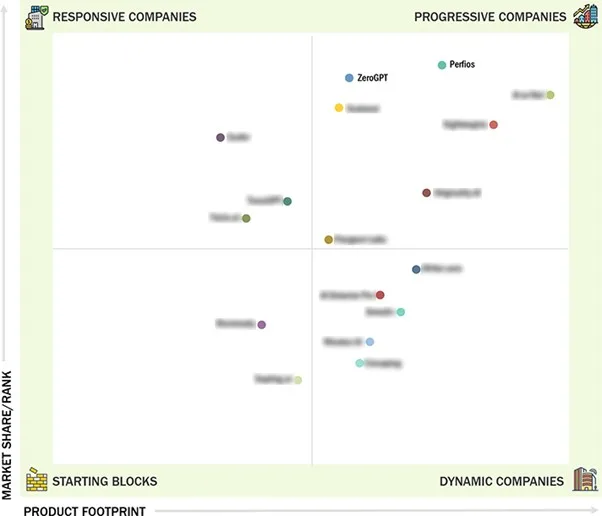
360Quadrants, powered by MarketsandMarketsTM, evaluated several startups in their ‘AI Detector Startups/SMEs Companies Assessment Report, 2025’. The evaluation covered over 170 companies, with the top 17 categorized and recognized as quadrant leaders. Factors such as revenue, geographic presence, growth strategies, investments, demand channels, and sales strategies were analyzed to determine each company’s position in the quadrant.
The main criteria for assessing product footprint included Offering (Platforms, API/SDKs), Detection Modality (AI-generated Text, AI-generated Image & Video, AI-generated Audio & Voice, AI-generated Code, Multimodal), Application (Academic Integrity, Content Authenticity Assessment, Plagiarism Detection, Deepfake and Synthetic Media Detection, Code Authenticity Checking, Misinformation and Disinformation Detection) and End User (BFSI, Healthcare & Life Sciences, Media & Entertainment, Education, Legal, Software & Technology Providers, Government & Défense, Consumers).
ZeroGPT is an online AI content detection tool designed to distinguish between text written by humans and that generated by AI models, such as ChatGPT, GPT-4, Google Gemini, and Claude. It supports multilingual detection and real-time feedback via a simple interface where users paste text and receive an ‘AI vs Human Written’ score. The company behind ZeroGPT positions it as free to use, and strong claims of high accuracy (over 98%) based on extensive training on AI and human-written text. However, user reviews and independent evaluations have raised concerns about its reliability, with multiple reports of high false-positive (human work incorrectly flagged as AI-written) and false negatives, which suggest caution in critical settings, such as academic integrity.
ZeroGPT's strategic approach can be better understood from the following fundamental pillars:
- Algorithmic Agility and Continuous Model Evolution
ZeroGPT prioritizes frequent algorithmic updates to keep pace with rapidly advancing large language models such as GPT-4, Gemini, and Claude. This adaptive learning ensures its detection engine remains resilient against new model architectures and adversarial text-generation tactics.
- Accessibility and Broad User Adoption
The platform’s web-based, free-to-use model focuses on simplicity and global accessibility. By lowering technical and financial barriers, ZeroGPT captures a wide user base, including educators, students, freelancers, and small enterprises, who are concerned with content authenticity.
- Transparency and Explainable Detection
ZeroGPT differentiates itself by offering probabilistic scoring and sentence-level highlighting, helping users understand why text may be AI-generated. This explainability builds user confidence and supports academic and compliance use cases where justification is essential.
- Scalability through API and Integration
Beyond its web tool, ZeroGPT is expanding its API-based detection services to integrate with LMS platforms, publishing systems, HR screening tools, and enterprise content pipelines. This enables real-time, automated verification at high throughput.
- Trust, Ethics, and Academic Integrity Focus
ZeroGPT’s early adoption within education and professional ethics spaces reflects its strategic emphasis on maintaining originality, preventing plagiarism, and supporting transparent AI usage policies.
- Brand Recognition and Market Positioning
As one of the earliest and most recognized AI text detection brands, ZeroGPT leverages its name familiarity and market presence to establish itself as a trusted solution in a rapidly growing and competitive AI detector ecosystem.
AI detector systems, such as ZeroGPT, are fast becoming necessary to mitigate the proliferation of AI-generated content. While they serve as deterrents to misuse and help preserve trust in contexts where original human work matters most, the technology is still evolving and faces significant limitations. And though players like ZeroGPT are trying to innovate and upgrade their products to address these limitations, the way ahead is challenging as they find themselves in a race to stay ahead of increasingly innovative and sophisticated language models.
About MarketsandMarkets™
Recognized as one of America's Best Management Consulting Firms by Forbes in their recent report, MarketsandMarkets™ is a blue ocean alternative in growth consulting and program management. It leverages a man-machine offering to drive substantial growth for progressive organizations in the B2B space. With the broadest perspective on emerging technologies, MarketsandMarkets™ excels at co-creating exceptional growth for clients worldwide.
Today, 80% of Fortune 2000 companies rely on MarketsandMarkets™, and 90 of the top 100 companies in each sector trust it to accelerate revenue growth. With a global clientele of over 13,000 organizations, MarketsandMarkets™ helps businesses thrive in a disruptive ecosystem.
The B2B economy is witnessing the emergence of USD 25 trillion in new revenue streams that are replacing existing ones within this decade. MarketsandMarkets™ works with clients on growth programs, helping them monetize this USD 25 trillion opportunity through its service lines—TAM Expansion, Go-to-Market (GTM) Strategy to Execution, Market Share Gain, Account Enablement, and Thought Leadership Marketing.
Built on the 'GIVE Growth' principle, MarketsandMarkets™ collaborates with various Forbes Global 2000 B2B companies to ensure they remain future-ready. The company’s insights and strategies are driven by industry experts, advanced AI, and its proprietary Market Intelligence Cloud, KnowledgeStore™, which integrates research and offers ecosystem-wide visibility into revenue shifts.
To find out more, visit www.MarketsandMarkets™.com or follow us on Twitter , LinkedIn and Facebook .
Contact:
Ms. Sipti Banga,
630 Dundee Road, Suite 430
Northbrook, IL 60062
USA: +1-888-600-6441
Email: [email protected]
80% of the Forbes Global 2000 B2B companies rely on MarketsandMarkets to identify growth opportunities in emerging technologies and use cases that will have a positive revenue impact.
- Food Packaging Market Size Set for Strong Growth Through 2030 Amid Rising Demand for Convenience Foods
- Crop Protection Chemical Market Size, Share & Growth Forecast (2025–2030)
- Mulch Films Market: Driving Sustainable Agriculture Through Innovation
- Agricultural Adjuvants Market Analysis, Trends, and Growth Outlook (2026–2031)
- Japan Enterprise Asset Management Market Growth: AI and Smart Infrastructure Drive Demand

