

How AI-Powered MES is Transforming Smart Factories by 2030
The manufacturing world is undergoing a profound transformation. As industries push toward efficiency, agility, and real-time decision-making, Artificial Intelligence (AI) integrated with Manufacturing Execution Systems (MES) is emerging as a game-changer. By 2030, AI-powered MES will not just support manufacturing operations it will drive autonomous, intelligent, and self-optimizing factories.
Modern smart factories demand more than traditional automation. They require systems that can learn, adapt, and predict outcomes. This is where AI-enabled MES becomes critical, bridging the gap between shop-floor operations and enterprise-level decision-making.
The Evolution of MES in the Era of AI
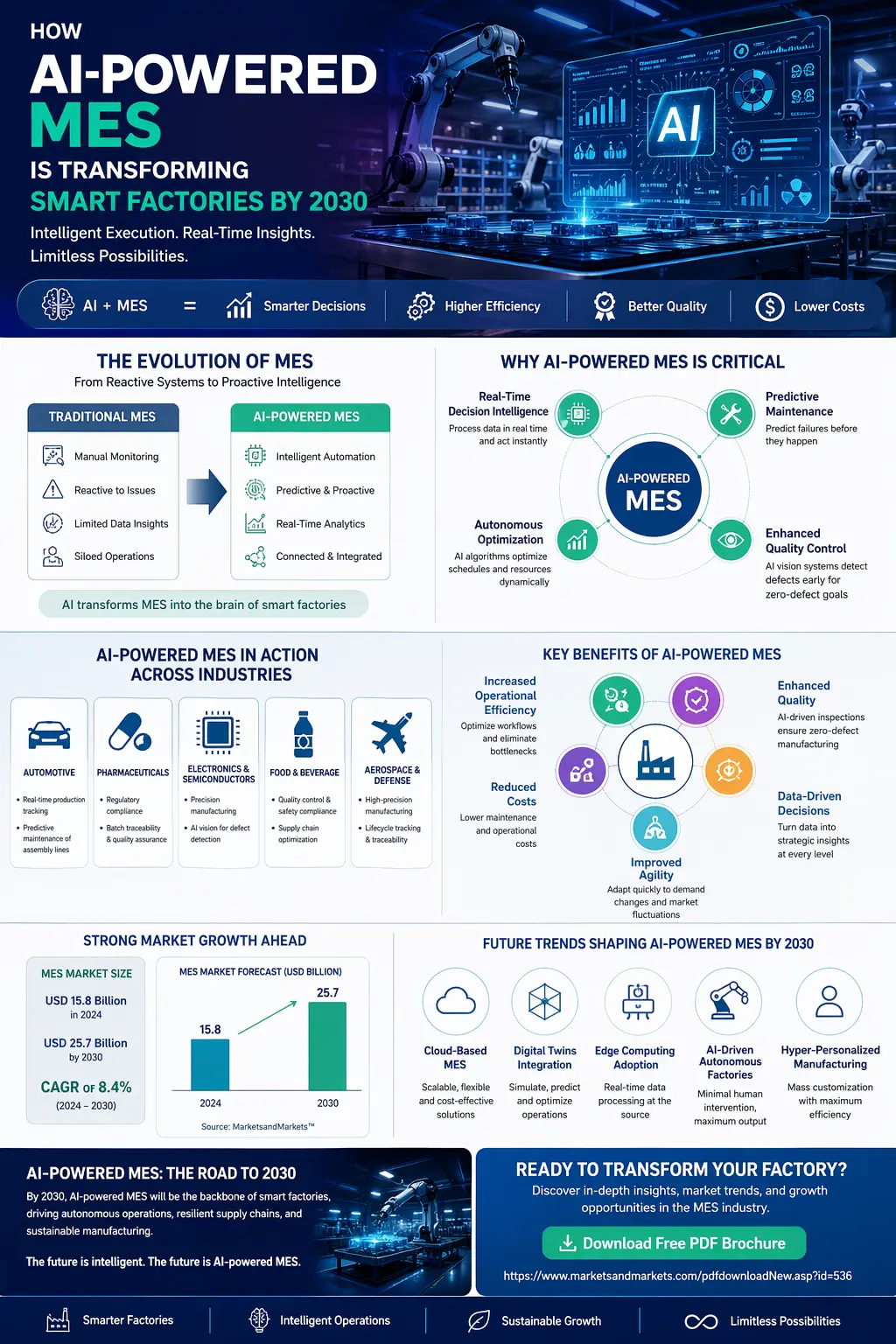
Traditionally, MES has been responsible for monitoring, tracking, and documenting production processes. However, with the integration of AI, MES has evolved from a reactive system to a proactive intelligence layer.
AI-powered MES can:
- Analyze vast volumes of production data in real time
- Predict equipment failures before they occur
- Optimize production schedules dynamically
- Improve quality control with minimal human intervention
According to recent industry insights, the global Manufacturing Execution Systems (MES) market is witnessing rapid growth due to increasing adoption of AI, IoT, and automation technologies.
Why AI-Powered MES is Critical for Smart Factories
Smart factories operate on interconnected systems, where machines, sensors, and software communicate seamlessly. AI-powered MES acts as the central nervous system, ensuring smooth coordination and intelligent decision-making.
Real-Time Decision Intelligence
AI enables MES to process real-time data and provide actionable insights instantly. This reduces downtime and enhances productivity.
Predictive Maintenance
Instead of reacting to machine failures, AI predicts them. This minimizes unplanned downtime and reduces maintenance costs.
Autonomous Production Optimization
AI algorithms continuously analyze production data and adjust parameters to improve efficiency and output.
Enhanced Quality Control
Computer vision and machine learning models integrated with MES can detect defects early, ensuring zero-defect manufacturing.
Integration with Smart Factory Ecosystem
AI-powered MES does not operate in isolation. It integrates with:
- ERP systems for business planning
- SCADA systems for real-time control
- IoT devices for data collection
- Digital twins for simulation
This integration is a key driver behind the growth of the smart factory market, which is projected to expand significantly by 2030.
Key Benefits of AI-Powered MES
Increased Operational Efficiency
AI optimizes workflows, reduces bottlenecks, and ensures smooth production processes.
Reduced Costs
Automation and predictive analytics lower operational and maintenance costs.
Improved Agility
Manufacturers can quickly adapt to demand fluctuations and market changes.
Data-Driven Decision Making
AI transforms raw data into strategic insights, enabling better decisions at every level.
Scalability
Cloud-based AI MES solutions allow manufacturers to scale operations seamlessly.
Industry Applications of AI-Powered MES
AI-powered MES is being widely adopted across industries:
Automotive
- Real-time production tracking
- Predictive maintenance of assembly lines
Pharmaceuticals
- Compliance with regulatory standards
- Batch traceability and quality assurance
Electronics & Semiconductor
- Precision manufacturing
- Defect detection using AI vision systems
Food & Beverage
- Quality control and safety compliance
- Supply chain optimization
Aerospace & Defense
- High-precision manufacturing
- Lifecycle tracking and traceability
Role of AI in Driving Industry 4.0
Industry 4.0 is defined by interconnected systems, automation, and data exchange. AI-powered MES is a core enabler of this revolution.
Key contributions include:
- Smart data analytics
- Autonomous decision-making
- Human-machine collaboration
- Digital twin integration
By 2030, factories will evolve into self-learning ecosystems, where MES systems continuously improve operations without manual intervention.
Future Trends Shaping AI-Powered MES by 2030
Rise of Cloud-Based MES
Cloud deployment will dominate, offering flexibility, scalability, and lower costs.
Integration with Digital Twins
AI-powered MES will simulate production processes, enabling scenario planning and optimization.
Edge Computing Adoption
Processing data closer to machines will reduce latency and improve decision-making speed.
AI-Driven Autonomous Factories
Factories will operate with minimal human intervention, driven by intelligent MES systems.
Hyper-Personalized Manufacturing
AI will enable mass customization without compromising efficiency.
Challenges in AI-Powered MES Adoption
Despite its benefits, adoption comes with challenges:
- High initial implementation cost
- Integration complexity with legacy systems
- Data security concerns
- Skill gap in AI and data analytics
However, as technology matures and costs decrease, these barriers are expected to diminish.
Strategic Importance for Businesses
Companies investing in AI-powered MES gain a competitive edge by:
- Enhancing productivity
- Reducing operational risks
- Improving customer satisfaction
- Accelerating innovation
In a rapidly evolving industrial landscape, AI-powered MES is no longer optional—it is a necessity.
Download Free PDF Brochure:
https://www.marketsandmarkets.com/pdfdownloadNew.asp?id=536
Explore detailed insights, market trends, and growth opportunities in the MES industry.
Top 10 Key Takeaways
- AI-powered MES is transforming traditional manufacturing into smart, autonomous systems.
- Real-time analytics enables faster and more accurate decision-making.
- Predictive maintenance reduces downtime and operational costs.
- Integration with IoT and ERP systems enhances overall efficiency.
- AI-driven MES improves product quality and reduces defects.
- Cloud-based MES solutions are gaining rapid adoption.
- Smart factories rely heavily on AI-powered MES for seamless operations.
- Industries like automotive and pharma are leading adopters.
- The MES market is expected to grow significantly by 2030.
- AI-powered MES is a cornerstone of Industry 4.0 transformation.
Frequently Asked Questions (FAQs)
1. What is AI-powered MES?
AI-powered MES is an advanced manufacturing execution system that uses artificial intelligence to analyze data, optimize processes, and automate decision-making in real time.
2. How does AI improve MES performance?
AI enhances MES by enabling predictive analytics, real-time insights, automated optimization, and improved quality control.
3. Which industries benefit most from AI-powered MES?
Industries such as automotive, pharmaceuticals, electronics, aerospace, and food & beverage benefit significantly from AI-powered MES.
4. What is the future of MES by 2030?
By 2030, MES will become highly intelligent, cloud-based, and integrated with AI, enabling autonomous and self-optimizing factories.
5. Is AI-powered MES suitable for small manufacturers?
Yes, with the rise of cloud-based solutions, AI-powered MES is becoming more accessible and cost-effective for small and medium-sized manufacturers.
80% of the Forbes Global 2000 B2B companies rely on MarketsandMarkets to identify growth opportunities in emerging technologies and use cases that will have a positive revenue impact.
- Food Packaging Market Size Set for Strong Growth Through 2030 Amid Rising Demand for Convenience Foods
- Mulch Films Market: Driving Sustainable Agriculture Through Innovation
- Agricultural Adjuvants Market Analysis, Trends, and Growth Outlook (2026–2031)
- Crop Protection Chemical Market Size, Share & Growth Forecast (2025–2030)
- Japan Enterprise Asset Management Market Growth: AI and Smart Infrastructure Drive Demand

