

Autonomous Mobile Robots (AMR) Technology Innovation: Key Trends, Growth Drivers and Opportunities
Introduction to Autonomous Mobile Robots (AMR) Technology
Autonomous Mobile Robots (AMRs) are revolutionizing industrial automation by enabling intelligent, flexible, and autonomous material handling across manufacturing facilities, warehouses, distribution centers, hospitals, and commercial environments. Unlike traditional Automated Guided Vehicles (AGVs), which rely on fixed routes and physical guidance systems, AMRs utilize Artificial Intelligence (AI), simultaneous localization and mapping (SLAM), computer vision, LiDAR, advanced sensors, and machine learning to navigate dynamic environments safely and efficiently. These robots can independently identify obstacles, optimize routes, and adapt to changing operational conditions without human intervention. As industries increasingly adopt Industry 4.0, smart manufacturing, and warehouse automation, AMRs are becoming a vital technology for improving productivity, operational efficiency, workplace safety, and supply chain resilience.
History of Autonomous Mobile Robots (AMR) Technology
The evolution of Autonomous Mobile Robots began with conventional Automated Guided Vehicles (AGVs) that followed predefined paths using magnetic tapes, wires, or QR codes. While AGVs improved material transportation, they lacked flexibility in dynamic environments. Advancements in robotics, artificial intelligence, computer vision, LiDAR, and edge computing enabled the development of AMRs capable of autonomous navigation and intelligent decision-making. The rise of e-commerce, labor shortages, and demand for warehouse automation further accelerated AMR adoption across logistics, manufacturing, healthcare, and retail industries. Today, modern AMRs operate collaboratively with human workers, integrate with Warehouse Management Systems (WMS) and Manufacturing Execution Systems (MES), and support highly automated, data-driven industrial operations.
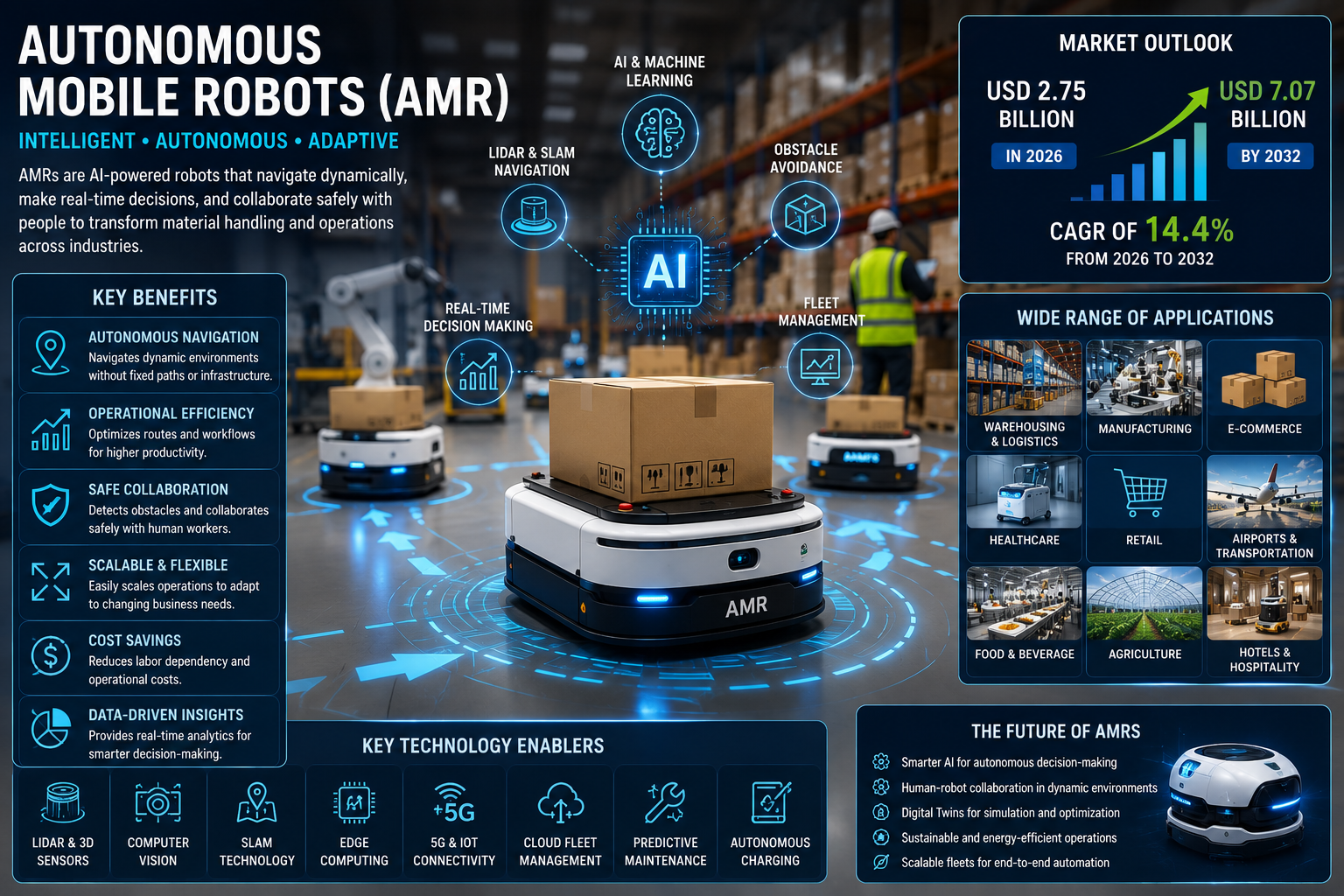
Benefits of Autonomous Mobile Robots (AMR) Technology
Autonomous Mobile Robots provide organizations with a highly flexible and scalable automation solution that improves operational efficiency while reducing manual labor and transportation bottlenecks. By leveraging AI-powered navigation, intelligent obstacle avoidance, and real-time fleet management, AMRs can safely transport goods, optimize workflows, and increase productivity across diverse operational environments. Their adaptability enables businesses to quickly respond to changing production requirements while improving workplace safety and lowering operating costs.
Key Benefits Include:
- Enables autonomous material handling without requiring fixed paths or physical guidance infrastructure.
- Improves operational efficiency through AI-powered navigation, intelligent route optimization, and real-time decision-making.
- Enhances workplace safety with advanced obstacle detection, collision avoidance, and collaborative human-robot interaction.
- Reduces labor dependency and operational costs by automating repetitive transportation tasks.
- Supports scalable warehouse, manufacturing, and logistics automation with flexible deployment.
- Integrates seamlessly with Warehouse Management Systems (WMS), Manufacturing Execution Systems (MES), IoT platforms, and cloud-based fleet management software.
- Increases productivity by enabling continuous 24/7 operations with minimal human intervention.
- Provides real-time operational insights through AI analytics, predictive maintenance, and fleet optimization.
Current Market Size and Growth Trends of the Autonomous Mobile Robots (AMR) Market
The Autonomous Mobile Robots market is experiencing strong growth as industries accelerate investments in warehouse automation, smart manufacturing, and intelligent logistics. The rapid expansion of e-commerce, increasing labor shortages, and the need for faster order fulfillment are driving widespread adoption of AMRs across distribution centers, manufacturing facilities, healthcare institutions, and retail operations. In addition, advancements in artificial intelligence, LiDAR, computer vision, edge computing, and robotics software are enabling AMRs to operate more efficiently in complex and dynamic environments. As organizations continue their digital transformation initiatives, AMRs are becoming a strategic investment for improving operational agility, productivity, and supply chain resilience.
According to MarketsandMarkets, the global Autonomous Mobile Robots (AMR) market was valued at USD 2.75 billion in 2026 and is projected to reach USD 7.07 billion by 2032, growing at a CAGR of 14.4% during the forecast period (2026–2032).
Download PDF Brochure: https://www.marketsandmarkets.com/pdfdownloadNew.asp?id=107280537
Key Market Growth Drivers
- Rapid adoption of warehouse automation driven by the growth of global e-commerce and omnichannel fulfillment.
- Increasing implementation of Industry 4.0, smart factories, and intelligent manufacturing systems.
- Rising demand for AI-powered robotics to improve operational efficiency and reduce labor dependency.
- Growing deployment of AMRs in logistics, healthcare, retail, manufacturing, and third-party logistics (3PL) operations.
- Continuous advancements in LiDAR, computer vision, SLAM navigation, AI algorithms, and edge computing.
- Increasing investments in robotics-as-a-service (RaaS) and cloud-connected fleet management platforms.
- Growing focus on workplace safety, operational flexibility, and intelligent material handling across industrial environments.
Key Drivers and Factors Influencing the Future of Autonomous Mobile Robots (AMR) Technology
The future of Autonomous Mobile Robots (AMR) technology is being driven by rapid advancements in artificial intelligence (AI), robotics, machine vision, LiDAR, edge computing, and industrial connectivity. As manufacturers, logistics providers, and healthcare organizations seek greater operational efficiency, AMRs are becoming an essential component of intelligent automation strategies. Unlike traditional automation systems, AMRs can dynamically navigate complex environments, collaborate safely with human workers, and optimize workflows in real time. Growing investments in Industry 4.0, warehouse automation, robotics-as-a-service (RaaS), and smart factories are further accelerating global AMR adoption, enabling businesses to improve productivity while addressing labor shortages and rising operational costs.
Key Growth Drivers
- Increasing adoption of Industry 4.0, smart manufacturing, and intelligent factory automation.
- Rapid expansion of e-commerce, driving demand for automated warehouse and fulfillment operations.
- Rising labor shortages and increasing labor costs across logistics, manufacturing, and healthcare industries.
- Growing implementation of AI, machine vision, LiDAR, and SLAM navigation for autonomous mobility.
- Increasing demand for flexible automation that adapts to changing production and warehouse layouts.
- Expansion of Robotics-as-a-Service (RaaS) models, making AMRs more accessible to small and medium-sized enterprises.
- Integration of AMRs with Warehouse Management Systems (WMS), Manufacturing Execution Systems (MES), ERP platforms, IoT devices, and cloud-based fleet management software.
Emerging Trends in Autonomous Mobile Robots (AMR) Technology
Autonomous Mobile Robot technology is evolving rapidly as organizations embrace intelligent automation to improve supply chain efficiency and operational flexibility. Modern AMRs combine AI-powered navigation, machine learning, advanced sensor fusion, and cloud-based fleet management to deliver highly adaptive and scalable robotic solutions. Emerging technologies such as Digital Twins, 5G connectivity, edge AI, and collaborative robotics are expanding the capabilities of AMRs, allowing them to operate more efficiently in dynamic industrial and commercial environments while supporting data-driven decision-making.
Key Emerging Trends
- Increasing adoption of AI-powered fleet management for intelligent task allocation and route optimization.
- Growing deployment of edge AI for real-time navigation, obstacle avoidance, and autonomous decision-making.
- Integration of Digital Twin technology for warehouse simulation, fleet optimization, and predictive maintenance.
- Rising use of 5G connectivity to enable low-latency communication between AMRs and centralized control systems.
- Expansion of collaborative robotics (cobots) working safely alongside human employees.
- Growing implementation of multi-robot orchestration platforms that coordinate hundreds of AMRs simultaneously.
- Increasing adoption of autonomous charging systems, cloud robotics, and predictive analytics to maximize fleet uptime and operational efficiency.
Opportunities and Challenges in the Autonomous Mobile Robots (AMR) Market
The Autonomous Mobile Robots market presents significant opportunities as businesses continue investing in digital transformation, warehouse automation, and intelligent logistics. AMRs are expanding beyond material handling to support inventory management, healthcare logistics, retail automation, agriculture, and hospitality. Their ability to increase efficiency while reducing manual intervention makes them an attractive solution across numerous industries. However, widespread adoption also presents challenges related to implementation costs, system integration, workforce adaptation, and cybersecurity.
Key Opportunities
- Growing adoption in e-commerce warehouses, distribution centers, and third-party logistics (3PL) operations.
- Increasing deployment in manufacturing facilities for material transportation and production line automation.
- Expansion into healthcare for pharmaceutical delivery, laboratory logistics, and hospital supply chain management.
- Rising implementation in retail, airports, hotels, and commercial buildings for service automation and inventory movement.
- Growing use of AMRs in agriculture, food processing, and cold storage facilities.
- Increasing demand for scalable automation solutions among small and medium-sized enterprises (SMEs).
Key Challenges
- High initial investment for advanced robotic systems and supporting infrastructure.
- Integration complexity with existing warehouse, manufacturing, and enterprise software systems.
- Cybersecurity risks associated with connected robotic fleets and cloud-based management platforms.
- Need for workforce training to operate, monitor, and maintain autonomous robotic systems.
- Navigation challenges in highly dynamic or unstructured operating environments.
- Compliance with evolving industrial safety standards and regulatory requirements for autonomous systems.
Innovations and Advancements in Autonomous Mobile Robots (AMR) Technology
Continuous innovation is enhancing the intelligence, flexibility, and efficiency of Autonomous Mobile Robots. Advances in artificial intelligence, computer vision, sensor fusion, and robotics software are enabling AMRs to perform increasingly sophisticated tasks while operating safely alongside human workers. These innovations are transforming AMRs from autonomous transport vehicles into intelligent mobile platforms capable of supporting predictive operations, autonomous collaboration, and real-time industrial decision-making.
Recent Innovations
- AI-powered computer vision systems enabling intelligent object recognition, pallet detection, and dynamic obstacle avoidance.
- Advanced LiDAR, 3D cameras, and sensor fusion technologies providing precise navigation in complex environments.
- Integration of Digital Twin platforms for virtual warehouse modeling, robotic simulation, and fleet optimization.
- Cloud-based AMR management platforms supporting remote monitoring, fleet analytics, software updates, and predictive maintenance.
- Autonomous robot-to-robot communication for coordinated fleet operations and optimized task execution.
- Development of self-charging AMRs with intelligent battery management for uninterrupted 24/7 operations.
- Integration of AMRs with AI, IoT, edge computing, robotic arms, automated storage and retrieval systems (AS/RS), and smart manufacturing platforms to create fully connected autonomous logistics ecosystems.
Future Applications and Industries That Will Benefit from Autonomous Mobile Robots (AMR) Technology
Autonomous Mobile Robots (AMRs) are expected to become a fundamental component of next-generation industrial automation, intelligent logistics, and smart infrastructure. As artificial intelligence (AI), edge computing, robotics, Digital Twins, 5G, and Industrial Internet of Things (IIoT) technologies continue to advance, AMRs will evolve into highly intelligent systems capable of autonomous navigation, collaborative decision-making, and adaptive workflow optimization. Future AMRs will move beyond material transportation to perform inspection, inventory management, autonomous delivery, predictive maintenance, and collaborative manufacturing tasks. These innovations will enable organizations to improve operational efficiency, reduce costs, enhance workplace safety, and build more resilient and agile supply chains.
Key Future Applications
- Smart Manufacturing: AMRs will automate material transportation, work-in-progress movement, production line replenishment, quality inspection, and collaborative manufacturing, enabling fully connected Industry 4.0 factories.
- Warehousing & Logistics: Intelligent AMRs will support automated order picking, inventory movement, pallet transportation, cross-docking, warehouse optimization, and last-mile logistics, significantly improving fulfillment speed and operational efficiency.
- E-commerce & Distribution Centers: Online retailers will deploy AI-powered AMRs to accelerate order processing, reduce fulfillment errors, optimize inventory management, and support high-volume seasonal demand.
- Healthcare & Hospitals: AMRs will transport medicines, laboratory samples, medical equipment, surgical supplies, meals, and linens while reducing staff workload and improving patient care efficiency.
- Retail & Commercial Facilities: Autonomous robots will perform inventory scanning, shelf replenishment, stock movement, customer assistance, and automated store logistics, creating smarter retail operations.
- Airports, Ports & Transportation Hubs: AMRs will streamline baggage handling, cargo transportation, terminal logistics, maintenance operations, and passenger support services while enhancing operational productivity.
- Food & Beverage Industry: Intelligent robots will automate ingredient transportation, packaging operations, warehouse logistics, cold storage movement, and sanitation support while maintaining food safety compliance.
- Agriculture & Farming: AMRs will assist in greenhouse logistics, harvesting support, autonomous crop transportation, precision farming, and agricultural warehouse operations.
- Data Centers & High-Tech Facilities: Autonomous robots will transport IT equipment, replacement components, batteries, and maintenance tools while supporting predictive infrastructure management and facility automation.
- Hospitality & Commercial Buildings: Hotels, convention centers, and office complexes will increasingly deploy AMRs for autonomous room service, cleaning assistance, security patrols, package delivery, and facility management.
Conclusion: The Promising Future of Autonomous Mobile Robots (AMR) Technology
Autonomous Mobile Robots are transforming industrial automation by providing intelligent, flexible, and scalable solutions for material handling, logistics, manufacturing, and service operations. Unlike conventional automated systems, AMRs leverage artificial intelligence, machine vision, LiDAR, SLAM navigation, and edge computing to navigate dynamic environments, collaborate safely with human workers, and make autonomous operational decisions in real time. Their ability to improve productivity while reducing labor dependency and operational costs makes them an essential technology for modern digital enterprises.
Find More Information on Autonomous Mobile Robots Technology Innovation @ https://www.marketsandmarkets.com/Market-Reports/autonomous-mobile-robots-market-107280537.html
80% of the Forbes Global 2000 B2B companies rely on MarketsandMarkets to identify growth opportunities in emerging technologies and use cases that will have a positive revenue impact.
- Food Packaging Market Size Set for Strong Growth Through 2030 Amid Rising Demand for Convenience Foods
- Crop Protection Chemical Market Size, Share & Growth Forecast (2025–2030)
- Mulch Films Market: Driving Sustainable Agriculture Through Innovation
- Agricultural Adjuvants Market Analysis, Trends, and Growth Outlook (2026–2031)
- Japan Enterprise Asset Management Market Growth: AI and Smart Infrastructure Drive Demand

