Autonomous Mobile Robots (AMR) Market Size, Share & Trends

Autonomous Mobile Robots (AMR) Market Size, Share & Trends by Navigation (Laser/LiDAR, Vision Guidance, SLAM, RFID Tags, Magnetic Sensors, Inertial Sensors), Type (Goods-to-person AMR, Pallet-handling AMR), Payload (<100 kg, 100-500 kg, >500 kg) - Global Forecast to 2032




AUTONOMOUS MOBILE ROBOTS MARKET SIZE, SHARE & TRENDS
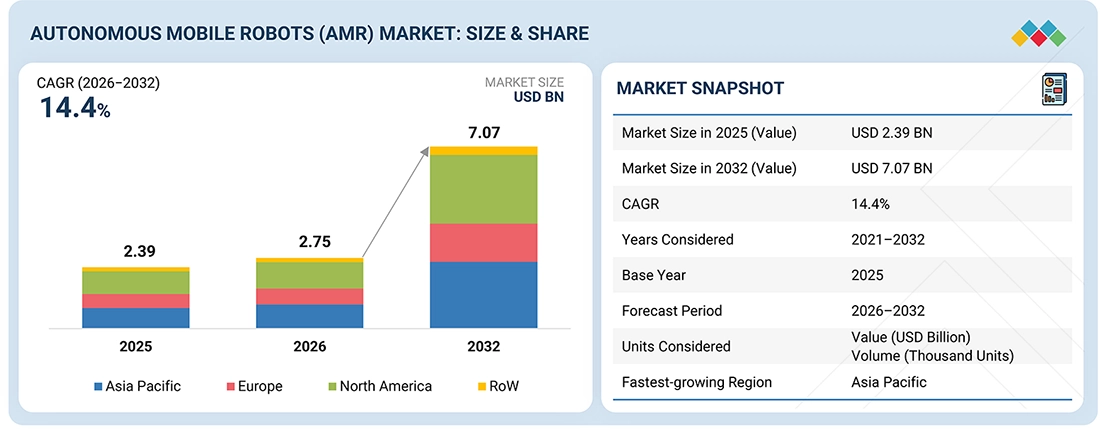
According to Marketsandmarkets, the global autonomous mobile robots market size was valued at USD 2.75 billion in 2026 and is projected to reach USD 7.07 billion by 2032, growing at a CAGR of 14.4% from 2026 to 2032. Growth is driven by rising adoption of AMRs across warehouses, manufacturing plants, and logistics facilities as organizations focus on flexible material movement, labor efficiency, and scalable automation. Increasing e-commerce activity, workforce constraints, and the transition toward smart warehouses are accelerating deployments. Advancements in navigation technologies, fleet coordination software, and system integration are enhancing reliability and throughput, supporting sustained market expansion across major regions.
MARKET SNAPSHOT TABLE
| REPORT METRIC | DETAILS |
|---|---|
| Market Size in 2025 (Value) | USD 2.39 Billion |
| Market Size in 2032 (Value) | USD 7.07 Billion |
| Growth Rate | CAGR of 14.4% from 2025–2032 |
| Years Considered | 2021–2032 |
| Base Year | 2025 |
| Forecast Period | 2026–2032 |
| Units Considered | Value (USD Billion), Volume (Thousand Units) |
| Report Coverage | Revenue Forecast, Company Ranking, Competitive Landscape, Growth Factors, and Trends |
| Top Companies |
|
| Growth Drivers |
|
| Segments Covered |
|
| Regions Covered | North America, Europe, Asia Pacific, and RoW |
Market Size & Forecast
• 2026 Market Size: USD 2.75 Billion
• 2032 Projected Market Size: USD 7.07 Billion
• CAGR (2026-2032): 14.4%
• Logistics/3PL Industry: Highest CAGR
• North America: Fastest growing market
KEY TAKEAWAYS
-
BY REGIONNorth America dominated the autonomous mobile robots market share, with a share of 37.3% in 2025.
-
BY PAYLOAD CAPACITYBy payload, the >500 kg segment is expected to register the highest CAGR of 16.2% during the forecast period.
-
BY INDUSTRYThe logistics/3PL industry is expected to register the highest CAGR of 16.7% during the forecast period.
-
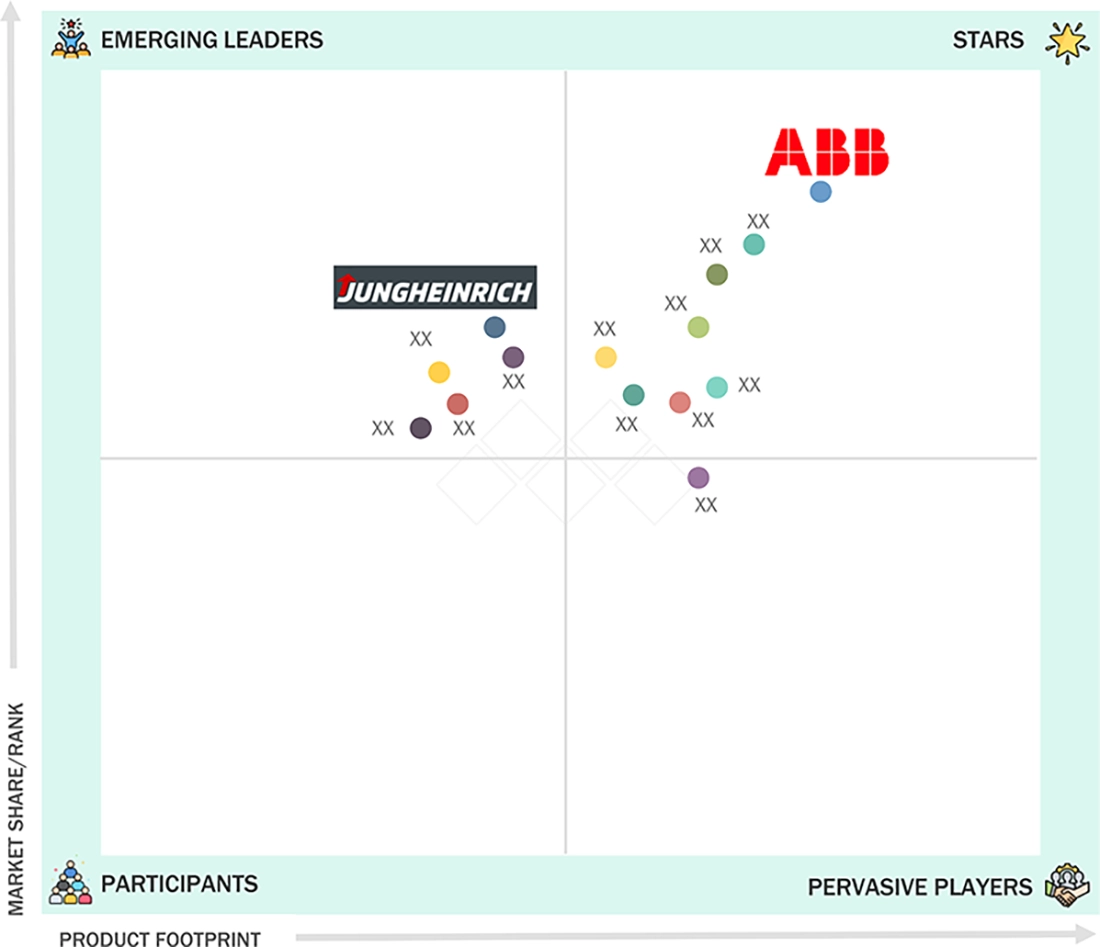
COMPETITIVE LANDSCAPE (KEY PLAYERS)ABB (Switzerland) and OMRON Corporation (Japan), among others, were identified as star players in the autonomous mobile robots market due to their strong market share and extensive product footprint.
-
COMPETITIVE LANDSCAPE (STARTUPS/SMES)GreyOrange (US) and Seegrid (US), among others, have distinguished themselves among startups and SMEs by securing strong footholds in specialized niche areas, underscoring their potential as emerging market leaders in the autonomous mobile robots market.
The autonomous mobile robots industry is witnessing steady growth as organizations adopt AMRs to enable flexible material movement across warehouses, manufacturing sites, and distribution centers. Demand is driven by the need for higher throughput, reduced manual handling, and adaptive navigation in dynamic environments. Advances in navigation, fleet orchestration software, and system integration are improving reliability, scalability, and operational efficiency. As companies focus on labor optimization and agile intralogistics, AMRs are becoming a core automation solution across industries. Increased adoption in brownfield facilities and tighter integration with warehouse and manufacturing systems are also improving return on investment and accelerating deployment timelines.
AMR Market Insights and Industry Analysis
The AMR robot price is influenced by several factors, including robot type, payload capacity, navigation technology, software capabilities, sensors, customization, application requirements, and deployment environment. While individual AMR pricing varies across solutions and applications, understanding these factors provides useful context for evaluating the broader autonomous mobile robot market. This market report focuses on market size, growth forecasts, technology trends, applications, regional developments, competitive landscape, and future opportunities across the AMR industry, helping stakeholders understand the evolving market rather than the price of an individual robotic product.
Source: Secondary Research, Interviews with Experts, MarketsandMarkets Analysis
TRENDS & DISRUPTIONS IMPACTING CUSTOMERS' CUSTOMERS
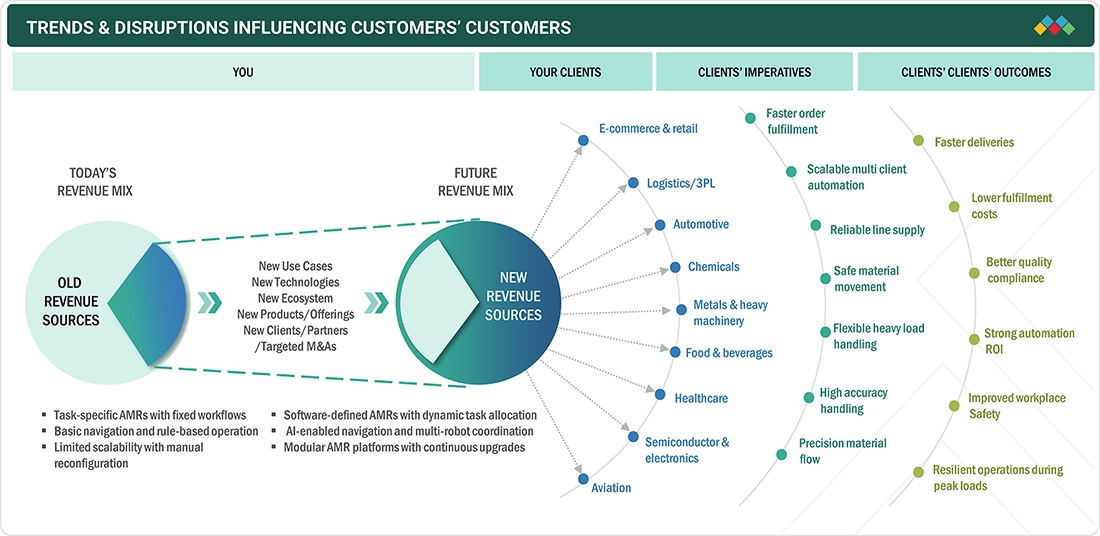
The figure shows the shift from fixed automation to flexible, software-driven AMR platforms used across e-commerce & retail, logistics & 3PL, automotive, chemicals, metals & heavy machinery, food & beverages, healthcare, semiconductor & electronics, and aviation. Key operational imperatives include faster order fulfillment, scalable automation, reliable line supply, safe and precise material movement, and accurate handling. These needs drive AMR adoption to manage higher throughput, SKU complexity, and demand variability. As a result, end customers benefit through faster deliveries, lower fulfillment costs, improved quality compliance, stronger automation returns, safer workplaces, and more resilient operations during peak periods.
Source: Secondary Research, Interviews with Experts, MarketsandMarkets Analysis
MARKET DYNAMICS

Level
-
Accelerated progress in robotics and Al

-
Increasing focus on warehouse automation


Level
-
High upfront implementation costs


Level
-
Rising demand for efficient last-mile delivery services

-
Growing demand for AMRs offering customizable hardware and programmable software


Level
-
Data integration complexities and system compatibility issues

Source: Secondary Research, Interviews with Experts, MarketsandMarkets Analysis
Driver: Accelerated progress in robotics and Al
Rising requirements for flexible operations, higher throughput, and improved safety are accelerating AMR adoption across e-commerce, logistics and 3PL, manufacturing, and healthcare. Advances in AI-driven navigation and vision systems enable reliable autonomous operation, reduce manual effort, and support consistent material flow in dynamic environments.
Restraint: High upfront implementation costs
AMR deployments require investment in robots, software platforms, integration with existing systems, and facility readiness. For small and mid-sized enterprises, initial costs, along with ongoing software upgrades and maintenance, can delay adoption, particularly where return timelines are closely scrutinized.
Opportunity: Rising demand for efficient last-mile delivery services
Growth in omnichannel fulfillment, same-day delivery expectations, and multi-site warehouse networks is creating strong demand for flexible AMR solutions. Integration with cloud-based WMS, fleet orchestration platforms, and digital twins enables scalable deployments, real-time optimization, and rapid adaptation to changing workflows.
Challenge: Data integration complexities and system compatibility issues
AMR adoption can be constrained by challenges in integrating with legacy WMS, MES, and ERP systems. In cost-sensitive regions with lower labor costs, adoption may progress more gradually despite long-term efficiency and safety benefits.
AUTONOMOUS MOBILE ROBOTS (AMR) MARKET: COMMERCIAL USE CASES ACROSS INDUSTRIES
| COMPANY | USE CASE DESCRIPTION | BENEFITS |
|---|---|---|
 |
Deploys autonomous mobile robots for intralogistics automation in manufacturing plants, warehouses, and distribution centers, supporting pallet transport, line feeding, and internal material movement | Improves material flow reliability | Enhances operational safety | Reduces manual handling | Supports scalable automation across high-throughput industrial environments |
 |
Provides AMRs for flexible warehouse automation, distribution centers, and manufacturing logistics, enabling picking, replenishment, and internal transport in dynamic layouts | Increases picking accuracy | Supports layout flexibility |Lowers operating costs | Enables rapid adaptation to changing workflow requirements |
|
|
Implements AMR-based solutions for internal logistics, production supply, and warehouse operations across automotive, food & beverage, and industrial manufacturing facilities | Enhances space utilization | Supports just-in-time material supply |Improves safety | Ensures stable performance in mixed human-robot environments |
|
|
Supplies AMRs for goods-to-person picking, sorting, and inventory movement in e-commerce, retail, manufacturing, and logistics facilities | Increases order fulfillment speed | Improves throughput scalability | Reduces labor dependency | Supports high-volume operations |
|
|
Delivers collaborative AMRs for internal transport of pallets, carts, and components in manufacturing, warehouses, and logistics sites | Enables fast deployment | Operational flexibility | Efficient material movement with minimal infrastructure changes |
Logos and trademarks shown above are the property of their respective owners. Their use here is for informational and illustrative purposes only.
MARKET ECOSYSTEM
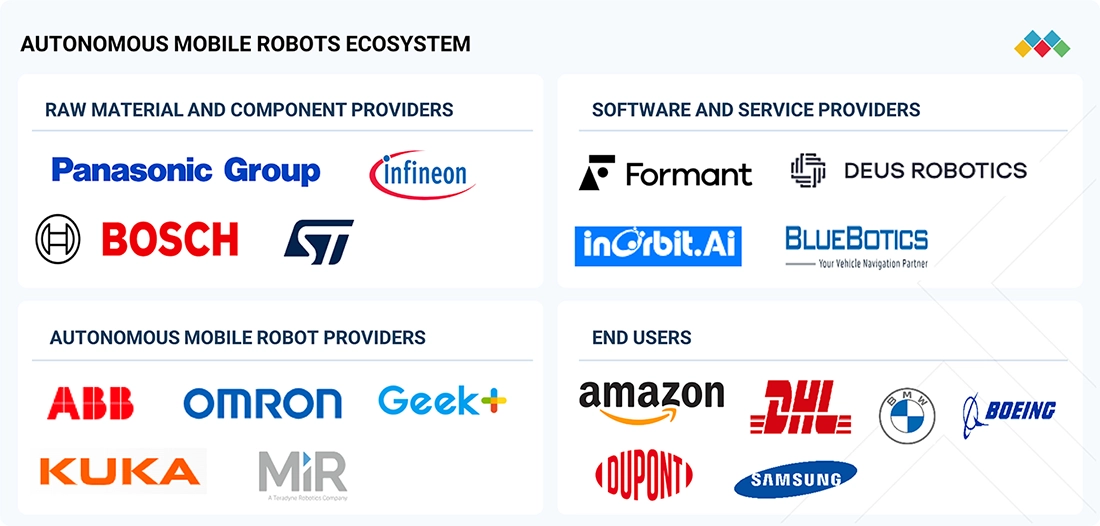
The autonomous mobile robots market trends ecosystem includes component suppliers, software and services providers, AMR manufacturers, and end users working together to enable automated intralogistics operations. Component suppliers deliver sensors, controllers, batteries, drives, and safety systems that support reliable autonomous movement. Software and service providers enable navigation, traffic management, fleet coordination, and system integration to ensure stable performance in dynamic environments. AMR manufacturers combine these capabilities to deliver flexible and scalable robots for internal material transport. End users across manufacturing, warehousing, logistics, and retail deploy AMRs to improve material flow efficiency, reduce manual handling, enhance safety, and support consistent, high-throughput operations.
Logos and trademarks shown above are the property of their respective owners. Their use here is for informational and illustrative purposes only.
MARKET SEGMENTS
Source: Secondary Research, Interviews with Experts, MarketsandMarkets Analysis
Autonomous Mobile Robots Market, by Payload Capacity
AMRs with a payload capacity of 100–500 kg are expected to hold the largest market share due to their strong balance of load-handling capability, maneuverability, and deployment flexibility. This payload range is widely adopted across warehouses, manufacturing plants, and distribution centers for pallet movement, component transport, line feeding, and order fulfillment. Their suitability for both medium-scale and large-scale operations, along with compatibility with brownfield and greenfield facilities, continues to support broad adoption across industries.
Autonomous Mobile Robots Market, by Industry
The e-commerce & retail industry is expected to account for the largest market share, driven by rising order volumes, shorter delivery timelines, and the need for high throughput fulfillment operations. AMRs are increasingly deployed for picking, sorting, replenishment, and inventory movement within fulfillment centers, supporting scalability while reducing labor dependency and improving operational accuracy in dynamic warehouse environments.
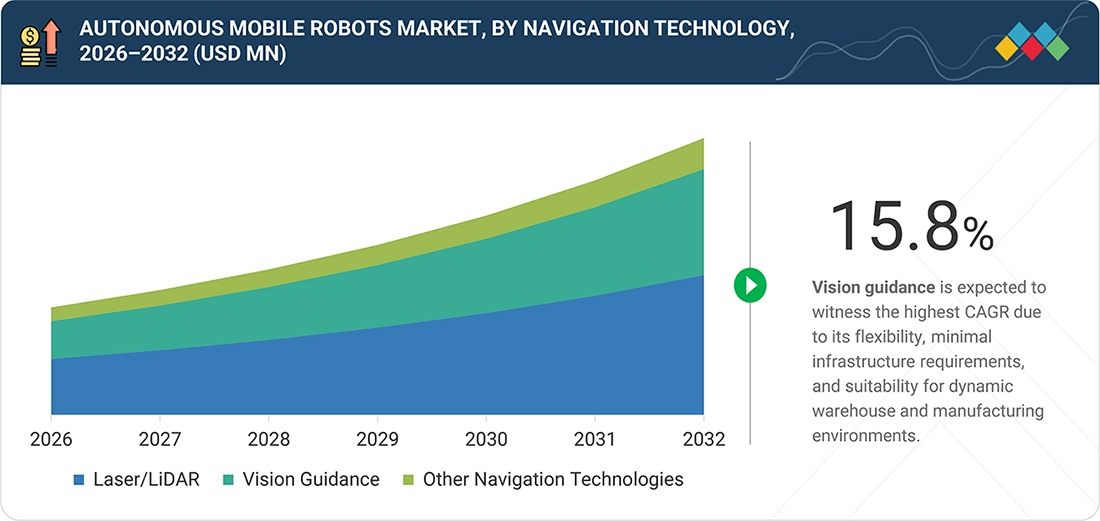
Autonomous Mobile Robots Market, by Navigation Technology
Laser/LiDAR-based navigation technology is expected to hold the largest market share due to its high positioning accuracy, reliability, and effectiveness in complex indoor environments. This technology enables precise mapping, real-time obstacle detection, and flexible route planning without extensive physical infrastructure, making it well-suited for warehouses, manufacturing facilities, and mixed traffic operational settings.
REGION
Asia Pacific to be fastest-growing region in autonomous mobile robots (AMR) market during forecast period
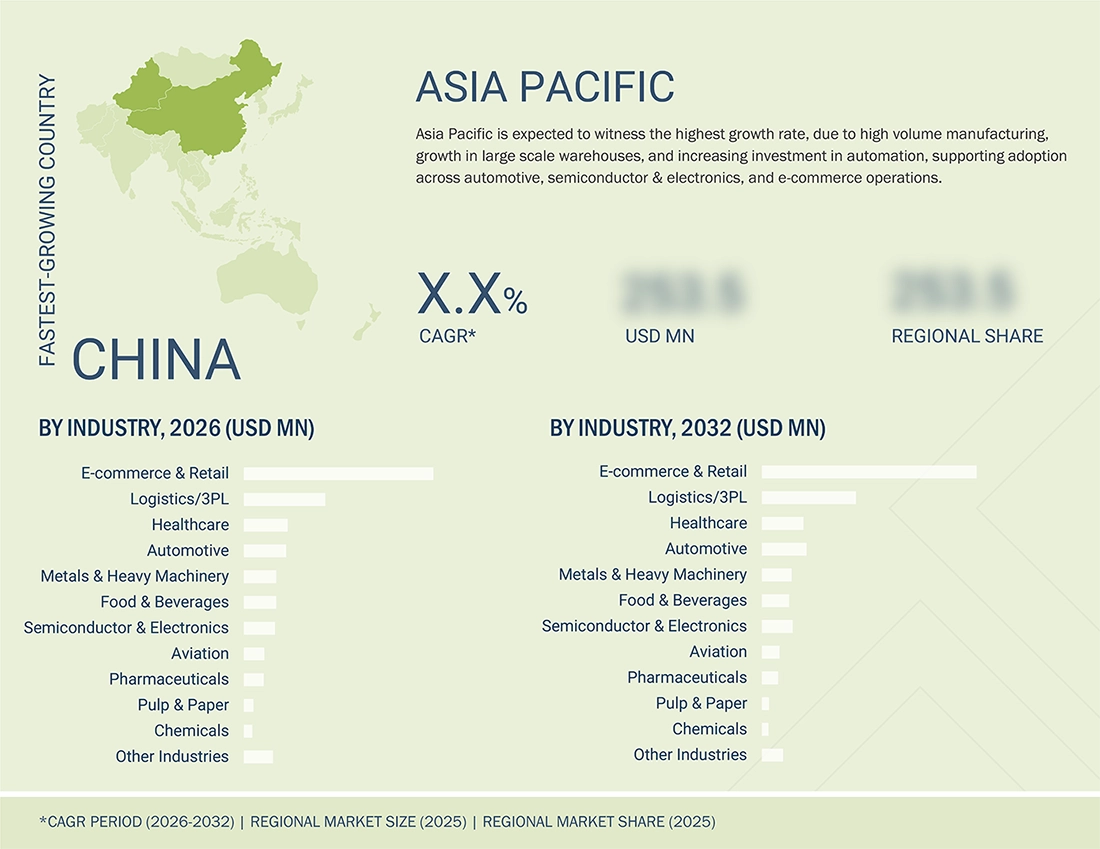
Asia Pacific is expected to be the fastest-growing region in the autonomous mobile robots market growth, supported by rapid industrialization, expanding manufacturing bases, and rising adoption of warehouse and e-commerce automation across China, Japan, South Korea, and India. Increasing labor costs, workforce shortages, and growing focus on smart factory and Industry 4.0 initiatives are accelerating AMR deployments. Demand is further driven by the need for flexible material movement, scalable fulfillment operations, and higher throughput in manufacturing and logistics facilities, supporting sustained regional growth.
AUTONOMOUS MOBILE ROBOTS (AMR) MARKET: COMPANY EVALUATION MATRIX
In the autonomous mobile robots companies, ABB is positioned as a Star, supported by its strong robotics portfolio, advanced navigation and control technologies, and deep integration capabilities across manufacturing, logistics, and intralogistics operations. Its strength lies in delivering scalable AMR solutions with high reliability, system level integration, and alignment with Industry 4.0 requirements. Jungheinrich AG, identified as an Emerging Leader, is gaining momentum by expanding its AMR offerings beyond traditional intralogistics, with increased focus on software-driven fleet management, interoperability, and flexible deployment models. Continued investment in autonomous navigation, digital platforms, and customer-specific applications is supporting Jungheinrich’s progression toward the leaders’ quadrant.
Source: Secondary Research, Interviews with Experts, MarketsandMarkets Analysis
KEY MARKET PLAYERS
- ABB (Switzerland)
- OMRON Corporation (Japan)
- Mobile Industrial Robots (Denmark)
- Zebra Technologies Corp. (US)
- KUKA SE & Co. KGaA (Japan)
- OTTO Motors (Canada)
- Locus Robotics (US)
- Oceaneering International, Inc. (US)
- SSI SCHAEFER (Germany)
- KNAPP AG (Austria)
- Jungheinrich AG (Germany)
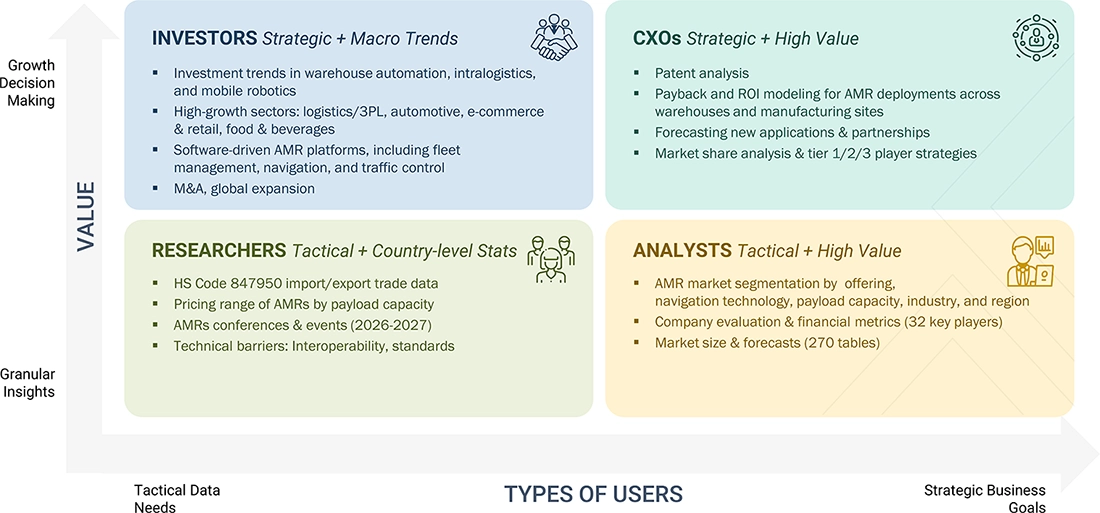
WHAT IS IN IT FOR YOU: AUTONOMOUS MOBILE ROBOTS (AMR) MARKET REPORT CONTENT GUIDE
DELIVERED CUSTOMIZATIONS
We have successfully delivered the following deep-dive customizations:
| CLIENT REQUEST | CUSTOMIZATION DELIVERED | VALUE ADDS |
|---|---|---|
| AMR Solution Provider |
|
|
| AMR Hardware Manufacturer |
|
|
| Software & Fleet Orchestration Provider | Assessment of AMR fleet orchestration, navigation, and control platforms |
|
RECENT DEVELOPMENTS
- August 2026: Geekplus launched RoboShuttle Hyper, a next-generation tote-to-person climbing autonomous mobile robot (AMR) designed for high-throughput warehouse fulfillment. The system can process up to 6,000 totes per hour per 1,000 square meters and climb at speeds of up to 1.5 m/s. Its parallel horizontal and vertical movement enables 50% higher concurrency, while double-deep, dual-pass retrieval improves storage density and operational efficiency. The system can coordinate up to 5,000 robots across 50,000 square meters and 3 million storage locations, while its new Max Workstation can exceed 800 totes per hour.
- June 2026: Hesai Technology partnered with Innok Robotics to enable reliable outdoor autonomy with advanced 3D LiDAR perception. Hesai’s LiDAR provides consistent sensing across changing light, weather, terrain, and dynamic obstacles, supporting safer and more reliable robot operation. Integrated with Innok’s AI-powered InnokCockpit™, the technology enables autonomous intralogistics, industrial transport, yard operations, and material movement. The solution improves navigation accuracy, reduces false detections and unnecessary stops, and helps increase robot uptime. The collaboration strengthens the path toward scalable, all-weather autonomous robotics across demanding industrial environments.
- June 2026: OMRON Robotics unveiled its next-generation LD-150 and LD-300 autonomous mobile robots (AMRs) at Automate 2026, designed to boost high-throughput material transport. The compact AMRs handle payloads of up to 150 kg and 300 kg while navigating tighter production spaces. With speeds of up to 2.1 m/s and wireless charging in 30 minutes or less, the robots are built for higher uptime and faster material flow. Integrated with OMRON FLOW Core, they enable streamlined deployment and mixed-fleet management alongside existing mobile robots. The new LD Series helps manufacturers reduce manual transport, improve operational efficiency, and scale flexible automation without major infrastructure changes.
- March 2026: Syncore highlighted Geek+ autonomous mobile robots (AMRs) as flexible solutions for high-performance warehouse automation. The portfolio supports tote-to-person, shelf-to-person, and automated sorting applications, improving picking speed, accuracy, and space utilization. Geek+ AMRs can adapt to changing order volumes and warehouse layouts without major infrastructure changes. Their modular design enables scalable automation across e-commerce, logistics, and manufacturing operations. The solutions help businesses streamline fulfillment, reduce operational costs, and build more flexible, future-ready warehouses.
- January 2026: Quasi Robotics secured CE and UKCA certification for its Model C2 autonomous mobile robotic cart, clearing the way for commercial deployment across Europe and the UK. The six-month certification process validated the robot’s safety, performance, electromagnetic compatibility, battery systems, and autonomous operation. Designed for material transport, Model C2 combines human-safe operation with modular hardware and software for flexible deployment. The AMR is built for manufacturing, healthcare, warehousing, and commercial facilities, supporting efficient intralogistics and reducing repetitive manual transport.
Table of Contents
 Exclusive indicates content/data unique to MarketsandMarkets and not available with any competitors.
Methodology
The study involved four major activities in estimating the current size of the autonomous mobile robots market. Exhaustive secondary research has been done to collect information on the market, peer market, and parent market. To validate these findings, assumptions, and sizing with industry experts across the value chain through primary research has been the next step. Both top-down and bottom-up approaches have been employed to estimate the complete market size. After that, market breakdown and data triangulation methods have been used to estimate the market size of segments and subsegments. Two sources of information—secondary and primary—have been used to identify and collect information for an extensive technical and commercial study of the autonomous mobile robots market.
Secondary Research
Various secondary sources have been referred to in the secondary research process to identify and collect information important for this study. The secondary sources include annual reports, press releases, and investor presentations of companies; white papers; journals and certified publications; and articles from recognized authors, websites, directories, and databases. Secondary research has been conducted to obtain key information about the industry’s supply chain, the market’s value chain, the total pool of key players, market segmentation according to the industry trends (to the bottom-most level), regional markets, and key developments from market- and technology-oriented perspectives. The secondary data has been collected and analyzed to determine the overall market size, further validated by primary research.
Primary Research
Extensive primary research was conducted after gaining knowledge about the current scenario of the autonomous mobile robots market through secondary research. Several primary interviews were conducted with experts from the demand and supply sides across four major regions—North America, Europe, Asia Pacific and RoW. This primary data was collected through questionnaires, emails, and telephonic interviews.

Note: The three tiers of the companies are defined based on their total revenue in 2023: Tier 1 - revenue greater than or equal to USD 1 billion; Tier 2 - revenue between USD 100 million and USD 1 billion; and Tier 3 revenue less than or equal to USD 100 million. Other designations include sales managers, marketing managers, and product managers.
To know about the assumptions considered for the study, download the pdf brochure
Market Size Estimation
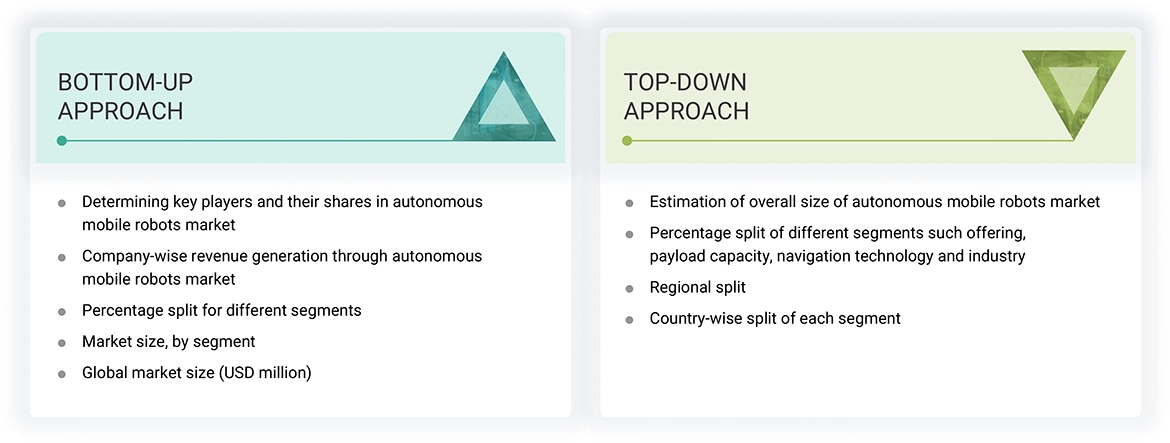
Both top-down and bottom-up approaches have been used to estimate and validate the total size of the autonomous mobile robots market. These methods have also been used extensively to estimate the size of various subsegments in the market. The following research methodology has been used to estimate the market size:
- Major players in the industry and markets have been identified through extensive secondary research.
- The industry’s value chain and market size (in terms of value) have been determined through primary and secondary research processes.
- All percentage shares, splits, and breakdowns have been determined using secondary sources and verified through primary sources.
Autonomous Mobile Robots (AMR) Market : Top-Down and Bottom-Up Approach
Data Triangulation
After arriving at the overall size of the autonomous mobile robots market from the market size estimation process explained above, the total market has been split into several segments and subsegments. Data triangulation and market breakdown procedures have been employed, wherever applicable, to complete the overall market engineering process and arrive at the exact statistics for all segments and subsegments of the market. The data has been triangulated by studying various factors and trends from both the demand and supply sides. Along with this, the market size has been validated using both top-down and bottom-up approaches.
Market Definition
The autonomous mobile robots market designs, manufactures, and deploys intelligent robots that are capable of navigating dynamic environments without human intervention. These are equipped with advanced sensors, artificial intelligence, and navigation systems to perform material handling, inventory management, and quality control. AMRs are available in different configurations and payload capacities, navigation technologies, and battery life. Due to a rising call for automation, labor shortages and increased efficiency requirement, the market of AMRs is looking towards great rise, propelling innovations and disrupting industries all around the globe.
Key Stakeholders
- Autonomous mobile robots manufacturers
- Sensors, actuators, and other hardware component providers
- AMR Software developers
- AMR suppliers and distributors
- E-commerce and retail companies
- Logistic companies
Report Objectives
- To define, describe and forecast the autonomous mobile robots market, in terms of offering, navigation technology, payload capacity, industry and region.
- To describe and forecast the market, in terms of value, with regard to four main regions: North America, Europe, Asia Pacific, and Rest of the World (RoW) along with their respective countries
- To provide detailed information regarding major factors influencing the market growth (drivers, restraints, opportunities, and challenges)
- To provide a detailed overview of the value chain of autonomous mobile robots market.
- To strategically analyze micromarkets with respect to individual growth trends, prospects, and contributions to the autonomous mobile robots market
- To analyze opportunities in the market for stakeholders by identifying high-growth segments of the autonomous mobile robots market.
- To strategically profile key players and comprehensively analyze their market position in terms of ranking and core competencies, along with detailing the competitive landscape for market leaders
- To analyze competitive strategies, such as product launches, expansions, mergers and acquisitions, adopted by key market players in the autonomous mobile robots market.
Available Customizations
With the given market data, MarketsandMarkets offers customizations according to the company’s specific needs. The following customization options are available for the report:
Company Information:
- Detailed analysis and profiling of additional market players (up to 5)
Key Questions Addressed by the Report
What is the current size of the Autonomous Mobile Robots market?
The global AMR market is valued at approximately USD 2.75 billion in 2026.
What is the projected market size of AMR by 2032?
The market is expected to reach USD 7.07 billion by 2032.
What is the CAGR of the Autonomous Mobile Robots market?
The market is growing at a CAGR of 14.4% (2026–2032).
What are the key growth drivers of the AMR market?
Growth is driven by e-commerce expansion, labor shortages, demand for flexible operations, and AI-based navigation systems.
Which industries are driving AMR adoption?
Major industries include logistics & 3PL, manufacturing, e-commerce, and healthcare.
Which segment leads the AMR market by application?
The logistics/3PL segment is expected to show the highest growth due to warehouse automation demand.
Which region dominates the AMR market?
North America dominates the market with a 37.3% share in 2025.
Which region is expected to grow fastest?
Asia Pacific is expected to grow rapidly due to strong e-commerce and manufacturing expansion.
Which companies are key players in the AMR market?
Key companies include ABB, OMRON, GreyOrange, Seegrid, Daifuku, KUKA, and Boston Dynamics.
What are the key trends in the AMR market?
Key trends include AI-powered navigation, fleet orchestration, smart warehouse integration, and increasing brownfield automation.
What factors influence AMR robot price?
AMR robot price varies based on payload capacity, navigation technology, sensors, software, customization, and application requirements.
What does the Autonomous Mobile Robots Market report cover?
The report covers market size, growth, trends, technologies, applications, regional insights, competitive landscape, and forecasts.


Personalize This Research
- Triangulate with your Own Data
- Get Data as per your Format and Definition
- Gain a Deeper Dive on a Specific Application, Geography, Customer or Competitor
- Any level of Personalization
Let Us Help You
- What are the Known and Unknown Adjacencies Impacting the Autonomous Mobile Robots (AMR) Market
- What will your New Revenue Sources be?
- Who will be your Top Customer; what will make them switch?
- Defend your Market Share or Win Competitors
- Get a Scorecard for Target Partners

Custom Market Research Services
We Will Customise The Research For You, In Case The Report Listed Above Does Not Meet With Your Requirements
Get 10% Free CustomisationTESTIMONIALS

Tetsuya Ohhira
Business Development Manager-Technology Business
Nikon Corporation,
Leading Japanese MNC specializing in optics and imaging productswww.nikon.com
MarketsandMarkets™ response
is quick. Their attitude is flexible and positive. Analyst Insights are globally considered and
significant. Client Services quickly respond to our inquiry and demand. Their wide range of global
surveys help us make our strategic plan.
We hope Knowledge Store will be easier to search
for a report.
VP - Marketing & Business Development
Leading Provider of Process Control Solutions
We engaged with MarketsandMarkets on a study to perform an analysis and recommend a Go-To-Market strategy for metrology and process control in the semiconductor market. The study was tailored to our targets and needs with well-defined milestones. Our overall experience with the MarketsandMarkets team was very good throughout the project in all aspects including the analysis methodologies used, the quality and depth of primary and secondary data sets, the professionalism and flexibility of the team and the ability to meet the target schedule and milestones. We want to thank MarketsandMarkets team for a job well done.
- Canada Autonomous Mobile Robots (AMR) Market
- Mexico Autonomous Mobile Robots (AMR) Market
- US Autonomous Mobile Robots (AMR) Market
- France Autonomous Mobile Robots (AMR) Market
- Germany Autonomous Mobile Robots (AMR) Market
- Italy Autonomous Mobile Robots (AMR) Market
- Spain Autonomous Mobile Robots (AMR) Market
- UK Autonomous Mobile Robots (AMR) Market
- Rest Of Europe Autonomous Mobile Robots (AMR) Market
- China Autonomous Mobile Robots (AMR) Market
- India Autonomous Mobile Robots (AMR) Market
- Japan Autonomous Mobile Robots (AMR) Market
- South Korea Autonomous Mobile Robots (AMR) Market
- Rest Of Asia Pacific Autonomous Mobile Robots (AMR) Market




Growth opportunities and latent adjacency in Autonomous Mobile Robots (AMR) Market