

FSO and VLC / Li-Fi Technology Innovation: Key Trends, Growth Drivers, and Future Opportunities
Introduction to FSO and VLC / Li-Fi Technology
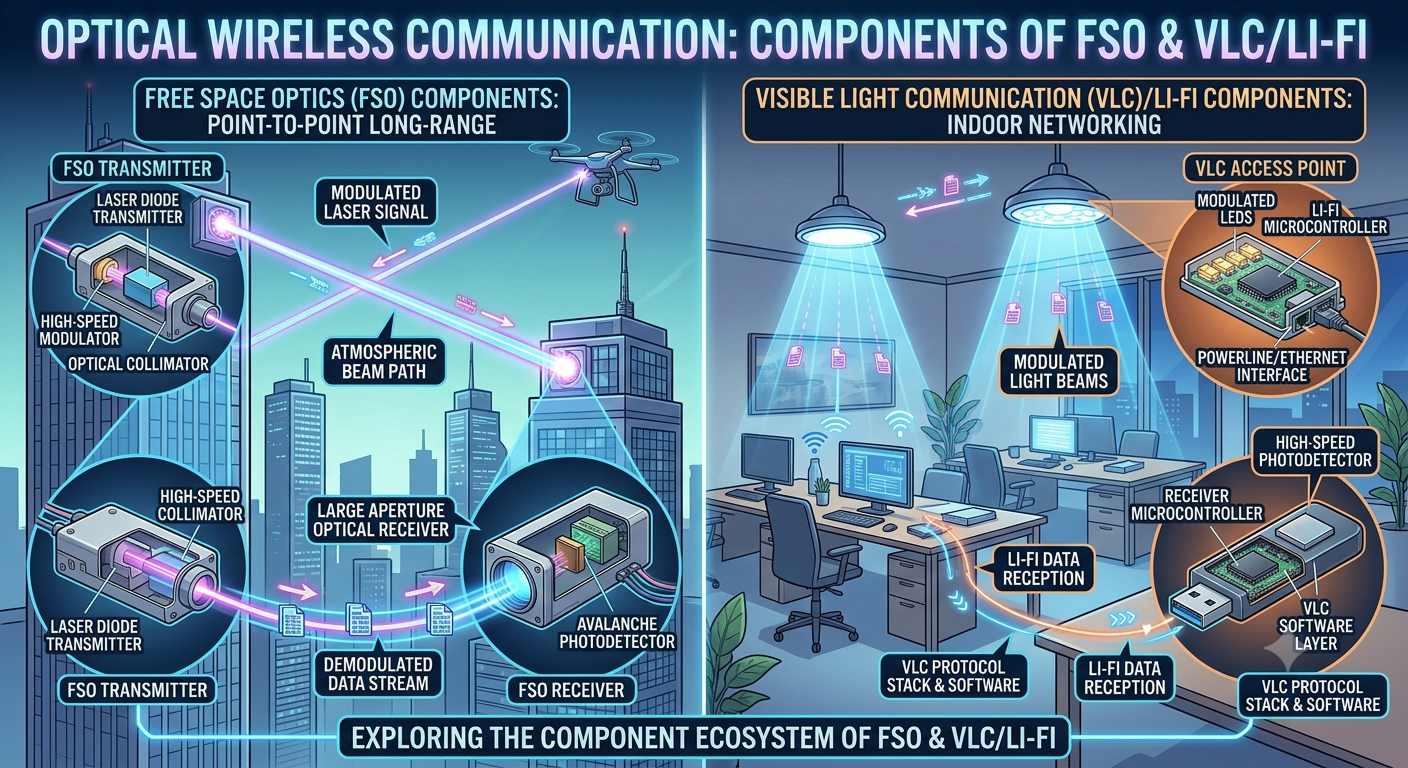
The rapid expansion of digital transformation, smart infrastructure, Industry 4.0, and next-generation wireless communications has accelerated demand for high-speed, secure, and energy-efficient networking technologies. Free Space Optics (FSO) and Visible Light Communication (VLC) , commonly known as Li-Fi (Light Fidelity), are emerging as revolutionary optical wireless communication technologies capable of complementing traditional Wi-Fi and cellular networks.
FSO transmits data using laser beams through free space without requiring fiber-optic cables, making it ideal for long-distance, high-bandwidth communication. Li-Fi, on the other hand, utilizes LED lighting infrastructure to transmit internet data through visible light, delivering ultra-fast wireless connectivity while simultaneously providing illumination.
Unlike conventional radio frequency (RF) communication, both technologies offer enhanced security, minimal electromagnetic interference, ultra-low latency, and exceptionally high bandwidth. These advantages are driving adoption across smart cities, defense, industrial automation, healthcare, aviation, transportation, education, and enterprise networking.
As organizations continue investing in digital infrastructure, FSO and Li-Fi are becoming integral components of future wireless ecosystems.
History of FSO and VLC / Li-Fi Technology
The concept of Free Space Optical communication has existed for several decades, initially serving military and satellite communications because of its secure, high-capacity transmission capabilities.
Visible Light Communication gained momentum after the widespread adoption of LED lighting systems. In 2011, researchers introduced Li-Fi, demonstrating that LED lights could transmit data at extremely high speeds while maintaining normal illumination.
Since then, continuous innovations in LED technology, photodetectors, optical modulation, AI-enabled networking, and semiconductor devices have transformed Li-Fi from a laboratory concept into a commercially viable communication technology suitable for enterprise and industrial applications.
Benefits of FSO and VLC / Li-Fi Technology
FSO and Li-Fi offer several advantages over traditional wireless communication technologies.
1. Ultra-High-Speed Connectivity
Optical communication delivers multi-gigabit data transfer rates, supporting bandwidth-intensive applications including 8K streaming, AR/VR, industrial automation, and AI workloads.
2. Enhanced Security
Light cannot penetrate solid walls, making Li-Fi significantly more secure than Wi-Fi for confidential communications.
3. Spectrum Availability
Unlike RF communication, visible light operates within an unlicensed spectrum, eliminating spectrum congestion.
4. Low Latency
FSO and Li-Fi enable near real-time communication, making them ideal for robotics, autonomous vehicles, and industrial automation.
5. Energy Efficiency
Li-Fi uses existing LED lighting infrastructure for communication, reducing energy consumption and improving sustainability.
6. Electromagnetic Interference Immunity
These technologies perform exceptionally well in environments where radio frequencies are restricted, including hospitals, aircraft, manufacturing plants, and defense facilities.
Current Market Size and Growth Trends of the FSO and VLC / Li-Fi Industry
According to MarketsandMarkets, the global FSO and VLC / Li-Fi market was valued at USD 2.78 billion in 2024 and is projected to reach USD 7.39 billion by 2029, growing at a CAGR of 21.6% during the forecast period (2024–2029).
Download PDF Brochure @ https://www.marketsandmarkets.com/pdfdownloadNew.asp?id=946
This remarkable growth reflects the increasing need for ultra-fast wireless communication, expanding smart infrastructure investments, and rapid digital transformation across industries.
Major growth factors include:
- Growing deployment of smart buildings and smart cities
- Rising investments in Industry 4.0
- Increasing demand for secure communication networks
- Expansion of 5G and future 6G ecosystems
- Rising adoption of connected healthcare solutions
- Growing use of optical communication in defense
- Increasing installation of LED lighting infrastructure
- Higher demand for wireless backhaul connectivity
The strong growth outlook highlights the increasing commercial viability of optical wireless communication technologies.
Key Drivers and Factors Influencing the Future of FSO and VLC / Li-Fi
Several technological and market trends are accelerating adoption worldwide.
Increasing Demand for High-Speed Data Transmission
The exponential growth of cloud computing, AI, IoT, and video streaming requires communication networks capable of delivering significantly higher bandwidth than conventional wireless technologies.
Expansion of Smart Cities
Governments are investing heavily in intelligent transportation systems, connected infrastructure, and smart lighting all of which create opportunities for Li-Fi deployment.
Industry 4.0 Adoption
Factories increasingly require secure, interference-free wireless communication for robots, autonomous vehicles, sensors, and industrial automation equipment.
Growing Defense Investments
Military organizations prefer optical wireless communication due to its resistance to RF jamming and interception.
Healthcare Digitalization
Hospitals are adopting Li-Fi because it eliminates electromagnetic interference with sensitive medical equipment.
Emerging Trends in FSO and VLC / Li-Fi Technology
Several breakthrough technologies continue advancing optical wireless communications.
AI-Powered Optical Network Optimization
Artificial intelligence dynamically manages optical communication links, improves bandwidth allocation, predicts network failures, and optimizes data transmission.
Hybrid RF–Li-Fi Networks
Organizations increasingly combine Wi-Fi and Li-Fi networks to maximize coverage, reliability, and throughput.
Intelligent Beam Steering
Advanced FSO systems use adaptive beam steering to maintain reliable communication even under changing environmental conditions.
Multi-Gigabit Li-Fi
Modern Li-Fi chipsets support multi-gigabit wireless connectivity suitable for enterprise networking and industrial applications.
Edge Computing Integration
Li-Fi networks increasingly support edge AI applications requiring ultra-low latency.
Digital Twin-Based Network Management
Digital twins simulate communication infrastructure, enabling predictive maintenance and network optimization.
Advanced Optical Components
Improved lasers, photodiodes, micro-LEDs, and optical modulators continue enhancing communication performance.
Opportunities and Challenges in the FSO and VLC / Li-Fi Market
Major Market Opportunities
The expanding adoption of optical wireless communication creates significant opportunities.
- Smart Manufacturing : Factories require high-speed wireless communication without RF interference.
- Smart Hospitals : Li-Fi enables secure communication while avoiding interference with medical equipment.
- Aviation : Aircraft cabins increasingly use Li-Fi for passenger connectivity and entertainment systems.
- Smart Transportation : Connected vehicles and intelligent traffic management benefit from secure optical communication.
- Defense and Homeland Security : Military communication systems increasingly utilize FSO for secure battlefield networking.
- Enterprise Networks : Organizations require secure indoor wireless connectivity for confidential operations.
Key Market Challenges
Despite its strong growth potential, the industry faces several challenges.
- Line-of-Sight Requirements : FSO communication requires a clear optical path between transmitter and receiver.
- Weather Sensitivity : Fog, rain, dust, and atmospheric turbulence can reduce FSO performance.
- Infrastructure Costs : Deploying optical communication infrastructure requires significant upfront investment.
- Limited Consumer Awareness : Many organizations remain unfamiliar with Li-Fi capabilities.
-
Standardization : Industry-wide interoperability standards continue evolving.
Innovations Transforming FSO and VLC / Li-Fi Technology
Several technological innovations are reshaping the future of optical wireless communication.
- AI-Based Adaptive Modulation : Machine learning algorithms continuously optimize transmission quality under changing conditions.
- Micro-LED Communication : Micro-LED technology enables significantly higher data transmission speeds than traditional LEDs.
- Optical MIMO Systems : Multiple optical transmitters and receivers improve throughput and network reliability.
- Quantum-Safe Optical Communications : Advanced encryption technologies enhance communication security for government and defense applications.
- Intelligent Network Orchestration : Software-defined networking enables automated optical communication management.
- Silicon Photonics : Integrated photonic chips reduce costs while improving communication efficiency.
- High-Capacity Optical Backhaul : FSO increasingly serves as an economical alternative to fiber deployment in urban and remote environments.
- Energy-Efficient Smart Lighting : Li-Fi integrates communication with LED lighting to reduce operational costs and energy consumption.
Future Applications and Industries Benefiting from FSO and VLC / Li-Fi
The future of Free Space Optics (FSO) and Visible Light Communication (VLC)/Li-Fi is closely tied to the growing demand for ultra-fast, secure, and energy-efficient wireless communication across multiple industries. As organizations continue to adopt digital transformation, Industry 4.0, artificial intelligence (AI), Internet of Things (IoT), and 5G/6G networks, optical wireless communication technologies are emerging as powerful alternatives and complements to conventional radio frequency (RF) systems. Their ability to deliver high-bandwidth, low-latency, interference-free connectivity makes them particularly valuable in environments where reliability, security, and network performance are critical. Increasing investments in smart cities, intelligent transportation, connected healthcare, and industrial automation are expected to significantly accelerate the deployment of FSO and Li-Fi solutions over the coming years.
Key Growth Drivers Across Future Applications
- Smart City Development – Expanding deployment of connected lighting and intelligent urban infrastructure.
- Industry 4.0 Adoption – Increasing use of automation, robotics, and smart factories.
- 5G/6G Network Expansion – Growing demand for high-speed wireless backhaul and last-mile connectivity.
- Healthcare Digitalization – Rising adoption of interference-free communication in hospitals and medical facilities.
- Defense & Homeland Security – Need for highly secure, low-latency optical communication systems.
- Smart Buildings – Integration of Li-Fi into intelligent lighting and building management systems.
- Connected Transportation – Growth of autonomous vehicles and intelligent transportation networks.
- Enterprise Digital Transformation – Increasing demand for secure, high-bandwidth indoor wireless connectivity.
- LED Lighting Adoption – Widespread installation of LED infrastructure enabling Li-Fi deployment.
- AI and IoT Integration – Growing use of AI, edge computing, and IoT devices requiring ultra-fast, reliable communication.
- Rising Data Traffic – Increasing demand for higher network capacity and bandwidth-intensive applications.
- Enhanced Cybersecurity Requirements – Preference for optical communication technologies that offer greater data security and reduced interception risks.
FSO and VLC / Li-Fi technologies are redefining the future of wireless communications by delivering ultra-fast, secure, and energy-efficient connectivity that complements existing RF-based networks. Their ability to provide high-bandwidth communication without spectrum congestion positions them as critical enablers of digital transformation across industries.
According to MarketsandMarkets, the global FSO and VLC / Li-Fi market is expected to grow from USD 2.78 billion in 2024 to USD 7.39 billion by 2029, reflecting a robust 21.6% CAGR. This growth is fueled by increasing investments in smart infrastructure, Industry 4.0, defense modernization, healthcare digitalization, and next-generation wireless networks.
As AI-driven network management, silicon photonics, micro-LED technologies, hybrid RF–Li-Fi architectures, and intelligent optical communication systems continue to evolve, FSO and Li-Fi are poised to become foundational technologies in future 5G, 6G, and smart city ecosystems. Organizations that embrace these innovations early will be well-positioned to achieve faster connectivity, enhanced security, improved operational efficiency, and long-term competitive advantage.
Find More Information on FSO and VLC / Li-Fi Technology Innovation @ https://www.marketsandmarkets.com/Market-Reports/visible-light-communication-market-946.html
80% of the Forbes Global 2000 B2B companies rely on MarketsandMarkets to identify growth opportunities in emerging technologies and use cases that will have a positive revenue impact.
- Food Packaging Market Size Set for Strong Growth Through 2030 Amid Rising Demand for Convenience Foods
- Crop Protection Chemical Market Size, Share & Growth Forecast (2025–2030)
- Mulch Films Market: Driving Sustainable Agriculture Through Innovation
- Agricultural Adjuvants Market Analysis, Trends, and Growth Outlook (2026–2031)
- Japan Enterprise Asset Management Market Growth: AI and Smart Infrastructure Drive Demand

