

HVAC in Data Center Technology Innovation: Key Trends, Growth Drivers and Opportunities
Introduction to HVAC in Data Center Technology
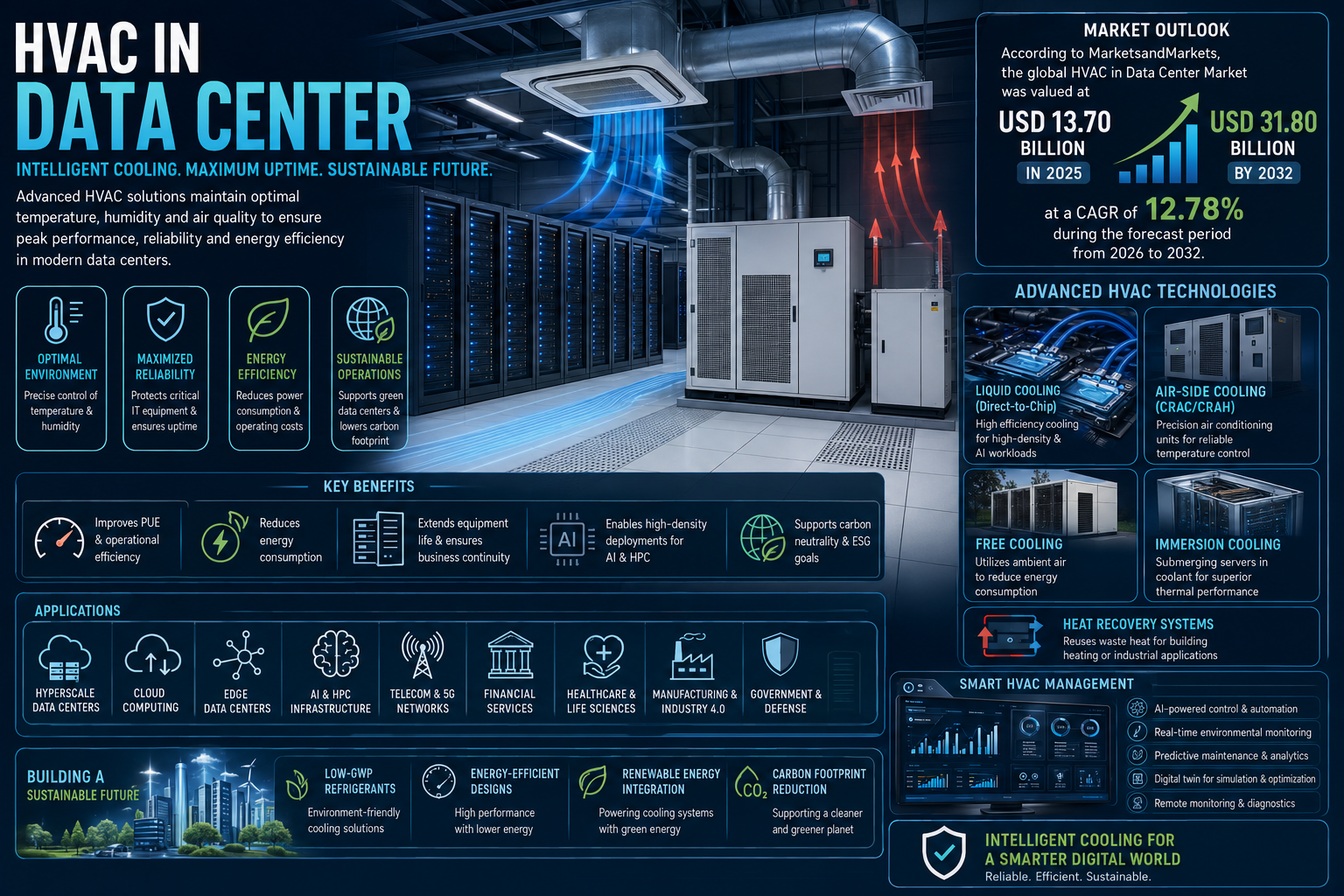
HVAC (Heating, Ventilation, and Air Conditioning) technology has become a critical component of modern data center infrastructure, ensuring optimal environmental conditions for high-performance computing systems. As data centers continue to expand in size and complexity due to cloud computing, artificial intelligence (AI), edge computing, and hyperscale deployments, efficient thermal management has become essential for maintaining equipment reliability, energy efficiency, and uninterrupted operations. Advanced HVAC systems regulate temperature, humidity, and airflow while reducing energy consumption and operational costs. With sustainability and carbon reduction becoming top priorities, innovative cooling technologies such as liquid cooling, free cooling, and AI-driven climate control are transforming the future of data center operations.
History of HVAC in Data Center Technology
The evolution of HVAC technology in data centers has closely followed the rapid advancement of computing infrastructure. Early data centers relied on conventional building air conditioning systems, which were often inefficient in handling high-density server environments. As computing workloads increased and server racks became more compact, specialized cooling solutions such as Computer Room Air Conditioning (CRAC) units and Computer Room Air Handlers (CRAH) were introduced to improve thermal management. Over time, the emergence of hyperscale data centers, cloud computing, and AI applications accelerated the development of intelligent HVAC systems featuring automated airflow optimization, liquid cooling, predictive maintenance, and AI-powered energy management. Today, modern HVAC solutions are designed to maximize cooling efficiency while supporting sustainability goals and reducing total operating costs.
Benefits of HVAC in Data Center Technology
Advanced HVAC systems are essential for maintaining optimal operating conditions within modern data centers, where even minor temperature fluctuations can impact server performance and reliability. Intelligent cooling technologies help reduce energy consumption, improve equipment lifespan, enhance operational efficiency, and support uninterrupted business continuity. By integrating AI-driven monitoring, predictive analytics, and energy-efficient cooling strategies, HVAC solutions enable data center operators to optimize performance while meeting sustainability and environmental objectives.
Key Benefits Include:
- Maintains optimal temperature, humidity, and airflow for mission-critical IT infrastructure.
- Improves server reliability, uptime, and overall equipment lifespan.
- Reduces operational costs through energy-efficient cooling technologies.
- Supports high-density computing environments, including AI, HPC, and cloud workloads.
- Enhances sustainability by lowering energy consumption and reducing carbon emissions.
- Enables predictive maintenance through AI-powered environmental monitoring.
- Improves Power Usage Effectiveness (PUE) and overall data center efficiency.
- Supports regulatory compliance and environmental standards for mission-critical facilities.
Current Market Size and Growth Trends of the HVAC in Data Center Market
The HVAC in Data Center market is witnessing significant growth as organizations continue investing in cloud computing, artificial intelligence, hyperscale data centers, and edge computing infrastructure. Rising server densities and increasing demand for high-performance computing have intensified the need for advanced thermal management solutions capable of delivering greater cooling efficiency while minimizing energy consumption. At the same time, sustainability initiatives and stricter environmental regulations are encouraging data center operators to adopt intelligent HVAC technologies, liquid cooling systems, AI-driven energy optimization, and environmentally friendly refrigerants to improve operational performance and reduce carbon footprints.
According to MarketsandMarkets, the global HVAC in Data Center market was valued at USD 13.70 billion in 2025 and is projected to reach USD 31.80 billion by 2032, growing at a CAGR of 12.78% during the forecast period (2026–2032).
Download PDF Brochure:
https://www.marketsandmarkets.com/pdfdownloadNew.asp?id=54488140
Key Market Growth Drivers
- Rapid expansion of hyperscale and colocation data centers worldwide.
- Increasing deployment of AI, machine learning, and high-performance computing (HPC) infrastructure.
- Growing adoption of cloud computing and edge data centers across industries.
- Rising demand for energy-efficient cooling technologies to reduce operating costs.
- Expansion of liquid cooling, immersion cooling, and free cooling solutions for high-density server environments.
- Increasing focus on green data centers, sustainability, and carbon emission reduction.
- Advancements in AI-powered HVAC monitoring, predictive maintenance, and intelligent airflow optimization.
Key Drivers and Factors Influencing the Future of HVAC in Data Center Technology
The future of HVAC in Data Center technology is being shaped by the rapid expansion of cloud computing, artificial intelligence (AI), edge computing, hyperscale facilities, and high-performance computing (HPC). As data centers handle increasingly power-intensive workloads, efficient thermal management has become essential to maintain uptime, improve energy efficiency, and reduce operational costs. At the same time, sustainability goals and stricter environmental regulations are encouraging operators to adopt intelligent HVAC systems, AI-powered cooling optimization, liquid cooling technologies, and low-carbon refrigeration solutions. These developments are transforming HVAC from a traditional cooling system into a smart, data-driven infrastructure that supports resilient and energy-efficient digital operations.
Key Growth Drivers
- Rapid expansion of hyperscale, colocation, and edge data centers across global markets.
- Increasing deployment of AI, machine learning, and high-performance computing (HPC) workloads requiring advanced cooling.
- Rising adoption of cloud computing and digital transformation initiatives across enterprises.
- Growing demand for energy-efficient HVAC systems to reduce operating expenses and improve Power Usage Effectiveness (PUE).
- Increasing implementation of liquid cooling, immersion cooling, and rear-door heat exchanger technologies for high-density server environments.
- Rising focus on sustainability, carbon neutrality, and green data center initiatives.
- Advancements in AI-powered environmental monitoring, predictive maintenance, and intelligent airflow management.
Emerging Trends in HVAC in Data Center Technology
HVAC technologies are evolving rapidly as data center operators seek smarter and more sustainable cooling strategies. Traditional air-based cooling systems are being complemented by liquid cooling, AI-driven automation, and real-time environmental monitoring to support increasingly dense computing environments. Modern HVAC platforms now leverage IoT sensors, Digital Twins, and predictive analytics to optimize cooling performance while minimizing energy consumption and operational costs.
Key Emerging Trends
- Growing adoption of liquid cooling and direct-to-chip cooling for AI servers and high-performance computing clusters.
- Increasing deployment of immersion cooling systems for ultra-high-density data center applications.
- Integration of AI and machine learning for automated cooling optimization and predictive energy management.
- Rising use of Digital Twin technology to simulate airflow, thermal performance, and HVAC efficiency before deployment.
- Expansion of free cooling and adiabatic cooling technologies to reduce dependence on conventional refrigeration.
- Growing implementation of IoT-enabled environmental monitoring for real-time temperature, humidity, and airflow control.
- Adoption of low Global Warming Potential (GWP) refrigerants to meet environmental regulations and sustainability targets.
Opportunities and Challenges in the HVAC in Data Center Market
The HVAC in Data Center market presents substantial opportunities as digital infrastructure continues expanding worldwide. The rapid growth of AI, cloud services, edge computing, and hyperscale facilities is creating strong demand for advanced cooling technologies capable of supporting higher rack densities and improving energy efficiency. However, operators must also address challenges related to rising energy costs, infrastructure complexity, sustainability requirements, and the significant capital investment associated with deploying next-generation HVAC systems.
Key Opportunities
- Increasing investment in hyperscale and edge data centers worldwide.
- Growing demand for cooling solutions supporting AI, HPC, and GPU-intensive workloads.
- Expansion of green data centers utilizing renewable energy and energy-efficient cooling technologies.
- Rising adoption of modular data centers requiring scalable HVAC infrastructure.
- Increasing demand for retrofit and modernization projects in existing data center facilities.
- Growth in smart building integration, enabling centralized monitoring and energy optimization.
Key Challenges
- High capital costs associated with advanced cooling infrastructure and liquid cooling deployment.
- Rising electricity prices impacting overall data center operating expenses.
- Managing thermal loads generated by increasingly dense AI and GPU server racks.
- Compliance with evolving environmental regulations governing refrigerants and carbon emissions.
- Integration challenges when upgrading legacy HVAC systems in existing facilities.
- Shortage of specialized professionals with expertise in advanced thermal management technologies.
Innovations and Advancements in HVAC in Data Center Technology
Continuous innovation is reshaping HVAC technology to meet the cooling demands of next-generation data centers. Artificial intelligence, predictive analytics, liquid cooling, and intelligent automation are enabling operators to optimize thermal performance while significantly reducing energy consumption. These advancements improve system reliability, maximize infrastructure utilization, and support long-term sustainability objectives across hyperscale, enterprise, and edge computing environments.
Recent Innovations
- AI-powered smart HVAC control systems that automatically adjust cooling based on server workloads and environmental conditions.
- Advanced direct-to-chip liquid cooling solutions for AI servers and high-density computing platforms.
- Deployment of immersion cooling technology to improve thermal efficiency while lowering energy consumption.
- Integration of Digital Twin platforms for virtual HVAC modeling, thermal simulation, and predictive maintenance.
- Cloud-based HVAC monitoring systems enabling remote diagnostics, performance analytics, and automated reporting.
- Intelligent airflow optimization using IoT sensors, variable-speed fans, and dynamic airflow management.
- Development of environmentally friendly HVAC systems utilizing low-GWP refrigerants, heat recovery technologies, and renewable energy integration.
Request Free Sample Report: https://www.marketsandmarkets.com/requestsampleNew.asp?id=54488140
Future Applications and Industries That Will Benefit from HVAC in Data Center Technology
HVAC in Data Center technology is expected to become one of the most important pillars of future digital infrastructure as demand for cloud computing, artificial intelligence (AI), high-performance computing (HPC), edge computing, and hyperscale data centers continues to accelerate. As server densities increase and next-generation processors generate significantly higher heat loads, traditional cooling methods will increasingly be complemented by AI-driven thermal management, liquid cooling, Digital Twin simulation, and intelligent energy optimization. Future HVAC systems will focus not only on maintaining optimal operating conditions but also on reducing energy consumption, improving sustainability, and supporting carbon-neutral data center operations. These innovations will enable organizations to build highly efficient, resilient, and environmentally responsible digital infrastructure.
Key Future Applications
- Hyperscale Data Centers: Advanced HVAC systems will support ultra-large cloud campuses by delivering intelligent cooling, automated airflow optimization, and energy-efficient thermal management for thousands of high-density server racks.
- Artificial Intelligence (AI) & High-Performance Computing (HPC): AI clusters and GPU-intensive workloads will increasingly rely on direct-to-chip liquid cooling, immersion cooling, and precision HVAC systems capable of managing extreme thermal loads.
- Edge Data Centers: Compact, distributed edge facilities will require intelligent HVAC technologies with remote monitoring, predictive maintenance, and autonomous environmental control to ensure reliable operations in diverse geographic locations.
- Cloud Computing Infrastructure: Public, private, and hybrid cloud providers will deploy AI-enabled HVAC systems to maximize equipment uptime, improve cooling efficiency, and reduce operational costs across global data center networks.
- Telecommunications & 5G Networks: HVAC solutions will support telecom edge facilities, network operation centers, and 5G infrastructure by maintaining optimal environmental conditions for mission-critical communication equipment.
- Financial Services & Banking: Mission-critical financial institutions will implement advanced cooling technologies to ensure continuous availability of transaction processing systems, digital banking platforms, and disaster recovery facilities.
- Healthcare & Life Sciences: Hospitals, research organizations, and pharmaceutical companies will depend on energy-efficient HVAC systems to maintain stable operating environments for healthcare data centers, genomic research, and AI-powered medical applications.
- Government & Defense: Government agencies and defense organizations will adopt highly resilient HVAC infrastructures to protect classified data centers, cybersecurity operations, and mission-critical computing environments.
- Industrial & Manufacturing: Smart factories and Industry 4.0 facilities will deploy edge computing and industrial data centers supported by intelligent HVAC systems that ensure reliable operation of connected production equipment and AI-enabled manufacturing platforms.
- Colocation Data Centers: Multi-tenant facilities will utilize scalable HVAC technologies that provide customized cooling for diverse customer workloads while improving energy efficiency and reducing total operating costs.
As digital transformation continues across industries, HVAC technology will evolve into an intelligent infrastructure platform that combines AI, IoT, automation, and sustainable cooling solutions to support the next generation of data centers.
Conclusion: The Promising Future of HVAC in Data Center Technology
HVAC technology has become a strategic component of modern data center infrastructure, enabling organizations to maintain optimal environmental conditions while improving energy efficiency, operational reliability, and equipment longevity. As digital workloads continue to expand through artificial intelligence, cloud computing, edge computing, and high-performance computing, demand for intelligent cooling solutions will continue to rise. Modern HVAC systems are evolving beyond traditional cooling by incorporating AI-driven automation, predictive maintenance, Digital Twin simulation, liquid cooling, and advanced environmental monitoring to support increasingly complex computing environments.
Find More Information on HVAC in Data Center Technology Innovation @ https://www.marketsandmarkets.com/Market-Reports/data-center-hvac-market-54488140.html
80% of the Forbes Global 2000 B2B companies rely on MarketsandMarkets to identify growth opportunities in emerging technologies and use cases that will have a positive revenue impact.
- Food Packaging Market Size Set for Strong Growth Through 2030 Amid Rising Demand for Convenience Foods
- Crop Protection Chemical Market Size, Share & Growth Forecast (2025–2030)
- Mulch Films Market: Driving Sustainable Agriculture Through Innovation
- Agricultural Adjuvants Market Analysis, Trends, and Growth Outlook (2026–2031)
- Japan Enterprise Asset Management Market Growth: AI and Smart Infrastructure Drive Demand

