

Machine Safety Technology Innovation: Key Trends, Growth Drivers and Opportunities
Introduction to Machine Safety Technology
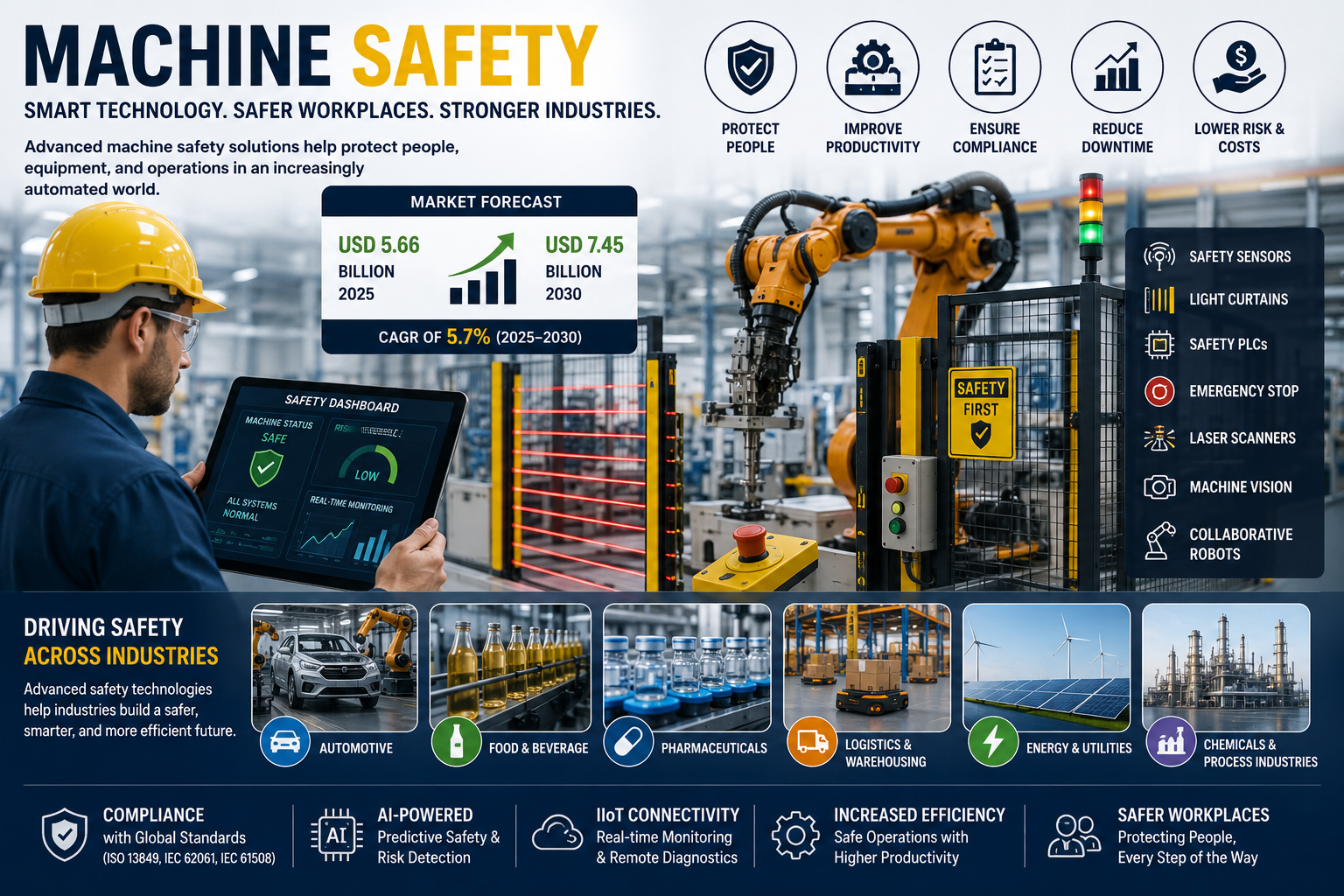
Machine safety technology plays a vital role in modern industrial automation by protecting workers, improving operational efficiency, and ensuring compliance with stringent workplace safety regulations. As Industry 4.0, AI, robotics, and smart manufacturing continue to evolve, intelligent safety systems are becoming essential for monitoring equipment, identifying hazards, and preventing accidents in real time. Key solutions such as safety sensors, safety switches, emergency stop devices, programmable safety controllers, light curtains, laser scanners, and collaborative robot safety systems help create safer work environments while minimizing downtime. Growing automation and increasing investments in smart factories are driving the adoption of machine safety technologies across industries including manufacturing, automotive, food & beverage, pharmaceuticals, logistics, and energy.
History of Machine Safety Technology
Machine safety has evolved from basic mechanical guards and manual safety procedures used during early industrialization to advanced, intelligent safety systems integrated into modern manufacturing. The introduction of electrical control systems, including emergency stop circuits, interlock switches, safety relays, and programmable logic controllers (PLCs), significantly improved workplace safety by reducing risks from human error and equipment failures. Today, Industry 4.0 technologies such as artificial intelligence (AI), the Industrial Internet of Things (IIoT), machine vision, digital twins, collaborative robots (cobots), predictive analytics, and cloud-connected safety systems enable real-time hazard detection, predictive maintenance, and automated responses, creating safer and more efficient industrial environments.
Benefits of Machine Safety Technology
Machine safety technology provides significant operational, financial, and regulatory advantages that extend far beyond accident prevention. Modern safety systems not only protect employees but also improve equipment performance, minimize production interruptions, reduce maintenance costs, and strengthen overall manufacturing efficiency. By integrating intelligent safety technologies into industrial operations, organizations can create safer workplaces while maintaining high levels of productivity and operational flexibility.
Key Benefits Include:
- Protects employees from workplace injuries and hazardous machinery.
- Reduces production downtime caused by equipment failures or accidents.
- Improves compliance with global machine safety and occupational safety regulations.
- Enables safe collaboration between workers and industrial robots.
- Enhances equipment reliability through continuous monitoring.
- Reduces maintenance costs through predictive diagnostics.
- Improves operational efficiency without compromising workplace safety.
- Strengthens business continuity by minimizing operational disruptions.
Current Market Size and Growth Trends of the Machine Safety Industry
The machine safety market is witnessing steady global growth, driven by increasing industrial automation, smart manufacturing initiatives, and stringent workplace safety regulations. As manufacturers adopt collaborative robots, autonomous production lines, and AI-powered equipment, demand for advanced safety solutions such as intelligent safety controllers, machine vision systems, laser scanners, and predictive safety analytics continues to rise. These technologies help organizations enhance worker safety, maintain operational efficiency, and comply with evolving international safety standards, making machine safety an essential component of modern industrial facilities.
According to MarketsandMarkets, the global machine safety market is projected to grow from USD 5.66 billion in 2025 to USD 7.45 billion by 2030, registering a CAGR of 5.7% during the forecast period.
Download PDF Brochure: https://www.marketsandmarkets.com/pdfdownloadNew.asp?id=1188
Several key factors are supporting this market growth:
- Increasing adoption of Industry 4.0 and smart manufacturing technologies.
- Rising deployment of industrial robots and collaborative robots (cobots).
- Growing focus on worker safety and occupational health regulations.
- Expansion of automated production lines across manufacturing industries.
- Increasing implementation of AI, machine vision, and Industrial IoT for intelligent safety monitoring.
- Rising investments in predictive maintenance and digital factory initiatives.
- Strong demand for regulatory compliance with international machine safety standards.
Key Drivers and Factors Influencing the Future of Machine Safety Technology
- Industry 4.0 and smart manufacturing are driving demand for intelligent machine safety systems that integrate with IIoT, AI, cloud computing, and connected production environments to ensure real-time monitoring and safer operations.
- Growing adoption of industrial robots and collaborative robots (cobots) is increasing the need for advanced safety technologies such as laser scanners, machine vision, force-limiting sensors, safety PLCs, and real-time motion control to enable safe human-machine collaboration.
- Stricter workplace safety regulations and compliance with standards such as ISO 13849, IEC 62061, IEC 61508, and OSHA are encouraging manufacturers to invest in advanced safety solutions that reduce risks, improve reliability, and meet regulatory requirements.
- AI, machine learning, predictive maintenance, and digital twin technologies are transforming machine safety by enabling continuous equipment monitoring, early hazard detection, risk simulation, and automated responses to minimize downtime and improve operational efficiency.
- Labor shortages and rising operational costs are accelerating industrial automation, making machine safety technologies essential for protecting workers while supporting higher productivity and long-term manufacturing competitiveness.
Emerging Trends in Machine Safety Technology
- AI-powered safety systems are enhancing workplace safety by analyzing real-time operational data to detect anomalies, predict hazards, and recommend corrective actions before incidents occur.
- Industrial IoT (IIoT) and connected safety ecosystems enable real-time communication between machines, sensors, controllers, and operators, improving monitoring, predictive maintenance, remote diagnostics, and incident response.
- Machine vision and AI-based image recognition are increasingly used to monitor operator behavior, verify safety compliance, inspect production processes, and identify unsafe conditions across industries.
- Collaborative robotics (cobots) are driving demand for advanced safety features such as force sensors, collision detection, speed monitoring, and intelligent motion control, enabling safe human-machine collaboration.
- Cybersecurity and digital twin technologies are becoming essential, with secure communication protocols protecting connected safety systems while digital twins allow manufacturers to simulate safety scenarios, optimize workflows, and identify risks before deployment.
Opportunities and Challenges in the Machine Safety Market
- Growing automation, smart factories, and industrialization are creating strong opportunities for machine safety solutions across automotive, electronics, pharmaceuticals, food & beverage, logistics, chemicals, and renewable energy industries.
- The rising adoption of collaborative robots (cobots), predictive maintenance, digital twins, and cloud-based safety platforms is driving demand for intelligent safety sensors, vision systems, programmable safety controllers, AI-powered analytics, and remote monitoring solutions.
- High implementation costs and the complexity of integrating advanced safety systems with legacy manufacturing equipment remain major barriers, particularly for small and medium-sized enterprises (SMEs).
- A shortage of skilled professionals capable of designing, deploying, and maintaining advanced safety systems limits adoption and highlights the need for workforce training and upskilling.
- Increasing connectivity introduces cybersecurity risks, making secure communication, cyber threat protection, and compliance with functional safety standards essential for ensuring reliable and safe industrial operations.
Innovations and Advancements in Machine Safety Technology
- Artificial intelligence (AI) is transforming machine safety through predictive analytics, automated hazard detection, and intelligent decision-making that helps prevent accidents and reduce downtime.
- Advanced machine vision systems use AI-enabled cameras for real-time monitoring of operator behavior, PPE compliance, machine status, and production quality, enabling autonomous safety responses.
- Next-generation Safety PLCs offer faster processing, enhanced diagnostics, and seamless integration with industrial automation systems, improving centralized safety management and operational efficiency.
- Wearable safety technologies, including smart helmets, connected safety vests, biometric sensors, and location-tracking devices, enhance worker protection through real-time health and environmental monitoring.
- Digital twins, edge computing, cloud technologies, robotics, and cybersecurity are driving the next generation of intelligent machine safety, enabling virtual safety testing, optimized production, secure operations, and continuously adaptive manufacturing environments.
Future Applications and Industries That Will Benefit from Machine Safety Technology
- Automotive and industrial manufacturing will remain major adopters, using advanced safety technologies such as safety PLCs, laser scanners, light curtains, and AI-enabled monitoring to support safe human-machine collaboration and high-speed automated production.
- Smart factories and industrial automation will increasingly rely on machine safety systems integrated with AI, IIoT, and predictive maintenance to enhance worker safety, improve equipment reliability, and maximize operational efficiency.
- Food & beverage and pharmaceutical industries will deploy intelligent safety solutions to protect workers operating automated equipment while ensuring compliance with strict quality, hygiene, and regulatory standards.
- Logistics and warehousing will benefit from machine safety technologies that enable the safe operation of autonomous mobile robots (AMRs), automated storage and retrieval systems (AS/RS), conveyor networks, and warehouse automation.
- Energy and utilities, including power generation, renewable energy, substations, and oil & gas facilities, will leverage advanced machine safety systems to protect critical infrastructure, reduce operational risks, and improve maintenance and asset reliability.
Additional industries expected to benefit significantly include:
- Electronics & Semiconductor Manufacturing
- Chemical Processing
- Mining & Metals
- Packaging
- Pulp & Paper
- Aerospace & Defense
- Renewable Energy
- Construction Equipment Manufacturing
- Data Centers
- Smart Infrastructure Projects
As collaborative robotics, AI-powered automation, and digital manufacturing continue to expand, machine safety technology will become increasingly integrated into every stage of industrial operations, enabling organizations to achieve safer workplaces, greater productivity, and sustainable long-term growth.
Conclusion: The Promising Future of Machine Safety Technology
Machine safety technology is becoming a strategic pillar of modern industrial operations, driven by the convergence of Industry 4.0, AI, collaborative robotics, IIoT, predictive analytics, and digital transformation. Beyond regulatory compliance, intelligent safety systems enhance worker protection, reduce downtime, improve operational efficiency, lower maintenance costs, and strengthen business resilience. According to MarketsandMarkets, the global machine safety market is projected to grow from USD 5.66 billion in 2025 to USD 7.45 billion by 2030, at a CAGR of 5.7% during the forecast period. As innovations in AI, machine vision, edge computing, digital twins, connected safety devices, and cybersecurity continue to advance, machine safety will play an increasingly critical role in enabling sustainable, efficient, and future-ready manufacturing environments.
Download Sample Research Report for Machine Safety Technology Innovation @ https://www.marketsandmarkets.com/Market-Reports/machine-safety-market-1188.html
80% of the Forbes Global 2000 B2B companies rely on MarketsandMarkets to identify growth opportunities in emerging technologies and use cases that will have a positive revenue impact.
- Food Packaging Market Size Set for Strong Growth Through 2030 Amid Rising Demand for Convenience Foods
- Mulch Films Market: Driving Sustainable Agriculture Through Innovation
- Agricultural Adjuvants Market Analysis, Trends, and Growth Outlook (2026–2031)
- Crop Protection Chemical Market Size, Share & Growth Forecast (2025–2030)
- Japan Enterprise Asset Management Market Growth: AI and Smart Infrastructure Drive Demand

