ADAS penetration in the light vehicle parc is projected to rise from 52.9% in 2025 to 80.0% by 2030, representing ~970.2 million vehicles. This transition is driven by accelerated OEM integration of ADAS systems, greater standardization of safety requirements, heightened demand for intelligent driving experiences, and the rapid deployment of software-defined vehicle architectures across both premium and mass-market segments.
The implications for the aftermarket industry are profound. As vehicles become safer, smarter, more connected, and increasingly autonomous, the aftermarket will gradually shift from labor-intensive mechanical repair to software diagnostics, sensor calibration, AI-driven predictive maintenance, and data monetization services.
Reinvention of Aftermarket
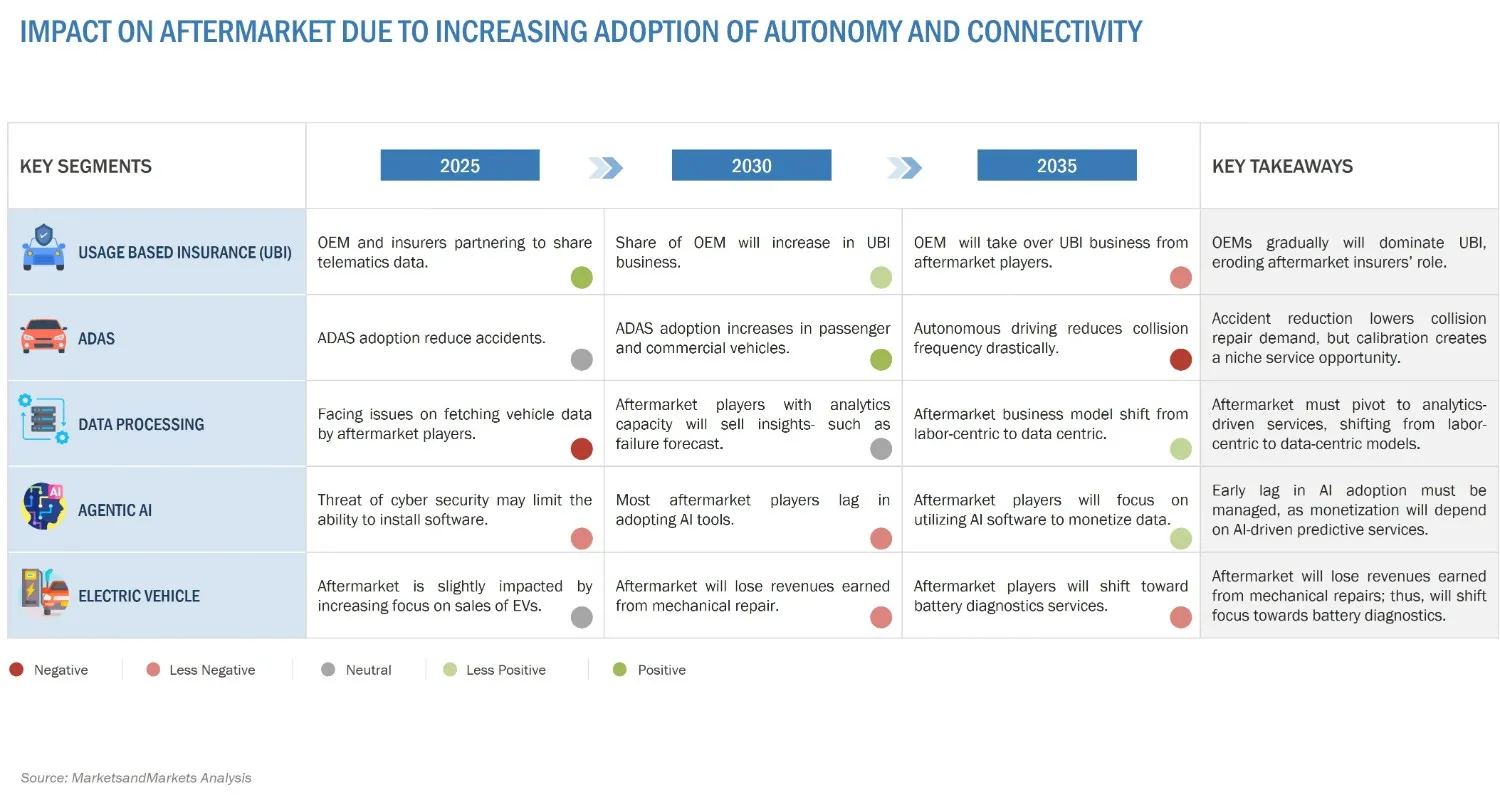
As ADAS adoption rises across passenger and commercial vehicles, accident frequency is expected to drop significantly, reducing traditional collision repair demand while increasing the need for sensor recalibration services.
By 2035, OEMs are expected to dominate Usage-Based Insurance (UBI) via connected telematics platforms, reducing reliance on independent insurers and aftermarket service providers.
Even minor repairs on ADAS-equipped vehicles now require recalibrating radar, LiDAR, and cameras, creating a premium service segment for certified workshops and technology-enabled garages.
As EV penetration rises, aftermarket revenues from engine-related repairs will decline, while demand for battery analytics, thermal management services, and charging-system diagnostics will rise rapidly.
Regional Outlook
Europe is leading the global shift toward ADAS-centric mobility. Strong regulatory frameworks and rapid adoption of premium vehicles are accelerating the deployment of ADAS and semi-autonomous technologies across major European markets.
-
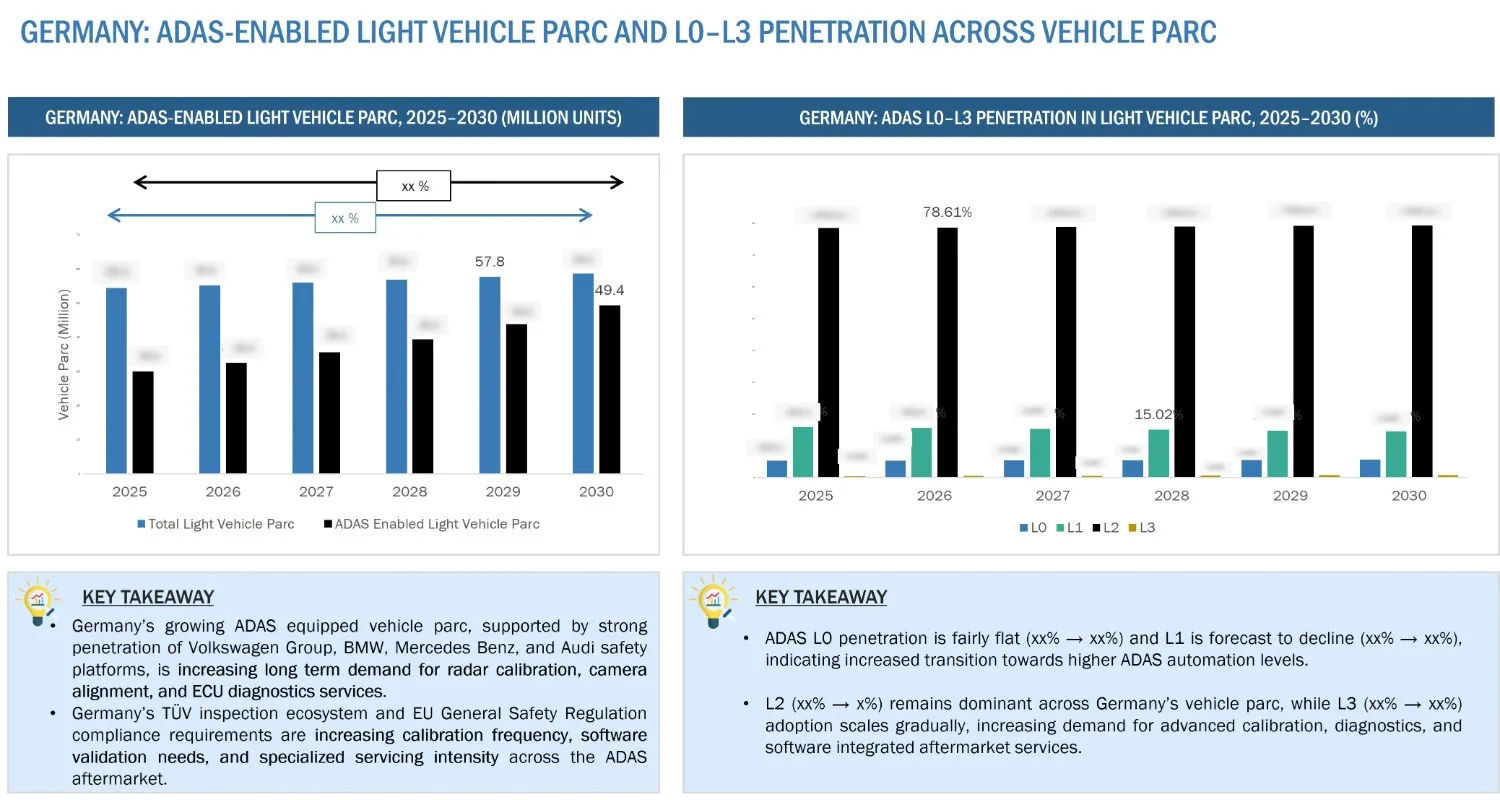
Germany is projected to become Europe’s largest ADAS-enabled vehicle market by 2030, supported by premium OEM adoption and tighter safety regulations that require radar, camera, and LiDAR-based driver assistance systems.
-
The UK is expected to reach nearly 95.0% ADAS-enabled vehicle penetration by 2030, signaling how quickly software-defined mobility is becoming mainstream across developed automotive markets.
For the aftermarket industry, this means vehicles are no longer simply mechanical products. They are becoming sensor-rich computing platforms that require constant software oversight, electronic diagnostics, and connectivity management. The transition becomes even more significant when considering the global autonomy mix entering vehicle production.
ADAS-equipped vehicles with Level 0 to Level 4 capabilities are projected to account for nearly 90.8% of global light vehicle sales by 2025, representing more than 60 million units. Level 2 autonomy is rapidly emerging as the industry standard as OEMs compete to differentiate themselves through intelligent driving technologies. This growth is fundamentally altering aftermarket service complexity.
A decade ago, replacing a bumper or windshield was a straightforward mechanical task. Today, the same repair on an ADAS-equipped vehicle may require recalibrating radar systems, LiDAR modules, front-facing cameras, ultrasonic sensors, steering angle sensors, and lane-assistance software. Even minor collisions increasingly require software validation after hardware replacement.
Tesla vehicles clearly demonstrate this transformation. A simple windshield replacement often requires recalibrating Autopilot camera systems. Mercedes-Benz DRIVE Pilot, BMW Highway Assistant, and Ford BlueCruise systems also depend on precise sensor alignment to maintain operational safety and compliance. As a result, the future aftermarket technician may increasingly resemble a software engineer or electronics specialist rather than a traditional mechanic.
Emergence of ADAS Sensors as Aftermarket Goldmine
Rising sensor complexity and the growing adoption of autonomous driving are unlocking high-value revenue streams across the global aftermarket.
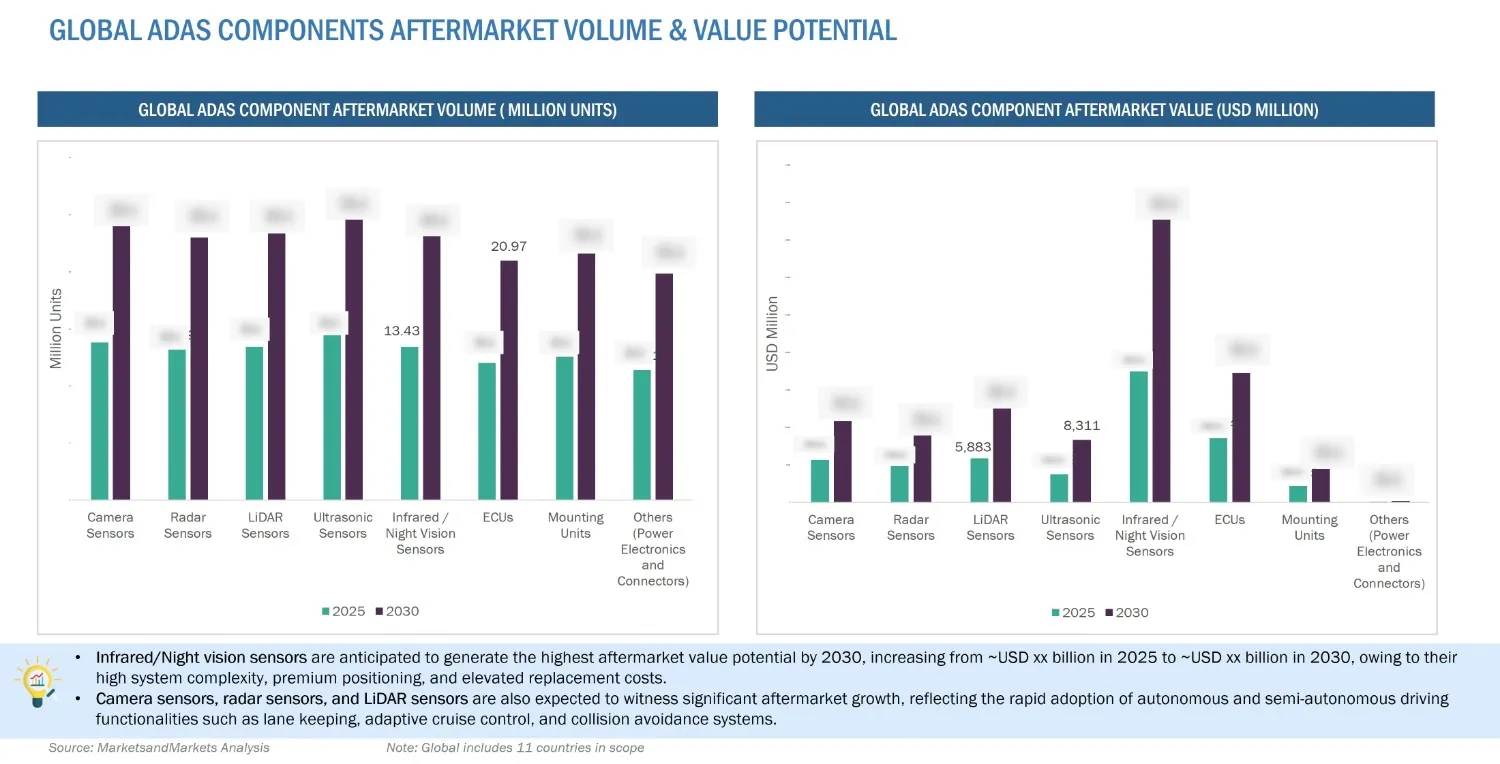
Infrared and night vision sensors are projected to be the largest aftermarket revenue opportunity, growing from USD 17.5 billion in 2025 to USD 38.8 billion by 2030, driven by high replacement costs and increasing premium vehicle integration.
The growing deployment of radar and LiDAR technologies in Level 2 and Level 3 vehicles is accelerating demand for advanced calibration, alignment, and diagnostic services in the aftermarket ecosystem.
Ultrasonic sensor aftermarket demand is projected to rise sharply as automated parking, proximity sensing, and low-speed autonomous maneuvering technologies become more integrated.
OEMs’ Transition Toward Control Future Mobility Ecosystem
-
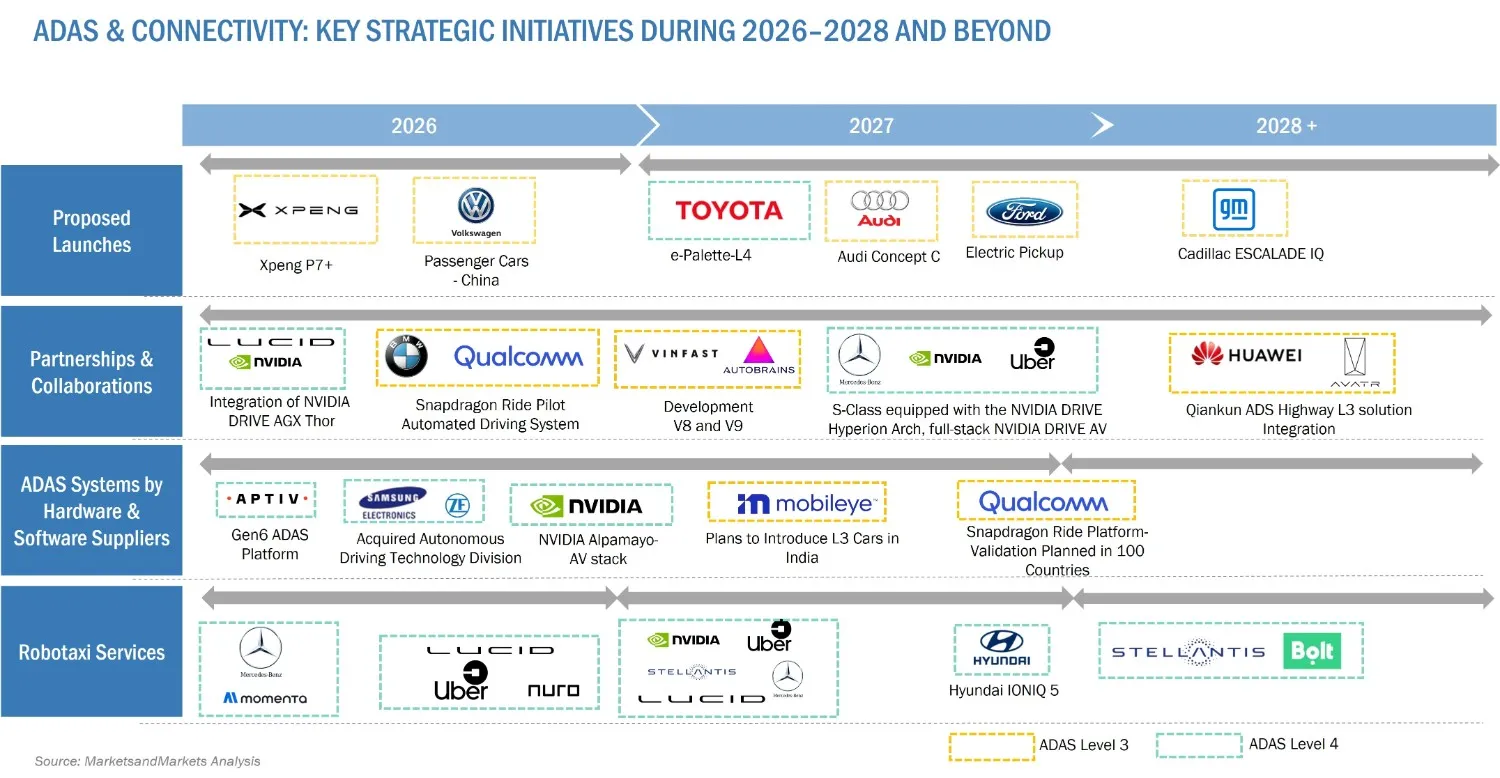
Leading global OEMs are no longer competing solely on vehicle performance or manufacturing scale—they are now competing on software ecosystems, autonomous driving capabilities, AI integration, and connected mobility platforms. The race toward software-defined vehicles is accelerating strategic partnerships across the automotive and technology industries, fundamentally reshaping the aftermarket landscape.
-
Tesla continues to lead the industry’s software-first transformation through rigorous deployment of Full Self-Driving (FSD) capabilities, Robotaxi commercialization initiatives, OTA software monetization, and AI-powered autonomous driving development. This approach is redefining vehicles as continuously evolving software platforms rather than static automotive products.
-
Mercedes-Benz is aggressively expanding its autonomous mobility strategy by collaborating with NVIDIA to integrate the DRIVE Hyperion autonomous driving platforms into next-generation premium vehicles. The company is also scaling DRIVE Pilot deployments across key global markets and strengthening software-defined vehicle architectures and Level 3 autonomous driving capabilities.
-
BMW is accelerating its intelligent mobility roadmap through strategic collaboration with Qualcomm and other technology providers to develop next-generation automated driving architectures, advanced cockpit electronics, and AI-powered driver-assistance platforms. The company is increasingly positioning software and connectivity as core differentiators across premium vehicle segments.
New Revenue Opportunities for Aftermarket Players
-
As connected vehicle penetration accelerates globally, aftermarket players are expected to generate new recurring revenue streams through vehicle health monitoring, driver behavior analytics, predictive service platforms, fleet telematics, and usage-based insurance integrations, all powered by real-time vehicle data ecosystems.
-
OTA software upgrades are gradually transforming the aftermarket business model from one-time repair transactions to subscription-driven digital service ecosystems, enabling continuous feature upgrades, remote diagnostics, software maintenance, and performance optimization.
-
AI-powered predictive maintenance platforms are expected to significantly reduce unexpected vehicle downtime by detecting component failures before breakdowns occur, creating high-growth opportunities in remote diagnostics, predictive repair scheduling, and cloud-based maintenance services.
Mechanical repairs will not disappear entirely, but their dominance is steadily declining. In their place, software intelligence, predictive analytics, AI diagnostics, cybersecurity, sensor calibration, and connected service ecosystems are becoming the new pillars of aftermarket profitability. The future aftermarket winner will not simply be the company with the largest repair network or the cheapest labor rates. It will be the company that best understands vehicle software, connectivity, AI-driven diagnostics, and data monetization. The industry is moving from wrenches to algorithms, and that shift has already begun.
Personalize This Research
- Triangulate with your Own Data
- Get Data as per your Format and Definition
- Gain a Deeper Dive on a Specific Application, Geography, Customer or Competitor
- Any level of Personalization
Request A Free Customisation
Let Us Help You
- What are the Known and Unknown Adjacencies Impacting the Impact of ADAS and Autonomous Vehicles on Automotive Aftermarket
- What will your New Revenue Sources be?
- Who will be your Top Customer; what will make them switch?
- Defend your Market Share or Win Competitors
- Get a Scorecard for Target Partners
Customized Workshop Request













Growth opportunities and latent adjacency in Impact of ADAS and Autonomous Vehicles on Automotive Aftermarket