The automotive E/E architecture has evolved from mechanical and relay-based electrical systems to highly software-centric vehicle platforms. Distributed architectures introduced during the 1990–2005 period relied on 70–100+ ECUs connected through CAN and LIN networks, resulting in increasing wiring complexity, weight, and integration costs. This was followed by ECU consolidation and domain-based architectures, which grouped functions into dedicated domains such as powertrain, body, and ADAS to improve system integration and scalability. As vehicle electronics and software content continued to expand, the limitations of domain architectures became increasingly apparent.
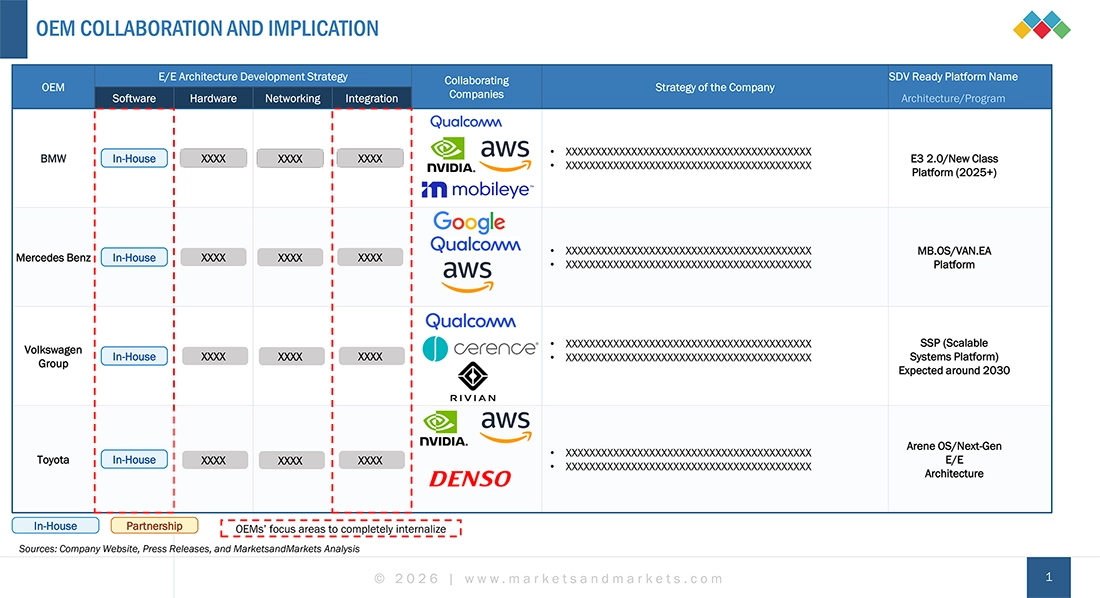
The industry is now transitioning toward zonal and various forms of centralized architectures to address growing software complexity, electrification requirements, and advanced ADAS workloads. Traditional domain-based systems depend on extensive wiring harnesses and numerous controllers, making them costly, heavy, and difficult to scale. Zonal architectures consolidate functions into regional controllers, reducing wiring harness length by 30–40%, lowering vehicle weight, simplifying manufacturing, and enabling tighter integration of low-voltage and high-voltage systems. This architectural shift is becoming a key enabler for software-defined vehicles (SDVs), particularly as OEMs seek to support increasingly sophisticated vehicle functions and faster software deployment cycles.
Beyond hardware optimization, zonal and centralized compute architectures are transforming the vehicle into a software-driven platform capable of generating value throughout its lifecycle. High-performance computing platforms enable real-time processing for ADAS and autonomous driving applications, while supporting over-the-air (OTA) updates, feature-on-demand services, and subscription-based business models. A unified E/E architecture also improves scalability across vehicle programs, reduces engineering duplication, and strengthens OEM control over software, data, and cybersecurity. As a result, competitive differentiation is shifting away from mechanical hardware toward compute capability, software ecosystems, and the ability to continuously deliver new features and services after the vehicle is sold.
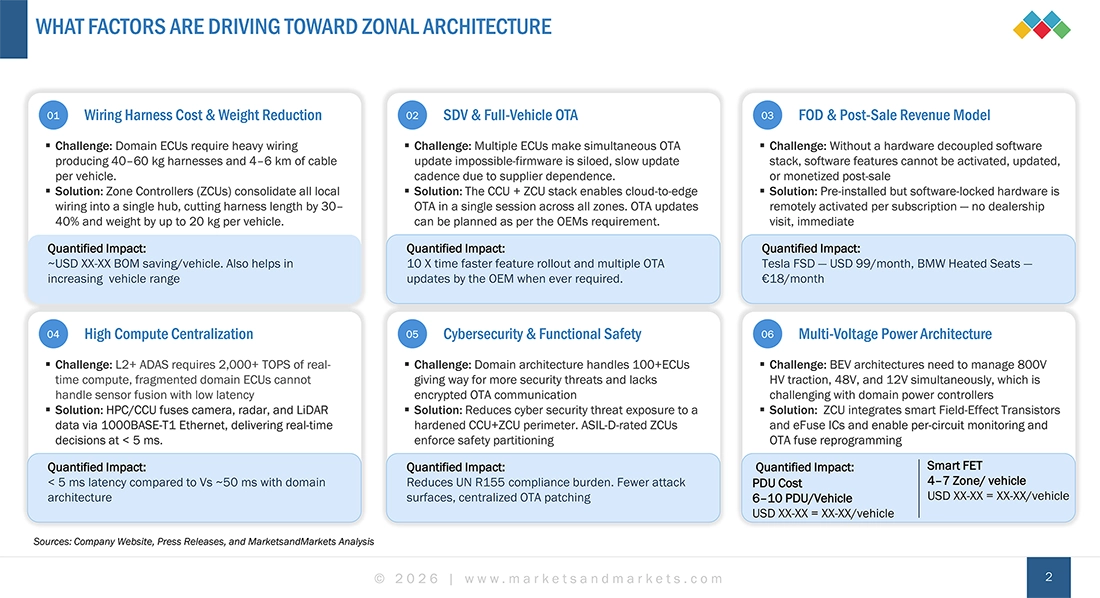
The global automotive industry is converging toward zonal and various forms of centralized E/E architectures, with virtually every major OEM expected to complete this transition by 2030. Emerging SDV leaders such as Tesla and Rivian are setting the benchmark, targeting fully centralized architectures between 2026 and 2028, while traditional OEMs, including BMW, Mercedes-Benz, GM, Ford, and Volkswagen, are progressively migrating through intermediate domain and zonal stages. As a result, E/E architecture is no longer a hardware integration exercise but a foundational business strategy that determines how effectively OEMs can deploy software, scale features, and monetize vehicle capabilities over their lifecycle.
By 2030, the primary differentiators among OEMs will not be the adoption of zonal architecture itself, but rather the sophistication of their compute platforms, software stacks, operating systems, and semiconductor strategies. Vehicles will increasingly be built on unified, scalable architectures capable of supporting multiple brands, vehicle segments, and powertrains through a common software and hardware foundation. This shift will reduce engineering duplication, accelerate feature deployment, and enable continuous over-the-air updates while improving cost efficiency across product portfolios. Consequently, competitive advantage is expected to move away from traditional mechanical performance toward computing power, AI capabilities, software ownership, and ecosystem control, positioning centralized SDV platforms as the cornerstone of future automotive innovation and profitability.
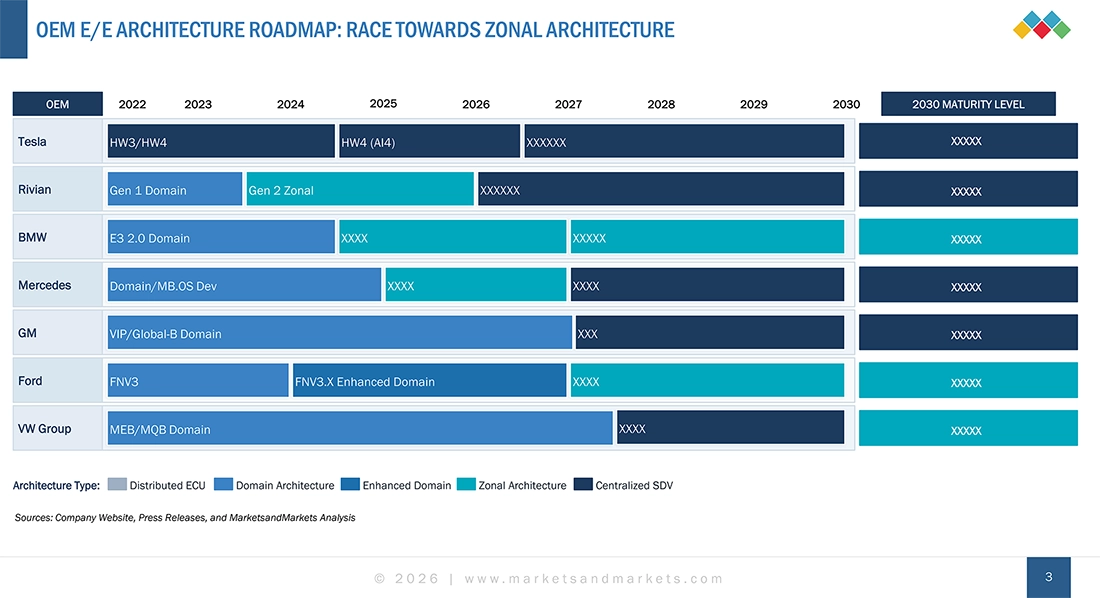
OEMs are increasingly reassessing their traditional dependence on Tier-1 suppliers and technology partners as software-defined vehicles (SDVs) become the primary source of differentiation and profitability. While collaboration with semiconductor vendors, software companies, cloud providers, and Tier-1 suppliers remains essential for accelerating innovation and reducing development risk, OEMs are progressively internalizing key software and hardware capabilities to gain greater control over their technology roadmap. Historically, OEMs outsourced large portions of E/E architecture, ECU development, and embedded software, which resulted in fragmented systems, limited software ownership, and dependence on supplier update cycles. In the SDV era, this model constrained the ability to deploy over-the-air updates, monetize digital services, manage vehicle data, and create a seamless user experience. Consequently, leading OEMs are investing heavily in proprietary operating systems, middleware, centralized compute platforms, and even custom silicon strategies to secure ownership of the technology stack. The objective is not to eliminate partnerships, but to shift suppliers toward providing enabling technologies and development support while retaining control over the software architecture, data, cybersecurity, and customer-facing features. This transition enables OEMs to capture a larger share of recurring software revenues, accelerate feature deployment, reduce integration complexity, and build sustainable competitive advantages that extend well beyond the initial vehicle sale.
CONCLUSION
By 2030, the automotive industry’s value pool will shift decisively from hardware integration toward software ownership, making control of the operating system, middleware, and compute platform a critical competitive advantage. As vehicles evolve into software-defined platforms, OEMs that own and control their software stack will be best positioned to monetize over-the-air (OTA) upgrades, feature-on-demand services, data-driven applications, and subscription-based offerings throughout a vehicle's 15–20-year lifecycle. The strategic focus is therefore moving beyond vehicle manufacturing toward platform ownership, where software capabilities and ecosystem control determine long-term profitability. OEMs that fail to establish a clear software and silicon strategy risk becoming hardware assemblers while platform owners capture a disproportionate share of post-sale revenue streams.
For Tier-1 suppliers, the transition to zonal and centralized architectures represents a structural transformation of the traditional ECU business model. As ECU counts decline from more than 100 controllers to a handful of high-performance computing nodes and zonal gateways, revenue opportunities tied to standalone hardware are expected to contract. Future growth will increasingly depend on providing software integration, zonal control modules, network management solutions, functional safety software, and advanced middleware capabilities. Suppliers that successfully reposition themselves as software and platform partners will remain strategically relevant, while those dependent on legacy ECU volume growth may face margin pressure and market consolidation.
Meanwhile, semiconductor and software platform providers are emerging as some of the biggest beneficiaries of the SDV transition. Automotive is rapidly becoming a compute-intensive industry where high-performance SoCs, AI accelerators, operating systems, and developer ecosystems form the foundation of vehicle differentiation. Compute capability is becoming a key benchmark, with next-generation autonomous and intelligent vehicle platforms requiring thousands of TOPS of processing power to support AI-driven functions. Beyond silicon performance, the battle is increasingly shifting toward software ecosystems, where stable operating systems, middleware frameworks, and developer-friendly environments can create powerful network effects. As a result, future industry leadership will be defined not only by vehicle engineering excellence but by the ability to control the full technology stack—from silicon and software to data and digital services.
Personalize This Research
- Triangulate with your Own Data
- Get Data as per your Format and Definition
- Gain a Deeper Dive on a Specific Application, Geography, Customer or Competitor
- Any level of Personalization
Request A Free Customisation
Let Us Help You
- What are the Known and Unknown Adjacencies Impacting the Future of Vehicle E/
- What will your New Revenue Sources be?
- Who will be your Top Customer; what will make them switch?
- Defend your Market Share or Win Competitors
- Get a Scorecard for Target Partners
Customized Workshop Request













Growth opportunities and latent adjacency in Future of Vehicle E/