The research process for this technical, market-oriented, and commercial study of the data center semiconductor market included the systematic gathering, recording, and analysis of data on companies operating in the market. It involved extensive use of secondary sources, directories, and databases (Factiva, OANDA) to identify and collect relevant information. In-depth interviews were conducted with primary respondents, including experts from core and related industries and preferred manufacturers, to obtain and verify critical qualitative and quantitative information and to assess the market's growth prospects. Key players in the data center semiconductor market were identified through secondary research, and their market rankings were determined through both primary and secondary research. This included studying the annual reports of top players and interviewing key industry experts, such as CEOs, directors, and marketing executives.
Secondary Research
In the secondary research process, various secondary sources were consulted to identify and collect information relevant to this study. Secondary sources included annual reports, press releases, and investor presentations of companies; white papers, certified publications, and articles by recognized authors; directories; and databases. Secondary research was conducted primarily to obtain key information on the industry's supply and value chains; a comprehensive list of key players; and market segmentation by industry trends, geographic markets, and key developments from market- and technology-oriented perspectives.
Primary Research
In the primary research process, primary sources from the supply and demand sides were interviewed to obtain qualitative and quantitative information for this report. Primary sources from the supply side included experts such as CEOs, vice presidents, marketing directors, technology and innovation directors, subject-matter experts, consultants, and key executives from major companies and organizations operating in the data center semiconductor market.
After the complete market engineering process (market statistics calculations, market breakdown, market size estimates, market forecasting, and data triangulation), extensive primary research was conducted to gather information and verify and validate the critical market numbers.
Several primary interviews were conducted with experts from the demand and supply sides across four major regions—North America, Europe, Asia-Pacific, and RoW. Approximately 25% of the primary interviews were conducted with the demand side and 75% with the supply side. This primary data was collected through questionnaires, emails, and telephone interviews.
BREAKDOWN OF PRIMARY INTERVIEW PARTICIPANTS
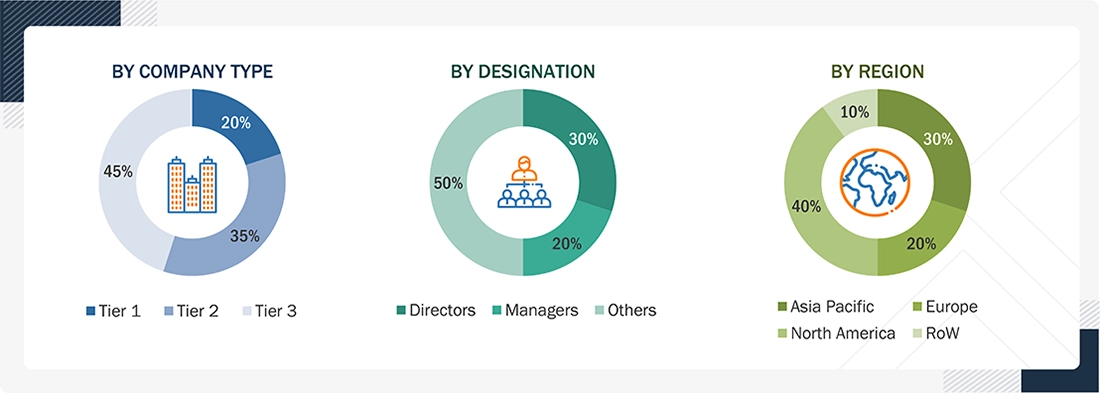
Notes: Other designations include technology heads, media analysts, sales managers, marketing managers, and product managers.
The three tiers of the companies are based on their total revenues as of 2025; Tier 1: >USD 1 billion, Tier 2: USD 500 million–1 billion, and Tier 3: <USD 500 million.
To know about the assumptions considered for the study, download the pdf brochure
Market Size Estimation
In the comprehensive market engineering process, top-down and bottom-up approaches, along with several data triangulation methods, were used to estimate and forecast the overall market segments and subsegments listed in this report. Key players in the market were identified through secondary research, and their market shares in the respective regions were determined through primary and secondary research. This entire procedure includes the study of annual and financial reports of the top market players and extensive interviews for key insights (quantitative and qualitative) with industry experts (CEOs, VPs, directors, and marketing executives).
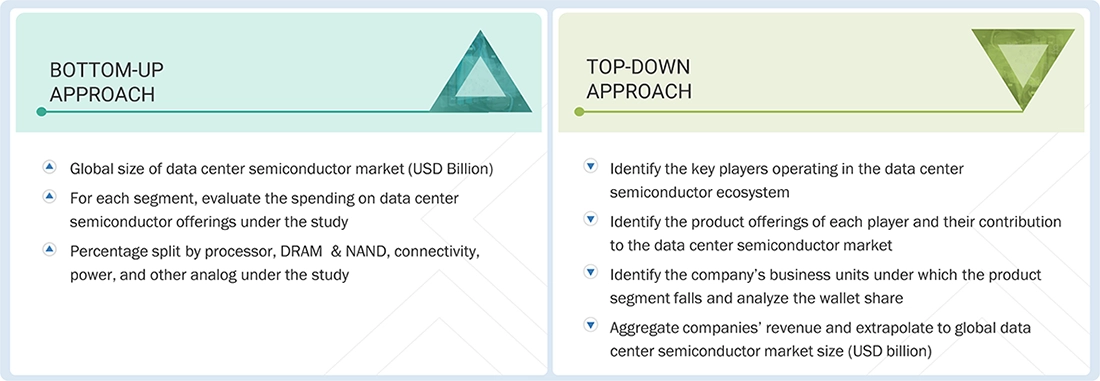
All percentage shares, splits, and breakdowns were determined using secondary sources and verified through primary sources. All parameters affecting the markets covered in this research study were accounted for, examined in detail, verified through primary research, and analyzed to obtain the final quantitative and qualitative data. This data was consolidated and supplemented with detailed inputs and analysis from MarketsandMarkets and presented in this report. The following figure represents this study’s overall market size estimation process.
BOTTOM-UP APPROACH
-
The bottom-up procedure was used to arrive at the overall size of the data center semiconductor market from the revenue of the key players (companies) and their market share. Calculations based on the revenue of the key players identified in the market led to the overall market size.
-
Key players in the data center semiconductor market were identified through secondary research, and their global market share has been determined through primary and secondary research.
-
The research methodology included a study of annual and quarterly financial reports and regulatory filings of major market players (public), as well as interviews with industry experts for detailed market insights.
-
All data center semiconductor market penetration rates, percentage shares, splits, and breakdowns for the market were determined using secondary sources and verified through primary sources.
-
All key macro indicators affecting the revenue growth of the market segments and subsegments have been accounted for, viewed in extensive detail, verified through primary research, and analyzed to obtain validated and verified quantitative and qualitative data.
-
The gathered market data was consolidated, enhanced with detailed inputs, analyzed, and presented in this report.
TOP-DOWN APPROACH
-
Focusing initially on the top-line investments and expenditures being made in the ecosystem of data center semiconductor; further splitting into processor type, DRAM & NAND, sensor, connectivity, power, other analog and listing key developments in key market areas
-
Identifying all major players in the data center semiconductor market by types and their penetration in various applications through secondary research and verifying with a brief discussion with industry experts
-
Analyzing revenue, product mix, geographic presence, and key applications for which all identified players serve data center semiconductor products to estimate and arrive at the percentage splits for all key segments
-
Discussing these splits with the industry experts to validate the information and identify key growth pockets across all key segments
-
Breaking down the total market based on verified splits and key growth pockets across all segments
Data Center Semiconductor Market : Top-Down and Bottom-Up Approach
Data Triangulation
After determining the overall market size, the market was segmented into several segments and subsegments using the market size estimation processes explained above. Data triangulation and market breakdown procedures were employed to complete the entire market engineering process and determine the exact statistics for each market segment and subsegment. The data was triangulated by analyzing various factors and trends from both the demand and supply sides in the data center semiconductor market.
Market Definition
The data center semiconductor market encompasses the design, manufacturing, and deployment of integrated circuits that enable computing, data center storage, networking, sensing, and power management in modern data centers. This includes high-performance processors and accelerators such as CPUs, GPUs, and AI-specific ASICs that handle training and inference workloads, along with connectivity chips (e.g., NICs, switches, and interconnects) that enable high-speed data transfer across servers and networks. The market also covers sensing components (temperature, humidity, and airflow sensors) that maintain optimal operating conditions, as well as power management semiconductors, including multiphase controllers, power stages, voltage regulators (POL and LDO), intermediate bus converters, and protection devices that regulate, distribute, and optimize energy use across data center infrastructure.
Key Stakeholders
-
Government and financial institutions and investment communities
-
Semiconductor companies
-
Equipment and material suppliers
-
Business providers
-
Research organizations
-
Technology standard organizations, forums, alliances, and associations
-
Data center operators and hyperscalers
-
OEMs and system integrators
-
Network infrastructure providers
-
Power solution vendors
-
Sensor manufacturers
-
End users
Report Objectives
-
To define, describe, segment, and forecast the size of the data center semiconductor market, in terms of value, based on processor type, DRAM & NAND, sensor, connectivity, power, and other analog
-
To provide detailed information regarding drivers, restraints, opportunities, and challenges influencing the growth of the market
-
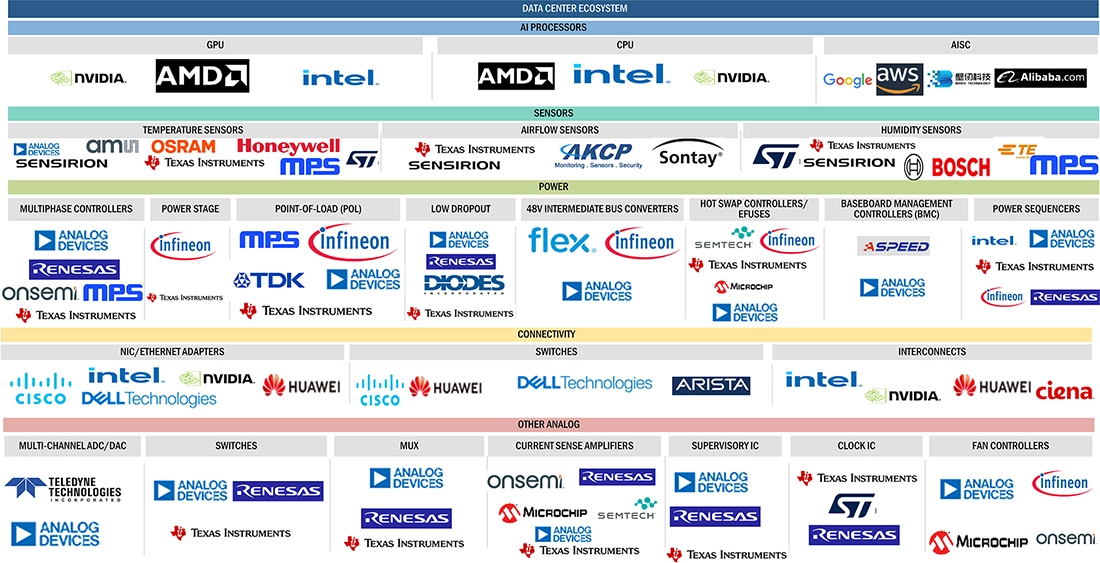
To provide an ecosystem analysis and regulations pertaining to the market
-
To analyze opportunities for stakeholders by identifying high-growth segments of the market
Available customizations:
With the given market data, MarketsandMarkets offers customizations according to the company’s specific needs. The following customization options are available for the report:














Growth opportunities and latent adjacency in Data Center Semiconductor Market