Employee Experience Management Market by Software (Integrated Software, Standalone Software), Standalone Software (Employee Survey & Feedback, Employee Engagement, Employee Recognition & Rewards, Employee Performance Management) - Global Forecast to 2032

icon1
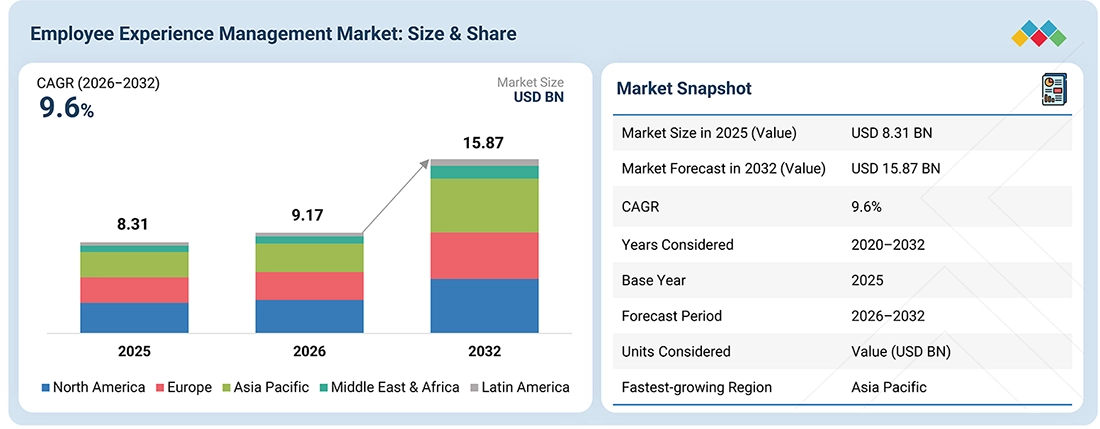
USD 15.87 BN
MARKET SIZE, 2032
icon2
CAGR 9.6%
(2026-2032)
icon3
350
REPORT PAGES
icon4
300
MARKET TABLES

OVERVIEW

employee-experience-management-market Overview

Source: Secondary Research, Interviews with Experts, MarketsandMarkets Analysis

The global employee experience management market is projected to reach USD 15.87 billion by 2032 from USD 9.17 billion in 2026, at a CAGR of 9.6% during the forecast period. The employee experience management market is witnessing strong growth, driven by increasing focus on employee engagement, rising adoption of digital workplace solutions, and the need to improve employee satisfaction, productivity, and retention. Employee experience management solutions enable organizations to collect employee feedback, measure engagement, manage performance, support learning and development, and deliver personalized workplace experiences throughout the employee lifecycle. The adoption of AI-powered analytics, employee listening platforms, cloud-based HR solutions, and automated feedback systems is further accelerating digital transformation across organizations. Growing emphasis on workforce well-being, hybrid work environments, talent retention, skills development, and data-driven HR decision-making is increasing demand for integrated and scalable employee experience management solutions across industries such as IT and IT-enabled services, BFSI, healthcare, manufacturing, retail, telecommunications, and government.

KEY TAKEAWAYS

  • By Offering
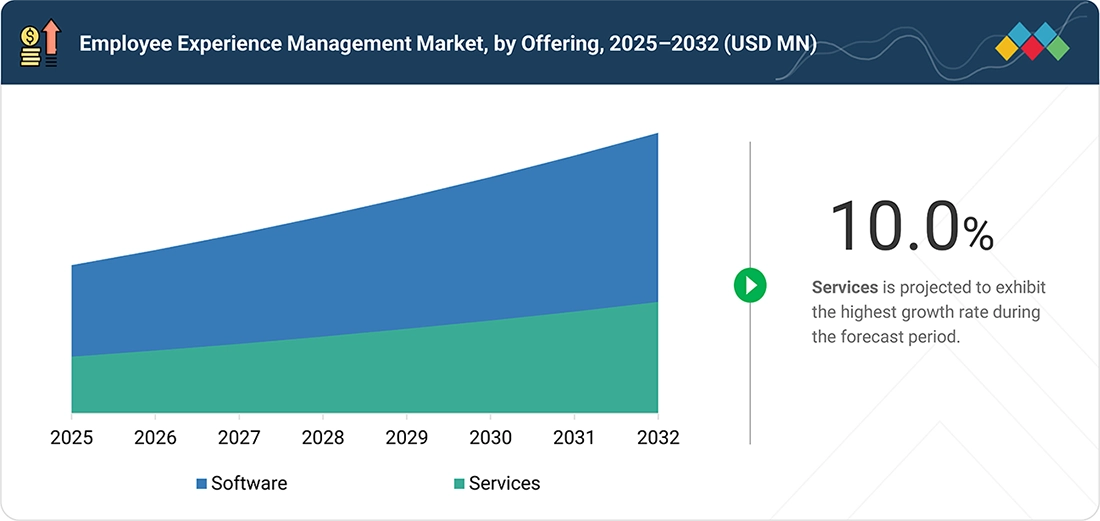
    By offering, the services segment is expected to register the highest CAGR of 10.0% during the forecast period.
  • By Industry
    By end user, the BFSI segment is projected to grow at the fastest rate of 10.6% from 2026 to 2032.
  • By Region
    Asia Pacific is projected to be the fastest-growing region in the global employee experience management market with a CAGR of 11.3% during the forecast period.
  • Competitive Landscape
    Qualtrics, SAP, and Oracle were identified as some of the star players in the employee experience management market, given their strong market share and product footprint.
  • Competitive Landscape Startup/SMEs
    Quantum Workplace, Clearcompany, MO, and Pixida have distinguished themselves among startups and SMEs in the employee experience management market.

The employee experience management market is growing as organizations focus on improving employee engagement, satisfaction, productivity, and retention. Enterprises are adopting employee experience management solutions to collect employee feedback, understand workforce needs, improve communication, and create a positive workplace environment. These solutions include employee engagement platforms, employee surveys, feedback and analytics tools, performance management, learning and development, and associated services, helping organizations identify employee concerns, strengthen workplace culture, and improve decision-making. As organizations adopt hybrid work models, digital workplace technologies, and employee-centric strategies, they require integrated, flexible, and data-driven platforms to manage the employee journey. Artificial intelligence (AI), people analytics, automation, and generative AI are enhancing personalized employee support, real-time feedback analysis, workforce insights, and employee service delivery. Increasing focus on employee well-being, skills development, diversity and inclusion, and talent retention is further driving the adoption of these solutions. This growing emphasis on personalized, data-driven, and technology-enabled workplaces is strengthening the role of employee experience management as a key component of workforce strategy and organizational performance.

TRENDS & DISRUPTIONS IMPACTING CUSTOMERS' CUSTOMERS

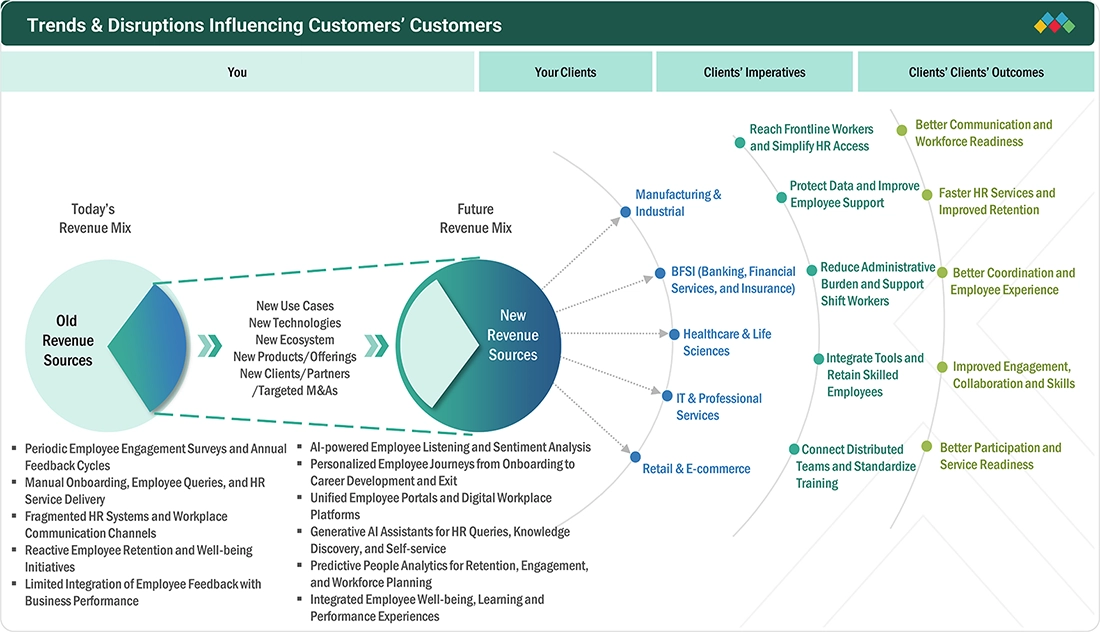
The employee experience management (EXM) market is evolving from periodic employee engagement surveys and fragmented HR services toward AI-driven, integrated employee experience platforms. Organizations are adopting advanced employee listening, sentiment analysis, personalized employee journeys, unified digital workplace platforms, and generative AI assistants to simplify HR access and improve workforce engagement. These solutions address the growing needs of manufacturing, BFSI, healthcare, IT and professional services, and retail and e-commerce industries. Key client imperatives include protecting employee data, reducing administrative burdens, improving employee support, integrating workplace tools, and connecting distributed teams through standardized training. These initiatives are expected to deliver better communication, faster HR services, improved employee retention, stronger collaboration, enhanced employee participation, and increased workforce readiness. As organizations focus on employee-centric strategies, EXM providers can expand revenue through new use cases, innovative technologies, integrated offerings, and strategic partnerships.
employee-experience-management-market Disruptions

Source: Secondary Research, Interviews with Experts, MarketsandMarkets Analysis

MARKET DYNAMICS

Drivers
Impact
Level
  • Escalating demand for real-time performance management
  • Enhancing employee experience through seamless technology integration
RESTRAINTS
Impact
Level
  • Budget constraints
  • Data privacy concerns
OPPORTUNITIES
Impact
Level
  • Reduced burnout and increased well-being
  • Talent attraction and retention
CHALLENGES
Impact
Level
  • Remote workers to pose unique hurdles for organizations
  • Quest to elevate employee productivity within organizational framework

Source: Secondary Research, Interviews with Experts, MarketsandMarkets Analysis

Driver: Escalating demand for real-time performance management

Organizations are increasingly adopting employee experience management (EXM) solutions to monitor employee performance, engagement, and productivity in real time. The shift toward hybrid work, distributed teams, and digital workplaces has increased the need for continuous feedback and actionable workforce insights. EXM platforms help organizations collect employee feedback, identify engagement gaps, track performance trends, and support timely managerial decisions. Integration with HR systems, collaboration tools, and workforce analytics platforms further improves visibility into employee experiences. The growing emphasis on employee-centric workplaces and data-driven human resource management is encouraging enterprises to invest in real-time performance monitoring and feedback solutions, driving demand for EXM platforms across industries.

Restraint: Budget constraints

Budget constraints can limit the adoption of employee experience management solutions, particularly among small and medium-sized enterprises. Implementing EXM platforms may require significant investment in software licensing, system integration, employee training, and ongoing maintenance. Organizations with limited HR technology budgets may prioritize essential business applications over employee experience initiatives. Additional expenses associated with customization, data migration, and integration with existing human resource management systems can further increase implementation costs. Moreover, demonstrating a clear return on investment through measurable improvements in employee engagement, productivity, and retention can be challenging. These financial considerations may delay purchasing decisions, restrict platform upgrades, and encourage organizations to adopt basic employee feedback tools instead of comprehensive EXM solutions.

Opportunity: Reduced burnout and increased well-being

Growing organizational focus on employee mental well-being, work-life balance, and burnout prevention is creating opportunities for the employee experience management market. Organizations are increasingly using EXM platforms to identify workplace stress, monitor employee sentiment, and understand factors affecting job satisfaction and productivity. Features such as pulse surveys, anonymous feedback, sentiment analysis, and personalized employee insights help HR teams identify potential issues and develop targeted well-being initiatives. Integration with workforce analytics and human resource systems enables organizations to recognize engagement patterns and take preventive action. As employers increasingly prioritize employee retention, psychological well-being, and sustainable productivity, demand for EXM solutions that support healthier workplace environments is expected to grow across sectors.

Challenge: Remote workers to pose unique hurdles for organizations

The growing prevalence of remote and hybrid work creates challenges for organizations seeking to deliver consistent employee experiences. Limited face-to-face interaction can make it difficult to identify employee concerns, maintain team connections, assess engagement, and communicate organizational goals effectively. Differences in time zones, communication preferences, digital access, and workplace environments can further complicate employee engagement initiatives. Organizations must also address survey fatigue, employee privacy concerns, and the risk of collecting feedback without taking meaningful action. EXM platforms can help overcome these barriers through digital feedback channels, sentiment analytics, and personalized engagement strategies. However, successful implementation requires effective change management, transparent communication, and integration with existing workplace tools to ensure remote employees feel supported and connected.

EMPLOYEE EXPERIENCE MANAGEMENT MARKET: COMMERCIAL USE CASES ACROSS INDUSTRIES

COMPANY USE CASE DESCRIPTION BENEFITS
company logo
Qualtrics provides employee experience management through Qualtrics XM for Employee Experience, including employee engagement surveys, pulse surveys, lifecycle feedback, and 360-degree development feedback. Organizations use AI-powered analytics to understand employee sentiment, identify engagement challenges, predict attrition risks, and guide managers in taking targeted actions. Improved employee engagement and retention | Real-time employee feedback and sentiment analysis | Early identification of attrition risks | Data-driven HR decisions | Enhanced workforce productivity
company logo
SAP provides employee experience management through SAP SuccessFactors Work Zone, which centralizes HR content, applications, services, and workflows in a personalized digital workplace. Organizations use guided employee journeys, AI-powered self-service, collaboration tools, and integrated HR processes to simplify daily tasks and support employees throughout their employment lifecycle. Centralized access to HR services and applications | Improved employee engagement and collaboration | Simplified HR processes and self-service | Personalized employee journeys | Increased workforce productivity
company logo
Oracle provides employee experience management through Oracle ME, part of Oracle Fusion Cloud HCM. Organizations use personalized employee journeys, targeted communications, continuous feedback, career development tools, peer recognition, and AI-powered digital assistance to improve employee interactions and support professional growth across the employee lifecycle. Personalized employee experiences | Improved employee satisfaction and engagement | Simplified HR support and task completion | Enhanced employee recognition and career development | Increased productivity and workforce connectivity

Logos and trademarks shown above are the property of their respective owners. Their use here is for informational and illustrative purposes only.

MARKET ECOSYSTEM

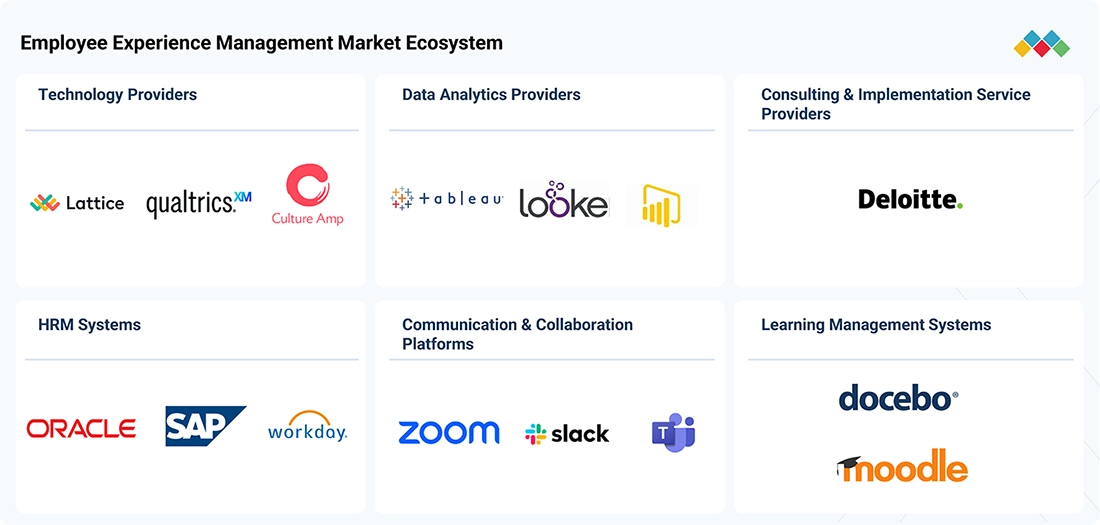
The employee experience management market comprises a diverse ecosystem of technology providers, data analytics providers, consulting and implementation service providers, HRM systems, communication and collaboration platforms, and learning management systems. Technology providers such as Qualtrics, Lattice, and Culture Amp help organizations measure employee engagement, gather feedback, and improve workplace experiences. Data analytics providers, including Tableau, Looker, and Microsoft Power BI, support workforce data analysis and actionable insights. Consulting and implementation services providers such as Deloitte assist organizations in deploying employee experience strategies and integrating solutions. HRM systems from Oracle, SAP, and Workday streamline employee information and HR processes. Communication and collaboration platforms such as Zoom, Slack, and Microsoft Teams enhance workplace connectivity, while learning management systems such as Docebo and Moodle support employee training, skills development, and continuous learning. Together, these providers enable organizations to improve employee satisfaction, productivity, engagement, and retention.
employee-experience-management-market Ecosystem

Logos and trademarks shown above are the property of their respective owners. Their use here is for informational and illustrative purposes only.

MARKET SEGMENTS
employee-experience-management-market Segments

Source: Secondary Research, Interviews with Experts, MarketsandMarkets Analysis

Employee Experience Management Market, by Offering

Software plays a significant role in the employee experience management market as organizations increasingly adopt digital platforms to enhance employee engagement, satisfaction, productivity, and retention. The rising demand for employee feedback, workforce analytics, performance management, and personalized employee experiences is driving this adoption. Moreover, integration with HR systems, collaboration tools, and AI-powered analytics further supports this trend. As organizations shift their focus towards employee-centric strategies and the digital transformation of the workplace, the demand for employee experience management software is expected to remain strong throughout the forecast period.

Employee Experience Management Market, by Industry

The IT and IT-enabled services industry represents a significant share of the employee experience management market as organizations prioritize employee engagement, retention, productivity, and workplace satisfaction. The growing use of hybrid work models, digital collaboration platforms, and continuous employee feedback is encouraging adoption. Increasing competition for skilled talent and the need to reduce employee turnover further support demand. As organizations focus on workforce well-being, personalized experiences, and data-driven HR decisions, adoption of employee experience management solutions is expected to increase throughout the forecast period.

REGION

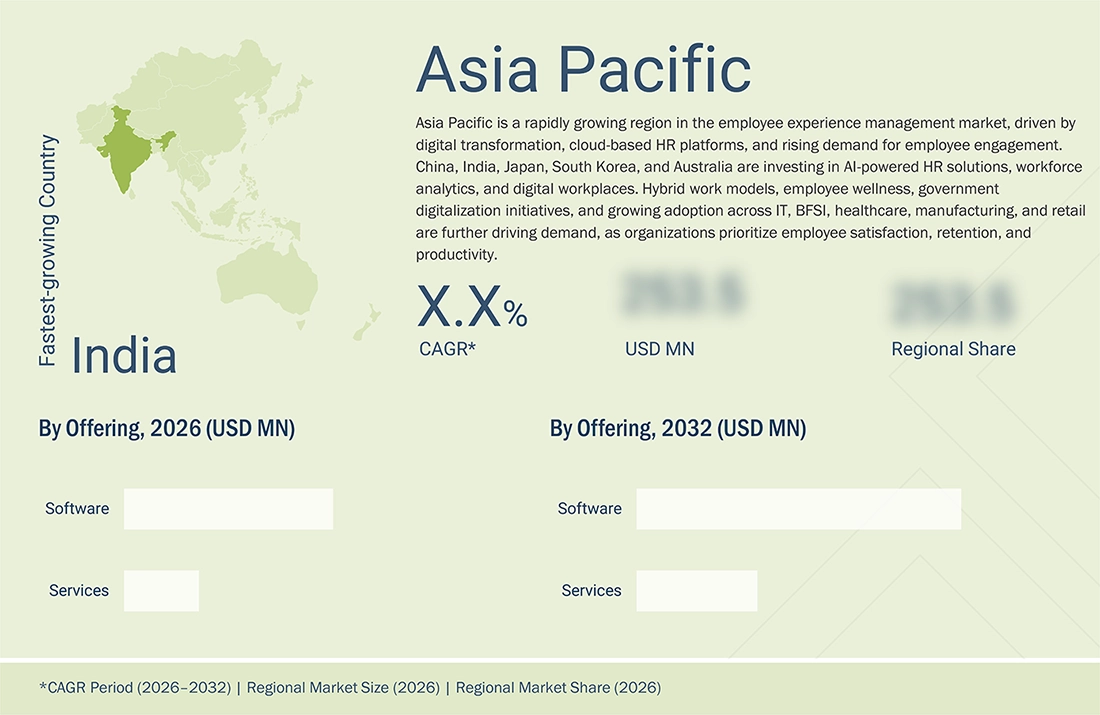
Asia Pacific is projected to register the fastest market growth during the forecast period

Asia Pacific is expected to be the fastest-growing region in the employee experience management market as organizations across IT, BFSI, manufacturing, healthcare, retail, and telecommunications increasingly invest in improving employee engagement and workplace productivity. Rapid digital transformation, expanding workforces, hybrid work adoption, and rising demand for talent retention across China, India, Japan, South Korea, and Australia are driving the adoption of employee experience management solutions. Organizations are increasingly implementing employee feedback platforms, employee engagement tools, HR service management, and AI-enabled employee support solutions to enhance satisfaction and streamline HR operations. The growing use of cloud-based HR platforms, generative AI, and workforce analytics is further increasing demand for personalized employee experiences and data-driven decision-making. Enterprises are also prioritizing employee well-being, internal communication, career development, and seamless digital workplace experiences to address changing workforce expectations. Together, increasing investments in HR technology, rising focus on employee retention, and ongoing workplace digitalization are expected to drive strong growth in the Asia Pacific employee experience management market.
employee-experience-management-market Region

EMPLOYEE EXPERIENCE MANAGEMENT MARKET: COMPANY EVALUATION MATRIX

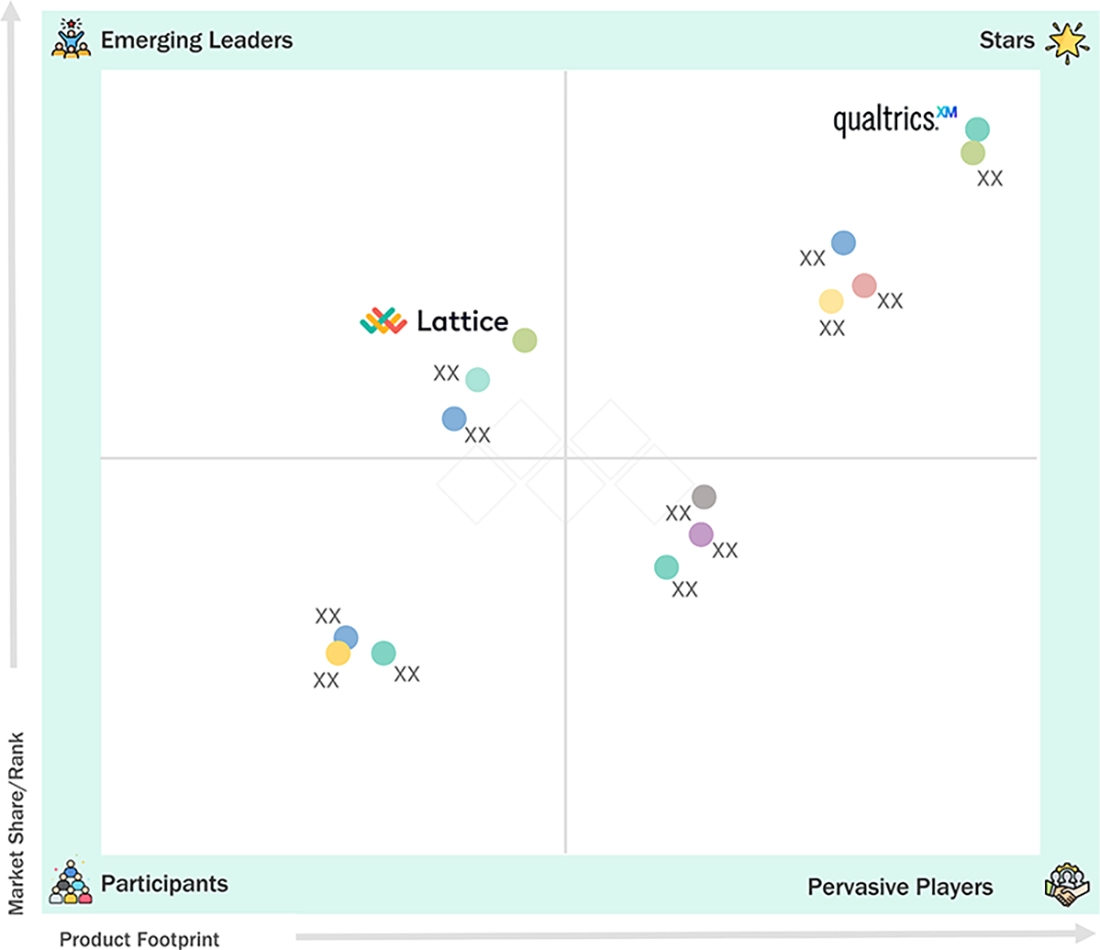
The company evaluation matrix assesses key players based on their product footprint and market share/rank. Qualtrics stands out in the Stars quadrant, reflecting its strong market presence and broad product portfolio in employee experience management. Lattice is positioned among the Emerging Leaders, demonstrating its focus on employee engagement, performance management, and workforce development capabilities. Other emerging vendors are distributed across the matrix, highlighting differences in product coverage and market reach.
employee-experience-management-market Evaluation Metrics

Source: Secondary Research, Interviews with Experts, MarketsandMarkets Analysis

KEY MARKET PLAYERS

  • Qualtrics (US)
  • SAP (Germany)
  • Oracle (US)
  • Microsoft (US)
  • Workday (US)
  • Zoom Video Communications (US)
  • Culture Amp (Australia)
  • Achievers (Canada)
  • Workleap (Canada)
  • SurveySparrow (US)
  • 15Five (US)
  • Awardco (US)
  • Vantage Circle (US)
  • Quantum Workplace (US)
  • ClearCompany (US)
  • Jostle (Canada)
  • Kudos (Canada)
  • Lattice (US)
  • Bonusly (US)
  • Motivosity (US)
  • WorkTango (US)
  • Blink (US)
  • MO (UK)
  • Pixida (Germany)

MARKET SCOPE

REPORT METRIC DETAILS
Market Size in 2025 (Value) USD 8.31 Billion
Market Size in 2026 (Value) USD 9.17 Billion
Market Forecast in 2032 (Value) USD 15.87 Billion
Growth Rate CAGR of 9.6% from 2026–2032
Years Considered 2020–2032
Base Year 2025
Forecast Period 2026–2032
Units Considered Value (USD Billion)
Report Coverage Revenue Forecast, Company Ranking, Competitive Landscape, Growth Factors, and Trends
Segments Covered
  • By Offering:
    • Software (Integrated Software
    • Standalone Software (Employee Survey & Feedback
    • Employee Engagement
    • Employee Retention & Rewards
    • Employee Performance Management
    • Other Software))
    • Services (Implementation & Integration
    • Support & Maintenance
    • Training & Development)
  • By Industry:
    • BFSI
    • Healthcare
    • IT & ITeS
    • Telecom
    • Government
    • Manufacturing
    • Other Industries
Regions Covered North America, Europe, Asia Pacific, Middle East & Africa, Latin America

WHAT IS IN IT FOR YOU: EMPLOYEE EXPERIENCE MANAGEMENT MARKET REPORT CONTENT GUIDE
employee-experience-management-market Content Guide

DELIVERED CUSTOMIZATIONS

We have successfully delivered the following deep-dive customizations:

CLIENT REQUEST CUSTOMIZATION DELIVERED VALUE ADDS
Leading Service Provider (US) Regional Analysis: • Further breakdown of the North American employee experience management market • Further breakdown of the European employee experience management market • Further breakdown of the Asia Pacific employee experience management market • Further breakdown of the Middle Eastern & African employee experience management market • Further breakdown of the Latin American employee experience management market • Identifies high-growth regional opportunities, enabling tailored market entry strategies • Optimizes resource allocation and investment based on region-specific demand and trends
Company Information Detailed analysis and profiling of additional market players (up to 5) • Broadens competitive insights, helping clients make informed strategic and investment decisions • Reveals market gaps and opportunities, supporting differentiation and targeted growth initiatives

RECENT DEVELOPMENTS

  • September 2026 : Interact introduced Cue, an adaptive AI intranet that personalizes content, information, and next steps according to employees’ roles, teams, and workplace context. It also launched Conductor, an agentic AI engine that helps HR, IT, and communications teams plan campaigns, manage approvals, automate content-related tasks, and track completion. The development highlights the growing adoption of personalized employee portals and AI-driven workflow automation in the employee experience management market.
  • September 2026 : Qualtrics announced its XM Data & AI Platform, designed to help organizations simulate outcomes, predict behavior, and deliver actions based on experience data. The platform is planned for availability in 2027 and builds on Qualtrics’ experience management capabilities across employees, customers, products, and brands. The announcement reflects the growing integration of predictive analytics and AI-driven decision-making into employee experience and engagement strategies.
  • August 2026 : Culture Amp announced that its Engage and Perform capabilities would be accessible through AI assistants, including ChatGPT and Claude, using Model Context Protocol (MCP) connectivity. The integration enables managers to access employee engagement, performance, and workplace culture insights within their existing workflows. This development demonstrates the shift toward embedding employee experience analytics into everyday business tools to support faster, data-driven workforce decisions.


 

Table of Contents

checkmarkExclusive indicates content/data unique to MarketsandMarkets and not available with any competitors.

TITLE
PAGE NO
1
INTRODUCTION


15
2
EXECUTIVE SUMMARY


3
PREMIUM INSIGHTS


4
MARKET OVERVIEW
This section summarizes market dynamics, key shifts, and high-impact trends shaping demand outlook.


4.1
MARKET DYNAMICS


4.1.1
DRIVERS


4.1.2
RESTRAINTS


4.1.3
OPPORTUNITIES


4.1.4
CHALLENGES


4.2
INTERCONNECTED MARKETS AND CROSS-SECTOR OPPORTUNITIES


4.3
STRATEGIC MOVES BY TIER-1/2/3 PLAYERS


5
INDUSTRY TRENDS
Covers the key developments, trend analysis, and actionable insights to support strategic planning and positioning.


5.1
PORTER’S FIVE FORCES ANALYSIS


5.1.1
THREAT OF NEW ENTRANTS


5.1.2
THREAT OF SUBSTITUTES


5.1.3
BARGAINING POWER OF SUPPLIERS


5.1.4
BARGAINING POWER OF BUYERS


5.1.5
INTENSITY OF COMPETITIVE RIVALRY


5.2
MACROECONOMIC OUTLOOK


5.2.1
INTRODUCTION


5.2.2
GDP TRENDS AND FORECAST


5.2.3
TRENDS IN EMPLOYEE EXPERIENCE MANAGEMENT INDUSTRY


5.3
SUPPLY CHAIN ANALYSIS


5.4
ECOSYSTEM ANALYSIS


5.5
PRICING ANALYSIS


5.5.1
AVERAGE SELLING PRICE, BY KEY PLAYER,


5.5.2
INDICATIVE PRICING ANALYSIS,


5.6
KEY CONFERENCES AND EVENTS, 2026–2027


5.7
TRENDS/DISRUPTIONS IMPACTING CUSTOMER BUSINESS


5.8
INVESTMENT AND FUNDING SCENARIO


5.9
CASE STUDY ANALYSIS


5.10
IMPACT OF 2025 US TARIFF ON EMPLOYEE EXPERIENCE MANAGEMENT MARKET


5.10.1
KEY TARIFF RATES


5.10.2
PRICE IMPACT ANALYSIS


5.10.3
IMPACT ON END-USE INDUSTRIES
 
 
6
TECHNOLOGICAL ADVANCEMENTS, AI-DRIVEN IMPACT, PATENTS, AND INNOVATIONS


6.1
KEY EMERGING TECHNOLOGIES


6.2
COMPLEMENTARY TECHNOLOGIES


6.3
TECHNOLOGY/PRODUCT ROADMAP


6.4
PATENT ANALYSIS


6.5
IMPACT OF AI/GEN AI ON EMPLOYEE EXPERIENCE MANAGEMENT MARKET


6.5.1
TOP USE CASES AND MARKET POTENTIAL


6.5.2
CASE STUDIES OF AI IMPLEMENTATION IN EMPLOYEE EXPERIENCE MANAGEMENT MARKET


6.5.3
INTERCONNECTED ADJACENT ECOSYSTEM AND IMPACT ON MARKET PLAYERS


6.5.4
CLIENTS’ READINESS TO ADOPT GENERATIVE AI IN EMPLOYEE EXPERIENCE MANAGEMENT
 
 
7
REGULATORY LANDSCAPE AND SUSTAINABILITY INITIATIVES


7.1
REGIONAL REGULATIONS AND COMPLIANCE


7.1.1
REGULATORY BODIES, GOVERNMENT AGENCIES, AND OTHER ORGANIZATIONS


7.1.2
INDUSTRY STANDARDS


7.2
SUSTAINABILITY INITIATIVES


7.3
IMPACT OF REGULATORY POLICIES ON SUSTAINABILITY INITIATIVES


8
CUSTOMER LANDSCAPE AND BUYER BEHAVIOR


8.1
DECISION-MAKING PROCESS


8.2
BUYER STAKEHOLDERS AND BUYING EVALUATION CRITERIA


8.3
ADOPTION BARRIERS AND INTERNAL CHALLENGES


8.4
UNMET NEEDS IN VARIOUS END-USE INDUSTRIES


9
EMPLOYEE EXPERIENCE MANAGEMENT MARKET, BY OFFERING (MARKET SIZE & FORECAST TO 2032 – IN VALUE, USD MILLION)


OFFERING-WISE DEMAND POTENTIAL AND THE GROWTH PATHWAYS SHAPING EMPLOYEE EXPERIENCE MANAGEMENT ADOPTION ACROSS DIVERSE INDUSTRIES


9.1
INTRODUCTION


9.2
SOFTWARE


9.2.1
INTEGRATED SOFTWARE


9.2.2
STANDALONE SOFTWARE


9.2.2.1
EMPLOYEE SURVEY & FEEDBACK


9.2.2.2
EMPLOYEE ENGAGEMENT


9.2.2.3
EMPLOYEE RECOGNITION & REWARDS


9.2.2.4
EMPLOYEE PERFORMANCE MANAGEMENT


9.2.2.5
OTHER SOFTWARE
 
 
9.3
SERVICES


9.3.1
INTEGRATION & IMPLEMENTATION


9.3.2
SUPPORT AND MAINTENANCE


9.3.3
TRAINING AND DEVELOPMENT
 
 
10
EMPLOYEE EXPERIENCE MANAGEMENT MARKET, BY INDUSTRY (MARKET SIZE & FORECAST TO 2032 – IN VALUE, USD MILLION)


INDUSTRY-WISE DEMAND POTENTIAL AND GROWTH PATHWAYS SHAPING EMPLOYEE EXPERIENCE MANAGEMENT ADOPTION ACROSS DIVERSE INDUSTRIES


10.1
INTRODUCTION


10.2
BFSI


10.3
HEALTHCARE


10.4
IT & ITES


10.5
TELECOM


10.6
GOVERNMENT


10.7
MANUFACTURING


10.8
OTHER INDUSTRIES


11
EMPLOYEE EXPERIENCE MANAGEMENT MARKET, BY REGION (MARKET SIZE & FORECAST TO 2032 – IN VALUE, USD MILLION)


(ASSESSING GROWTH PATTERNS, INDUSTRY FORCES, REGULATORY LANDSCAPE, AND MARKET POTENTIAL ACROSS KEY GEOGRAPHIES AND COUNTRIES)


11.1
INTRODUCTION


11.2
NORTH AMERICA


11.2.1
US


11.2.2
CANADA


11.3
EUROPE


11.3.1
UK


11.3.2
GERMANY


11.3.3
FRANCE


11.3.4
ITALY


11.3.5
SPAIN


11.3.6
NORDIC COUNTRIES


11.3.7
REST OF EUROPE


11.4
ASIA PACIFIC


11.4.1
CHINA


11.4.2
JAPAN


11.4.3
INDIA


11.4.4
AUSTRALIA & NEW ZEALAND


11.4.5
SOUTH KOREA


11.4.6
SOUTHEAST ASIA


11.4.7
REST OF ASIA PACIFIC


11.5
MIDDLE EAST AND AFRICA


11.5.1
UAE


11.5.2
SAUDI ARABIA


11.5.3
SOUTH AFRICA


11.5.4
REST OF MIDDLE EAST & AFRICA


11.6
LATIN AMERICA


11.6.1
BRAZIL


11.6.2
MEXICO


11.6.3
REST OF LATIN AMERICA
 
 
12
COMPETITIVE LANDSCAPE


12.1
OVERVIEW


12.2
KEY PLAYER STRATEGIES/RIGHT TO WIN


12.3
REVENUE ANALYSIS OF TOP 5 PLAYERS (2021–2025)


12.4
MARKET SHARE ANALYSIS,


12.5
COMPANY VALUATION AND FINANCIAL METRICS


12.6
BRAND COMPARISON


12.7
COMPANY EVALUATION MATRIX: KEY PLAYERS,


12.7.1
STARS


12.7.2
EMERGING LEADERS


12.7.3
PERVASIVE PLAYERS


12.7.4
PARTICIPANTS


12.7.5
COMPANY FOOTPRINT: KEY PLAYERS,


12.7.5.1
COMPANY FOOTPRINT


12.7.5.2
OFFERING FOOTPRINT


12.7.5.3
INDUSTRY FOOTPRINT


12.7.5.4
REGION FOOTPRINT
 
 
12.8
COMPANY EVALUATION MATRIX: STARTUPS/SMES,


12.8.1
PROGRESSIVE COMPANIES


12.8.2
RESPONSIVE COMPANIES


12.8.3
DYNAMIC COMPANIES


12.8.4
STARTING BLOCKS


12.8.5
COMPETITIVE BENCHMARKING: STARTUPS/SMES,


12.8.5.1
DETAILED LIST OF KEY STARTUPS/SMES


12.8.5.2
COMPETITIVE BENCHMARKING OF KEY STARTUPS/SMES
 
 
12.9
COMPETITIVE SITUATION


12.9.1
PRODUCT LAUNCHES


12.9.2
DEALS


12.9.3
EXPANSIONS
 
 
13
COMPANY PROFILES


13.1
KEY PLAYERS


13.1.1
MICROSOFT


13.1.2
ORACLE


13.1.3
SAP


13.1.4
QUALTRICS


13.1.5
WORKDAY


13.1.6
ZOHO CORPORATION


13.1.7
ZOOM VIDEO COMMUNICATIONS


13.1.8
CULTURE AMP


13.1.9
WORKLEAP


13.1.10
SURVEYSPARROW


13.1.11
15FIVE


13.1.12
AWARDCO


13.1.13
ACHIEVERS


13.1.14
VANTAGE CIRCLE


13.2
STARTUPS/SMES


13.2.1
WORKTANGO


13.2.2
QUANTUM WORKPLACE


13.2.3
LATTICE


13.2.4
BLINK


13.2.5
CLEAR COMPANY


13.2.6
JOSTEL


13.2.7
KUDOS


13.2.8
BONUSLY


13.2.9
MOTIVOSITY


13.2.10
MO
 
 
14
RESEARCH METHODOLOGY


14.1
RESEARCH DATA


14.1.1
SECONDARY DATA


14.1.1.1
KEY DATA FROM SECONDARY SOURCES


14.1.2
PRIMARY DATA


14.1.2.1
KEY DATA FROM PRIMARY SOURCES


14.1.2.2
KEY PRIMARY PARTICIPANTS


14.1.2.3
BREAKDOWN OF PRIMARY INTERVIEWS


14.1.2.4
KEY INDUSTRY INSIGHTS
 
 
14.2
MARKET SIZE ESTIMATION


14.2.1
BOTTOM-UP APPROACH


14.2.2
TOP-DOWN APPROACH


14.3
MARKET FORECAST APPROACH


14.3.1
SUPPLY SIDE


14.3.2
DEMAND SIDE


14.4
DATA TRIANGULATION


14.5
RESEARCH ASSUMPTIONS


14.6
RESEARCH LIMITATIONS AND RISK ASSESSMENT


15
APPENDIX


15.1
DISCUSSION GUIDE


15.2
KNOWLEDGESTORE: MARKETSANDMARKETS' SUBSCRIPTION PORTAL


15.3
AVAILABLE CUSTOMIZATIONS


15.4
RELATED REPORTS


15.5
AUTHOR DETAILS


Methodology

The research study involved four major activities in estimating the employee experience management market size. Exhaustive secondary research has been done to collect important information about the market and peer markets. The next step was to validate these findings and assumptions and size them with the help of primary research with industry experts across the value chain. Both top-down and bottom-up approaches have been utilized to estimate the market size. Subsequently, market breakdown and data triangulation methods have been employed to determine the sizes of segments and subsegments.

Secondary Research

The market size of companies offering employee experience management software and services for various subscribers is arrived at based on the secondary data available through paid and unpaid sources and by analyzing the different offerings (software and services) of major companies in the ecosystem and rating them based on their performance and quality. In the secondary research process, various sources were referred to for identifying and collecting information for this study. The secondary sources included annual reports, press releases and investor presentations of companies, white papers, journals, and certified publications and articles from recognized authors, directories, and databases.

Secondary research was mainly used to obtain key information about the industry’s supply chain, the total pool of key players, market classification, and segmentation according to the industry trends to the bottom-most level, regional markets, and key developments from both market- and technology-oriented perspectives, all of which were further validated by primary sources.

Primary Research

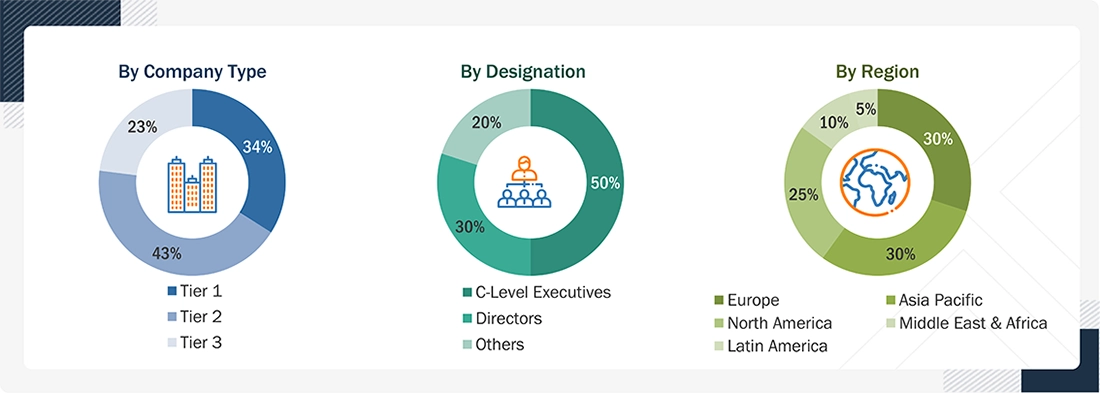
In the primary research process, various primary sources from both the supply and demand sides were interviewed to obtain qualitative and quantitative information for the report. Supply-side primary sources include industry experts such as chief executive officers (CEOs), vice presidents (VPs), marketing directors, technology and innovation directors, and other key executives from companies and organizations that provide employee experience management solutions. The primary sources from the demand side include end users, such as chief information officers (CIOs), consultants, service professionals, technicians and technologists, and managers at public and investor-owned utilities.

In the market engineering process, top-down and bottom-up approaches have been extensively used, along with several data triangulation methods, to perform market estimation and market forecasting for the overall market segments and subsegments listed in the report. Extensive qualitative and quantitative analyses have been performed on the complete market engineering process to list key information/insights throughout the report.

After the complete market engineering (including calculations for market statistics, market breakup, market size estimations, market forecasting, and data triangulation), extensive primary research has been conducted to gather information. Primary research has been conducted to identify the segmentation, industry trends, key players, competitive landscape, and key market dynamics, such as drivers, restraints, opportunities, challenges, and key strategies.

BREAKDOWN OF PRIMARIES

Employee Experience Management Market Size, and Share

Note 1: Tier 1 companies have revenues exceeding USD 10 billion. Tier 2 companies have revenues ranging from USD 1 billion to USD 10 billion. Tier 3 companies have revenues between USD 500 million and USD 1 billion.
Source: Secondary Literature, Expert Interviews, and MarketsandMarkets Analysis

To know about the assumptions considered for the study, download the pdf brochure

Market Size Estimation

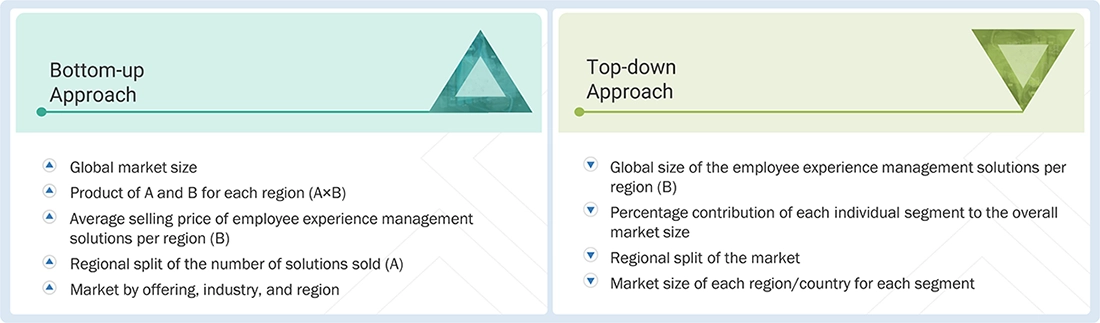
In the market engineering process, the top-down and bottom-up approaches were used along with multiple data triangulation methods to estimate and validate the size of the employee experience management market, as well as other dependent submarkets. The research methodology used to estimate the market sizes includes the following:

  • Initially, MarketsandMarkets focuses on top-line investments and spending in the ecosystems. Further, significant developments in the critical market area have been considered.
  • Tracking the recent and upcoming developments in the employee experience management market that include investments, R&D activities, product launches, collaborations, mergers and acquisitions, and partnerships, as well as forecasting the market size based on these developments and other critical parameters.
  • Conduct multiple discussions with key opinion leaders to learn about the diverse types of authentications and brand protection offerings used and the applications for which they are used to analyze the breakdown of the scope of work carried out by major companies.
  • Segmenting the market based on technology types concerning applications wherein the types are to be used and deriving the size of the global employee experience management market.
  • Segmenting the overall market into various market segments.
  • Validating the estimates at every level through discussions with key opinion leaders, such as chief executives (CXOs), directors, and operations managers, and finally with the domain experts at MarketsandMarkets.

Employee Experience Management Market: Top-Down and Bottom-Up Approach

Employee Experience Management Market Top Down and Bottom Up Approach

Data Triangulation

After arriving at the overall market size from the above estimation process, the employee experience management market has been split into several segments and subsegments. To complete the overall market engineering process and arrive at the exact statistics for all segments and subsegments, data triangulation and market breakdown procedures have been used, wherever applicable. The data has been triangulated by studying various factors and trends from both the demand and supply sides.

The employee experience management market size has been validated using top-down and bottom-up approaches.

Market Definition

Employee experience management (EXM) is a comprehensive solution that combines technology, tools, and services to enhance employee engagement, productivity, and retention, which in turn can significantly impact an organization's profitability and efficiency. EXM involves shaping every interaction an employee has with a company, from the hiring process to onboarding and exit strategies. Both IT and HR departments play a critical role in implementing strategies that support optimal employee performance. Technology is a key enabler of a positive EXM strategy, and by selecting the right tools and integrating them seamlessly, organizations can create a data-driven, personalized, and continually evolving employee experience that fosters productivity, loyalty, and a thriving company culture.

Key Stakeholders

  • Employee experience management software and service providers
  • Value-added resellers (VARs)
  • Research organizations
  • Consulting firms
  • Application service providers
  • Cloud platform providers
  • Investors and venture capitalists
  • System integrators (SIs)
  • Technology providers
  • Suppliers, distributors, and contractors
  • End users/Enterprise users

Report Objectives

  • To determine, segment, and forecast the employee experience management market on the basis of offering (software and services), industry, and region in terms of value
  • To forecast the size of the market segments with respect to five main regions: North America, Europe, Asia Pacific, Middle East & Africa, and Latin America
  • To provide detailed information about the major factors (drivers, restraints, opportunities, and challenges) influencing the market growth
  • To study the complete value chain and related industry segments and perform a value chain analysis of the market landscape
  • To strategically analyze the macro and micromarkets with respect to individual growth trends, prospects, and contributions to the total market
  • To analyze the industry trends, pricing data, patents, and innovations related to the market
  • To analyze the opportunities for stakeholders by identifying the high-growth segments of the market
  • To profile the key players in the market and comprehensively analyze their market share/ranking and core competencies
  • To track and analyze competitive developments, such as mergers & acquisitions, product launches & developments, partnerships, agreements, collaborations, business expansions, and R&D activities 

Available customizations:

With the given market data, MarketsandMarkets offers customizations per the company’s specific needs. The following customization options are available for the report:

Geographic Analysis

  • Further breakdown of the Asia Pacific market into countries contributing 75% to the regional market size
  • Further breakdown of the North American market into countries contributing 75% to the regional market size
  • Further breakdown of the Latin American market into countries contributing 75% to the regional market size
  • Further breakdown of the Middle East African market into countries contributing 75% to the regional market size
  • Further breakdown of the European market into countries contributing 75% to the regional market size

Company Information

  • Detailed analysis and profiling of additional market players (up to 5)


Personalize This Research

  • Triangulate with your Own Data
  • Get Data as per your Format and Definition
  • Gain a Deeper Dive on a Specific Application, Geography, Customer or Competitor
  • Any level of Personalization
Request A Free Customisation

Let Us Help You

  • What are the Known and Unknown Adjacencies Impacting the Employee Experience Management Market
  • What will your New Revenue Sources be?
  • Who will be your Top Customer; what will make them switch?
  • Defend your Market Share or Win Competitors
  • Get a Scorecard for Target Partners
Customized Workshop Request

Custom Market Research Services

We Will Customise The Research For You, In Case The Report Listed Above Does Not Meet With Your Requirements

Get 10% Free Customisation

TESTIMONIALS

Growth opportunities and latent adjacency in Employee Experience Management Market

THIS REPORT TELLS YOU

How big the Employee Experience Management market is, and who leads it.

GROWTHIQ TELLS YOU NEW

Where your company should play next, and who is taking your share.

Get your company's view of this market. Free snapshot.

DMCA.com Protection Status
popup img