The study involved four major activities in estimating the current size of the fast-charging lithium-ion battery market. Exhaustive secondary research was done to collect information on the market, peer market, and parent market. To validate these findings, assumptions, and sizing with industry experts across the value chain through primary research was the next step. Both top-down and bottom-up approaches were employed to estimate the complete market size. After that, market breakdown and data triangulation methods were used to estimate the market size of segments and subsegments. Two sources of information, secondary and primary, were used to identify and collect information for an extensive technical and commercial study of the fast-charging lithium-ion battery market.
Secondary Research
Various secondary sources were referred to in the secondary research process to identify and collect information important for this study. The secondary sources included annual reports, press releases, and investor presentations of companies; white papers; journals and certified publications; and articles from recognized authors, websites, directories, and databases. Secondary research was conducted to obtain key information about the industry’s supply chain, the market’s value chain, the total pool of key players, market segmentation according to the industry trends (to the bottom-most level), regional markets, and key developments from market- and technology-oriented perspectives. The secondary data was collected and analyzed to determine the overall market size, further validated by primary research.
Primary Research
Extensive primary research was conducted after gaining knowledge about the current scenario of the fast-charging lithium-ion battery market through secondary research. Several primary interviews were conducted with experts from the demand and supply sides across four major regions: North America, Europe, the Asia Pacific, and the RoW. This primary data was collected through questionnaires, emails, and telephonic interviews.
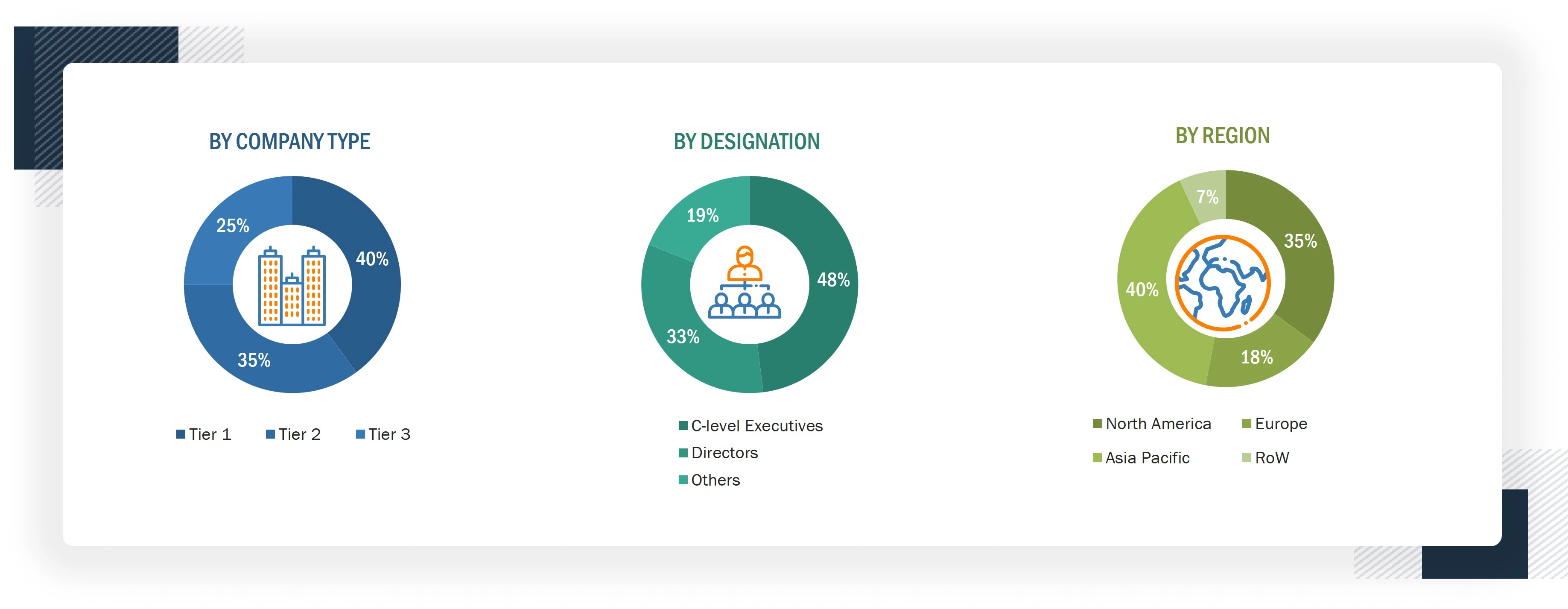
Notes: Other designations include product managers, sales managers, and marketing managers.
Three tiers of companies have been defined based on their total revenue as of 2024: tier 3: revenue less than USD 500 million; tier 2: revenue between USD 500 million and USD 1 billion; and tier 1: revenue more than USD 1 billion.
The Rest of the World (RoW) mainly includes South America, Africa, and the Middle East.
To know about the assumptions considered for the study, download the pdf brochure
Market Size Estimation
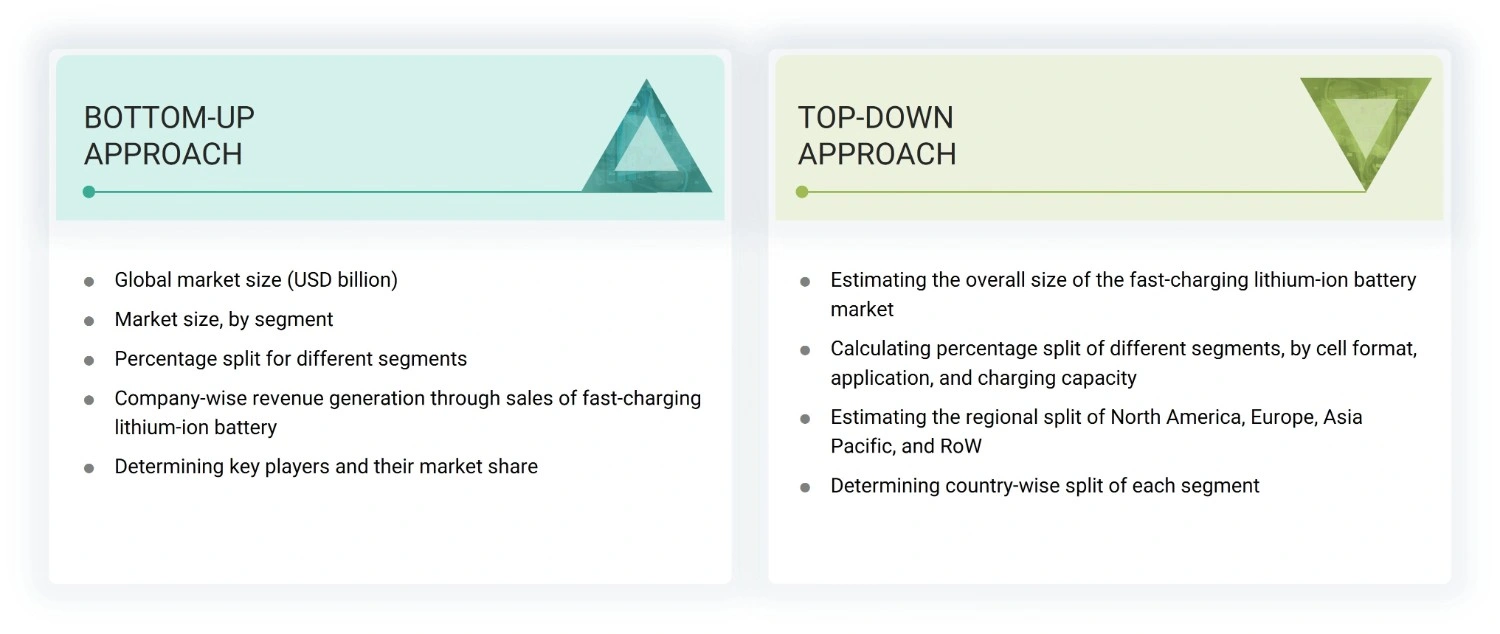
Both top-down and bottom-up approaches were used to estimate and validate the total size of the fast-charging lithium-ion battery market. These methods have also been used extensively to estimate the size of various subsegments in the market. The following research methodology has been used to estimate the market size:
-
Major players in the industry and markets were identified through extensive secondary research.
-
The industry’s value chain and market size (in terms of value) were determined through primary and secondary research processes.
-
All percentage shares, splits, and breakdowns were determined using secondary sources and verified through primary sources.
Fast-Charging Lithium-ion Battery Market : Top-Down and Bottom-Up Approach
Data Triangulation
After arriving at the overall size of the fast-charging lithium-ion battery market from the market size estimation process explained above, the total market was split into several segments and subsegments. Data triangulation and market breakdown procedures were employed, wherever applicable, to complete the overall market engineering process and arrive at the exact statistics for all segments and subsegments of the market. The data has been triangulated by studying various factors and trends from both the demand and supply sides. Along with this, the market size was validated using both top-down and bottom-up approaches.
Market Definition
The fast-charging lithium-ion battery market refers to battery technologies designed to enable significantly reduced charging time while maintaining performance, safety, and lifecycle stability. These batteries support high power input through advanced cell chemistries, optimized electrode materials, and efficient thermal management systems, allowing rapid energy transfer without degradation. They are widely used in applications where quick turnaround and high energy availability are critical, particularly in electric mobility and portable electronics. Integration with advanced battery management systems ensures controlled charging, improved efficiency, and protection under high load conditions. The market is driven by increasing demand for reduced downtime, enhanced user convenience, and scalable energy solutions, positioning fast-charging batteries as a key enabler of next-generation electrification.
Key Stakeholders
-
Fast-charging lithium-ion battery manufacturers
-
Government bodies and policymakers
-
Standards organizations, forums, alliances, and associations
-
Market research and consulting firms
-
Raw material suppliers and distributors
-
Research institutes and organizations
-
Material and technology providers
-
Battery cell and battery pack manufacturers
-
Electric vehicle manufacturers and OEMs
-
Charging infrastructure providers
-
Testing, inspection, and certification providers
-
Distributors and resellers
Report Objectives
-
To define, describe, and forecast the fast-charging lithium-ion battery market based on cell format, application, and charging capacity, in terms of value
-
To describe the applications of fast-charging lithium-ion battery
-
To describe and forecast the size of the fast-charging lithium-ion battery market, by four regions: North America, Europe, Asia Pacific, and the Rest of the World (RoW), along with their respective countries, in terms of value
-
To provide detailed information regarding drivers, restraints, opportunities, and challenges influencing market growth
-
To strategically analyze micromarkets1 with respect to individual growth trends, prospects, and contributions to the overall market size
-
To study the complete value chain of the fast-charging lithium-ion battery market
-
To analyze opportunities for stakeholders by identifying high-growth segments of the fast-charging lithium-ion battery market
-
To strategically profile the key players and comprehensively analyze their market positions in terms of their ranking and core competencies2
-
To analyze competitive developments, such as product launches, acquisitions, collaborations, and partnerships, in the fast-charging lithium-ion battery market
-
To provide ecosystem analysis, case study analysis, patent analysis, technology analysis, impact of AI/Gen AI, impact of 2025 US tariff, key conferences and events, Porter’s five forces analysis, and regulations pertaining to the market under study
Customization Options:
With the given market data, MarketsandMarkets offers customizations according to the company’s specific needs. The following customization options are available for the report:
Company Information:
-
Detailed analysis and profiling of additional market players (up to 5)













Growth opportunities and latent adjacency in Fast-Charging Lithium-ion Battery Market