The study encompassed four primary tasks to determine the present and future scope of the forecourts market energy players, convenience store players, independent retailers, OEMs, charging point operators, and energy storage service players in the market. Initially, extensive secondary research was conducted to gather data on the market, its related sectors, and overarching industries. Subsequently, primary research involving industry experts across the value chain corroborated and validated these findings and assumptions. The complete market size was estimated by using the bottom-up and top-down methodologies. Following this, a market breakdown and data triangulation approach were utilized to determine the size of specific segments and subsegments within the market.
Secondary Research
The secondary sources referred to the company's annual reports/presentations, industry association publications, directories, technical handbooks, international energy agency, technical articles, and databases, which were used to identify and collect information for an extensive study of the energy players, convenience store players, independent retailers, OEMs, charging point operators, BESS and V2G operators in the market. The secondary sources used while estimating the market sizing are the corporate filings (such as annual reports, investor presentations, and financial statements), automotive sales database, and government websites. Secondary data was collected and analyzed to determine the overall market size, further validated through primary research. The primary sources—experts from related industries, OEMs, energy players, and convenience stores—were interviewed to obtain and verify critical information and assess prospects and market estimations. Historical sales data were collected and analyzed, and industry trends were considered to arrive at the forecast, which was further validated by primary research.
Primary Research
In the primary research process, various primary sources from both the supply and demand sides were interviewed to obtain qualitative and quantitative information on the market. The primary sources from the supply side included various industry experts, such as CXOs, vice presidents, directors from business development, marketing, product development/innovation teams, and related key executives from various key companies. Various system integrators, industry associations, independent consultants/industry veterans, and key opinion leaders were also interviewed.
Primary interviews were conducted to gather insights such as sizing estimates on the forecourts market, charging infrastructure development, EV adoption rate, BESS and V2G projects during the forecast period, and future technology trends. Data triangulation of all these points was done using the information gathered from secondary research and model mapping. Stakeholders from the demand and supply sides were interviewed to understand their views on the abovementioned points.
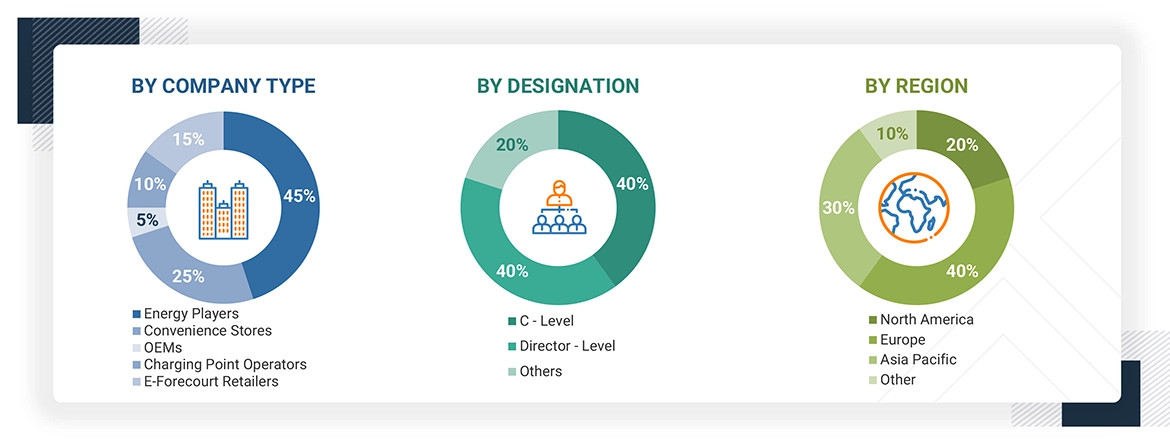
Note: Other designations include sales, marketing, and product managers.
Source: Secondary Research, Primary Interviews, and MarketsandMarkets Analysis
To know about the assumptions considered for the study, download the pdf brochure
Market Size Estimation
As mentioned below, a detailed market estimation approach was followed to estimate and validate the value of the forecourts market.
-
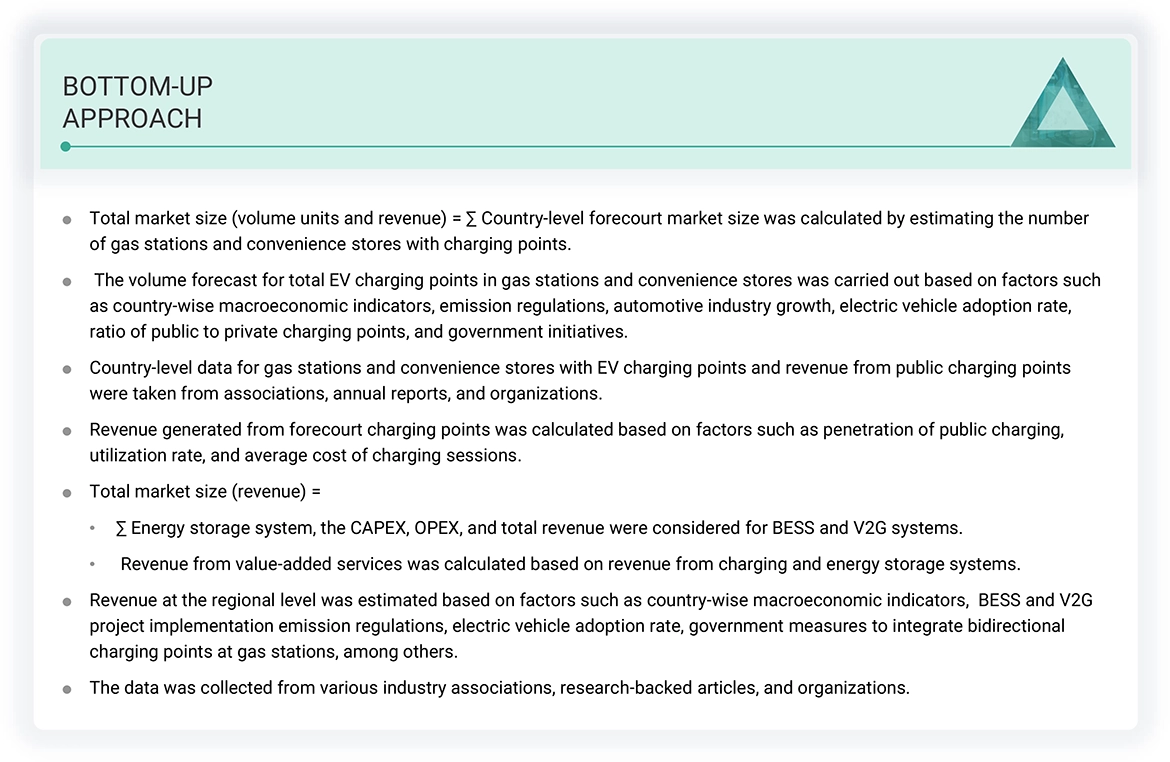
The bottom-up approach was used to estimate and validate the forecourts market size. The forecourts market size - total gas stations and convenience stores with EV charging points per country- was derived by mapping the existing number of gas stations and convenience stores with EV charging points at the country level. The market potential for revenue from charging points was forecasted based on factors such as expected public charging points, share of public vs. private charging, and average charging sessions per public charger.
-
The revenue from value-added services and energy storage (BESS and V2G) was calculated using the top-down approach.
-
The data points were largely fetched from country-level associations, databases, and data experts. Each country/region's total value was then summed up to reveal the total revenue of the forecourts market. The data was validated through primary interviews with industry experts. The penetration of different segments was derived from secondary research and primary interviews.
-
The market data gathered was consolidated, enhanced with detailed inputs, analyzed, and presented in this report.
Forecourts Market : Top-Down and Bottom-Up Approach
Market Definition
E-forecourts are gas charging stations that have one or more EV charging points, and convenience stores with at least one EV charging point are considered part of the report.
-
Value-added service: Revenue earned from offering convenience services on premises, such as operators offering services directly or in partnerships with other service providers
-
Energy storage service: Revenue earned through the BESS model and V2G
-
Revenue from charging: Revenue received from charging on its premises
Stakeholders
-
E-Forecourt Retailers
-
Charging Point Operators
-
OEMs
-
Convenience Stores
-
Energy Players
-
Independent Retailers
-
Forecourt Operators
Report Objectives
-
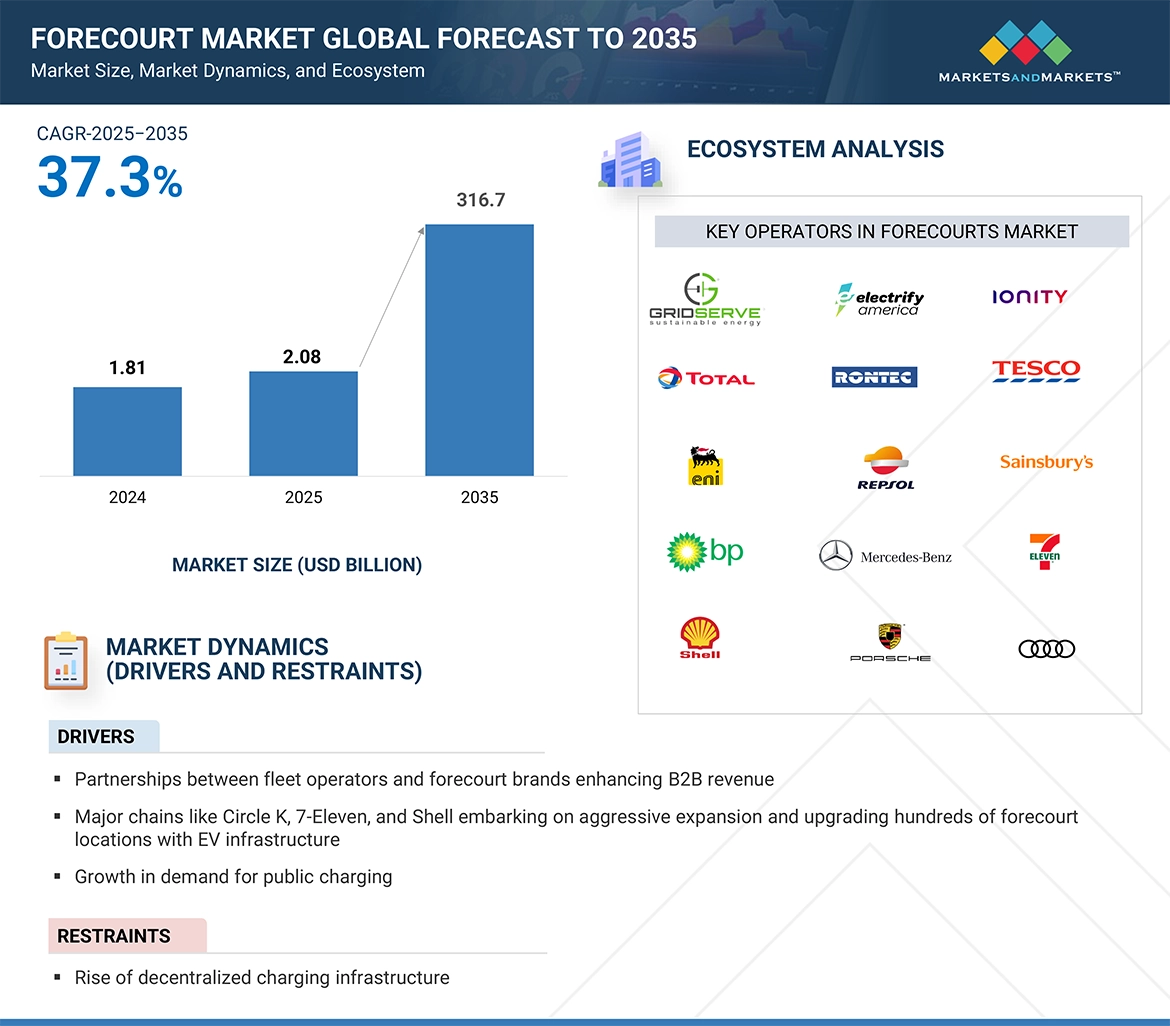
To define, describe, and forecast the forecourts market in terms of value (USD million) and analyze the revenue models
-
To understand the dynamics (drivers, restraints, opportunities, and challenges) of the forecourts market
-
To analyze the revenue earned by leading players operating in the forecourts market
-
To strategically analyze key player strategies and revenue analysis
-
To study the following with respect to the market
-
Trends and Disruptions Impacting Customers' Businesses
-
Market Ecosystem
-
Investment and Funding Scenario
-
Case Studies
-
Forecourt Players’ Strategies
-
To analyze the growth opportunities in the forecourts market for stakeholders















Growth opportunities and latent adjacency in Forecourts Market